
Weak Augmentation

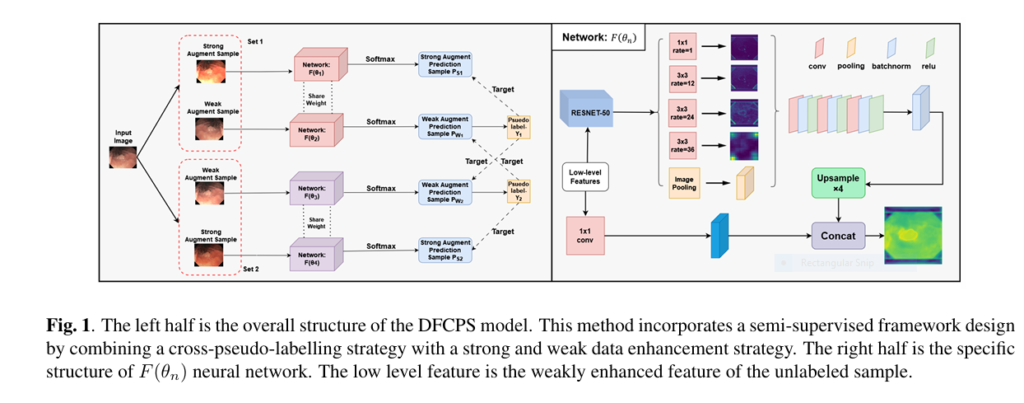
DFCPS AI model accurately segmenting gastrointestinal polyps in endoscopic imagery with minimal labeled data.

Revolutionizing Healthcare: How DFCPS’ Breakthrough Semi-Supervised Learning Slashes Medical Image Segmentation Costs by 90%

Medical imaging—CT scans, MRIs, and X-rays—generates vast amounts of data critical for diagnosing diseases like cancer, cardiovascular conditions, and gastrointestinal disorders. However, manual analysis is time-consuming, error-prone, and costly , leaving clinicians overwhelmed. Enter Deep Feature Collaborative Pseudo Supervision (DFCPS) , a groundbreaking semi-supervised learning model poised to transform medical image segmentation. In this article, […]
Revolutionizing Healthcare: How DFCPS’ Breakthrough Semi-Supervised Learning Slashes Medical Image Segmentation Costs by 90% Read More »

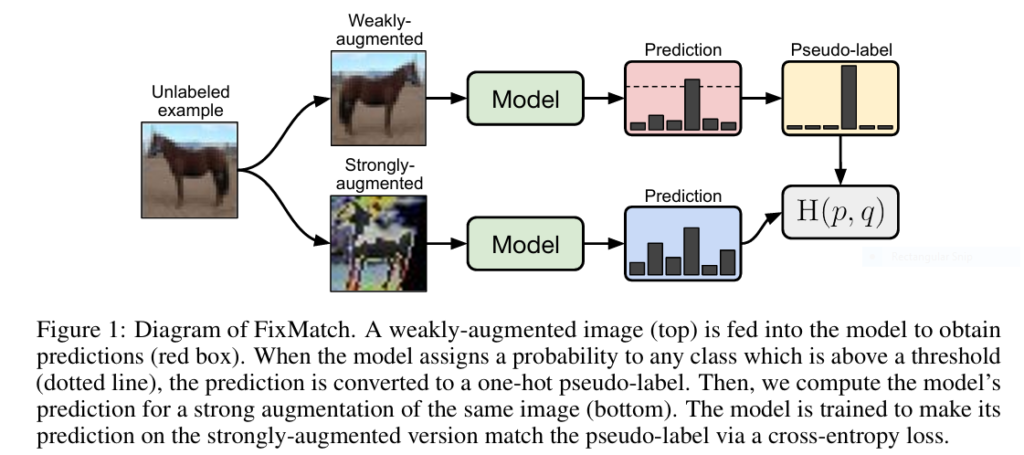
Diagram of FixMatch. A weakly-augmented image (top) is fed into the model to obtain predictions (red box). When the model assigns a probability to any class which is above a threshold (dotted line), the prediction is converted to a one-hot pseudo-label. Then, we compute the model’s prediction for a strong augmentation of the same image (bottom). The model is trained to make its prediction on the strongly-augmented version match the pseudo-label via a cross-entropy loss.

FixMatch: Simplified SSL Breakthrough

Semi-supervised learning (SSL) tackles one of AI’s biggest bottlenecks: the need for massive labeled datasets. Traditional methods grew complex and hyperparameter-heavy—until FixMatch revolutionized the field. This elegantly simple algorithm combines pseudo-labeling and consistency regularization to achieve state-of-the-art accuracy with minimal labels, democratizing AI for domains with scarce annotated data. The SSL Challenge: Complexity vs. Scalability Deep learning thrives on

FixMatch: Simplified SSL Breakthrough Read More »

Follow by Email
Tiktok