Machine Learning

Machine learning (ML) is a key area of artificial intelligence (AI) that helps computers learn from data and get better at tasks over time, without needing to be directly programmed. By recognizing patterns in data, ML algorithms can make predictions and decisions that are useful in many fields, from healthcare to finance and e-commerce. Whether it’s improving customer service or helping businesses make smarter decisions, machine learning is changing the way we interact with technology. Keep up with the latest in machine learning by following our blog for updates and insights.

SemiCD-VL architecture overview showing VLM guidance, dual projection heads, and contrastive regularization.

Revolutionize Change Detection: How SemiCD-VL Cuts Labeling Costs 5X While Boosting Accuracy

Change detection—the critical task of identifying meaningful differences between images over time—just got a seismic upgrade. For industries relying on satellite monitoring (urban planning, disaster response, agriculture), pixel-level annotation has long been the costly, time-consuming bottleneck stifling innovation. But a breakthrough AI framework—SemiCD-VL—now slashes labeling needs by 90% while delivering unprecedented accuracy, even outperforming fully supervised models. The Crippling […]

Revolutionize Change Detection: How SemiCD-VL Cuts Labeling Costs 5X While Boosting Accuracy Read More »

CMKD: Slash 99% Storage Costs & Dominate UDA Challenges

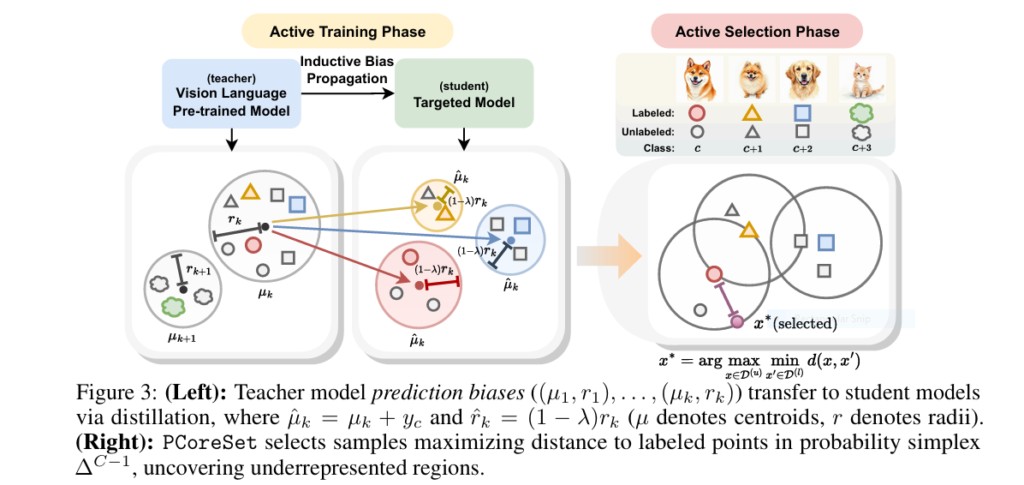
Unsupervised Domain Adaptation (UDA) faces two persistent roadblocks: effectively leveraging powerful modern foundation models and the crippling storage overhead of deploying multiple domain-specific models. A groundbreaking approach merges Vision-Language Pre-training (VLP) like CLIP with innovative techniques—Cross-Modal Knowledge Distillation (CMKD) and Residual Sparse Training (RST)—to smash these barriers, achieving state-of-the-art results while reducing deployment parameters by over 99%. Why Traditional Revolutionizing Unsupervised

CMKD: Slash 99% Storage Costs & Dominate UDA Challenges Read More »

Revolutionizing Medical Image Segmentation: SemSim’s Semantic Breakthrough

Medical image segmentation is the cornerstone of modern diagnostics and treatment planning. From pinpointing tumor boundaries to mapping cardiac structures, its precision directly impacts patient outcomes. Yet, a critical bottleneck persists: the massive annotation burden. Manual labeling demands hours of expert time per scan, creating a severe shortage of labeled data that throttles AI’s potential. Enter semi-supervised learning

Revolutionizing Medical Image Segmentation: SemSim’s Semantic Breakthrough Read More »

Uncertainty Beats Confidence in semi-supervised learning

In the ever-evolving landscape of artificial intelligence, semi-supervised learning (SSL) has emerged as a powerful approach for harnessing the vast potential of unlabeled data. Traditionally, SSL techniques rely heavily on pseudo-labels—model-generated labels for unlabeled samples—and confidence thresholds to determine their reliability. But this paradigm has long suffered from a critical flaw: overconfidence in model predictions

Uncertainty Beats Confidence in semi-supervised learning Read More »

Discover Rare Objects with AnomalyMatch AI

Imagine finding a single unique galaxy among 100 million images—a cosmic needle in a haystack. This daunting task faces astronomers daily. But what if an AI could pinpoint these rarities while slashing human review time by 90%? Enter AnomalyMatch, the breakthrough framework transforming anomaly detection in astronomy, medical imaging, industrial inspection, and beyond. The Anomaly Detection Crisis

Discover Rare Objects with AnomalyMatch AI Read More »

Diagram of FixMatch. A weakly-augmented image (top) is fed into the model to obtain predictions (red box). When the model assigns a probability to any class which is above a threshold (dotted line), the prediction is converted to a one-hot pseudo-label. Then, we compute the model’s prediction for a strong augmentation of the same image (bottom). The model is trained to make its prediction on the strongly-augmented version match the pseudo-label via a cross-entropy loss.

FixMatch: Simplified SSL Breakthrough

Semi-supervised learning (SSL) tackles one of AI’s biggest bottlenecks: the need for massive labeled datasets. Traditional methods grew complex and hyperparameter-heavy—until FixMatch revolutionized the field. This elegantly simple algorithm combines pseudo-labeling and consistency regularization to achieve state-of-the-art accuracy with minimal labels, democratizing AI for domains with scarce annotated data. The SSL Challenge: Complexity vs. Scalability Deep learning thrives on

FixMatch: Simplified SSL Breakthrough Read More »

Complete overview of proposed GGLA-NeXtE2NET network.

GGLA-NeXtE2NET: Advanced Brain Tumor Recognition

The accurate and timely diagnosis of brain tumors is a critical challenge in modern medicine. Magnetic Resonance Imaging (MRI) is an essential non-invasive tool that provides detailed images of the brain’s internal structures, helping to identify the size, location, and type of tumors. However, the interpretation of these images can be complex due to the

GGLA-NeXtE2NET: Advanced Brain Tumor Recognition Read More »

The complete workflow of proposed EG-VAN model.

EG-VAN Transforms Skin Cancer Diagnosis

Skin cancer diagnosis faces critical challenges: subtle variations within the same cancer type, striking similarities between benign and malignant lesions, and limited access to specialist dermatologists. Traditional methods often struggle with accuracy and scalability, leading to delayed or missed diagnoses. Enter EG-VAN – a groundbreaking AI system achieving 98.20% accuracy in classifying nine skin cancer types. This breakthrough

EG-VAN Transforms Skin Cancer Diagnosis Read More »

Architecture of DGLA-ResNet50 model. (a) Structure of GLA Bneck feature extraction module.

Enhancing Skin Lesion Detection Accuracy

Skin cancer continues to be one of the fastest-growing cancers worldwide, with early detection being critical for effective treatment. Traditional diagnostic methods rely heavily on dermatologists’ expertise and dermoscopy, a non-invasive skin imaging technique. However, the manual nature of dermoscopy makes the process time-consuming and subjective. To overcome these limitations, the research paper titled “Skin

Enhancing Skin Lesion Detection Accuracy Read More »

The proposed multi-label skin lesion classification framework has three branches: dermoscopy imaging modality branch (green block), clinical imaging modality branch (yellow block), and a hybrid-meta branch (orange block). Modified Xception module based dermoscopy and clinical imaging modalities’ features are first concatenated, then fed to the input of hybrid-meta branch, and finally concatenated with the meta-data.

AI Revolutionizes Skin Cancer Diagnosis

New Deep Learning Model Boosts Accuracy for Early Detection Skin cancer, particularly melanoma, remains one of the deadliest cancers worldwide. The stakes for early detection couldn’t be higher: diagnose melanoma at an advanced stage, and the 10-year survival rate plummets to a grim 39%. Catch it early, however, and survival rates soar above 93%. This

AI Revolutionizes Skin Cancer Diagnosis Read More »

Follow by Email
Tiktok