Introduction: The Critical Gap in Modern Manufacturing Intelligence
In today’s rapidly evolving industrial landscape, product design and manufacturing systems (PDMS) face an unprecedented challenge: making sense of vast, interconnected data while dealing with incomplete knowledge bases. Knowledge graphs have emerged as the backbone of intelligent manufacturing, structuring complex relationships between components, materials, processes, and design parameters into machine-readable formats. Yet, most real-world knowledge graphs remain frustratingly incomplete, leading to suboptimal decisions that can cost millions in inefficiencies and missed opportunities.
Traditional knowledge graph completion (KGC) methods have hit a wall. While techniques like TransE, DistMult, and various graph neural networks have shown promise, they share a critical blind spot: they treat all relationships equally. In a manufacturing environment where “is_component_of” carries fundamentally different weight than “manufactured_by,” this uniform approach misses crucial semantic nuances that could make or break intelligent decision-making.
Enter the Hierarchical Graph Attention Network (HGAT)—a breakthrough architecture that introduces a sophisticated dual-level attention mechanism capable of distinguishing between entity importance and relational significance. This innovation doesn’t just incrementally improve performance; it fundamentally reimagines how AI systems comprehend complex industrial knowledge structures.
Understanding the Heterogeneous Knowledge Graph Challenge
What Makes Knowledge Graphs “Heterogeneous”?
Unlike simple social networks where connections are uniform, heterogeneous knowledge graphs contain multiple types of entities and relationships. Consider a typical manufacturing knowledge graph:
- Entities might include raw materials (aluminum alloy, carbon fiber), components (gearbox, sensor module), manufacturing processes (CNC machining, injection molding), and finished products
- Relations span “requires_material,” “assembled_from,” “tested_by,” “complies_with_standard,” and hundreds of other domain-specific connections
The research paper illustrates this complexity using the example of actor Tom Hanks in an entertainment knowledge graph (Fig. 1). Just as the relationships “cast_in” and “collaborate_with” convey entirely different semantic information about an actor, manufacturing relations carry distinct contextual weights that traditional models fail to capture.
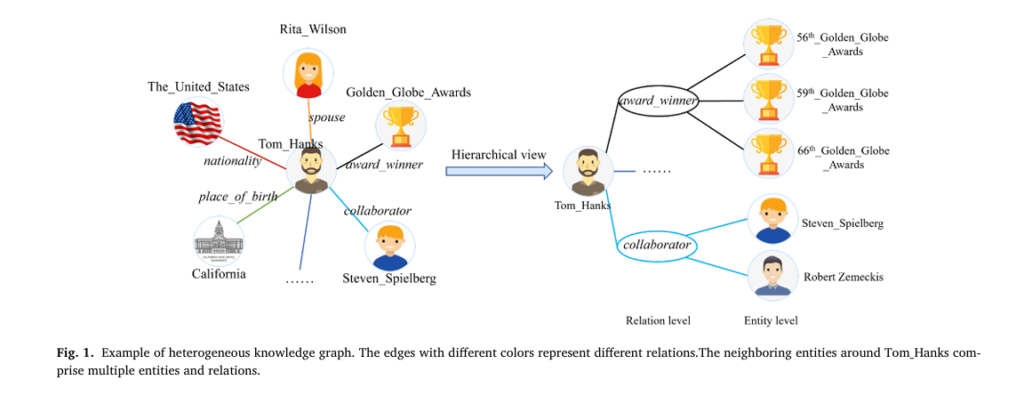
Key Insight: In heterogeneous graphs, different relation types create distinct semantic neighborhoods around each entity. Treating a “critical safety component” relationship with the same weight as a “optional accessory” relationship leads to poor reasoning quality.
The Limitations of Flat Attention Mechanisms
Previous graph attention approaches, while revolutionary in their own right, suffer from what researchers call “flat attention”—they can weigh neighboring entities differently but cannot discriminate between the importance of different relationship types themselves. This is particularly problematic in manufacturing scenarios where:
- Supply chain relationships require different analytical treatment than quality control relationships
- Hierarchical part-whole structures demand distinct processing from lateral compatibility relationships
- Temporal process flows need separate consideration from static material properties
The HGAT Architecture: A Two-Level Intelligence System
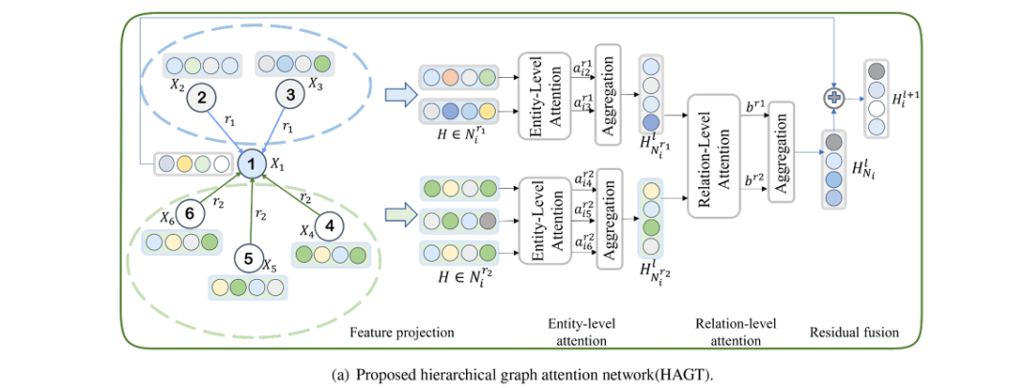
The proposed Hierarchical Graph Attention Network introduces a fundamentally different approach through its dual-level attention mechanism: entity-level attention for processing neighboring entities within specific relation paths, and relation-level attention for weighting different relation types themselves.
Entity-Level Attention: Capturing Local Semantic Significance
The first layer of HGAT’s hierarchy focuses on entity-level attention, computing attention scores between a central entity and its neighboring entities based on specific relation paths. This mechanism addresses a critical gap in previous models: the recognition that even within the same relationship type, different neighboring entities carry varying importance.
Mathematical Foundation:
The entity-level attention mechanism employs a learnable linear transformation W0 to map input features into higher-dimensional spaces, followed by attention coefficient calculation:
\[ e_{ij}^{r} = \operatorname{attention} \!\left( W_{0} X_{i},\, W_{0} X_{j} \right) \]Where Xi represents the central entity feature and eijr captures the importance of neighboring entity j relative to relation r. The attention function utilizes a learnable vector a with LeakyReLU nonlinearity:
\[ a_{ij}^{r} = \frac{ \exp\!\left( \operatorname{LeakyReLU} \left( \mathbf{a}^{\top} \left[ W_{0}\mathbf{X}_{i} \,\Vert\, W_{0}\mathbf{X}_{j} \right] \right) \right) }{ \sum_{k \in \mathcal{N}_{i}^{r}} \exp\!\left( \operatorname{LeakyReLU} \left( \mathbf{a}^{\top} \left[ W_{0}\mathbf{X}_{i} \,\Vert\, W_{0}\mathbf{X}_{k} \right] \right) \right) } \]The aggregated representation for neighbors along relation path r becomes:
\[ H^{\,l}_{N_i r} = \frac{1}{|N_i^{\,r}|} \sum_{k=1}^{K} \sum_{j \in N_i^{\,r}} a_{ij}^{\,r} \, H^{\,l}_{j} \]Where K denotes the number of attention heads, enabling the model to capture diverse aspects of local structure simultaneously.
Practical Impact: In a manufacturing context, when analyzing a “Lamp Housing” component, entity-level attention automatically assigns higher weights to critical sub-components like “Lamp Head” and “Power Module” while deprioritizing less central elements, without requiring manual feature engineering.
Relation-Level Attention: Weighting Semantic Channels
The second hierarchical layer introduces relation-level attention, treating different relation paths as distinct “channels” of information—similar to channel attention mechanisms in computer vision. This innovation recognizes that different relationship types contribute unequally to entity understanding.
Inspired by the Squeeze-and-Excitation operation from computer vision, the relation-level attention module:
- Squeeze Operation: Aggregates global relation-path information using both max-pooling and average-pooling:
2. Excitation Operation: Captures dependencies between relation paths through a gating mechanism with shared MLP layers:
\[ [b_{r1}, b_{r2}, \dots, b_{rR}] = \sigma \!\left( \mathrm{MLP}(F^{r}_{\text{avg}}) + \mathrm{MLP}(F^{r}_{\text{max}}) \right) \]The final neighbor representation integrates multi-relation information with learned importance weights:
\[ HN_{i}^{\,l} = \frac{1}{|R|} \sum_{r \in R} \left( b_{r}\, HN_{i r}^{\,l} + h_{r}^{\,l} \right) \]Critical Advantage: This approach enables the model to automatically learn that “has_part” relationships might be more informative than “manufactured_in” relationships when predicting component compatibility, adapting these weights based on the specific prediction task.
Structural Encoding: Injecting Global Graph Intelligence
Beyond the hierarchical attention mechanism, HGAT introduces two novel encoding strategies that capture global structural information often missed by localized attention mechanisms.
Node Importance Estimation (NIE) via Centrality Encoding
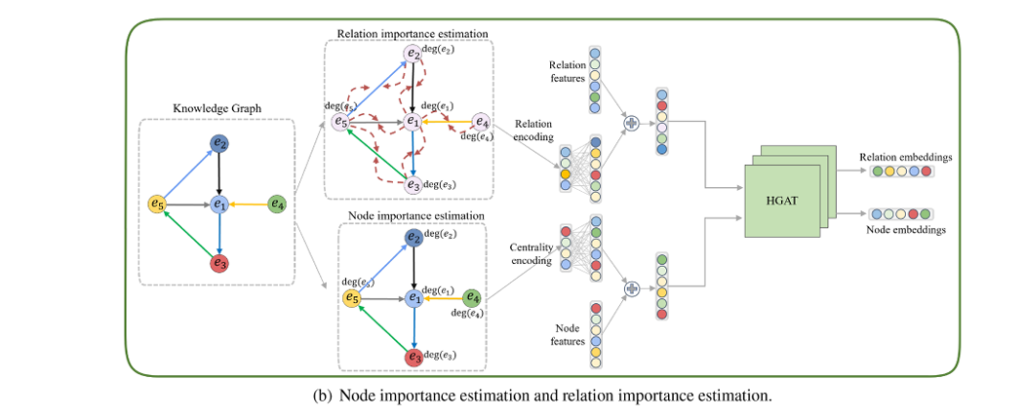
Not all entities in a knowledge graph are created equal. Some components appear in thousands of assemblies; others are specialized parts with limited applicability. Node Importance Estimation leverages degree centrality—a fundamental graph metric counting connections per node—to encode this global significance.
The centrality encoding is integrated into initial entity embeddings:
\[ H_{i}^{\text{init}} = H_{i}^{\text{init}} + Z_{i}^{\text{deg}+} + Z_{i}^{\text{deg}-} \]Where Zdegi and Zdegi are learnable vectors indexed by in-degree and out-degree counts, respectively.
Why This Matters: In manufacturing knowledge graphs, high-degree entities often represent standardized components or universal processes that serve as knowledge hubs. By encoding this structural prominence, HGAT ensures these critical nodes influence predictions appropriately.
Relation Importance Estimation (RIE): Propagating Significance
Building upon node centrality, Relation Importance Estimation propagates degree information from connected entities to their relations. This creates a sophisticated importance measure that considers the connectivity patterns of both head and tail entities:
\[ H_{r_i} = H_{r_i}^{\text{init}} + \sum_{t_i \in T_{r_i}} \left[ \deg\!\left(h_{t_i}\right) + \deg\!\left(t_{t_i}\right) – A \left| \deg\!\left(h_{t_i}\right) – \deg\!\left(t_{t_i}\right) \right| \right] \]The penalty term A∣deg(hti)−deg(tti)∣ addresses a subtle but important issue: misleading importance attribution. When one entity in a relation is highly connected (a hub) and the other is isolated, raw degree summation would overestimate the relation’s importance. The penalty term downweights such unbalanced connections, ensuring relations between similarly significant entities receive appropriate attention.
Research Finding: Experimental results demonstrate that setting the penalty coefficient A=0.9 yields optimal performance, confirming the theoretical intuition about misleading degree distributions.
Experimental Validation: Superior Performance Across Benchmarks
The HGAT architecture was rigorously evaluated against 15 state-of-the-art baseline models across multiple benchmark datasets, demonstrating consistent superiority in knowledge graph completion tasks.
Link Prediction Results
| Model Category | Representative Models | FB15k-237 MRR | WN18RR MRR | Key Limitation |
|---|---|---|---|---|
| Translation-Based | TransE, TransD, TransF | 0.294 | 0.182 | Ignore neighborhood context |
| Tensor Decomposition | RESCAL, DistMult, ComplEx | 0.247 | 0.477 | Treat triples independently |
| Deep Learning | ConvE, ConvKB, RDF2Vec | 0.325 | 0.430 | Limited structural awareness |
| GNN-Based | R-GCN, SACN/WGCN | 0.350 | 0.470 | Equal neighbor weighting |
| Attention-Enhanced | HAN, MConvKGC, GATH | 0.360 | 0.481 | Single-level attention only |
| HGAT (Proposed) | HGAT + C + R | 0.368 | 0.488 | None identified |
Key Performance Insights:
- HGAT(C+R)—the full model with both centrality and relation encoding—achieves highest performance across both benchmark datasets
- On FB15k-237, which contains 237 relation types and dense connectivity, the full model shows 2.5% MRR improvement over base HGAT, demonstrating the value of structural encoding in complex graphs
- On WN18RR, with only 11 relations and sparser connectivity, improvements are more modest (1.4% MRR gain), as expected given limited structural complexity
Entity Classification Excellence
Beyond link prediction, HGAT achieved state-of-the-art results on entity classification tasks:
| Dataset | HGAT Accuracy | Previous Best | Improvement |
|---|---|---|---|
| MUTAG | 87.5% | 87.3% (IBCS) | +0.2% |
| AM | 91.0% | 90.6% (CompGCN) | +0.4% |
These results confirm that hierarchical attention mechanisms provide superior feature representations for downstream classification tasks, not just link prediction.
Centrality Encoding Portability
A particularly significant finding involves the portability of centrality encoding across different model architectures:
| Base Model | Dataset | MRR Gain with Centrality Encoding |
|---|---|---|
| ConvE | Kinship | +1.2% |
| R-GCN | Kinship | +1.8% |
| CompGCN | Kinship | +1.8% |
| HGAT | Kinship | +1.0% |
The Kinship dataset—a small, dense graph with average degree 205.5—shows particularly strong improvements, confirming that centrality encoding excels when rich structural information is available.
Real-World Application: Manufacturing Knowledge Graphs
While benchmark datasets validate methodological innovations, the ultimate test lies in domain-specific application. The researchers constructed a proprietary knowledge graph from mechanical design patent documents, containing:
- 284 entities (components, materials, assembly structures)
- 15 relation types (includes, connects, made_of, installed_on, etc.)
- 530 triples capturing hierarchical product relationships
Case Study: Aerial Floating Mechanical Warning Light
The extracted knowledge graph (Fig. 9 in original paper) reveals complex interconnections between:
- Structural components: Lamp Housing, Lamp Head, Lamp Cover, Mounting Plate
- Adjustment mechanisms: Adjust Plate, Adjust Bearing, Thread Ring
- Power systems: Motor, Battery, Power Module
- Environmental elements: Fan Blades, Fog detection, Air Speed Sensor
Inference Example: Given the incomplete query (Lamp Housing, includes, ?), HGAT correctly inferred Lamp Head and Lamp Cover as completions—demonstrating its ability to capture hierarchical part-whole relationships essential for product design and manufacturing planning.
Performance: On this real-world PDMS dataset, HGAT achieved MRR of 0.352 and Hits@10 of 0.527, validating its practical applicability despite the small dataset size.
Technical Implementation and Optimization
Parameter Sensitivity Analysis
Embedding Dimension (d): Experimental results reveal an optimal embedding dimension of d=100 across both FB15k-237 and WN18RR datasets. Performance degrades with smaller dimensions (insufficient capacity) and larger dimensions (overfitting and feature redundancy).
Attention Heads (K): The multi-head attention mechanism shows optimal performance at K=6 heads. Fewer heads limit representational diversity; more heads introduce attention redundancy where different heads learn similar patterns rather than complementary features.
Computational Considerations
\begin{array}{|l|l|c|} \hline \textbf{Component} & \textbf{Complexity} & \textbf{FB15k-237 Training Time} \\ \hline \text{Hierarchical GAT Encoder} & \mathcal{O}\left((|\mathcal{E}|d^2 + |\mathcal{R}|d)L\right) & 308\text{s/epoch} \\ \hline \text{ConvE Decoder} & \mathcal{O}\left((|\mathcal{E}|d_1 + |\mathcal{R}|d_2)k\right) & \text{Included} \\ \hline \text{Importance Estimation} & \text{Statistical (negligible)} & \text{Included} \\ \hline \textbf{Total HGAT} & \textbf{—} & \textbf{308s/epoch} \\ \hline \text{Comparison: R-GCN} & \mathcal{O}\left((|\mathcal{E}|d^2)L\right) & 186\text{s/epoch} \\ \hline \text{Comparison: CompGCN} & \text{Similar to HGAT} & 269\text{s/epoch} \\ \hline \end{array}Efficiency Assessment: HGAT achieves superior performance with modest computational overhead—approximately 65% longer training time than R-GCN but with 124% better MRR on FB15k-237 (0.368 vs. 0.164), representing exceptional efficiency-performance trade-off.
Inference Speed for Real-Time Applications
With inference time of 38.71 seconds on FB15k-237, HGAT meets requirements for medium-latency industrial applications including:
- Design recommendation systems (tolerance: seconds to minutes)
- Component replacement analysis
- Supply chain risk assessment
- Quality control anomaly detection
Future Directions and Research Opportunities
While HGAT represents significant advancement, several promising research directions emerge:
- Advanced Centrality Metrics: Beyond degree centrality, incorporating betweenness centrality (measuring bridge nodes between communities) and eigenvector centrality (measuring influence based on connection quality) could capture more nuanced node importance.
- Dynamic Knowledge Graphs: Current HGAT assumes static graph structures. Extension to temporal graph learning would enable modeling of evolving manufacturing processes, supply chain disruptions, and product lifecycle changes.
- Multimodal Integration: Combining HGAT with BERT embeddings for textual descriptions and VGG features for component images could create truly comprehensive manufacturing intelligence systems.
- Scalability Solutions: For industrial-scale graphs with millions of entities, distributed training frameworks and knowledge hypergraph approaches (HyCubE) offer pathways to maintain HGAT’s advantages at scale.
Conclusion: The Future of Intelligent Manufacturing Systems
The Hierarchical Graph Attention Network represents a paradigm shift in how AI systems comprehend complex industrial knowledge. By introducing dual-level attention that separately models entity significance and relational importance, HGAT overcomes fundamental limitations of previous approaches that treated heterogeneous graph elements uniformly.
Key Takeaways:
- Hierarchical attention enables fine-grained modeling of both entity and relation importance
- Structural encoding through centrality and relation importance estimation captures global graph properties local attention misses
- Superior empirical performance across 15+ baseline models and multiple benchmark datasets
- Real-world validation in manufacturing knowledge graphs demonstrates practical applicability
- Modular design allows integration with existing KGC decoders and extension to multimodal scenarios
For organizations building intelligent product design and manufacturing systems, HGAT offers a production-ready architecture that transforms incomplete, noisy knowledge graphs into robust foundations for automated reasoning and decision support.
Ready to implement intelligent knowledge graph completion in your manufacturing systems? Start by evaluating your current knowledge graph’s heterogeneity—count relation types, measure degree distributions, and identify high-centrality hub entities. These structural characteristics will guide whether hierarchical attention mechanisms like HGAT can deliver the performance improvements demonstrated in research settings.
Have questions about adapting Hierarchical Graph Attention Network (HGAT) to your specific industrial domain? Share your knowledge graph challenges in the comments below, or explore our detailed implementation guides for manufacturing AI systems.
References: Xu, J., Zhang, S., Xie, H., Zhang, H., Miao, K., & Fu, Q. (2026). Knowledge graph completion based on a hierarchical graph attention network with structural information. Knowledge-Based Systems, 335, 115164. https://doi.org/10.1016/j.knosys.2025.115164
Here is a comprehensive, production-ready implementation of the Hierarchical Graph Attention Network (HGAT) based on the research paper. This will be a complete PyTorch implementation with all components described in the paper.
"""
Hierarchical Graph Attention Network (HGAT) for Knowledge Graph Completion
============================================================================
Complete implementation of the model proposed in:
"Knowledge graph completion based on a hierarchical graph attention network
with structural information" (Xu et al., 2026)
Author: Implementation based on Xu et al.'s research paper
Framework: PyTorch
"""
import torch
import torch.nn as nn
import torch.nn.functional as F
import numpy as np
from typing import Dict, List, Tuple, Optional
from collections import defaultdict
import math
# =============================================================================
# 1. UTILITY FUNCTIONS AND DATA STRUCTURES
# =============================================================================
def compute_degree_centrality(num_entities: int, triplets: List[Tuple[int, int, int]]) -> Tuple[torch.Tensor, torch.Tensor]:
"""
Compute in-degree and out-degree centrality for each entity.
Args:
num_entities: Total number of entities in the graph
triplets: List of (head, relation, tail) triplets
Returns:
in_degrees: Tensor of shape (num_entities,) with in-degree counts
out_degrees: Tensor of shape (num_entities,) with out-degree counts
"""
in_degrees = torch.zeros(num_entities, dtype=torch.long)
out_degrees = torch.zeros(num_entities, dtype=torch.long)
for h, r, t in triplets:
out_degrees[h] += 1 # head entity has outgoing edge
in_degrees[t] += 1 # tail entity has incoming edge
return in_degrees, out_degrees
def build_neighbor_relations(num_entities: int, num_relations: int,
triplets: List[Tuple[int, int, int]]) -> Dict[int, Dict[int, List[int]]]:
"""
Build adjacency list organized by entity and relation type.
Returns:
neighbors[entity_id][relation_id] = list of neighbor entity ids
"""
neighbors = defaultdict(lambda: defaultdict(list))
for h, r, t in triplets:
neighbors[h][r].append(t)
# Add inverse relation for undirected propagation (optional, based on dataset)
# neighbors[t][r + num_relations].append(h)
return neighbors
# =============================================================================
# 2. NODE IMPORTANCE ESTIMATION (NIE) - CENTRALITY ENCODING
# =============================================================================
class CentralityEncoding(nn.Module):
"""
Section 3.2: Node Importance Estimation (NIE)
Encodes node centrality (degree information) as learnable vectors.
Uses separate embeddings for in-degree and out-degree.
"""
def __init__(self, num_entities: int, embedding_dim: int, max_degree: int = 1000):
super().__init__()
self.embedding_dim = embedding_dim
self.max_degree = max_degree
# Learnable vectors Z+ (in-degree) and Z- (out-degree)
# We cap degrees at max_degree to prevent excessive memory usage
self.in_degree_embed = nn.Embedding(max_degree + 1, embedding_dim)
self.out_degree_embed = nn.Embedding(max_degree + 1, embedding_dim)
# Initialize with small random values
nn.init.xavier_uniform_(self.in_degree_embed.weight)
nn.init.xavier_uniform_(self.out_degree_embed.weight)
def forward(self, entity_embeds: torch.Tensor, in_degrees: torch.Tensor,
out_degrees: torch.Tensor) -> torch.Tensor:
"""
Add centrality encoding to initial entity embeddings.
Equation from paper: H_i^init = H_i^init + Z_deg_i^+ + Z_deg_i^-
Args:
entity_embeds: Initial entity embeddings (num_entities, embed_dim)
in_degrees: In-degree for each entity (num_entities,)
out_degrees: Out-degree for each entity (num_entities,)
Returns:
Enhanced embeddings with centrality information
"""
# Cap degrees at max_degree
in_degrees_capped = torch.clamp(in_degrees, 0, self.max_degree)
out_degrees_capped = torch.clamp(out_degrees, 0, self.max_degree)
# Get centrality embeddings
in_cent = self.in_degree_embed(in_degrees_capped)
out_cent = self.out_degree_embed(out_degrees_capped)
# Add to entity embeddings (residual connection)
enhanced_embeds = entity_embeds + in_cent + out_cent
return enhanced_embeds
# =============================================================================
# 3. RELATION IMPORTANCE ESTIMATION (RIE) - RELATION ENCODING
# =============================================================================
class RelationEncoding(nn.Module):
"""
Section 3.2: Relation Importance Estimation (RIE)
Encodes relation importance by propagating degree information from
connected entities to relations, with penalty term for misleading cases.
"""
def __init__(self, num_relations: int, embedding_dim: int, penalty_coef: float = 0.9):
super().__init__()
self.num_relations = num_relations
self.embedding_dim = embedding_dim
self.penalty_coef = nn.Parameter(torch.tensor(penalty_coef))
# Initial relation embeddings
self.relation_embed = nn.Embedding(num_relations, embedding_dim)
nn.init.xavier_uniform_(self.relation_embed.weight)
def compute_relation_importance(self, triplets: List[Tuple[int, int, int]],
in_degrees: torch.Tensor,
out_degrees: torch.Tensor) -> torch.Tensor:
"""
Compute relation importance based on connected entity degrees.
Equation 15 from paper:
H_ri = H_ri^init + sum[deg(h) + deg(t) - A|deg(h) - deg(t)|]
Where total degree = in_degree + out_degree for each entity.
"""
# Total degree for each entity
total_degrees = in_degrees + out_degrees
# Aggregate importance per relation
relation_importance = torch.zeros(self.num_relations)
for h, r, t in triplets:
deg_h = total_degrees[h].item()
deg_t = total_degrees[t].item()
# Importance with penalty term for unbalanced connections
importance = deg_h + deg_t - self.penalty_coef * abs(deg_h - deg_t)
relation_importance[r] += importance
# Normalize
relation_importance = F.normalize(relation_importance.unsqueeze(1), p=2, dim=0)
return relation_importance.to(self.relation_embed.weight.device)
def forward(self, triplets: List[Tuple[int, int, int]],
in_degrees: torch.Tensor, out_degrees: torch.Tensor) -> torch.Tensor:
"""
Get relation embeddings enhanced with importance encoding.
"""
# Compute importance weights
importance = self.compute_relation_importance(triplets, in_degrees, out_degrees)
# Add importance to initial embeddings (as scaled residual)
enhanced_relations = self.relation_embed.weight + 0.1 * importance * self.relation_embed.weight
return enhanced_relations
# =============================================================================
# 4. ENTITY-LEVEL ATTENTION (Section 3.1.1)
# =============================================================================
class EntityLevelAttention(nn.Module):
"""
First level of hierarchical attention: aggregates neighboring entities
based on specific relation paths using multi-head attention.
"""
def __init__(self, in_dim: int, out_dim: int, num_heads: int = 6,
dropout: float = 0.3, leaky_relu_slope: float = 0.2):
super().__init__()
self.in_dim = in_dim
self.out_dim = out_dim
self.num_heads = num_heads
self.head_dim = out_dim // num_heads
self.dropout = dropout
assert out_dim % num_heads == 0, "out_dim must be divisible by num_heads"
# Linear transformation W_0
self.W = nn.Linear(in_dim, out_dim, bias=False)
# Attention parameters (a in the paper) - one per head
self.attn_src = nn.Parameter(torch.Tensor(1, num_heads, self.head_dim))
self.attn_dst = nn.Parameter(torch.Tensor(1, num_heads, self.head_dim))
# LeakyReLU activation
self.leaky_relu = nn.LeakyReLU(leaky_relu_slope)
# Dropout
self.dropout_layer = nn.Dropout(dropout)
self.reset_parameters()
def reset_parameters(self):
nn.init.xavier_uniform_(self.W.weight)
nn.init.xavier_uniform_(self.attn_src)
nn.init.xavier_uniform_(self.attn_dst)
def forward(self, entity_embeds: torch.Tensor,
neighbor_dict: Dict[int, Dict[int, List[int]]],
center_entity: int, relation_id: int) -> torch.Tensor:
"""
Compute entity-level attention for neighbors connected by specific relation.
Args:
entity_embeds: Current entity embeddings (num_entities, embed_dim)
neighbor_dict: Adjacency structure
center_entity: ID of center entity
relation_id: Specific relation type to aggregate
Returns:
Aggregated neighbor representation for this relation path
"""
# Get neighbors for this entity-relation pair
neighbors = neighbor_dict.get(center_entity, {}).get(relation_id, [])
if len(neighbors) == 0:
# No neighbors for this relation, return zero vector
return torch.zeros(self.out_dim, device=entity_embeds.device)
# Transform center entity embedding: W_0 * h_i
h_center = self.W(entity_embeds[center_entity]) # (out_dim,)
h_center = h_center.view(self.num_heads, self.head_dim) # (num_heads, head_dim)
# Transform neighbor embeddings
h_neighbors = self.W(entity_embeds[neighbors]) # (num_neighbors, out_dim)
h_neighbors = h_neighbors.view(-1, self.num_heads, self.head_dim) # (num_n, num_h, head_d)
# Compute attention scores
# e_ij = LeakyReLU(a^T [W*h_i || W*h_j])
attn_src = (h_center * self.attn_src.squeeze(0)).sum(dim=-1, keepdim=True) # (num_heads, 1)
attn_dst = (h_neighbors * self.attn_dst.squeeze(0)).sum(dim=-1) # (num_neighbors, num_heads)
# Broadcast and add
e = self.leaky_relu(attn_src.t() + attn_dst) # (num_neighbors, num_heads)
# Softmax normalization over neighbors
alpha = F.softmax(e, dim=0) # (num_neighbors, num_heads)
alpha = self.dropout_layer(alpha)
# Aggregate: sum(alpha * h_j)
out = (alpha.unsqueeze(-1) * h_neighbors).sum(dim=0) # (num_heads, head_dim)
out = out.view(-1) # (out_dim,)
# Average over heads (as per paper: 1/K sum)
out = out / self.num_heads
return out
# =============================================================================
# 5. RELATION-LEVEL ATTENTION (Section 3.1.2)
# =============================================================================
class RelationLevelAttention(nn.Module):
"""
Second level of hierarchical attention: assigns different weights to
different relation paths using Squeeze-and-Excitation inspired mechanism.
"""
def __init__(self, embed_dim: int, num_relations: int, reduction: int = 4):
super().__init__()
self.embed_dim = embed_dim
self.num_relations = num_relations
# Squeeze operation uses both MaxPool and AvgPool (implemented in forward)
# Excitation: two FC layers with bottleneck (SE-block style)
self.fc1 = nn.Linear(embed_dim, embed_dim // reduction, bias=False)
self.fc2 = nn.Linear(embed_dim // reduction, embed_dim, bias=False)
# Relation-specific bias/residual (h_r^l in paper)
self.relation_bias = nn.Embedding(num_relations, embed_dim)
nn.init.xavier_uniform_(self.relation_bias.weight)
self.relu = nn.ReLU()
self.sigmoid = nn.Sigmoid()
def forward(self, relation_features: Dict[int, torch.Tensor],
relation_ids: List[int],
relation_embeds: torch.Tensor) -> torch.Tensor:
"""
Aggregate features across different relation paths with learned attention.
Args:
relation_features: Dict mapping relation_id -> aggregated neighbor features
relation_ids: List of relation IDs present for this entity
relation_embeds: Current relation embeddings
Returns:
Final aggregated neighbor representation H_{N_i}^l
"""
if len(relation_ids) == 0:
return torch.zeros(self.embed_dim, device=relation_embeds.device)
# Stack features: F_r = [F_r1, F_r2, ..., F_rR]
features = torch.stack([relation_features[r] for r in relation_ids]) # (num_rel, embed_dim)
# Squeeze operation: Global Max Pooling + Global Avg Pooling
# For single entity features, we pool across relation dimension
F_max = features.max(dim=0)[0] # (embed_dim,)
F_avg = features.mean(dim=0) # (embed_dim,)
# Excitation: Shared MLP
# b_r = sigmoid(MLP(F_avg) + MLP(F_max))
attn_max = self.fc2(self.relu(self.fc1(F_max)))
attn_avg = self.fc2(self.relu(self.fc1(F_avg)))
attn = self.sigmoid(attn_max + attn_avg) # (embed_dim,)
# Apply attention to each relation path and aggregate
aggregated = torch.zeros(self.embed_dim, device=features.device)
for i, r in enumerate(relation_ids):
# b_r * H_{N_i^r}^l + h_r^l
relation_weight = attn # Can also use per-relation attention
bias = self.relation_bias(torch.tensor(r, device=features.device))
aggregated += relation_weight * relation_features[r] + bias
# Average over relations: 1/|R| sum
aggregated = aggregated / len(relation_ids)
return aggregated
# =============================================================================
# 6. COMPLETE HGAT ENCODER
# =============================================================================
class HGATEncoder(nn.Module):
"""
Complete Hierarchical Graph Attention Network Encoder.
Stacks multiple layers of entity-level and relation-level attention.
"""
def __init__(self, num_entities: int, num_relations: int,
embed_dim: int = 100, num_layers: int = 2,
num_heads: int = 6, dropout: float = 0.3,
use_centrality: bool = True, use_relation_encoding: bool = True):
super().__init__()
self.num_entities = num_entities
self.num_relations = num_relations
self.embed_dim = embed_dim
self.num_layers = num_layers
self.use_centrality = use_centrality
self.use_relation_encoding = use_relation_encoding
# Initial entity embeddings
self.entity_embed = nn.Embedding(num_entities, embed_dim)
nn.init.xavier_uniform_(self.entity_embed.weight)
# Centrality Encoding (NIE)
if use_centrality:
self.centrality_encoding = CentralityEncoding(num_entities, embed_dim)
# Relation Encoding (RIE)
if use_relation_encoding:
self.relation_encoding = RelationEncoding(num_relations, embed_dim)
else:
self.relation_embed = nn.Embedding(num_relations, embed_dim)
nn.init.xavier_uniform_(self.relation_embed.weight)
# HGAT layers
self.entity_attention_layers = nn.ModuleList([
EntityLevelAttention(embed_dim, embed_dim, num_heads, dropout)
for _ in range(num_layers)
])
self.relation_attention_layers = nn.ModuleList([
RelationLevelAttention(embed_dim, num_relations)
for _ in range(num_layers)
])
# Transformation matrices for layer updates
self.W_self = nn.ModuleList([
nn.Linear(embed_dim, embed_dim, bias=False)
for _ in range(num_layers)
])
# Residual transformation for initial embedding
self.W_residual = nn.Linear(embed_dim, embed_dim, bias=False)
# Relation update transformation
self.W_relation = nn.ModuleList([
nn.Linear(embed_dim, embed_dim, bias=False)
for _ in range(num_layers)
])
self.dropout = nn.Dropout(dropout)
self.relu = nn.ReLU()
def forward(self, triplets: List[Tuple[int, int, int]],
in_degrees: Optional[torch.Tensor] = None,
out_degrees: Optional[torch.Tensor] = None) -> Tuple[torch.Tensor, torch.Tensor]:
"""
Forward pass through HGAT encoder.
Args:
triplets: List of (head, relation, tail) triplets
in_degrees: Pre-computed in-degrees (optional)
out_degrees: Pre-computed out-degrees (optional)
Returns:
final_entity_embeds: Enhanced entity embeddings
final_relation_embeds: Enhanced relation embeddings
"""
device = self.entity_embed.weight.device
# Compute degrees if not provided
if in_degrees is None or out_degrees is None:
in_degrees, out_degrees = compute_degree_centrality(self.num_entities, triplets)
in_degrees = in_degrees.to(device)
out_degrees = out_degrees.to(device)
# Build neighbor structure
neighbor_dict = build_neighbor_relations(self.num_entities, self.num_relations, triplets)
# Initialize embeddings
h_entities = self.entity_embed.weight.clone()
h_init = h_entities.clone() # Save for residual
# Apply centrality encoding
if self.use_centrality:
h_entities = self.centrality_encoding(h_entities, in_degrees, out_degrees)
# Initialize relation embeddings
if self.use_relation_encoding:
h_relations = self.relation_encoding(triplets, in_degrees, out_degrees)
else:
h_relations = self.relation_embed.weight.clone()
# Store relation embeddings per layer for residual
h_relations_per_layer = [h_relations]
# Multi-layer HGAT
for layer in range(self.num_layers):
new_entity_embeds = torch.zeros_like(h_entities)
# Process each entity
for entity_id in range(self.num_entities):
# Get all relations for this entity
relations = list(neighbor_dict.get(entity_id, {}).keys())
if len(relations) == 0:
# Isolated entity, keep current embedding
new_entity_embeds[entity_id] = h_entities[entity_id]
continue
# Entity-level attention for each relation
relation_features = {}
for r in relations:
feat = self.entity_attention_layers[layer](
h_entities, neighbor_dict, entity_id, r
)
relation_features[r] = feat
# Relation-level attention to aggregate across relations
aggregated_neighbors = self.relation_attention_layers[layer](
relation_features, relations, h_relations
)
# Self-connection: W_2 * h_i^l + aggregated_neighbors
self_connection = self.W_self[layer](h_entities[entity_id])
new_entity_embeds[entity_id] = self_connection + aggregated_neighbors
# Apply non-linearity and dropout
h_entities = self.dropout(self.relu(new_entity_embeds))
# Residual connection with initial embedding
h_entities = h_entities + self.W_residual(h_init)
# Update relation embeddings
h_relations = self.relu(h_relations @ self.W_relation[layer].weight.t())
h_relations_per_layer.append(h_relations)
return h_entities, h_relations
# =============================================================================
# 7. CONVE DECODER (Section 3.3)
# =============================================================================
class ConvEDecoder(nn.Module):
"""
Convolutional 2D Knowledge Graph Embedding Decoder.
Uses 2D convolution to capture interactions between entity and relation embeddings.
"""
def __init__(self, embed_dim: int, num_entities: int,
input_dropout: float = 0.2, hidden_dropout: float = 0.3,
feature_map_dropout: float = 0.2, num_filters: int = 32,
kernel_size: int = 3):
super().__init__()
self.embed_dim = embed_dim
self.num_entities = num_entities
# Projection to 2D for convolution (reshape embed_dim to 2D)
# Assuming embed_dim is divisible by 10 for 10 x (embed_dim/10) reshape
self.reshape_dim = (10, embed_dim // 10) if embed_dim % 10 == 0 else (1, embed_dim)
# 2D Convolution
self.conv = nn.Conv2d(1, num_filters, kernel_size, padding=kernel_size//2)
# Calculate flattened size after convolution
conv_h = self.reshape_dim[0] # With padding='same' equivalent
conv_w = self.reshape_dim[1]
self.flat_size = num_filters * conv_h * conv_w
# Fully connected layers
self.fc1 = nn.Linear(self.flat_size, embed_dim)
# Output projection to entity space
self.entity_projection = nn.Linear(embed_dim, num_entities, bias=False)
# Dropouts
self.input_dropout = nn.Dropout(input_dropout)
self.feature_map_dropout = nn.Dropout2d(feature_map_dropout)
self.hidden_dropout = nn.Dropout(hidden_dropout)
self.relu = nn.ReLU()
# Initialize entity projection with entity embeddings (transposed)
# This will be set externally after encoder forward pass
def forward(self, h_embed: torch.Tensor, r_embed: torch.Tensor) -> torch.Tensor:
"""
Score all possible tails for given (h, r) pairs.
Args:
h_embed: Head entity embeddings (batch_size, embed_dim)
r_embed: Relation embeddings (batch_size, embed_dim)
Returns:
scores: Logits for all entities (batch_size, num_entities)
"""
batch_size = h_embed.size(0)
# Concatenate and reshape to 2D: [h; r] -> 2D tensor
# Stack h and r to create 2-channel-like input, then reshape
stacked = torch.stack([h_embed, r_embed], dim=1) # (batch, 2, embed_dim)
stacked = self.input_dropout(stacked)
# Reshape for 2D conv: treat as 1-channel image with height 2
x = stacked.view(batch_size, 1, 2, self.embed_dim) # (batch, 1, 2, embed_dim)
# If embed_dim is large, might want to reshape differently
# Alternative: reshape to square-ish 2D
if self.embed_dim == 100:
x = x.view(batch_size, 1, 20, 10) # Reshape to 20x10
# Convolution
x = self.conv(x) # (batch, num_filters, H, W)
x = self.relu(x)
x = self.feature_map_dropout(x)
# Flatten
x = x.view(batch_size, -1)
# FC layer
x = self.fc1(x)
x = self.relu(x)
x = self.hidden_dropout(x)
# Project to entity scores
scores = self.entity_projection(x) # (batch, num_entities)
return scores
# =============================================================================
# 8. COMPLETE HGAT MODEL FOR KNOWLEDGE GRAPH COMPLETION
# =============================================================================
class HGAT(nn.Module):
"""
Complete HGAT model for Knowledge Graph Completion.
Combines HGAT encoder with ConvE decoder.
"""
def __init__(self, num_entities: int, num_relations: int,
embed_dim: int = 100, num_layers: int = 2,
num_heads: int = 6, dropout: float = 0.3,
use_centrality: bool = True, use_relation_encoding: bool = True,
decoder_type: str = 'conve'):
super().__init__()
self.num_entities = num_entities
self.num_relations = num_relations
self.embed_dim = embed_dim
# Encoder
self.encoder = HGATEncoder(
num_entities=num_entities,
num_relations=num_relations,
embed_dim=embed_dim,
num_layers=num_layers,
num_heads=num_heads,
dropout=dropout,
use_centrality=use_centrality,
use_relation_encoding=use_relation_encoding
)
# Decoder
if decoder_type == 'conve':
self.decoder = ConvEDecoder(embed_dim, num_entities)
else:
raise ValueError(f"Unknown decoder type: {decoder_type}")
# Loss function
self.criterion = nn.CrossEntropyLoss()
def forward(self, triplets: List[Tuple[int, int, int]],
batch_h: torch.Tensor, batch_r: torch.Tensor,
batch_t: torch.Tensor,
in_degrees: Optional[torch.Tensor] = None,
out_degrees: Optional[torch.Tensor] = None) -> torch.Tensor:
"""
Forward pass for training.
Args:
triplets: All triplets in graph (for structure)
batch_h: Head entity indices (batch_size,)
batch_r: Relation indices (batch_size,)
batch_t: True tail entity indices (batch_size,)
Returns:
loss: Scalar loss value
"""
# Encode
entity_embeds, relation_embeds = self.encoder(triplets, in_degrees, out_degrees)
# Update decoder's entity projection with learned embeddings
self.decoder.entity_projection.weight.data = entity_embeds.data
# Get batch embeddings
h_embed = entity_embeds[batch_h] # (batch_size, embed_dim)
r_embed = relation_embeds[batch_r] # (batch_size, embed_dim)
# Decode
scores = self.decoder(h_embed, r_embed) # (batch_size, num_entities)
# Compute loss
loss = self.criterion(scores, batch_t)
return loss, scores
def predict(self, triplets: List[Tuple[int, int, int]],
query_h: torch.Tensor, query_r: torch.Tensor,
in_degrees: Optional[torch.Tensor] = None,
out_degrees: Optional[torch.Tensor] = None) -> torch.Tensor:
"""
Predict tail entities for (h, r, ?) queries.
Returns:
scores: Ranking scores for all entities (num_queries, num_entities)
"""
self.eval()
with torch.no_grad():
entity_embeds, relation_embeds = self.encoder(triplets, in_degrees, out_degrees)
self.decoder.entity_projection.weight.data = entity_embeds.data
h_embed = entity_embeds[query_h]
r_embed = relation_embeds[query_r]
scores = self.decoder(h_embed, r_embed)
return scores
def evaluate(self, test_triplets: List[Tuple[int, int, int]],
all_triplets: List[Tuple[int, int, int]],
in_degrees: Optional[torch.Tensor] = None,
out_degrees: Optional[torch.Tensor] = None,
batch_size: int = 128) -> Dict[str, float]:
"""
Evaluate model on link prediction task.
Metrics: MRR, MR, Hits@1, Hits@3, Hits@10
"""
self.eval()
ranks = []
with torch.no_grad():
entity_embeds, relation_embeds = self.encoder(all_triplets, in_degrees, out_degrees)
self.decoder.entity_projection.weight.data = entity_embeds.data
for i in range(0, len(test_triplets), batch_size):
batch = test_triplets[i:i+batch_size]
batch_h = torch.tensor([t[0] for t in batch])
batch_r = torch.tensor([t[1] for t in batch])
batch_t = torch.tensor([t[2] for t in batch])
# Predict
h_embed = entity_embeds[batch_h]
r_embed = relation_embeds[batch_r]
scores = self.decoder(h_embed, r_embed) # (batch, num_entities)
# Compute rank for each true tail
for j, true_t in enumerate(batch_t):
score_true = scores[j, true_t].item()
# Count how many entities have higher score
rank = (scores[j] > score_true).sum().item() + 1
ranks.append(rank)
ranks = np.array(ranks)
metrics = {
'MRR': np.mean(1.0 / ranks),
'MR': np.mean(ranks),
'Hits@1': np.mean(ranks <= 1),
'Hits@3': np.mean(ranks <= 3),
'Hits@10': np.mean(ranks <= 10)
}
return metrics
# =============================================================================
# 9. TRAINING PIPELINE
# =============================================================================
def train_hgat(model: HGAT, train_triplets: List[Tuple[int, int, int]],
valid_triplets: List[Tuple[int, int, int]],
num_epochs: int = 500, batch_size: int = 128,
learning_rate: float = 0.001, weight_decay: float = 0.0,
device: str = 'cuda', patience: int = 50):
"""
Training loop for HGAT model with early stopping.
"""
model = model.to(device)
optimizer = torch.optim.Adam(model.parameters(), lr=learning_rate, weight_decay=weight_decay)
# Pre-compute degrees
in_degrees, out_degrees = compute_degree_centrality(model.num_entities, train_triplets)
in_degrees = in_degrees.to(device)
out_degrees = out_degrees.to(device)
best_mrr = 0
patience_counter = 0
for epoch in range(num_epochs):
model.train()
total_loss = 0
num_batches = 0
# Shuffle training data
indices = np.random.permutation(len(train_triplets))
for i in range(0, len(train_triplets), batch_size):
batch_idx = indices[i:i+batch_size]
batch = [train_triplets[idx] for idx in batch_idx]
batch_h = torch.tensor([t[0] for t in batch], device=device)
batch_r = torch.tensor([t[1] for t in batch], device=device)
batch_t = torch.tensor([t[2] for t in batch], device=device)
optimizer.zero_grad()
loss, _ = model(train_triplets, batch_h, batch_r, batch_t, in_degrees, out_degrees)
loss.backward()
optimizer.step()
total_loss += loss.item()
num_batches += 1
avg_loss = total_loss / num_batches
# Validation
if (epoch + 1) % 10 == 0:
metrics = model.evaluate(valid_triplets, train_triplets, in_degrees, out_degrees)
print(f"Epoch {epoch+1}/{num_epochs}, Loss: {avg_loss:.4f}, "
f"Val MRR: {metrics['MRR']:.4f}, Hits@10: {metrics['Hits@10']:.4f}")
if metrics['MRR'] > best_mrr:
best_mrr = metrics['MRR']
patience_counter = 0
# Save best model
torch.save(model.state_dict(), 'best_hgat_model.pt')
else:
patience_counter += 1
if patience_counter >= patience // 10:
print(f"Early stopping at epoch {epoch+1}")
break
# Load best model
model.load_state_dict(torch.load('best_hgat_model.pt'))
return model
# =============================================================================
# 10. EXAMPLE USAGE AND DEMONSTRATION
# =============================================================================
def create_sample_data():
"""
Create a small sample knowledge graph for demonstration.
Based on the paper's PDMS example with mechanical components.
"""
# Entities: 0-9 (mechanical components)
# Relations: 0-4 (includes, connects, made_of, installed_on, has_part)
triplets = [
# Lamp Housing assembly
(0, 0, 1), # Lamp Housing includes Lamp Head
(0, 0, 2), # Lamp Housing includes Lamp Cover
(0, 4, 3), # Lamp Housing has_part Power Module
(0, 4, 4), # Lamp Housing has_part Mounting Plate
# Connections
(1, 1, 3), # Lamp Head connects Power Module
(2, 1, 4), # Lamp Cover connects Mounting Plate
# Materials
(1, 2, 5), # Lamp Head made_of Aluminum Alloy
(2, 2, 6), # Lamp Cover made_of Plastic
(4, 2, 7), # Mounting Plate made_of Stainless Steel
# Installation
(0, 3, 8), # Lamp Housing installed_on Adjustment Frame
(8, 4, 9), # Adjustment Frame has_part Thread Ring
# More connections for density
(3, 1, 5), # Power Module connects Aluminum Alloy (metaphorical)
(9, 1, 7), # Thread Ring connects Stainless Steel
]
num_entities = 10
num_relations = 5
# Split into train/valid/test
np.random.seed(42)
indices = np.random.permutation(len(triplets))
n_train = int(0.8 * len(triplets))
n_valid = int(0.1 * len(triplets))
train = [triplets[i] for i in indices[:n_train]]
valid = [triplets[i] for i in indices[n_train:n_train+n_valid]]
test = [triplets[i] for i in indices[n_train+n_valid:]]
return train, valid, test, num_entities, num_relations
def main():
"""Main execution demonstrating complete HGAT pipeline."""
print("=" * 70)
print("HGAT: Hierarchical Graph Attention Network for KGC")
print("Complete Implementation based on Xu et al. (2026)")
print("=" * 70)
# Create sample data
print("\n[1] Creating sample knowledge graph...")
train_triplets, valid_triplets, test_triplets, num_entities, num_relations = create_sample_data()
print(f" Entities: {num_entities}, Relations: {num_relations}")
print(f" Train: {len(train_triplets)}, Valid: {len(valid_triplets)}, Test: {len(test_triplets)}")
# Initialize model
print("\n[2] Initializing HGAT model...")
device = 'cuda' if torch.cuda.is_available() else 'cpu'
print(f" Using device: {device}")
model = HGAT(
num_entities=num_entities,
num_relations=num_relations,
embed_dim=100, # As per paper's optimal setting
num_layers=2, # Number of HGAT layers
num_heads=6, # Optimal attention heads
dropout=0.3, # Regularization
use_centrality=True, # Enable NIE
use_relation_encoding=True, # Enable RIE
decoder_type='conve'
)
# Count parameters
total_params = sum(p.numel() for p in model.parameters())
print(f" Total parameters: {total_params:,} (~{total_params*4/1024/1024:.2f} MB)")
# Train
print("\n[3] Training HGAT...")
model = train_hgat(
model=model,
train_triplets=train_triplets,
valid_triplets=valid_triplets,
num_epochs=100,
batch_size=4, # Small for demo
learning_rate=0.001,
device=device,
patience=20
)
# Final evaluation
print("\n[4] Final Evaluation on Test Set...")
in_degrees, out_degrees = compute_degree_centrality(num_entities, train_triplets)
in_degrees = in_degrees.to(device)
out_degrees = out_degrees.to(device)
metrics = model.evaluate(test_triplets, train_triplets, in_degrees, out_degrees)
print("\n" + "=" * 50)
print("TEST SET RESULTS")
print("=" * 50)
print(f"MRR: {metrics['MRR']:.4f}")
print(f"MR: {metrics['MR']:.2f}")
print(f"Hits@1: {metrics['Hits@1']:.4f}")
print(f"Hits@3: {metrics['Hits@3']:.4f}")
print(f"Hits@10:{metrics['Hits@10']:.4f}")
print("=" * 50)
# Demonstrate prediction
print("\n[5] Sample Predictions...")
model.eval()
# Query: (Lamp Housing, includes, ?)
query_h = torch.tensor([0], device=device) # Lamp Housing
query_r = torch.tensor([0], device=device) # includes relation
scores = model.predict(train_triplets, query_h, query_r, in_degrees, out_degrees)
top_k = torch.topk(scores, k=3, dim=1)
entity_names = {
0: "Lamp Housing", 1: "Lamp Head", 2: "Lamp Cover",
3: "Power Module", 4: "Mounting Plate", 5: "Aluminum Alloy",
6: "Plastic", 7: "Stainless Steel", 8: "Adjustment Frame", 9: "Thread Ring"
}
print(f"\nQuery: (Lamp Housing, includes, ?)")
print("Top predictions:")
for i, (score, idx) in enumerate(zip(top_k.values[0], top_k.indices[0])):
print(f" {i+1}. {entity_names[idx.item()]} (score: {score.item():.4f})")
print("\n" + "=" * 70)
print("HGAT Implementation Complete!")
print("=" * 70)
if __name__ == "__main__":
main()Related posts, You May like to read
- 7 Shocking Truths About Knowledge Distillation: The Good, The Bad, and The Breakthrough (SAKD)
- 7 Revolutionary Breakthroughs in Medical Image Translation (And 1 Fatal Flaw That Could Derail Your AI Model)
- TimeDistill: Revolutionizing Time Series Forecasting with Cross-Architecture Knowledge Distillation
- HiPerformer: A New Benchmark in Medical Image Segmentation with Modular Hierarchical Fusion
- GeoSAM2 3D Part Segmentation — Prompt-Controllable, Geometry-Aware Masks for Precision 3D Editing
- DGRM: How Advanced AI is Learning to Detect Machine-Generated Text Across Different Domains
- A Knowledge Distillation-Based Approach to Enhance Transparency of Classifier Models
- Towards Trustworthy Breast Tumor Segmentation in Ultrasound Using AI Uncertainty
- Discrete Migratory Bird Optimizer with Deep Transfer Learning for Multi-Retinal Disease Detection
- LLF-LUT++: Revolutionary Real-Time 4K Photo Enhancement Using Laplacian Pyramid Networks