Self-Supervised Learning

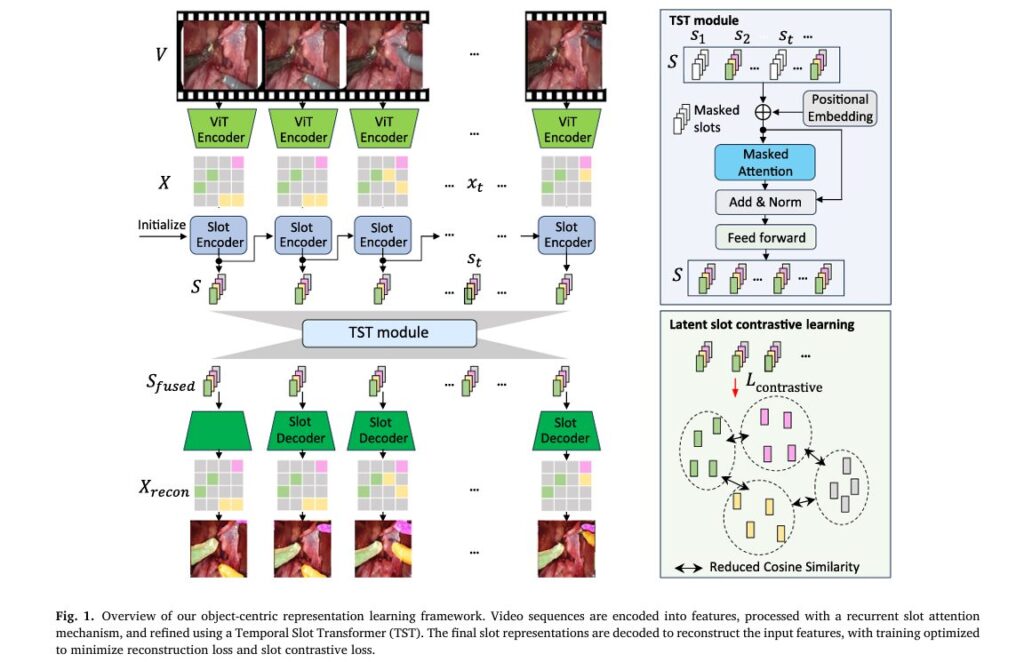
Overview of proposed Slot-BERT model.

Slot-BERT: Revolutionary AI Breakthrough for Self-Supervised Surgical Video Analysis

Introduction: The Challenge of Understanding Complex Surgical Videos Modern surgical procedures generate vast amounts of video data that hold immense potential for training, quality assessment, and AI-assisted decision-making. Yet, one persistent challenge has plagued computer vision researchers: how can machines automatically identify and track surgical instruments and anatomical structures without human-labeled data? Traditional supervised learning […]

Slot-BERT: Revolutionary AI Breakthrough for Self-Supervised Surgical Video Analysis Read More »
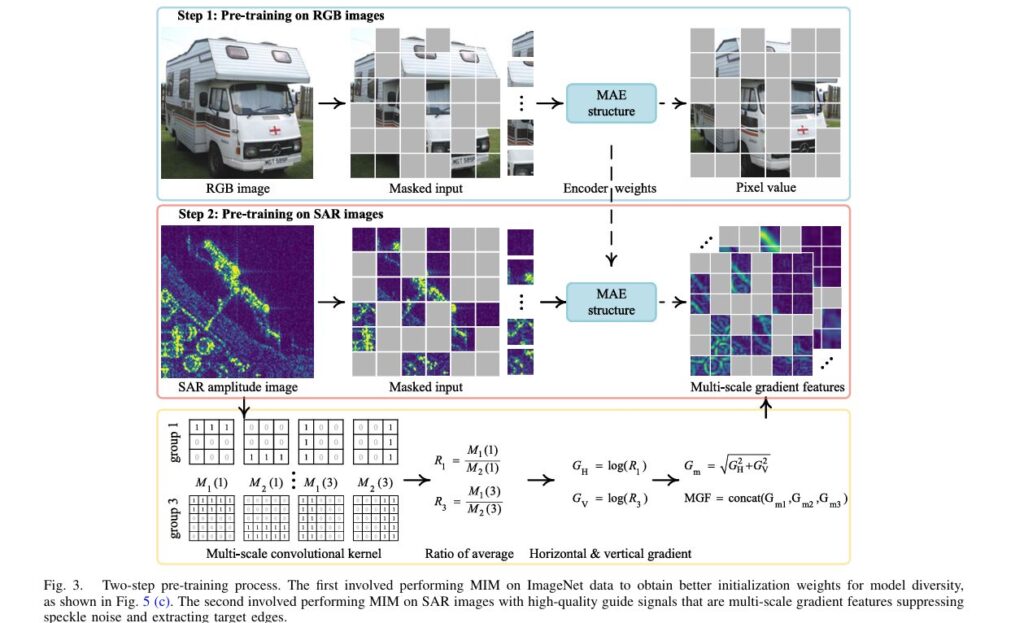
SARATR-X: Revolutionary Foundation Model Transforms SAR Target Recognition with Self-Supervised Learning

SARATR-X: Revolutionary Foundation Model Transforms SAR Target Recognition with Self-Supervised Learning

Introduction: Breaking New Ground in Radar Image Analysis Imagine a technology that can see through clouds, darkness, and adverse weather conditions to identify vehicles, ships, and aircraft with remarkable precision. This is the power of Synthetic Aperture Radar (SAR), and now, researchers have developed SARATR-X—the first foundation model specifically designed to revolutionize how machines understand

SARATR-X: Revolutionary Foundation Model Transforms SAR Target Recognition with Self-Supervised Learning Read More »

SurgeNetXL: Revolutionizing Surgical Computer Vision with Self-Supervised Learning

SurgeNetXL: Revolutionizing Surgical Computer Vision with Self-Supervised Learning

Introduction The operating room represents one of the most data-rich environments in modern medicine, yet surprisingly, computer vision technology has lagged behind other medical specialties. While pathology and radiology have embraced AI solutions at near-market deployment stages, surgical computer vision remains in its infancy—constrained not by algorithmic limitations, but by the scarcity of comprehensive, well-annotated

SurgeNetXL: Revolutionizing Surgical Computer Vision with Self-Supervised Learning Read More »

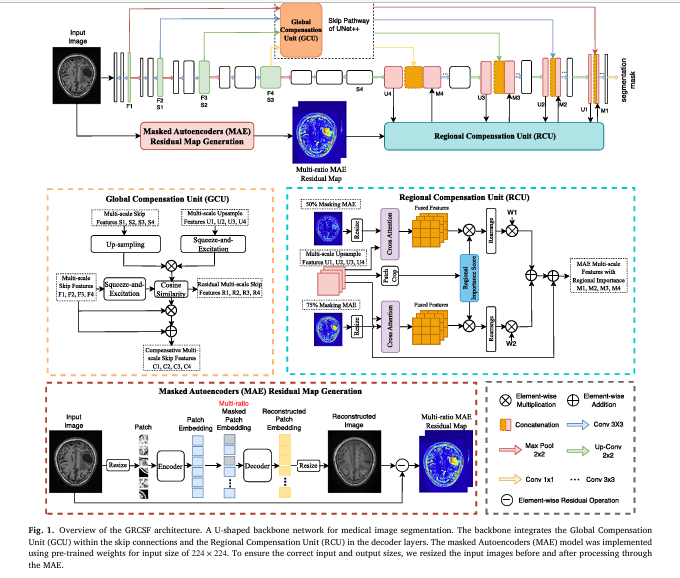
GRCSF’s Dual-Feature Compensation Framework Achieves State-of-the-Art Lesion Segmentation

Revolutionizing Medical Imaging: How GRCSF Dual-Feature Compensation Framework Achieves State-of-the-Art Lesion Segmentation

Introduction: The Critical Need for Accurate Lesion Segmentation in Modern Medicine In the rapidly evolving landscape of medical diagnostics, accurate lesion segmentation stands as a cornerstone for effective patient care. From diagnosing life-threatening conditions like ischemic stroke and lung cancer to quantifying subtle coronary artery calcifications, the ability to precisely delineate abnormal tissue from healthy

Revolutionizing Medical Imaging: How GRCSF Dual-Feature Compensation Framework Achieves State-of-the-Art Lesion Segmentation Read More »

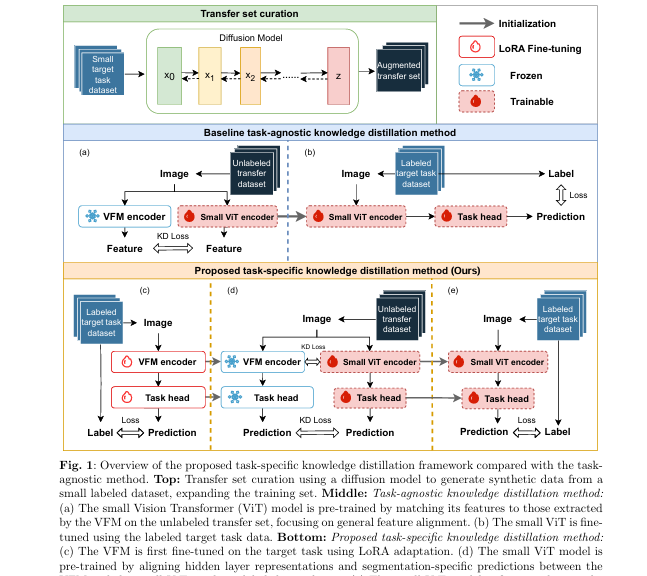
Visual illustration of task-specific knowledge distillation transferring learned features from a large Vision Foundation Model (SAM) to a lightweight ViT-Tiny for medical image segmentation.

Task-Specific Knowledge Distillation in Medical Imaging: A Breakthrough for Efficient Segmentation

Revolutionizing Medical Image Segmentation with Task-Specific Knowledge Distillation In the rapidly evolving field of medical artificial intelligence, task-specific knowledge distillation (KD) is emerging as a game-changing technique for enhancing segmentation accuracy while reducing computational costs. As highlighted in the recent research paper Task-Specific Knowledge Distillation for Medical Image Segmentation , this method enables efficient transfer

Task-Specific Knowledge Distillation in Medical Imaging: A Breakthrough for Efficient Segmentation Read More »

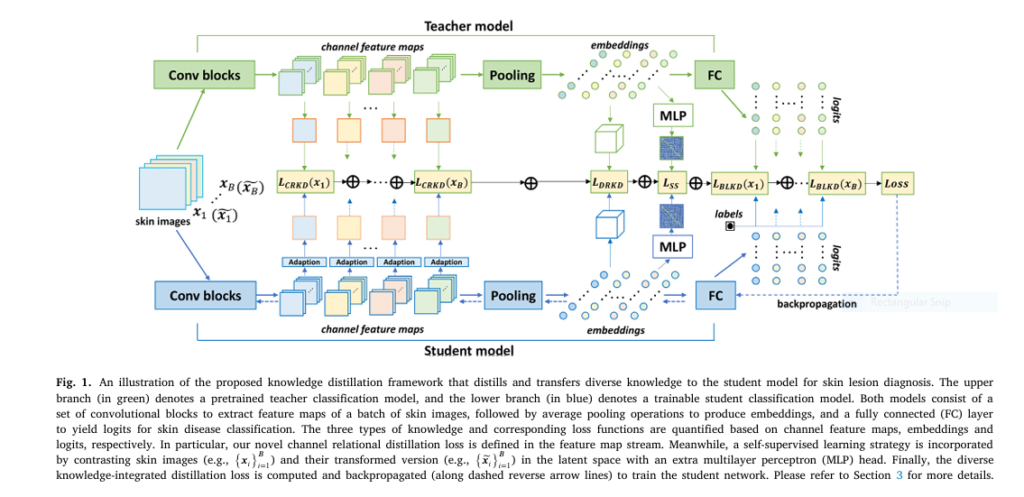
A novel SSD-KD framework for Skin Cancer Detection

5 Shocking Secrets of Skin Cancer Detection: How This SSD-KD AI Method Beats the Competition (And Why Others Fail)

The Hidden Crisis in AI Skin Cancer Diagnosis: A 7% Accuracy Gap That Could Cost Lives Every year, millions of people face the terrifying reality of skin cancer. With over 5 million cases diagnosed annually in the U.S. alone, early detection isn’t just important—it’s life-saving. Artificial Intelligence (AI) promised a revolution in dermatology, offering dermatologist-level

5 Shocking Secrets of Skin Cancer Detection: How This SSD-KD AI Method Beats the Competition (And Why Others Fail) Read More »

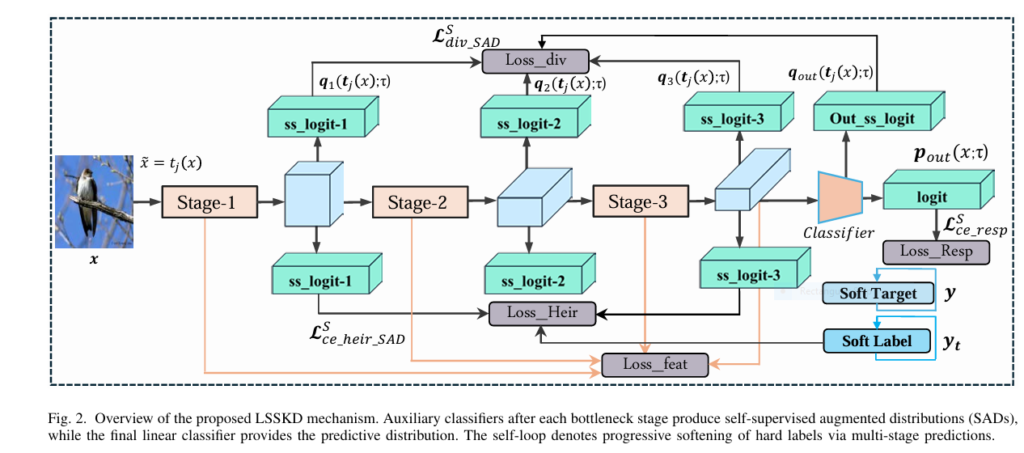
Diagram illustrating the Layered Self‑Supervised Knowledge Distillation (LSSKD) framework, showing auxiliary classifiers enhancing student model performance on edge devices.

7 Incredible Upsides and Downsides of Layered Self‑Supervised Knowledge Distillation (LSSKD) for Edge AI

As deep learning continues its meteoric rise in computer vision and multimodal sensing, deploying high‑performance models on resource‑constrained edge devices remains a major hurdle. Enter Layered Self‑Supervised Knowledge Distillation (LSSKD)—an innovative framework that leverages self‑distillation across multiple network stages to produce compact, high‑accuracy student models without relying on massive pre‑trained teachers. In this article, we’ll

7 Incredible Upsides and Downsides of Layered Self‑Supervised Knowledge Distillation (LSSKD) for Edge AI Read More »

Follow by Email
Tiktok