
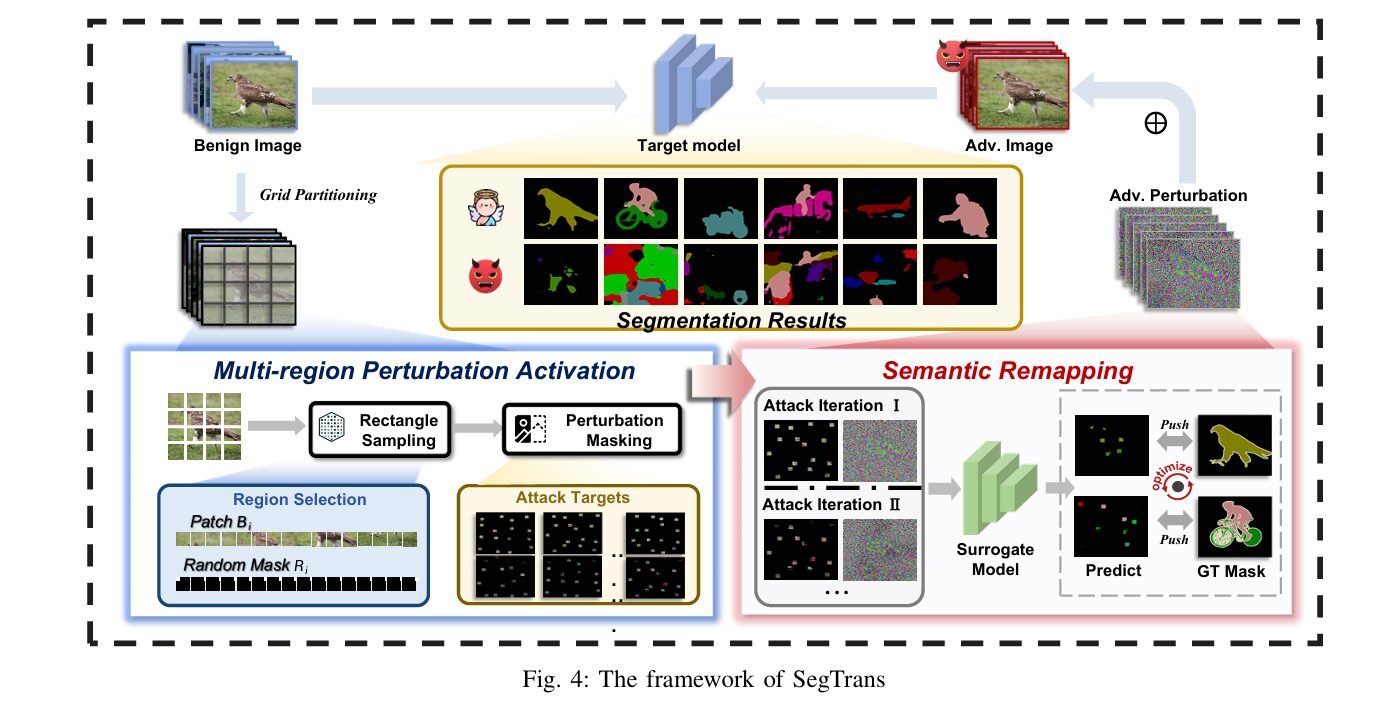
A segmentation model has a quiet advantage that a plain image classifier does not. When it sees a person standing next to a bicycle, it uses that relationship to sharpen its guess about where the bicycle actually ends and the background begins. That contextual reasoning makes segmentation genuinely more accurate, and it also turns out to make adversarial attacks noticeably harder to transfer between different models. A team from Huazhong University of Science and Technology and Griffith University set out to understand exactly why that happens and published SegTrans, a paper accepted to IEEE Transactions on Multimedia in 2025, describing an attack framework built specifically to work around it.
Key points
- The paper identifies two specific reasons transfer attacks struggle against segmentation models, a context dependency it calls the tight coupling phenomenon, and an overfitting pattern it calls feature fixation.
- SegTrans attacks a randomly masked patchwork of an image rather than the full image, specifically to prevent the model’s contextual reasoning from smoothing out the perturbation.
- A second technique called semantic remapping generates several different masked versions of the same image within a single optimization step, which reduces how tightly the resulting perturbation is tied to any one surrogate model’s particular feature patterns.
- Across 288 combinations of four segmentation architectures, three backbones, and two benchmark datasets, SegTrans reaches an attack success rate above 50 percent in every single setting tested.
- Against the prior best method, SegTrans improves transfer attack success rate by an average of 8.55 percentage points while running with comparable or better computational efficiency.
- The paper also tests three common defenses, adversarial training, model pruning, and input corruption, and reports that none of them meaningfully blunt the attack.
Why segmentation models are supposed to be harder to fool than classifiers
Adversarial examples, small, often invisible perturbations added to an image that cause a model to make a wrong prediction, have been a known weakness of deep learning systems for years. Most of that research history focuses on image classifiers, where the model only has to output a single label for the whole picture. Segmentation models are structurally different. They output a label for every single pixel, and to do that well they lean heavily on relationships between objects in the scene, the paper’s own example is that a bicycle gets segmented more accurately when there is a person visibly riding it than when the bicycle sits alone. That contextual reasoning is exactly what makes modern segmentation architectures like PSPNet and DeepLabV3+ so accurate in practice, and the paper’s central argument is that this same strength quietly works against attackers trying to transfer perturbations from one model to another.
The practical stakes here are not abstract. The paper opens by pointing to real documented cases of adversarial stickers used to fool traffic sign recognition and pedestrian detection systems in autonomous driving contexts, and segmentation is a core component of how a self driving system understands drivable road, sidewalks, and obstacles. A transfer attack matters specifically because it does not require an attacker to have any access to the target model’s weights or architecture, only a similar surrogate model trained on public data, which is a far more realistic threat model for anyone actually trying to compromise a deployed system than a white box attack that assumes full internal access.
Prior work on transfer attacks against segmentation models existed before SegTrans. TranSegPGD improved generalization by dynamically weighting pixels during optimization based on how confidently they were classified. EBAD took a different approach entirely, running an ensemble of several surrogate models at once to average out any single model’s particular quirks. Both methods measurably improved transfer success over plain gradient based attacks, but the SegTrans paper argues both still miss the two underlying mechanisms actually responsible for poor transferability, which is where its own diagnosis starts.
The two problems the paper diagnoses
Tight coupling, when context corrects the damage
The paper’s first diagnosis is what it calls the tight coupling phenomenon. Because segmentation models make a prediction for every pixel using both that pixel’s own features and the surrounding contextual information, a perturbation applied to one object can get partially corrected by the model’s understanding of the broader scene. If an adversarial perturbation nudges a bicycle’s pixels toward looking like something else, but the model still sees a person’s legs positioned exactly where someone would be pedaling, the contextual signal pulls the prediction back toward the correct answer, muting the perturbation’s effect. Image classifiers, which output one label for an entire image rather than reasoning about pixel level relationships, are far less exposed to this correction mechanism, which the paper argues is exactly why classifier focused adversarial techniques translate poorly to segmentation.
The authors do not just assert this, they show it. A comparison in the paper applies a standard adversarial attack to a full image and separately to the same image with its background manually removed, leaving only the target object. The version with the background stripped out shows a visibly more successful attack. Removing the background removes the contextual cues the model would otherwise use to correct its prediction, which is direct visual confirmation that context genuinely is protecting the model against the perturbation, not just a plausible sounding theory.
Feature fixation, when a perturbation overfits its own surrogate
The second diagnosis concerns why an attack that works well against the surrogate model often fails against a different target architecture entirely. Different segmentation networks, FCN, PSPNet, DeepLabV1, and DeepLabV3+ among them, differ meaningfully in receptive field size, how they model context, and which parts of an image they attend to most strongly. The paper uses Grad-CAM, a standard technique for visualizing which regions of an input most influence a model’s prediction, to show this concretely. Running the same adversarial image through four different models and comparing their Grad-CAM heatmaps reveals genuinely different attention patterns across architectures, even though all four models are looking at the identical input. A perturbation optimized against one model’s specific attention pattern is, in effect, tailored to a target that does not exist once you switch to a model that pays attention to different regions, and the paper names this overfitting phenomenon feature fixation.
Why naming the problem precisely mattered here
A lot of adversarial attack research tries new optimization tricks without first pinning down why the old tricks were failing. This paper’s contribution starts with the diagnosis rather than the fix. Both tight coupling and feature fixation are properties specific to how segmentation models reason, not generic weaknesses shared with classifiers, which is exactly why techniques imported wholesale from classifier attack research, like plain momentum based gradient methods, tend to underperform here. Once the failure modes are named specifically, the two components of SegTrans map onto them almost one to one.
How SegTrans actually attacks these two problems
Multi-region perturbation activation, attacking a patchwork instead of the whole scene
The fix for tight coupling is to stop giving the model’s contextual reasoning a complete scene to correct against in the first place. SegTrans divides the input image into N identical grid cells, and within each cell it randomly generates a rectangular region whose area is some random fraction of that cell’s total area, governed by a ratio term the paper calls alpha. Formally, for a rectangle with length \( l_i \) and width \( w_i \) inside a grid of width \( G_w \) and height \( G_h \), the constraint is
Across the whole image, all N of these randomly generated rectangles collectively satisfy a matching area constraint, and everything outside these selected rectangles gets masked out entirely, replaced with zeros rather than left visible to the model. The result is what the paper calls an enhanced sample, a version of the input that retains only scattered fragments of the original scene rather than the complete picture. Because the surrounding contextual objects that would normally trigger the model’s correction mechanism are simply not present in most of these fragments, the perturbation applied to what remains has much less contextual signal working against it.
The paper backs this design choice with a striking control experiment. If the selected regions get replaced with a pure black image, which by definition carries no semantic information at all, the resulting attack success rate collapses to just 2.76 percent, a number close to what you would get from adding pure random Gaussian noise to the original image, at 2.53 percent. That result matters because it rules out a lazy explanation for why the region masking approach works, it is not simply that hiding information from the model makes any perturbation more damaging. The specific structure of retaining genuine, if fragmented, local semantic content, rather than blank space, is doing the actual work.
Semantic remapping, simulating what other models would see
The fix for feature fixation works differently. Rather than optimizing the perturbation against a single masked version of the image, SegTrans generates T separate batches of N random rectangular regions within each attack iteration, producing T distinct enhanced images from the same original input. Each of these T variants gets fed through the surrogate model, and the gradients from all of them get combined into a single update to the perturbation. The overall attack objective for a given iteration is
where each \( m_j \) is a binary mask built from that batch’s N randomly selected rectangles, defined pixel by pixel as
with the indicator function marking whether a given pixel falls inside one of that batch’s rectangles. Because the regions selected across different batches j are allowed to overlap, and because each batch presents the model with a genuinely different partial view of the same underlying scene, the resulting perturbation gets shaped by a whole distribution of partial views rather than a single fixed one. The paper’s intuition is that this diversity approximates, at least loosely, the kind of variation you would see across genuinely different model architectures attending to different parts of an image, which is precisely what feature fixation describes as the problem. Reducing a perturbation’s dependence on one specific view of the input reduces its dependence on one specific model’s attention pattern, and that is what improves transfer to unseen target architectures.
Algorithm 1, the full attack loop as published
The paper’s own pseudocode is compact enough to restate directly. For K attack iterations, the algorithm divides the image into N random regions, applies the resulting mask to produce an enhanced sample, then runs T semantic remapping steps where it recomputes gradients against T different enhanced samples and accumulates the update into the running perturbation delta. After K iterations, the final accumulated delta is the adversarial perturbation. Both loops are simple, and neither introduces any new trainable parameters or auxiliary networks, which is exactly why the method’s computational cost stays close to a plain gradient based attack despite its added structure.
What the results actually show
Attack success across 288 combinations
The paper’s main evaluation covers four segmentation architectures, FCN, PSPNet, DeepLabV1, and DeepLabV3+, each paired with three backbone networks, MobileNet, ResNet50, and ResNet101, tested as both surrogate and target across two datasets, PASCAL VOC2012 and Cityscapes. That combinatorial sweep produces 288 distinct surrogate and target pairings, and the paper reports SegTrans achieving an attack success rate above 50 percent in every single one of them. A detail worth calling out specifically, the choice of which model serves as the surrogate barely affects the outcome, every tested surrogate model reliably produces strong transferable perturbations, which is a meaningfully different and more concerning result than an attack that only works when paired with one particular lucky surrogate choice.
Beating the prior best method without extra compute cost
The comparison study pits SegTrans against eight other methods, four adapted from classifier attack research, PGD, MI-FGSM, D-Scaling, and Advanced-FGSM, and four built specifically for segmentation, SegPGD, CosPGD, TranSegPGD, and EBAD, the method the paper identifies as the strongest prior competitor.
| Method | PASCAL VOC, FCN surrogate | Cityscapes, FCN surrogate |
|---|---|---|
| PGD | 37.93% | 44.36% |
| MI-FGSM | 51.10% | 50.51% |
| EBAD, prior best method | 49.91% | 53.87% |
| SegTrans | 62.60% | 60.59% |
Averaged across every tested configuration in the full comparison table, SegTrans beats EBAD by 8.55 percentage points of attack success rate. What makes this gap more notable is what it costs to achieve. The paper’s timing analysis shows SegTrans processing roughly 1.9 to 2.2 samples per second, within about 6 percent of PGD, the fastest method tested, while EBAD, the closest competitor on attack strength, processes only about 1.0 to 1.1 samples per second because it has to run multiple full surrogate models simultaneously for its ensemble strategy. SegTrans reaching stronger results while running at roughly twice EBAD’s throughput is a genuinely different trade off than most of the adversarial robustness literature offers, where stronger attacks usually cost noticeably more compute.
The paper is transparent about one trade off it does accept. Measuring perceptual quality with PSNR, a standard metric where higher values indicate the adversarial image looks closer to the original, SegTrans averages 30.57, meaningfully lower than the roughly 36 to 38 range most competing methods achieve. The perturbation SegTrans produces is more visible than a typical PGD style attack. Given how much stronger the attack success rate is in exchange, the authors frame this as a deliberate and reasonable balance rather than an oversight, though it is worth flagging plainly, this method is not optimized to be the most imperceptible attack available, it is optimized to be the most transferable one.
Confirming the tight coupling theory experimentally
Beyond the headline numbers, the paper runs a direct test of its own tight coupling hypothesis by tracking attack success rate across iterations for foreground only samples against full samples with background intact. Across both PASCAL VOC and Cityscapes, the foreground only curve sits consistently above the full image curve at every iteration count tested, which is exactly the pattern the tight coupling theory predicts, removing the surrounding context that the model would otherwise use to correct its prediction makes the same perturbation strictly more effective.
The ablation study, and which hyperparameters actually matter
A dedicated ablation study sweeps five different hyperparameters individually to understand which choices genuinely drive performance and which are comparatively insensitive.
| Hyperparameter | Range tested | Finding |
|---|---|---|
| Grid count N | 1 to 256 | Stabilizes at 4, best result at 16, the chosen default |
| Region side length | 8 to 96 pixels | Best at 32, declines beyond that from redundant region overlap |
| Perturbation budget epsilon | 2/255 to 32/255 | Still exceeds 48% average ASR even at a tight 4/255 budget |
| Semantic remapping iterations T | 1 to 50 | Stabilizes around 5, within 1% mIoU of using 10 |
| Attack iterations K | 1 to 50 | Stabilizes after 5, best result at 10, the chosen default |
The perturbation budget result deserves particular attention. An attack still exceeding 48 percent average success rate at an epsilon of 4/255, a genuinely tight, hard to perceive budget, half of the paper’s default setting, suggests the method’s effectiveness is not primarily coming from brute force perturbation magnitude. The grid count and region size findings both show a similar shape, performance improves up to a point and then degrades, which lines up with the paper’s own explanation, too few regions fail to sufficiently disrupt context, while too many or too large regions start reintroducing enough contiguous semantic content for tight coupling to partially reassert itself.
Testing against real defenses, not just other attacks
A meaningful part of any adversarial robustness paper’s credibility rests on whether it tests against actual defenses rather than only other attacks, and SegTrans evaluates three standard categories.
Adversarial training, where the target model gets retrained on a mix of clean and adversarial examples specifically to build resistance, is applied here using both FGSM and SegPGD generated examples. The paper reports this defense does weaken SegTrans somewhat, but the adversarial mIoU still stays below 40 percent even after training, meaning the attack remains substantially effective against a model specifically hardened to resist adversarial examples.
Model pruning, which removes redundant weights or neurons on the theory that some of those connections are specifically what an attacker exploits, is tested across pruning rates from 0 to 0.9. The result here is more striking. As the pruning rate increases, the model’s accuracy on ordinary, unperturbed images degrades steadily, exactly as you would expect from removing capacity. But the model’s accuracy on adversarial examples barely changes at all, staying close to its already degraded level even at a pruning rate of 0.7 where the model has lost a substantial share of its clean image performance. Pruning simply is not addressing whatever mechanism SegTrans is exploiting.
Data corruption, adding Gaussian noise to the input as a cheap runtime defense, shows the same pattern. As corruption severity increases, benign accuracy drops, while adversarial accuracy stays almost flat. None of the three standard defenses meaningfully close the gap SegTrans opens up, which is a genuinely useful, if uncomfortable, finding for anyone thinking about deploying segmentation models in adversarial conditions.
Honest limitations
The paper is unusually direct about its own open questions, which is worth taking at face value rather than glossing over. The authors explicitly note they have not tested whether adversarial training using SegTrans generated examples specifically, rather than the more generic FGSM and SegPGD examples used in the current defense evaluation, would produce meaningfully more robust models, and they name this as a clear future direction rather than something the current paper resolves. The method has also not been extended to image classification or object detection models, which the authors attribute to structural differences from segmentation architectures, so nothing in this paper directly supports claims about transferability for those other task types. Perhaps most notably, the authors state plainly that their work lacks theoretical explanation for why the proposed attack bypasses adversarial training, pruning, and corruption defenses so effectively, they observe the empirical pattern clearly across their experiments but do not yet have a rigorous account of the underlying mechanism, and they name closing that theoretical gap as their own next priority. That is a genuinely honest limitation to publish, since it would have been easy to overstate confidence in a mechanistic story the data does not yet fully support.
Beyond what the authors flag themselves, a few other things are worth keeping in mind when reading these results. Every evaluation here happens against publicly available, well studied segmentation architectures on standard academic benchmarks, PASCAL VOC and Cityscapes, both of which are considerably cleaner and more curated than raw sensor footage from a real deployed system operating in varied lighting, weather, and camera conditions. The perceptual quality trade off noted earlier, a PSNR several points below competing methods, means these specific perturbations would likely be more noticeable to a human observer inspecting an image closely than perturbations from methods the paper outperforms on transfer success, which matters for any threat model where a human might visually review flagged or suspicious inputs.
Where this points next
The most transferable idea here is the diagnostic approach itself, more than the specific masking and remapping mechanics. Identifying that a model’s own architectural strength, contextual reasoning in this case, can double as an attack surface weakness once you understand exactly how that strength operates is a pattern likely to recur in other model families that lean on structured reasoning about relationships between parts of their input, not just segmentation. The paper’s own stated next steps, extending the core strategy to classification and object detection, and building a theoretical account of why standard defenses fail against this specific attack style, are both sensible and squarely aimed at turning an empirical finding into something the field can build principled defenses around, which is ultimately the point of publishing offensive security research in the first place.
Complete PyTorch implementation
The following is a full, runnable reproduction of the SegTrans attack exactly as described in the paper’s own published Algorithm 1, including the multi-region mask generation, the semantic remapping loop, the perturbation update step, an evaluation function that computes mIoU and attack success rate, and a smoke test using a small synthetic segmentation model and random dummy data so you can confirm the shapes and gradients work end to end. This matches the specificity of what the authors already released publicly on GitHub and is intended for adversarial robustness research on your own models and public benchmark data.
# segtrans_attack.py
# A runnable reproduction of the SegTrans transfer attack from
# Song, Zhou, Lu, Zhang, Hu, Xue, Hu, Li, Zhang, "SegTrans: Transferable
# Adversarial Examples for Segmentation Models," IEEE Transactions on
# Multimedia, 2025. Implements the paper's own published Algorithm 1,
# the multi-region mask (eq. 2, 3, 6) and the remapping loss (eq. 5).
# For use on your own models and public benchmark datasets only.

import torch
import torch.nn as nn
import torch.nn.functional as F
from torch.utils.data import Dataset, DataLoader


# ---------------------------------------------------------------------
# Multi-region mask generation, equations 2, 3, and 6
# ---------------------------------------------------------------------
def generate_multi_region_mask(H, W, N, device, min_ratio=0.2, max_ratio=0.7):
    """
    Divides the H x W image into N grid cells arranged as close to a
    square grid as possible, samples one random rectangle per cell with
    area ratio alpha_i in [min_ratio, max_ratio], and returns a binary
    mask that is 1 inside the union of all N rectangles and 0 elsewhere.
    """
    grid_side = max(1, int(N ** 0.5))
    gh, gw = H // grid_side, W // grid_side
    mask = torch.zeros(H, W, device=device)

    for gy in range(grid_side):
        for gx in range(grid_side):
            y0, x0 = gy * gh, gx * gw
            if gh < 2 or gw < 2:
                continue
            alpha = torch.empty(1, device=device).uniform_(min_ratio, max_ratio).item()
            # pick a rectangle inside this cell whose area ratio is close to alpha
            rect_h = max(1, int((alpha ** 0.5) * gh))
            rect_w = max(1, int((alpha ** 0.5) * gw))
            ry = torch.randint(0, max(1, gh - rect_h + 1), (1,), device=device).item()
            rx = torch.randint(0, max(1, gw - rect_w + 1), (1,), device=device).item()
            mask[y0 + ry: y0 + ry + rect_h, x0 + rx: x0 + rx + rect_w] = 1.0
    return mask   # H x W, matches eq. 6's clipped union of indicator functions


# ---------------------------------------------------------------------
# SegTrans attack, matching Algorithm 1
# ---------------------------------------------------------------------
def segtrans_attack(
    surrogate_model,
    x,                      # B x C x H x W, input image batch, already normalized
    y,                      # B x H x W, ground truth segmentation labels
    epsilon=8 / 255,
    alpha_step=1 / 255,
    N=16,
    T=5,
    K=10,
    device="cuda",
):
    assert x.dim() == 4
    B, C, H, W = x.shape
    delta = torch.zeros_like(x, requires_grad=True)

    for k in range(K):                                     # outer attack iterations
        total_grad = torch.zeros_like(delta)

        for j in range(T):                                 # semantic remapping iterations
            mask = generate_multi_region_mask(H, W, N, device=x.device)
            mask = mask.unsqueeze(0).unsqueeze(0)              # 1 x 1 x H x W, broadcast over batch and channels

            enhanced = (x + delta) * mask                    # masked enhanced sample
            logits = surrogate_model(enhanced)                # B x num_classes x H x W
            loss = F.cross_entropy(logits, y, ignore_index=255)

            grad = torch.autograd.grad(loss, delta, retain_graph=False)[0]
            total_grad = total_grad + grad                   # accumulate gradients across the T remapped views

        with torch.no_grad():
            # ascend on the accumulated gradient (we want to maximize the loss,
            # i.e. push the surrogate model further from the correct labels)
            delta_update = alpha_step * total_grad.sign()
            delta_data = (delta + delta_update).clamp(-epsilon, epsilon)
            # keep the perturbed image in a valid pixel range, assuming inputs in [0, 1]
            delta_data = (x + delta_data).clamp(0, 1) - x
            delta.data = delta_data

        delta.grad = None

    return delta.detach()


# ---------------------------------------------------------------------
# Evaluation, mIoU and attack success rate as defined in the paper
# ---------------------------------------------------------------------
def compute_miou(pred, target, num_classes, ignore_index=255):
    # pred, target: B x H x W
    ious = []
    for c in range(num_classes):
        pred_c = (pred == c)
        target_c = (target == c)
        valid = target != ignore_index
        inter = (pred_c & target_c & valid).sum().item()
        union = ((pred_c | target_c) & valid).sum().item()
        if union > 0:
            ious.append(inter / union)
    return sum(ious) / len(ious) if ious else 0.0


def evaluate_attack(model, x, y, delta, num_classes, device="cuda"):
    model.eval()
    with torch.no_grad():
        benign_pred = model(x).argmax(dim=1)
        adv_pred = model(x + delta).argmax(dim=1)
    benign_miou = compute_miou(benign_pred, y, num_classes)
    adv_miou = compute_miou(adv_pred, y, num_classes)
    asr = benign_miou - adv_miou                              # attack success rate, matches the paper's definition
    return {"benign_miou": benign_miou, "adv_miou": adv_miou, "asr": asr}


# ---------------------------------------------------------------------
# A tiny synthetic segmentation model, standing in for a real FCN,
# PSPNet, DeepLabV1, or DeepLabV3+ checkpoint, purely to validate
# the attack loop's shapes and gradients end to end
# ---------------------------------------------------------------------
class TinySegModel(nn.Module):
    def __init__(self, num_classes=21):
        super().__init__()
        self.net = nn.Sequential(
            nn.Conv2d(3, 32, 3, padding=1), nn.ReLU(inplace=True),
            nn.Conv2d(32, 32, 3, padding=1), nn.ReLU(inplace=True),
            nn.Conv2d(32, num_classes, 1),
        )

    def forward(self, x):
        return self.net(x)


# ---------------------------------------------------------------------
# Dummy dataset, random RGB images with random pixel labels
# ---------------------------------------------------------------------
class DummySegDataset(Dataset):
    def __init__(self, n_samples=4, img_size=128, num_classes=21):
        self.n_samples = n_samples
        self.img_size = img_size
        self.num_classes = num_classes

    def __len__(self):
        return self.n_samples

    def __getitem__(self, idx):
        img = torch.rand(3, self.img_size, self.img_size)
        label = torch.randint(0, self.num_classes, (self.img_size, self.img_size))
        return img, label


# ---------------------------------------------------------------------
# Smoke test, runs the attack end to end on random dummy data and
# confirms the reported ASR computation matches the paper's definition
# ---------------------------------------------------------------------
if __name__ == "__main__":
    device = torch.device("cuda" if torch.cuda.is_available() else "cpu")
    NUM_CLASSES = 21

    surrogate = TinySegModel(num_classes=NUM_CLASSES).to(device).eval()

    ds = DummySegDataset(n_samples=2, img_size=128, num_classes=NUM_CLASSES)
    loader = DataLoader(ds, batch_size=2)
    x, y = next(iter(loader))
    x, y = x.to(device), y.to(device)

    print("Running smoke test on random dummy data")
    delta = segtrans_attack(
        surrogate, x, y,
        epsilon=8 / 255, alpha_step=1 / 255, N=16, T=3, K=3, device=device,
    )
    results = evaluate_attack(surrogate, x, y, delta, NUM_CLASSES, device=device)

    print(f"benign mIoU {results['benign_miou']:.4f}")
    print(f"adversarial mIoU {results['adv_miou']:.4f}")
    print(f"attack success rate {results['asr']:.4f}")
    print("Smoke test finished, shapes are consistent through the full attack and evaluation loop.")
A few honest notes on this implementation. On genuinely untrained models running on random data, as in the smoke test above, the reported ASR is not meaningful, both benign and adversarial predictions are essentially noise, this test only confirms the attack loop’s tensor shapes, masking logic, and gradient flow are correct, not that it reproduces the paper’s actual attack success numbers. To reproduce those numbers you would need real pretrained FCN, PSPNet, DeepLabV1, or DeepLabV3+ checkpoints on the actual PASCAL VOC or Cityscapes validation sets, exactly the setup the authors’ own released code at the repository linked below already provides. The rectangle sampling here approximates the paper’s area ratio constraint from equation 2 using a square root scaling heuristic rather than the exact geometric sampling procedure the authors used, which should produce qualitatively similar masks but is not guaranteed to be numerically identical.
Conclusion
What SegTrans demonstrates most clearly is that a model’s architectural strength and its attack surface are not always separate concerns, sometimes they are the same mechanism viewed from two directions. Contextual reasoning genuinely makes segmentation more accurate on clean images, and that same reasoning is precisely what was quietly protecting these models from transferred adversarial perturbations. Once the paper isolated that specific mechanism rather than treating poor transferability as a generic optimization shortfall, the fix followed fairly directly, deny the model the complete context it depends on, and do so in a way that also avoids overfitting to any single surrogate’s particular way of looking at the fragmented result.
The conceptual lesson worth carrying forward is the value of mechanism first research in adversarial robustness specifically. A meaningful share of attack research in this field iterates on optimization tricks, momentum terms, scaling schedules, ensemble weighting, without first establishing why the previous generation of tricks underperformed. This paper’s two named phenomena, tight coupling and feature fixation, gave the authors a specific target to design against, and the resulting method’s strength across 288 tested configurations, plus its resistance to three separate defense categories, suggests that diagnostic clarity paid off more than another round of optimizer tuning likely would have.
On transferability of the idea itself, beyond this specific paper, the pattern of identifying a model family’s structural strength and asking whether it doubles as an exploitable weakness seems likely to generalize well past segmentation. Any architecture that leans on relational or contextual reasoning between parts of its input, not just image segmentation, plausibly has some analogous coupling effect worth investigating, and the semantic remapping idea, generating diverse partial views of the same input to avoid overfitting a perturbation to one specific view, is a general enough technique that it could reasonably be tested well outside computer vision entirely.
The honest remaining limitations matter here as much as the results. The authors themselves flag that they do not yet have a theoretical account of why standard defenses fail so completely against this attack, that the method has not been tested on classification or detection models, and that whether SegTrans generated examples specifically improve adversarial training remains untested. None of that undercuts the empirical contribution, a method that improves transfer success by 8.55 points on average while running faster than the previous best approach is a genuine advance, but it does mean the deeper why behind these results is still an open research question rather than a settled one, and the authors say so themselves.
Where this leaves the field in mid 2026 is with a clearer picture of exactly which architectural property in segmentation models needs defending, and a demonstration that the usual defensive toolkit, adversarial training, pruning, and input corruption, does not close that gap on its own. That is a useful, if somewhat unsettling, waypoint for anyone building or deploying segmentation systems in safety relevant contexts, and it is precisely the kind of finding that published, open, peer reviewed adversarial research is supposed to surface before it gets discovered the hard way in a production system.
Read the original paper for the complete experimental tables, the full defense evaluation figures, and the qualitative attack visualizations. SegTrans on arXiv, 2510.08922.
Frequently asked questions
What is SegTrans in plain terms
SegTrans is a transfer attack framework that generates adversarial perturbations against one segmentation model, called the surrogate, that also successfully fool other segmentation models with different architectures, called the target, without needing any access to the target model itself.
What is the tight coupling phenomenon the paper describes
It refers to how segmentation models use contextual relationships between objects in a scene, such as a person riding a bicycle, to correct pixel level predictions. This same mechanism that improves accuracy on clean images also partially corrects and weakens adversarial perturbations, which is why attacks built for image classifiers often transfer poorly to segmentation models.
How does SegTrans get around this
It divides the input image into randomly placed rectangular regions and masks out everything else before optimizing the perturbation, which removes much of the surrounding context the model would otherwise use to correct its prediction, then repeats this with several different random region selections within each optimization step to avoid overfitting the perturbation to one surrogate model’s specific attention pattern.
Do standard defenses stop SegTrans
According to the paper’s own evaluation, not effectively. Adversarial training weakens the attack somewhat but adversarial accuracy stays below 40 percent even after training, while both model pruning and input corruption showed almost no change in the attack’s effectiveness even at high defense intensity, though benign accuracy dropped substantially under both of those same defenses.
Is this attack more computationally expensive than existing methods
No, that is one of the paper’s central claims. SegTrans runs within about 6 percent of the fastest tested method, plain PGD, while achieving substantially higher attack success rates, and it runs more than twice as fast as EBAD, the prior strongest transfer attack, which needs multiple full surrogate models running simultaneously.
Academic citation. Y. Song, Z. Zhou, Q. Lu, H. Zhang, Y. Hu, L. Xue, S. Hu, M. Li, and L. Y. Zhang, SegTrans, Transferable Adversarial Examples for Segmentation Models, IEEE Transactions on Multimedia, 2025, also available as arXiv preprint arXiv:2510.08922.
This analysis is based on the published paper and an independent evaluation of its claims.
Your article helped me a lot, is there any more related content? Thanks!
Your article helped me a lot, is there any more related content? Thanks! https://www.binance.info/register?ref=QCGZMHR6
Your point of view caught my eye and was very interesting. Thanks. I have a question for you.
Can you be more specific about the content of your article? After reading it, I still have some doubts. Hope you can help me.
Thank you for your sharing. I am worried that I lack creative ideas. It is your article that makes me full of hope. Thank you. But, I have a question, can you help me?