Skin Lesion Classification

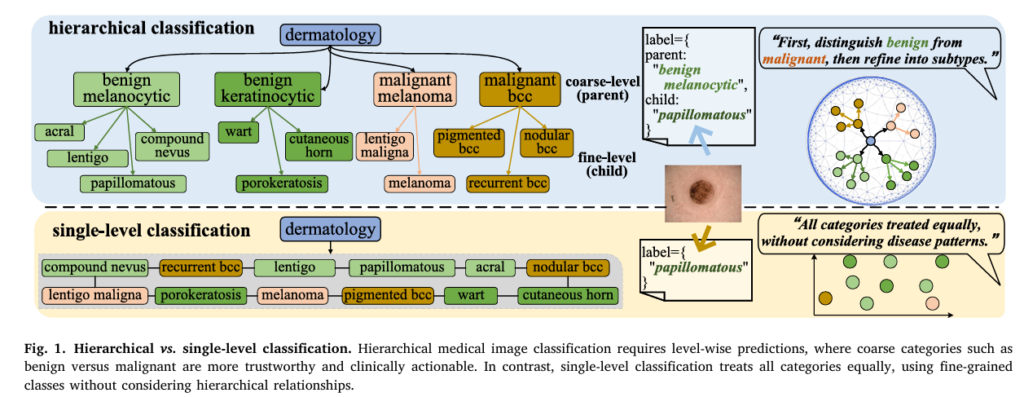
H2CL: Dual-Geometry Hyperbolic-Euclidean Image-Text Learning for Medical Hierarchical Classification.

H2CL: Dual-Geometry Hyperbolic-Euclidean Image-Text Learning for Medical Hierarchical Classification

A UNSW Sydney team built H²CL — a dual-geometry image-text framework that simultaneously operates in Euclidean and hyperbolic spaces, combining group contrastive learning with a hyperbolic entailment loss, to classify medical images across clinical taxonomies. The result: 7% accuracy gains…
H2CL: Dual-Geometry Hyperbolic-Euclidean Image-Text Learning for Medical Hierarchical Classification Read More »

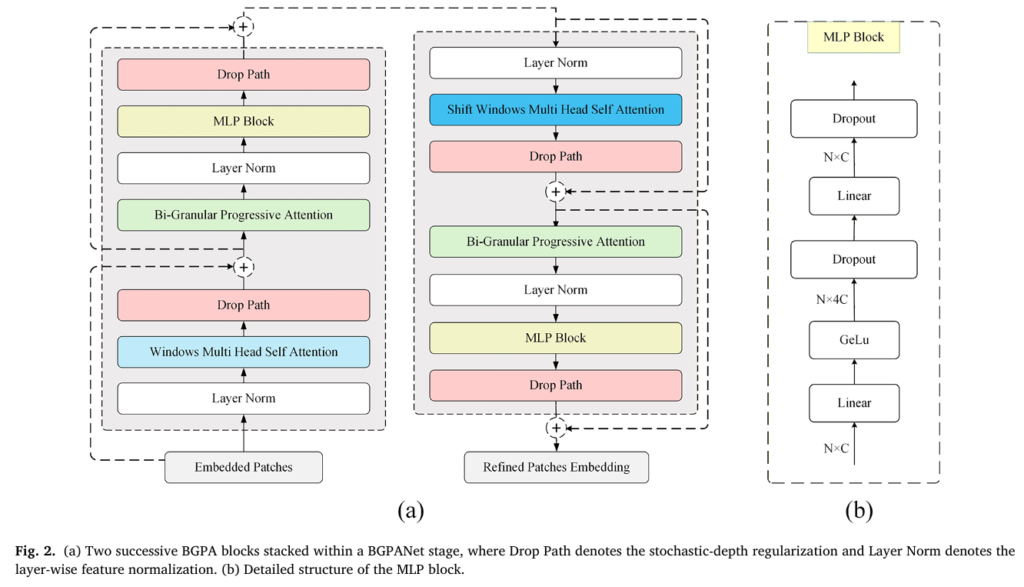
BGPANet: How Bi-Granular Progressive Attention Cracked the Skin Cancer Diagnosis Problem

BGPANet: How Bi-Granular Progressive Attention Cracked the Skin Cancer Diagnosis Problem

How a research team from Changchun University designed a network that mimics the “local-first, global-second” reasoning of expert clinicians — and in doing so, achieved state-of-the-art accuracy on two major skin cancer benchmarks while solving the imbalanced data problem that…

BGPANet: How Bi-Granular Progressive Attention Cracked the Skin Cancer Diagnosis Problem Read More »

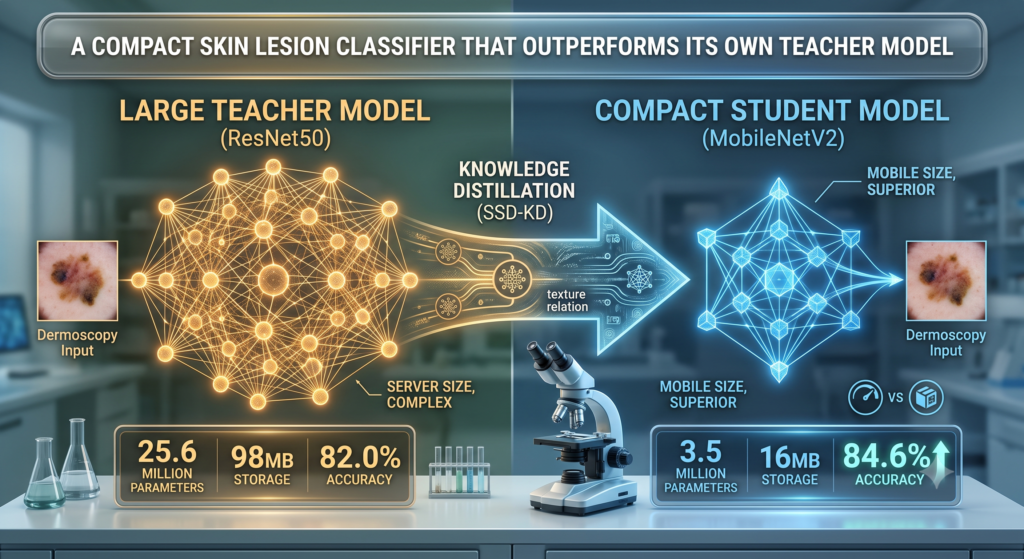
SSD-KD: A Compact Skin Lesion Classifier That Outperforms Its Own Teacher Model

SSD-KD: A Compact Skin Lesion Classifier That Outperforms Its Own Teacher Model

Skin cancer detection has become one of the clearer success stories for deep learning in medicine, with models trained on large dermoscopy image collections repeatedly matching or approaching dermatologist level accuracy on benchmark datasets. The catch is that the models…

SSD-KD: A Compact Skin Lesion Classifier That Outperforms Its Own Teacher Model Read More »