AI in medical imaging

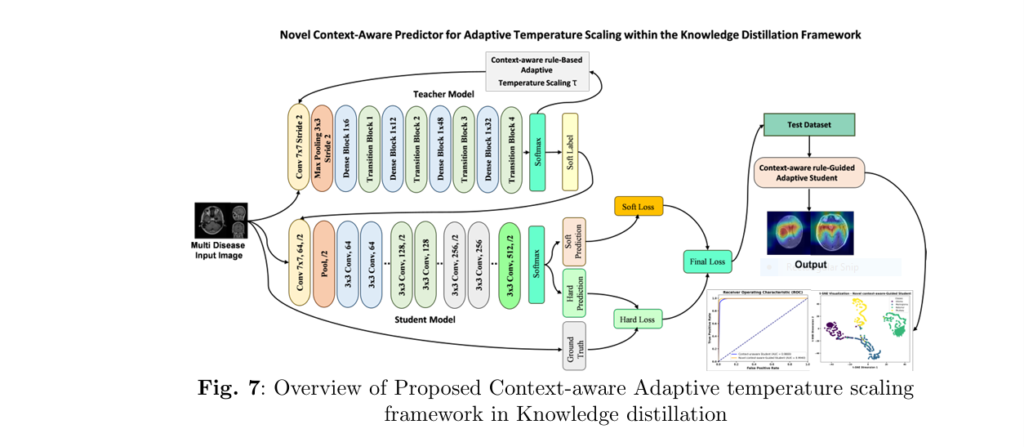
Context-Aware Knowledge Distillation model

7 Unbelievable Wins & Pitfalls of Context-Aware Knowledge Distillation for Disease Prediction

Introduction: The Good, the Bad, and the Revolutionary Medical image classification has always been a double-edged sword—brimming with promise yet hindered by complexity. From MRI scans clouded by noise to gastrointestinal images plagued with ambiguity, traditional machine learning models often stumble when faced with uncertainty. But what if there were a way to transcend these […]

7 Unbelievable Wins & Pitfalls of Context-Aware Knowledge Distillation for Disease Prediction Read More »

Diagram illustrating the DIOR-ViT architecture for differential ordinal classification in pathology images

7 Astonishing Ways DIOR-ViT Transforms Cancer Grading (Avoiding Common Pitfalls)

Cancer grading in pathology images is both an art and a science—and it’s riddled with subjectivity, inter-observer variability, and technical roadblocks. Enter DIOR-ViT, a groundbreaking differential ordinal learning Vision Transformer that shatters conventions and delivers robust, high-accuracy cancer classification across multiple tissue types. In this deep-dive SEO-optimized guide, we unpack the seven game-changing innovations behind

7 Astonishing Ways DIOR-ViT Transforms Cancer Grading (Avoiding Common Pitfalls) Read More »

Hierarchical Vision Transformers (H-ViT) enhancing prostate cancer grading accuracy through AI-driven pathology analysis

7 Revolutionary Insights from Hierarchical Vision Transformers in Prostate Biopsy Grading (And Why They Matter)

Introduction: Bridging the Gap Between AI and Precision Pathology In the evolving landscape of medical imaging, Hierarchical Vision Transformers (H-ViT) are emerging as a game-changer in prostate biopsy grading , offering unprecedented accuracy and generalizability. Traditional deep learning models have struggled with real-world variability, but H-ViTs are setting new benchmarks by combining self-supervised pretraining, weakly

7 Revolutionary Insights from Hierarchical Vision Transformers in Prostate Biopsy Grading (And Why They Matter) Read More »

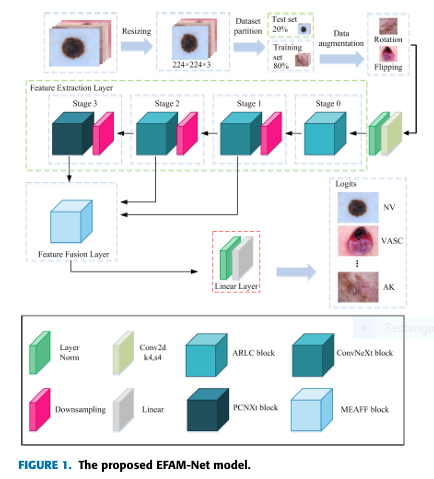
Illustration of SPCB-Net architecture showing SK feature pyramid, SAP attention module, and bilinear-trilinear pooling layers for skin cancer detection"

7 Revolutionary Advancements in Skin Cancer Detection (With a Powerful New AI Tool That Outperforms Existing Models)

Introduction: A Critical Need for Advanced Skin Cancer Detection Skin cancer is one of the most common and deadly forms of cancer worldwide. According to the Skin Cancer Foundation , 1 in 5 Americans will develop skin cancer in their lifetime , and melanoma alone accounts for more deaths than all other skin cancers combined

7 Revolutionary Advancements in Skin Cancer Detection (With a Powerful New AI Tool That Outperforms Existing Models) Read More »

Diagram showing intra-class patch swap between two images of the same category, illustrating the self-distillation process without a teacher model.

7 Shocking Wins and Pitfalls of Self-Distillation Without Teachers (And How to Master It!)

Introduction In the world of deep learning, especially in computer vision, knowledge distillation (KD) has been a go-to method to compress large models and improve performance. But the classic approach heavily relies on teacher-student architectures, which come with high memory, computational costs, and training complexity. The new research paper “Intra-class Patch Swap for Self-Distillation” proposes

7 Shocking Wins and Pitfalls of Self-Distillation Without Teachers (And How to Master It!) Read More »

Super-resolution ultrasound with multi-frame deconvolution improving microbubble localization

🚀 7 Game-Changing Wins & Pitfalls of Multi-Frame Deconvolution in Super-Resolution Ultrasound (SRUS)

Introduction: A New Era in Ultrasound Imaging Super-resolution ultrasound (SRUS), or Ultrasound Localization Microscopy (ULM), has redefined the boundaries of medical imaging by enabling visualization of microvasculature at a scale previously thought unattainable. Traditional ultrasound methods are limited by diffraction, but SRUS pushes through this barrier by tracking microbubble (MB) contrast agents in vivo. However,

🚀 7 Game-Changing Wins & Pitfalls of Multi-Frame Deconvolution in Super-Resolution Ultrasound (SRUS) Read More »

Disentangled generative model showcasing independent factors of age, ethnicity, and camera in synthetic retinal images

🔍 7 Breakthrough Insights: How Disentangled Generative Models Fix Biases in Retinal Imaging (and Where They Fail)

Introduction: Why Bias in Retinal Imaging Matters More Than Ever Retinal fundus images are crucial in diagnosing conditions from diabetic retinopathy to cardiovascular diseases. But here’s the problem: most AI models trained on retinal images learn the wrong things. Imagine this: a deep learning system that diagnoses ethnicity instead of actual disease features—because the camera

🔍 7 Breakthrough Insights: How Disentangled Generative Models Fix Biases in Retinal Imaging (and Where They Fail) Read More »

Medical AI transforming tumor segmentation with EGTA-KD technology

Revolutionary AI Breakthrough: Non-Contrast Tumor Segmentation Saves Lives & Avoids Deadly Risks

Imagine detecting deadly tumors without injecting risky contrast agents. A revolutionary AI framework called EGTA-KD is making this possible, achieving near-perfect segmentation (90.8% accuracy) on non-contrast scans while eliminating allergic reactions and kidney damage linked to traditional methods. This isn’t futuristic hype – it’s validated across brain, liver, and kidney tumors in major clinical datasets. The Deadly Cost of Current

Revolutionary AI Breakthrough: Non-Contrast Tumor Segmentation Saves Lives & Avoids Deadly Risks Read More »

Counterfactual contrastive learning closes the performance gap between majority and minority scanners, especially where it matters most: in low-data settings and real-world deployments

Title: 5 Powerful Reasons Why Counterfactual Contrastive Learning Beats Traditional Medical Imaging Techniques (And How It Can Transform Your Practice)

Introduction: The Future of Medical Imaging Starts Here Medical imaging has long been a cornerstone of diagnostics, but traditional methods often fall short when it comes to adapting to real-world variability. Enter counterfactual contrastive learning , an innovative framework that’s changing the game by leveraging causal image synthesis to improve model robustness and downstream performance.

Title: 5 Powerful Reasons Why Counterfactual Contrastive Learning Beats Traditional Medical Imaging Techniques (And How It Can Transform Your Practice) Read More »

SVIS-RULEX SFMOV heatmap overlay on a chest X-ray: Red/Orange areas highlight regions of high statistical significance (e.g., mean intensity, skewness, entropy) corresponding to COVID-19 lung opacities, validated by radiologists. Blue areas show less relevant tissue

3 Breakthroughs & 1 Warning: How Explainable AI SVIS-RULEX is Revolutionizing Medical Imaging (Finally!)

For years, artificial intelligence (AI) has promised to revolutionize medical diagnosis, particularly in analyzing complex medical images like X-rays, MRIs, and ultrasounds. Deep learning models consistently achieve superhuman accuracy in spotting tumors, infections, and subtle pathologies. Yet, a critical roadblock remains: the “black box” problem. How does the AI really make its decision? Without transparency, doctors hesitate to

3 Breakthroughs & 1 Warning: How Explainable AI SVIS-RULEX is Revolutionizing Medical Imaging (Finally!) Read More »

Follow by Email
Tiktok