
A few years ago, the story in AI coding was simple: you used GitHub Copilot or ChatGPT, and everything else was a distant second. That story has changed. Chinese AI labs — operating under intense competition and with enormous engineering talent and resources — have shipped models that are not just competitive with Western alternatives but, in specific areas, genuinely better. For developers who care about performance rather than provenance, the Chinese AI ecosystem deserves serious attention.
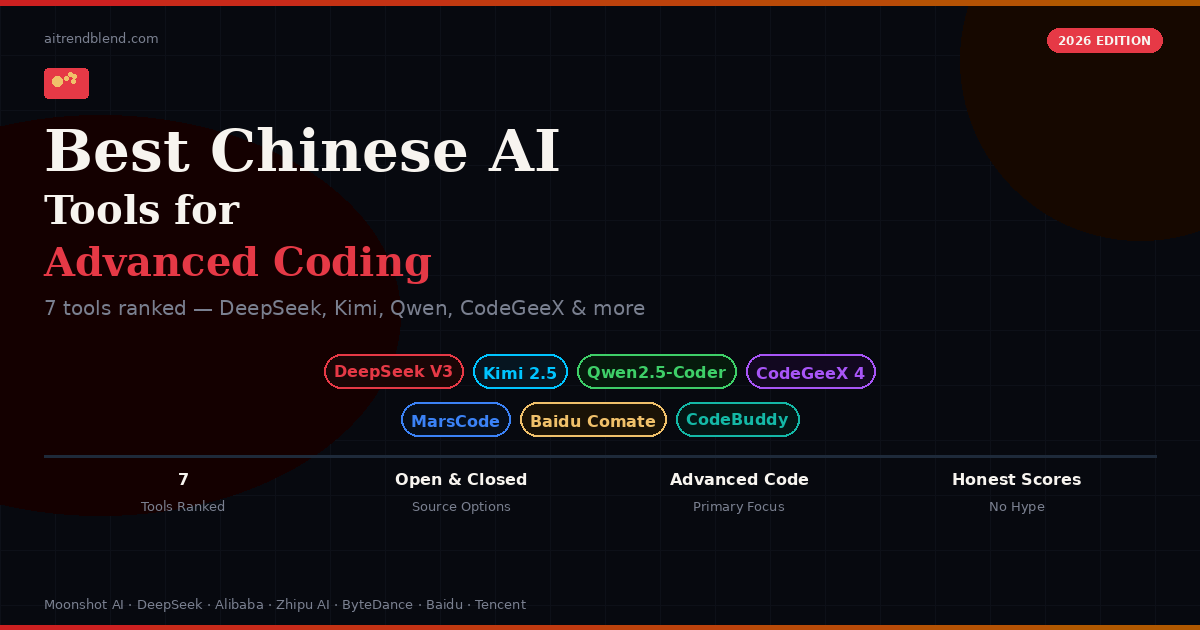
The seven tools in this ranking span the full range of what’s available: open-source models you can run yourself, API-based services, IDE-native plugins, and agentic systems. They come from seven different organisations — DeepSeek AI, Moonshot AI, Alibaba, Zhipu AI, ByteDance, Baidu, and Tencent — each with a different philosophy about what good AI coding assistance looks like.
I tested each one on the same set of advanced coding tasks: complex refactoring, architecture design, bug detection, code generation from natural language, and documentation. The scoring reflects real-world coding performance, not benchmark numbers from the organisations themselves.
The 7 Best Chinese AI Tools for Advanced Coding
The model that rewrote the open-source coding narrative
DeepSeek V3 is the most significant open-source coding model released anywhere in the world in recent memory — and that’s not an exaggeration. When it dropped with competitive performance against GPT-4o and Claude Sonnet at a fraction of the training cost, it forced a real conversation about whether frontier AI requires the compute budgets that Western labs had assumed were necessary.
For advanced coding specifically, DeepSeek V3 is exceptional. Its mixture-of-experts architecture — 671 billion total parameters, but only around 37 billion active per token — gives it deep capability without the inference cost of a dense model of equivalent size. In practice, it handles complex code generation, architectural reasoning, and bug detection at a level that puts it in the same bracket as Claude Opus 4.6 and GPT-4o on most tasks.
The open-weights release is the game-changer for many developers. You can run DeepSeek V3 on your own infrastructure, integrate it into your own tooling, and fine-tune it on your codebase without sending your proprietary code to an external API. For enterprise teams with data residency requirements, that’s not a nice-to-have — it’s a fundamental requirement.
Where DeepSeek V3 slightly trails the closed-source frontier is in the most ambiguous architectural problems — situations where there are many valid approaches and the model needs to reason about which one best fits a specific set of unstated constraints. It’s excellent but occasionally slightly less nuanced than Claude Opus 4.6 on genuinely open-ended design questions. On well-specified coding tasks, the gap disappears.
- Open weights — self-host on your own infrastructure
- Frontier-level coding performance at lower cost
- 128K context window handles large codebases
- MIT licensed — commercial use fully permitted
- Strong on code generation, refactoring, and explanation
- Active community and rapid improvement cadence
- Self-hosting at full scale requires serious compute
- Slightly less nuanced on ambiguous architecture questions
- API service availability can vary by region
- Newer releases occasionally change behaviour unexpectedly
When the task needs a team, not just a model
Kimi 2.5 takes a different bet from every other model on this list. Rather than making one very large, very smart model, Moonshot AI built a system that spins up coordinated agents to work on different parts of a coding problem simultaneously. For tasks that decompose cleanly — refactoring multiple files, adding tests and documentation across a large codebase, implementing a feature across several independent system layers — this architecture delivers throughput that sequential models simply can’t match.
We covered Kimi 2.5 in detail in our head-to-head comparison with Claude Opus 4.6 (linked below). The summary: Kimi wins on speed and throughput for well-structured parallel coding tasks, and Claude wins on depth for problems that require reasoning across interconnected dependencies. Both are excellent, but they’re excellent at different things.
For Chinese developers in particular, Kimi has excellent Chinese-language understanding that surfaces in its handling of comments, variable names, and documentation in bilingual codebases. That’s not a trivial advantage if your team writes comments in Chinese or if you’re working with Chinese-language documentation alongside your code.
- Outstanding speed on parallelisable coding tasks
- Multi-agent coordination for large-scale refactoring
- Excellent bilingual (Chinese/English) code handling
- Strong multi-file feature implementation
- Competitive pricing for high-volume use
- Cross-agent context sharing still has coordination overhead
- Weaker than DeepSeek on deep architecture reasoning
- Proprietary API — no self-hosting option
- Less nuanced on cross-file bug detection
Alibaba’s coding specialist — broad language coverage done seriously
Qwen2.5-Coder is what you get when a hyperscale cloud provider decides to build a code-specific model seriously. Alibaba trained this on an enormous corpus of code and technical documentation, and the results show: 92 programming languages supported, with genuinely good performance in languages that other models treat as afterthoughts.
The model family runs from 0.5B parameters (fast enough for real-time autocomplete on modest hardware) up to 72B (frontier-level quality for complex generation tasks). That range makes it unusually practical for teams who need different capability levels for different parts of their workflow — a small model for inline suggestions and a large model for architectural reasoning.
Code repair is a specific strength. Given broken or partially complete code, Qwen2.5-Coder diagnoses and fixes issues with a precision that comes from code-specific pretraining. It doesn’t just generate plausible fixes — it tends to understand why the code is wrong and address the root cause rather than papering over symptoms.
- Open weights in multiple sizes — 0.5B to 72B
- 92 programming languages supported
- Excellent code repair and bug fixing
- Apache 2.0 — permissive commercial licensing
- Runs well on consumer hardware at smaller sizes
- Strong fill-in-the-middle (FIM) completion
- 72B model still needs significant GPU for full inference
- Architecture reasoning less deep than DeepSeek V3 at 72B
- Smaller models sacrifice quality noticeably
- Less community tooling than DeepSeek ecosystem
The IDE-native option that developers actually enjoy using day-to-day
CodeGeeX 4 plays a different game from the heavyweight models above it. Instead of competing on raw benchmark numbers, Zhipu AI built something optimised for the daily experience of a working developer — fast IDE integration, accurate inline completion, and a conversational interface that stays out of your way until you need it.
The VS Code and JetBrains integrations are among the cleanest in the Chinese AI ecosystem. The model is lean enough (9 billion parameters in the local version) to run with acceptable latency on developer machines, which means completions arrive fast enough to feel like genuine assistance rather than a waiting game. For developers who spend most of their day inside an IDE, that responsiveness matters more than marginal quality improvements on complex benchmarks.
Code explanation is a particular strength. Ask CodeGeeX 4 to explain a complex function and it consistently produces clear, accurate explanations pitched at the right level — not dumbed down, not overly academic. For developers onboarding to an unfamiliar codebase, that capability is genuinely valuable on a day-to-day basis.
- Best-in-class IDE integration among Chinese tools
- Fast enough for real-time inline completion
- Free tier is genuinely useful, not crippled
- Excellent code explanation and documentation generation
- Handles Chinese-language codebases naturally
- 9B parameters limits depth on complex architecture tasks
- Not the right tool for frontier-level reasoning problems
- Smaller context window vs. DeepSeek or Kimi
- API access requires registration with a Chinese phone number
“The interesting thing about the Chinese AI coding ecosystem isn’t that it caught up — it’s that different labs made fundamentally different architectural bets and several of those bets turned out to be right in ways that even Western labs hadn’t fully explored.” — aitrendblend.com editorial, March 2026
ByteDance’s entry: clean, capable, and surprisingly well-integrated
ByteDance built MarsCode on top of their Doubao foundation model and integrated it with a cloud-based development environment. The combination is more coherent than it sounds on paper: the cloud sandbox means MarsCode can actually run your code, see the output, and reason about it — a significant advantage over tools that only read and generate static text.
That execution capability changes how MarsCode approaches debugging. Rather than analysing code statically and reasoning about what might go wrong, it can run a failing test, see the actual error output, and reason about the real failure rather than a hypothetical one. For certain classes of debugging tasks — particularly test failures, runtime errors, and unexpected output — this produces better results than static analysis alone.
The web-based IDE is clean and fast, and the VS Code plugin handles inline completions competently. MarsCode isn’t trying to be the deepest reasoning model in this list — it’s trying to be the most complete development environment, where the AI assistance is deeply integrated with the tools rather than bolted on as an afterthought.
- Can execute code — sees real runtime errors, not hypothetical ones
- Clean, fast cloud IDE with integrated AI
- Good inline completion in VS Code plugin
- Free tier with meaningful capabilities
- Strong for debugging real runtime failures
- Weaker reasoning depth vs. DeepSeek, Kimi, Qwen
- Cloud IDE requires internet — no offline use
- Less mature than Copilot for pure IDE completion experience
- Limited API access for developers wanting to integrate it
Enterprise-ready, Wenxin-powered, and better than it gets credit for
Baidu Comate doesn’t get as much attention in international developer communities as DeepSeek or Kimi, but it’s worth a look — especially for enterprises that need a managed, supported coding AI with proper team management, usage analytics, and on-premise deployment options.
Powered by Baidu’s Wenxin (ERNIE) model, Comate handles code generation and completion competently across common languages. Its particular strength is in the enterprise workflow layer: code review integration, team-level usage dashboards, and the ability to connect to internal documentation and coding standards to keep suggestions consistent with your organisation’s practices.
For Chinese enterprises building on a domestic cloud stack (Baidu Cloud infrastructure) with compliance requirements that favour domestic AI providers, Comate is the natural choice. It’s not the most technically impressive model on this list, but it’s backed by a company with real enterprise support capabilities and a track record in the Chinese enterprise market.
- Strong enterprise features: team management, analytics, SSO
- On-premise deployment option for compliance-heavy environments
- Internal documentation integration keeps suggestions on-brand
- Good Chinese-language codebase support
- Backed by Baidu’s enterprise support organisation
- Weaker raw coding performance vs. DeepSeek or Qwen
- Enterprise tier pricing is opaque (quote-based)
- Less useful for individual developers outside enterprise context
- Limited international documentation and community
Still finding its stride, but the Tencent ecosystem integration has real value
CodeBuddy is Tencent’s AI coding assistant, powered by their Hunyuan model. It lands at the bottom of this ranking not because it’s bad — it genuinely isn’t — but because the other tools on this list are competing at a level that raises the bar for everyone. CodeBuddy would have been impressive by 2024 standards.
Where CodeBuddy has a specific niche is in game development. Tencent is one of the world’s largest game companies, and that domain expertise shows up in CodeBuddy’s handling of game-related code: Unity/Unreal patterns, game networking concepts, and the specific optimisation concerns that game developers deal with daily. For game developers working in the Tencent Cloud ecosystem, it’s the most contextually aware option available.
The Tencent Cloud integration also has genuine value for teams already in that ecosystem — CloudBase function generation, Tencent’s managed database patterns, and WeChat Mini Program development are areas where CodeBuddy has notably better context than general-purpose models.
- Strong game development context (Unity, Unreal, networking)
- Deep Tencent Cloud ecosystem integration
- WeChat Mini Program development support
- Free tier for individual developers
- General coding quality noticeably behind the top tier
- Limited context window
- Less useful outside the Tencent ecosystem
- Rapidly being lapped by DeepSeek and Kimi on benchmarks
Quick Comparison: All 7 Tools at a Glance
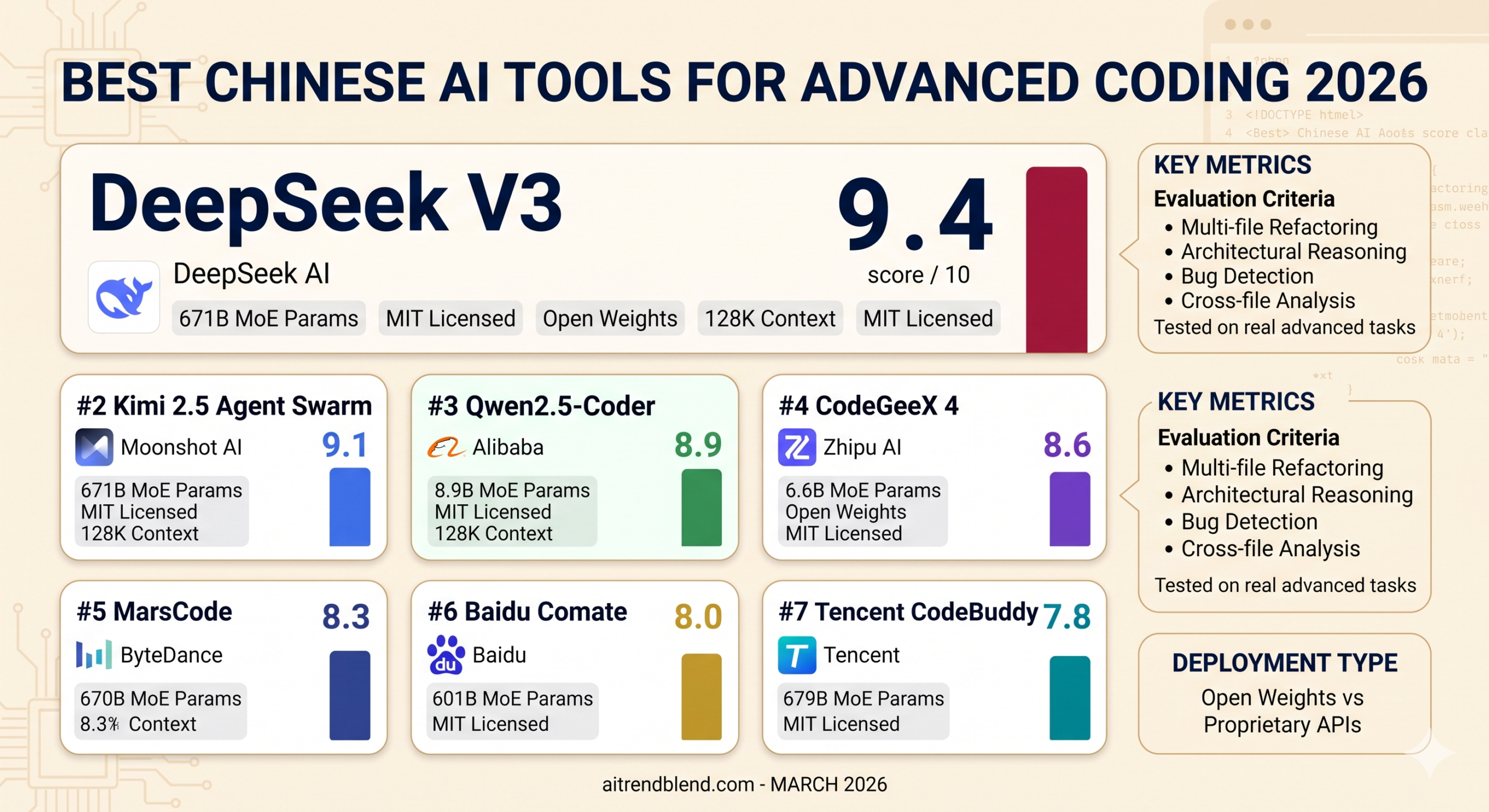
| TOOL | SCORE | COMPANY | OPEN SOURCE | CONTEXT | BEST FOR |
|---|---|---|---|---|---|
| DeepSeek V3 | 9.4 | DeepSeek AI | Open (MIT) | 128K | All-around frontier coding + self-hosting |
| Kimi 2.5 Swarm | 9.1 | Moonshot AI | API only | 128K | Parallel multi-file coding at speed |
| Qwen2.5-Coder | 8.9 | Alibaba | Open (Apache 2.0) | 128K | Multi-language + flexible deployment sizes |
| CodeGeeX 4 | 8.6 | Zhipu AI | Open | 128K | IDE-native daily coding assistance |
| MarsCode | 8.3 | ByteDance | Proprietary | 64K | Debugging with real code execution |
| Baidu Comate | 8.0 | Baidu | Enterprise | 32K | Enterprise teams on Baidu Cloud |
| Tencent CodeBuddy | 7.8 | Tencent | Proprietary | 32K | Game dev + WeChat Mini Programs |
Which Tool Is Right for You?
If you need frontier coding quality and full control over your infrastructure
DeepSeek V3 is the clear answer. MIT licensed, open weights, deployable on your own hardware, and genuinely competitive with GPT-4o and Claude on advanced coding tasks. There’s no other open-source model that comes close at this quality level in 2026.
If speed and throughput matter more than depth
Kimi 2.5’s agent swarm is the right tool for large-scale migrations, test coverage sprints, or any task where the same transformation needs to be applied across many independent files quickly. The architecture delivers throughput that single-model approaches simply can’t match.
If you need broad language support or flexible deployment sizes
Qwen2.5-Coder is the most flexible option. The range from 0.5B to 72B parameters means you can deploy an appropriate size for each use case — a tiny model for real-time autocomplete, a larger one for complex generation tasks — all from the same model family with consistent behaviour.
If you want a capable daily coding assistant inside your IDE
CodeGeeX 4 is built for exactly this use case. It’s fast enough to feel responsive, accurate enough to be genuinely useful, and the IDE integrations are among the best in the Chinese AI ecosystem.
Why Chinese AI Coding Tools Deserve Serious Attention
The reason Chinese AI coding tools have risen so quickly isn’t mysterious. Chinese tech companies employ enormous numbers of software engineers, operate at massive scale, and have built strong AI research organisations over the past decade. When those organisations turned their attention specifically to coding models, they brought real domain expertise and access to vast training data.
DeepSeek’s training efficiency breakthrough — achieving frontier-level results at a small fraction of the compute cost of Western models — was genuinely surprising to the broader AI research community. It wasn’t just an incremental improvement; it suggested that the dominant assumptions about what frontier AI requires were wrong. That has implications for the whole industry, not just for developers choosing tools.
The open-source posture of several of these labs is also worth noting. DeepSeek, Qwen, and CodeGeeX all release model weights openly, in contrast to the increasingly proprietary approach of OpenAI, Anthropic, and Google. Whether that openness is strategic or genuinely altruistic, the practical effect is the same: developers get access to powerful models they can understand, modify, and deploy on their own terms.
There are legitimate considerations around data sovereignty and trust that each team needs to evaluate for their own context. But the technical quality argument is no longer a reason to dismiss Chinese AI coding tools. The work speaks for itself.
Try These Tools on Your Real Code
All seven tools have free tiers or open access. The best way to evaluate them is on a real task from your current project.