
You have been posting on Twitter/X for six months. Your tweet impressions fluctuate between 40 and 200, your follower count moves by single digits on good weeks, and your most-liked post was a meme you dashed off in thirty seconds. Meanwhile someone in your niche posts an opinion thread at 9 PM on a Tuesday and wakes up with 4,000 new followers. The platform has not changed — your approach to it has. And Grok might be the most underestimated tool for fixing that.
Here is the thing most Twitter/X growth guides miss: Grok is not just another AI chatbot you can use to write tweets. It lives inside X. It sees what is trending right now, which conversations are gaining momentum, which topics your target audience is already engaging with today — not six months ago. No other mainstream AI tool has that. ChatGPT does not. Claude does not. Gemini does not. When you prompt Grok well, you are essentially getting a real-time content strategist who reads the entire platform before giving you advice.
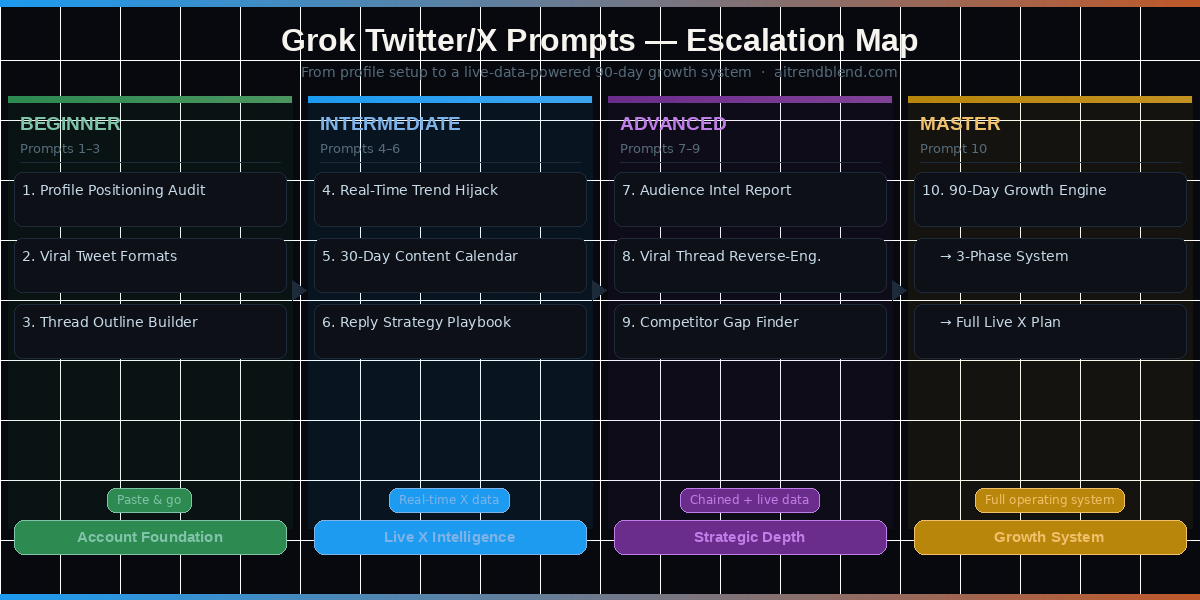
These ten prompts are built to use that advantage systematically — from setting up your account positioning to deploying a full growth operating system by the end. I have tested every one of them across different niches. The gap between a shallow prompt and a well-structured one is not marginal on X. It is the difference between a generic tweet no one reads and a thread that pulls in 500 new followers over a weekend.
Why Grok Handles Twitter/X Growth Differently
Every AI tool can write tweets. The question is whether those tweets connect to what is actually happening on the platform right now — and for that, Grok has a structural advantage nothing else can match. It is trained on X data and, in its most capable versions, has live access to X’s firehose of posts, trending topics, and real-time conversations. When you ask Grok what to write about today, it does not have to guess. It can tell you what people in your niche are already arguing about, what questions are going unanswered, and where the gaps in the current conversation are.
Compared to using Claude or ChatGPT for Twitter/X strategy, Grok is sharper on platform-specific mechanics. It understands the rhythm of X: the fact that threads outperform single tweets for following growth, that reply-first engagement is the fastest way to get seen before you have an audience, that certain tweet formats — hot takes, contrarian stances, numbered lists — reliably outperform narrative posts in the feed. Ask Claude for a Twitter growth strategy and you will get good general advice. Ask Grok and you will get advice that accounts for what is actually trending in your niche this week.
Grok has real-time access to X’s trending conversations and post data. Prompts that ask Grok to analyze “what’s being discussed in [NICHE] on X right now” produce genuinely current intelligence — not recycled best-practices from a training dataset that is months out of date. Always use this feature deliberately.
The limitation worth naming upfront: Grok’s real-time data access is stronger on the paid X Premium tier, and the quality of live data responses can vary by region and topic volume. For niche communities with fewer active posters, the real-time signal is thinner. You will still get useful output, but the “what’s trending right now” element matters most in high-volume niches — tech, finance, sports, politics, self-improvement. In smaller communities, rely more on Grok’s strategic reasoning and less on its trend-scanning capability.
Before You Start: How to Get the Best Results
Access Grok through X itself — either the Grok tab on the app or at grok.x.ai. The version available to X Premium subscribers (Grok 3 or 3.5 depending on your tier) is significantly more capable than the free version, particularly for real-time data tasks. If you are running these prompts for Twitter/X growth specifically, the live X integration is what makes the difference, so Premium access is worth it for this use case.
Before running any of the ten prompts, create a short account brief you can paste at the top of each conversation. Something like: “My X account is @[handle], focused on [niche]. My target audience is [description]. I post [X times per week]. My best-performing recent tweet got [N] impressions/likes. My growth goal for the next 60 days is [followers / impressions / engagement rate].” This brief eliminates the back-and-forth and keeps Grok’s output grounded in your specific situation rather than generic growth advice.
Always open a fresh Grok conversation for strategic work — do not mix your growth prompts into a casual chat thread. And explicitly tell Grok to search X when you want live data: “Search X for current conversations about [topic] and base your answer on what you find.” Without that instruction, Grok may answer from training data alone rather than pulling real-time signals.
The 10 Best Grok Prompts for Twitter/X Account Growth
Prompt 1: The X Profile Positioning Audit
Your bio, name, and pinned tweet are the three things a potential follower sees before deciding whether to follow you. Most accounts get this wrong — bios are either too vague (“Thoughts on tech and life”) or too cluttered (five unrelated interests jammed into 160 characters). The best X bios communicate one clear value proposition in a voice that matches the content the account actually posts.
This prompt runs a full audit on your existing profile and delivers five rewritten bio options, each targeting a different conversion mechanism. It also covers your display name and pinned tweet strategy — two elements most growth guides skip entirely.
I want you to audit and rewrite my Twitter/X profile to maximize follower conversion.

My current bio: [PASTE YOUR CURRENT BIO — OR WRITE "STARTING FRESH"]
My niche: [YOUR NICHE — BE SPECIFIC, NOT JUST "TECH" OR "FINANCE"]
My target follower: [WHO SHOULD HIT FOLLOW AND WHY — AGE, INTEREST, PROBLEM THEY HAVE]
My biggest credibility signal: [EXPERIENCE, RESULT, OR UNIQUE ANGLE YOU BRING]
My content style: [HOT TAKES / EDUCATIONAL THREADS / COMMENTARY / DATA / HUMOR]

Please:
1. Audit my current bio — what is working, what is killing conversions
2. Write 5 new bio versions (max 160 characters each):
   — Authority-led (leads with your credibility)
   — Benefit-led (leads with what the follower gains)
   — Voice-led (leads with personality and tone)
   — Niche call-out (directly names who it is for)
   — Curiosity-gap (makes them want to see your content to understand)
3. Recommend a display name strategy for my niche
4. Suggest a pinned tweet concept — what format and angle would convert a profile visitor into a follower right now

# Hard limit: 160 characters per bio. No emojis unless they are common in my niche.
Prompt 2: The Viral Tweet Format Generator
Not all tweet formats perform equally, and the ones that work best change by niche. A numbered list dominates in business and productivity. A single punchy hot take rules in political commentary. A before/after format outperforms in fitness and personal transformation. Most creators pick one format and stick with it — which is comfortable but leaves a lot of impressions on the table.
This prompt generates ten tweet drafts for a single idea, spread across five high-performing formats. It is a fast way to understand which format your content naturally fits while giving you real posts you can schedule immediately.
Write 10 tweets about the following idea, using 5 different high-performing X formats (2 tweets per format):

Core idea: [THE INSIGHT, OPINION, OR FACT YOU WANT TO TWEET ABOUT]
My niche: [NICHE]
My audience: [WHO READS MY CONTENT]
Tone: [DIRECT AND OPINIONATED / EDUCATIONAL / DRY HUMOR / CONVERSATIONAL]

The 5 formats to use:
1. Hot take (a strong opinion that will divide the room)
2. Numbered list (3–5 punchy items, each under 10 words)
3. Counter-intuitive claim (starts with "Most people think X. They're wrong.")
4. Personal observation (first-person, specific, shows lived experience)
5. One-liner (single sentence, under 100 characters, stops the scroll)

For each tweet: write the tweet text, then add a [FORMAT NOTE] explaining why this version would perform well with my audience.

Keep every tweet under 280 characters. No hashtags unless they are genuinely common in my niche.

# Avoid starting any tweet with "I think" or "In my opinion" — just state it directly
Prompt 3: The Thread Outline Builder
Threads are the single best organic growth mechanism on X in 2026. A good thread holds attention for multiple clicks, gets saved and retweeted by people who want to share the information with their audience, and — critically — keeps appearing in followers’ feeds as each new tweet in the thread shows up. The problem is that most threads either start strong and fizzle out, or pack so much information into each tweet that readers bounce before the hook.
This prompt builds you a tight ten-tweet thread outline with individual tweet drafts, engineered for maximum read-through rate. The structure it uses — hook, conflict, resolution, CTA — is the same one behind most threads that break into the tens of thousands of impressions.
Build a 10-tweet thread on the following topic for Twitter/X:

Topic: [WHAT THE THREAD IS ABOUT]
Core argument or insight: [THE ONE THING YOU WANT THE READER TO BELIEVE OR KNOW BY THE END]
My niche: [NICHE]
My audience knowledge level: [BEGINNER / INTERMEDIATE / EXPERT IN THIS TOPIC]

Thread structure:
Tweet 1: Hook — a statement so interesting or surprising the reader has to click "Show more"
Tweets 2–3: Setup the problem or context (why this matters right now)
Tweets 4–7: Core content — the 3–4 most valuable points, one per tweet
Tweet 8: The twist or counterintuitive insight that reframes everything before it
Tweet 9: Practical takeaway — one thing the reader can do today
Tweet 10: CTA — ask for one specific action (retweet, follow, comment with answer to a question)

Write the actual tweet text for each position. Keep each tweet under 260 characters. Make Tweet 1 work as a standalone viral tweet even without the thread.

# The first tweet must be strong enough to go viral on its own. Everything else earns that.
Prompt 4: The Real-Time Trend Hijack
This is where Grok earns its edge over every other AI tool for Twitter/X. You can explicitly ask it to search X right now and find what conversations in your niche are gaining momentum — then help you insert your voice into those conversations in a way that feels native rather than opportunistic. Done badly, trend-surfing looks desperate. Done with the right angle and timing, it is the fastest way to get seen by an audience that has never heard of you.
The intermediate escalation here is the role assignment and the multi-step structure: search first, analyze, then output a content strategy based on what is actually live on the platform today.
Search X right now and act as a real-time content strategist for a [NICHE] account.

My account focus: [WHAT YOUR ACCOUNT IS ABOUT]
My audience: [WHO FOLLOWS YOU]
My content voice: [HOW YOU WRITE — E.G. ANALYTICAL, OPINIONATED, HUMOROUS, EDUCATIONAL]

Step 1 — Search X: Find the top 3 conversations or trending topics in [NICHE] that are gaining traction right now. List them with a brief description of the sentiment and key viewpoints.

Step 2 — Filter: From those 3, identify which one is the best fit for my account voice and audience. Explain why the others are a worse fit.

Step 3 — Content plan: For the best-fit trend, write:
  a) One standalone tweet I could post in the next 2 hours to enter the conversation
  b) Three high-value replies I could leave on popular posts in this conversation to get visibility
  c) One thread concept that adds original insight to this trending topic (give me the hook + outline only)

# Prioritize trends that will still be relevant in 24–48 hours, not ones peaking right now and fading fast
Prompt 5: The 30-Day Content Calendar for X
Random posting is the number-one growth killer on X. The algorithm rewards accounts that post consistently within a defined niche — each post reinforces your topical authority and makes X more likely to show your content to people interested in that topic. But maintaining consistency requires having a plan before the week starts, not scrambling for ideas at 8 PM.
This prompt generates a full 30-day content calendar built around your niche, mixing tweet types, thread days, and engagement slots (days dedicated to replying and reposting rather than original content). It accounts for the weekly rhythm of X engagement — which days of the week drive the most impressions in most niches.
Act as a Twitter/X growth strategist. Build me a 30-day content calendar for a [NICHE] account.

My posting goal: [X POSTS PER WEEK — BE REALISTIC]
My content strengths: [WHAT YOU ARE GOOD AT — DATA, OPINION, STORYTELLING, ANALYSIS, HUMOR]
My 90-day follower goal: [TARGET NUMBER OR "DOUBLE CURRENT FOLLOWING"]
Current account size: [FOLLOWER COUNT RANGE — E.G. UNDER 500 / 500–5K / 5K–50K]

For each week, define:
- A weekly content theme (a focused angle within my niche)
- Daily posting plan: tweet type (hot take / thread / data post / reply day / repost with comment)
- Best posting window for each type (based on 2026 X engagement patterns)
- One "anchor post" per week — the most important piece of content that week

Include:
- 2 thread days per month (full thread outline prompt)
- 4 "engagement-only" days (no original posts — only strategic replies to high-impression accounts)
- 1 "experiment slot" per week for testing a new format or angle

# Make this achievable for a solo creator. Quality over volume always wins on X.
Prompt 6: The Reply Strategy Playbook
The single fastest growth tactic for accounts under 10,000 followers on X is not posting great original content. It is leaving great replies on posts that already have a large audience. Every visible, high-quality reply you leave under a creator with 100,000 followers is a free ad seen by their entire audience. But “great reply” is not as simple as agreeing enthusiastically — there is a clear anatomy to replies that drive profile clicks versus replies that get ignored.
This prompt builds you a reply strategy playbook: which accounts to target, what reply structures to use in which situations, and a set of ready-to-deploy reply templates personalized to your niche and voice.
You are a Twitter/X engagement strategist. Build me a reply strategy playbook for growing a [NICHE] account.

My account voice: [HOW YOU WRITE — E.G. ANALYTICAL, CONTRARIAN, SUPPORTIVE, HUMOROUS]
My expertise level in this niche: [BEGINNER / PRACTITIONER / EXPERT]
Target audience I want to attract: [WHO YOU WANT TO FOLLOW YOU]

Build me:
1. Account targeting criteria — what signals to look for when choosing which posts to reply to (follower count range, engagement rate, topic relevance, timing)
2. Reply anatomy breakdown — the structure of a reply that drives profile clicks (contrast with replies that get ignored)
3. Five reply templates for these common scenarios:
   a) Adding a data point or nuance to a popular opinion
   b) Respectfully disagreeing with a large account
   c) Sharing a personal experience that validates the original post
   d) Asking a follow-up question that deepens the conversation
   e) Sharing a contrarian take without being hostile
4. Three accounts in my niche I should be replying to most actively (search X for current top voices in [NICHE])
5. What to avoid — 3 reply behaviors that hurt credibility and follower conversion

# Replies should add genuine value. Never agree just to be visible. Never self-promote in a reply.
“On X, you earn the right to be heard by adding to conversations that already have an audience — not by shouting into the void with original posts no one sees yet.”
— aitrendblend editorial, March 2026
Prompt 7: The Audience Intelligence Report
Most creators describe their target audience in demographic terms — “25–40 year old tech professionals” — and wonder why their content does not resonate. Demographics are almost useless for content strategy. What matters is psychographics: what this audience believes, what they are afraid of, what they argue about with other people in the niche, and what kind of content they save versus just like. Getting this right changes everything about how you write.
This is an advanced prompt because it asks Grok to perform a research task using live X data — mining current conversations to build a psychographic profile of your target audience — and then translate that into a direct content strategy with specific post angles.
Act as an audience research analyst. Search X to build a psychographic profile of the [NICHE] audience.

I am building a [NICHE] account targeting [AUDIENCE DESCRIPTION].

Step 1 — Search X: Find the most active conversations happening in [NICHE] right now. Look at post content, reply sentiment, and what gets the most engagement.

Step 2 — Psychographic profile: Based on what you find, describe:
  a) The 3 core beliefs this audience holds about [NICHE TOPIC]
  b) The 2–3 things they are most frustrated or angry about in this space
  c) The type of content they save and share (vs just like)
  d) The 2–3 creators or voices they already trust and why
  e) The language patterns they use — specific words, phrases, insider terms

Step 3 — Content angles: Based on this profile, give me:
  - 5 tweet angles that will strongly resonate with this psychographic
  - 2 angles I should avoid because they will feel wrong to this audience
  - The single most divisive but high-engagement topic in this niche right now

Step 4 — Positioning gap: What angle or voice is currently underrepresented among the top accounts in [NICHE]? What could I own?

# Base your analysis on real current X data, not generic assumptions about this audience type
Prompt 8: The Viral Thread Reverse-Engineer
The fastest way to understand what makes a thread go viral in your niche is to study the threads that already have. Not to copy them — but to extract the structural, psychological, and timing principles that made them work, then apply those principles to your own original ideas. Most creators look at a viral thread and think “great content.” This prompt teaches you to look at it and think “repeatable pattern.”
The advanced element here is the chained analysis: search for viral examples, extract patterns, map those patterns to your niche and voice, and output an original thread brief. The full chain produces something neither pure search nor pure generation could give you alone.
Act as a content strategist. Search X and reverse-engineer viral threads in my niche to extract growth patterns.

My niche: [NICHE]
My content voice: [YOUR WRITING STYLE]
Thread topic I want to write about: [YOUR THREAD IDEA]

Step 1 — Search X: Find 3 threads in [NICHE] that went viral in the past 30 days (high retweets + bookmarks relative to the account's typical performance). List each with a brief description.

Step 2 — Pattern extraction: For each viral thread, identify:
  a) Hook structure (what type of opening made people click)
  b) Content structure (how the information was organized)
  c) Emotional arc (what emotion the thread built and resolved)
  d) The "surprise" element — the tweet in the thread that got the most individual engagement

Step 3 — Pattern synthesis: What do all 3 threads have in common? List the 3–5 structural or psychological patterns that appear across all of them.

Step 4 — Apply to my topic: Using those patterns, build a 10-tweet thread outline for my topic above. Align the structure and emotional arc with what is demonstrably working right now in this niche.

# I want original content, not a copy. Use the patterns as a framework, not a template to fill in.
Prompt 9: The Competitor Gap and Differentiation Finder
Understanding what the top five accounts in your niche are not doing is more valuable than studying what they are doing. The gaps they leave — topics they avoid, formats they never use, audience segments they talk past — are your fastest path to a distinct voice. This prompt builds a systematic competitor gap analysis using live X data, and ends with a differentiation statement you can use as a filter for every piece of content you produce.
You are a competitive intelligence analyst for Twitter/X. Help me find the gaps I can own in my niche.

My niche: [NICHE]
My target audience: [AUDIENCE DESCRIPTION]
My account voice and strengths: [HOW YOU WRITE AND WHAT YOU BRING]

Step 1 — Search X: Find the 5 most followed active accounts in [NICHE] right now. List each with their approximate follower count and a one-line description of their content style.

Step 2 — Content audit: For each of the 5 accounts, identify:
  a) Their dominant content format
  b) Topics they post about most
  c) Topics they notably avoid or underserve
  d) Audience segments their content seems to ignore

Step 3 — Gap analysis: Across all 5 accounts, what are the most significant:
  a) Topic gaps (important niche topics no one covers well)
  b) Format gaps (content formats none of them use effectively)
  c) Audience gaps (segments of the niche audience being underserved)

Step 4 — Differentiation statement: Based on my voice and strengths, write a one-sentence differentiation statement I could own — the angle that is both genuinely underrepresented in my niche AND authentic to how I write.

Step 5 — First content move: What is the single first piece of content I should post to start claiming this positioning?

# Be direct about which gaps are worth owning and which ones are gaps for a reason (low audience interest)
Prompt 10: The 90-Day Twitter/X Growth Engine (Master Prompt)
This is the prompt you run once when you decide to get serious about X, and revisit every 30 days to recalibrate. It draws on Grok’s live X data access, your account context, and a phased growth architecture — combining everything from the previous nine prompts into a single, deployable operating system. The output is not a list of tips. It is a day-by-day, week-by-week plan specific enough to follow without thinking about what to do next.
Give Grok everything you have. The more context you pack into the brief, the more precisely calibrated the plan becomes. This is the master prompt — it earns that title by integrating role assignment, live data search, phased structure, constraints, and a built-in review loop all in one.
You are a senior Twitter/X growth strategist with real-time access to X data. Build my complete 90-day growth plan.

ACCOUNT BRIEF:
Handle / niche: [YOUR @HANDLE AND NICHE]
Current followers: [NUMBER]
Account age: [HOW LONG IT HAS EXISTED]
Weekly posting capacity: [REALISTIC POSTS PER WEEK]
Best-performing tweet: [DESCRIBE IT AND ITS ENGAGEMENT]
Worst-performing content type: [WHAT CONSISTENTLY UNDERPERFORMS FOR YOU]
Content strengths: [WHAT YOU DO WELL — ANALYSIS, HUMOR, DATA, STORYTELLING]
90-day follower goal: [YOUR TARGET]

LIVE RESEARCH: Before building the plan, search X for:
1. The top 3 trending conversations in [NICHE] right now
2. The 3 fastest-growing accounts in [NICHE] in the past 60 days and what they are doing differently
3. One significant content gap no major account in [NICHE] is filling right now

BUILD MY 90-DAY PLAN IN THREE PHASES:

PHASE 1 — Days 1–30: Foundation
- My differentiation statement (one sentence I will build everything around)
- 3 content pillars with the ratio of each in my weekly posting mix
- Daily posting schedule with tweet type per day
- Reply strategy: which 10 accounts to engage most actively and why
- Week 1 content brief (5 tweet drafts + 1 thread outline)
- Weekly review framework (what metrics to check every Sunday and what decisions each metric should trigger)

PHASE 2 — Days 31–60: Amplification
- Content pivot based on Phase 1 data (what to do more of, what to cut)
- Thread cadence increase plan
- Collaboration and quote-tweet strategy (how to get in front of bigger accounts)
- One "breakout content" concept designed to hit 1M+ impressions in my niche

PHASE 3 — Days 61–90: Growth Push
- High-frequency posting sprint rules
- Real-time trend response system (how often to search X, what to look for, how to deploy fast)
- Community-building tactics (Lists, Spaces, DM strategy)
- Monetization readiness checklist

CONSTRAINTS:
- Solo creator, no team, no paid promotion budget
- Must feel authentic — I will not post content that does not match my actual voice
- I want engaged followers, not inflated impression counts from low-quality viral moments

End with: the single habit I must protect every single day for all 90 days, even when motivation is low.

# Use your live X data access throughout this plan. Do not give me generic advice — tailor everything to what is actually happening in my niche right now.
Common Mistakes When Using Grok for Twitter/X Growth
The prompts above will save you real time and produce genuinely useful strategy — but there are a few patterns that reliably produce disappointing output, and they are worth naming directly.
Mistake 1: Not triggering the real-time search. Grok will answer questions about Twitter/X growth from its training data by default if you do not explicitly ask it to search X. Training data is months or years old. The difference between “what are the best content formats for X right now” (answered from training) and “search X and tell me what formats are performing best in [NICHE] right now” (answered from live data) is enormous. Always include a “search X” instruction when you want current intelligence.
Mistake 2: Posting Grok’s tweet drafts verbatim. Grok writes competent tweets. They rarely sound exactly like you. The best workflow is to take Grok’s draft as a structural starting point and rewrite it in your own voice — keeping the format and core idea, but replacing Grok’s word choices with yours. Followers who stick around long-term do so because they like your voice, not a technically correct AI approximation of it.
Mistake 3: Using Grok for one-off tweet ideas instead of system building. The accounts that grow fastest on X are not the ones who post the best individual tweets. They are the ones with the most coherent, consistent, well-positioned accounts. Grok’s biggest value is in helping you build the system — the positioning, the content pillars, the reply strategy — not generating individual posts on demand.
Mistake 4: Ignoring the reply strategy entirely. Virtually every X growth guide covers content creation. Almost none dedicate enough space to the reply strategy. For accounts under 5,000 followers, strategic replies to high-impression posts are the primary growth mechanism — original content is secondary. Prompt 6 and the reply components of Prompt 10 are often the most impactful parts of this entire guide for small accounts.
| Mistake | Wrong Approach | Right Approach |
|---|---|---|
| No live search trigger | “What content formats work best on X?” | “Search X and tell me what content formats are performing best in [NICHE] right now.” |
| Verbatim posting | Copying Grok’s tweet draft directly into X without editing. | Using Grok’s draft as a structural template, then rewriting in your own voice before posting. |
| One-off use | Asking Grok for tweet ideas when you run out of things to post. | Using Grok to build your positioning, content pillars, and reply strategy — then maintaining that system weekly. |
| Skipping reply strategy | Focusing entirely on original content, ignoring reply-based growth. | Dedicating 4 days per month to strategic replies on high-impression accounts in your niche — before worrying about original posts. |
| Empty context brief | “Write me a thread about productivity.” | “Act as a strategist for my productivity account targeting burned-out corporate employees. My voice is dry and data-driven. Write a thread that…” |
What Grok Still Struggles With on Twitter/X Strategy
Grok’s real-time X access is genuinely powerful — but it has edges you need to understand. The quality of live data responses degrades significantly in small or niche communities where fewer people are actively posting. If your niche has a total active posting community of a few thousand accounts, Grok’s “what’s trending in [NICHE] right now” searches will return thinner, less reliable signal. The real-time advantage is most pronounced in high-volume niches: AI, finance, tech, sports, politics, entrepreneurship. In more specialized communities — mycology, vintage watchmaking, regional poetry — treat Grok’s live search outputs with more skepticism and verify manually.
Grok also has a tendency toward confident-sounding generalizations when giving strategic advice. Statements like “threads perform 3x better than single tweets for follower growth” can sound like data-backed conclusions when they are actually reasonable pattern-matches from training. For any specific claim Grok makes about X’s algorithm behavior, treat it as a hypothesis to test rather than a fact to build on. X’s algorithm changes frequently and Grok’s training data, however recent, cannot fully account for the latest shifts.
Finally, Grok writes in a particular style — clear, direct, slightly punchy — that suits some X niches and not others. If your niche rewards dry academic analysis, lyrical storytelling, or niche-specific humor with specific cultural references, Grok’s drafts will need significant editing. The output is a starting point, not a finished product. Treat it that way consistently and the tool becomes genuinely useful. Treat it as a finished product and your account will gradually start sounding like a competent AI rather than a person worth following.
Building a Real Audience on X — What These Prompts Actually Give You
The ten prompts in this guide do not automate your Twitter/X growth. They automate the thinking that most creators avoid doing — the positioning work, the competitor analysis, the audience research — because it is harder and less immediately satisfying than just posting and hoping. Using Grok to work through these systematically compresses weeks of trial-and-error into a few focused sessions. That is the real value proposition: not speed of posting, but clarity of strategy.
There is a broader principle embedded in prompting well for any platform. The more specifically you can describe your situation — your audience, your constraints, your strengths, your goals — the more useful the output becomes. Vague inputs produce vague strategies. The creators who get the most from Grok are the ones who have already done enough thinking to brief it properly. The prompts here are designed to prompt that thinking in you even before Grok responds.
Some things will always stay human. The specific opinions you hold. The lived experience that makes a personal-observation tweet land differently than a generic take on the same topic. The judgment call on whether to weigh in on a controversy or stay quiet. The patience to reply thoughtfully to a comment when you would rather just move on. Grok can give you the map. The journey still requires your presence.
X in 2026 is a noisier, more competitive platform than it was three years ago — but the fundamentals that drive genuine audience growth have not changed: consistent niche authority, smart engagement, and a voice people trust. Grok’s real-time access to the platform makes all three of those things faster to build. The accounts that figure out how to use it well in the next twelve months will have a meaningful head start on the ones still posting into the void.
Try These Prompts in Grok Right Now
Open Grok on X, paste your account brief, and run Prompt 1. The first five minutes of focused strategy work will tell you more about your account than a month of guessing.