
10 Best Claude Prompts for TikTok Viral Account in 3 Months (2026 Guide)
You post three videos. Nothing. You post five more. Still nothing. Your friend in a completely unrelated niche somehow gets 200,000 views on a clip of her making pasta — and here you are, staring at a 147-view notification wondering what you are doing wrong. The TikTok algorithm is not random. But cracking it without a real content system behind you is genuinely hard — and most creators burn out trying to reverse-engineer it alone.
That is exactly where Claude changes the game. Not by writing your captions for you or cranking out generic hashtag lists — but by helping you think through your niche with real sharpness, build a content calendar that accounts for trend cycles, and write hooks that stop the scroll before a viewer even realizes they stopped. I have spent time testing these prompts across a range of TikTok niches and the difference between a vague instruction to Claude and a structured, specific prompt is not subtle. It is the difference between a paragraph of fluff and an actual strategy you can act on this week.
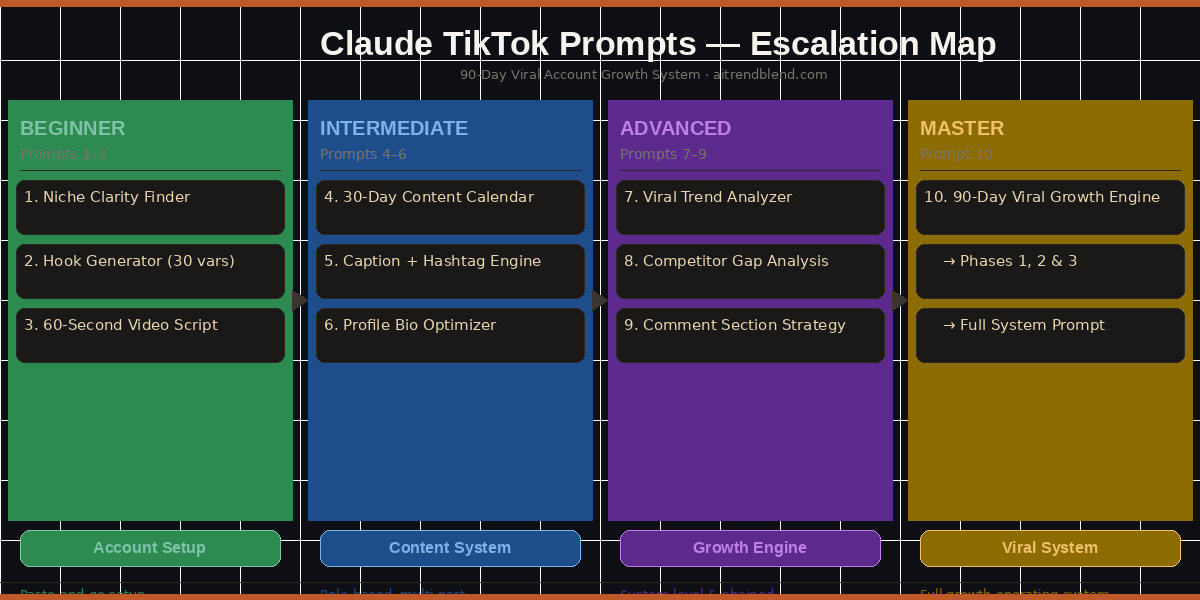
This guide gives you exactly 10 prompts, built to escalate from beginner-level setup tasks to a full 90-day viral growth engine by the end. Whether you are starting a brand new account from zero or trying to breathe life into a stalled one, these are the prompts that will save you hours of spinning your wheels.
Why Claude Handles TikTok Content Strategy Differently
Most AI tools will give you hashtags. Claude will give you a content architecture. That distinction matters more on TikTok than almost any other platform because TikTok rewards consistency, niche specificity, and audience retention signals — not just keyword stuffing in a caption. Claude’s ability to hold a large amount of context at once means you can feed it your niche, your target audience, your posting frequency, your current stats, and three competitor examples — and it synthesizes all of that into genuinely tailored advice rather than recycling a generic “post 3 times a day” framework.
Compared to ChatGPT for this specific use case, Claude tends to be more conservative about making things up. When you ask Claude to reason about what hook structure would work for a specific audience segment, it thinks through the psychology before giving you a list — which usually means the list is shorter but actually useful. Gemini has gotten better at real-time trend data, but Claude edges it out when you need long-form, structured thinking — like a 90-day content roadmap or a detailed competitor gap analysis. For TikTok strategy work that requires real depth, Claude is my first stop.
Claude’s large context window lets you give it your full TikTok situation — niche, audience, stats, competitors — all at once. The more context you pack in, the more specific and usable its output becomes. Generic prompts get generic answers.
One thing to understand going in: Claude does not have real-time access to TikTok’s trending audio or current hashtag data. You will need to bring those details yourself. But for strategy, scripting, hook writing, calendar planning, and psychology-led content angles — it is hard to beat.
Before You Start: How to Get the Best Results
A few setup habits will dramatically improve every prompt you run. First, use Claude Sonnet 4.5 or Opus 4.6 — not the older models. The older versions handle creative tasks fine, but for nuanced audience psychology and multi-step strategy work, the newer models are noticeably sharper. If you are on a free plan, Sonnet is your best accessible option.
Second, start every session with a context block. Before you paste any of the prompts below, drop in a short paragraph about your TikTok situation. Something like: “I am building a TikTok account focused on budget home renovation for first-time homeowners in the US. My account is 3 weeks old, I have 48 followers, and I post 4 times per week. My top-performing video got 3,200 views on a before/after tile floor reveal.” That two-sentence context block transforms every subsequent answer Claude gives you.
Third, use Claude’s Projects feature if you have access to it. Create a TikTok Growth project, paste your context block into the project instructions, and every conversation inside that project inherits your niche and account details automatically. This saves you from re-explaining yourself every session and keeps your strategy consistent across weeks of conversations.
Treat Claude like a new strategist on your team. Brief it properly at the start of every session — your niche, your target audience age and location, your weekly posting schedule, and your single best-performing video so far. Briefs that take 30 seconds to write save you hours of back-and-forth.
The 10 Best Claude Prompts for TikTok Viral Account Growth
Prompt 1: The Niche Clarity Finder
Most new TikTok accounts fail not because of bad content but because of fuzzy positioning. “Fitness” is not a niche. “15-minute workouts for women over 40 who hate the gym” is. The difference in audience retention, comment engagement, and follow-through rate is enormous — and most creators spend months figuring this out by trial and error. This prompt short-circuits that process entirely.
Use it before you post your first video or when you feel like your existing account is “all over the place.” Feed Claude your broad topic, your personal experience level, and the type of viewer you want to attract. What comes back is a breakdown of viable micro-niches with honest assessments of competition level and content longevity.
I want to build a viral TikTok account around [YOUR BROAD TOPIC].

My background: [DESCRIBE YOUR KNOWLEDGE OR EXPERIENCE IN 1-2 SENTENCES]
Target viewer: [AGE RANGE, LOCATION, MAIN PROBLEM OR INTEREST]
Posting capacity: [HOW MANY VIDEOS PER WEEK YOU CAN REALISTICALLY MAKE]

Please do the following:
1. Suggest 5 specific micro-niches within this topic that work well on TikTok in 2026
2. For each micro-niche, rate the competition level (low / medium / high) and content longevity (evergreen vs trend-dependent)
3. Identify which 2 micro-niches best match my background and posting capacity
4. Give me the single best "account positioning sentence" for each of those 2 — the one-line description that would go in my TikTok bio

# Be honest about which niches are overcrowded. I'd rather hear it now.
Prompt 2: The Hook Generator (30 Variations)
The hook — your video’s first 1.5 seconds — is the only thing standing between a scroll and a view. Every creator knows this, but most still write hooks like: “Today I am going to show you how to…” That phrase is a skip trigger. Viewers have been conditioned to swipe past anything that sounds like the start of a boring tutorial.
This prompt generates 30 hook variations for any video topic, sorted into five psychological categories. It does not just hand you lines — it explains the emotional mechanism behind each category so you understand which to reach for when.
I need 30 TikTok video hook variations for the following video topic:

Video topic: [DESCRIBE WHAT YOUR VIDEO IS ABOUT IN 1-2 SENTENCES]
My niche: [YOUR NICHE]
Target viewer: [WHO YOU ARE TALKING TO]

Please organize the hooks into 5 psychological categories:
1. Curiosity gap (makes them need to see the answer)
2. Relatability (makes them feel seen or understood)
3. Controversy or counter-intuitive claim
4. Shock or surprising statistic
5. Direct call-out (speaks directly to a specific person)

Give 6 hooks per category. Each hook should be under 10 words and designed to be spoken aloud on camera. Flag your top 3 overall with a ★ symbol.

# Avoid anything that starts with "Today I'm going to" or "In this video"
Prompt 3: The 60-Second Video Script
A lot of creators either script too tightly — ending up sounding robotic — or not at all, rambling past the viewer’s attention span. The sweet spot is a beat-by-beat outline that guides your delivery without scripting every word. This prompt produces exactly that: a structured 60-second script broken into timed sections with emotional cues.
Write a 60-second TikTok video script for the following:

Topic: [VIDEO TOPIC]
Hook I want to use: [PASTE YOUR CHOSEN HOOK HERE]
Key point I want to make: [THE ONE THING YOU WANT VIEWERS TO REMEMBER]
Call to action: [WHAT YOU WANT THEM TO DO AT THE END — FOLLOW, COMMENT, SHARE]
Tone: [CASUAL AND FUNNY / EDUCATIONAL AND CALM / ENERGETIC AND FAST-PACED]

Structure it in timed beats:
- 0–3 sec: Hook delivery
- 3–10 sec: Setup / context
- 10–40 sec: Main content (broken into 2-3 clear points)
- 40–55 sec: Payoff or reveal
- 55–60 sec: CTA

Write the actual spoken words for each beat, plus a [CAMERA/ACTION] note in brackets.
Keep sentences short. No filler words. This should feel natural when spoken aloud.

# Aim for 130-150 words total — the right length for 60 seconds at natural speaking pace
Prompt 4: The 30-Day Content Calendar
Consistency is non-negotiable in the first 90 days of TikTok growth — and the biggest enemy of consistency is running out of ideas mid-month. This prompt builds you a full 30-day content calendar with video ideas, formats, and posting days mapped out. It accounts for TikTok’s known engagement rhythms (weekday evenings and Sunday afternoons tend to outperform Saturday mornings) and mixes evergreen content with trend-reactive slots.
The intermediate escalation here is the role assignment: you are asking Claude to think like a content strategist familiar with your niche, not just a list generator. The output structure forces planning at the series level, not just individual videos.
Act as an experienced TikTok content strategist who specializes in growing accounts in the [YOUR NICHE] space.

Build me a 30-day TikTok content calendar with the following specs:
- Posting frequency: [X VIDEOS PER WEEK]
- Target audience: [DESCRIBE AUDIENCE]
- Content goal for this month: [BRAND AWARENESS / FOLLOWERS / ENGAGEMENT / SALES]
- My content strengths: [E.G. TALKING-HEAD VIDEOS, B-ROLL, TUTORIALS, STORYTELLING]

For each video slot, provide:
1. Video concept (1-2 sentences)
2. Content format (talking head / tutorial / POV / trend-based / storytelling / duet)
3. Hook idea (under 10 words)
4. Best posting day + time (based on 2026 TikTok engagement patterns)

Group the 30 days into 4 weekly themes that build on each other.
Add 4 "trend-reactive" slots with a placeholder note instead of a fixed idea.

# Make the calendar ambitious but realistic for a solo creator without a production team
Prompt 5: The Viral Caption and Hashtag Engine
Here is something most creators get backwards: the caption is not a description of your video. It is an extension of the hook — a second chance to pull people into the comments or save the video. Captions that end with a question or a polarizing statement consistently outperform descriptive ones, and the first line is truncated in the feed, so it has to do work immediately.
This prompt generates a caption system, not a one-off caption. You get three versions at different lengths and tones, plus a hashtag breakdown that separates high-reach tags from niche-specific ones — because mixing both is how you balance discoverability with community building.
You are a TikTok caption strategist. Write captions and hashtags for this video:

Video summary: [2-3 SENTENCE DESCRIPTION OF WHAT HAPPENS IN THE VIDEO]
My niche: [NICHE]
Target emotion I want the viewer to feel: [CURIOUS / INSPIRED / ENTERTAINED / VALIDATED]

Write 3 caption versions:
Version A — Short and punchy (under 100 characters, ends with a hook question)
Version B — Storytelling (150-200 characters, pulls them in with a mini narrative)
Version C — Bold opinion (under 120 characters, states a controversial or surprising take)

For each caption, show the first 60 characters separately — that is what appears before "...more" in the feed.

Then provide:
- 5 high-reach hashtags (over 500M posts) relevant to this video
- 7 mid-tier hashtags (10M–500M posts)
- 5 niche-specific hashtags (under 10M posts)
- Recommended hashtag count to use: # Tell me your honest recommendation based on 2026 TikTok algorithm behavior

# Never suggest fake or purchased hashtag strategies. Only organic growth approaches.
Prompt 6: The TikTok Profile Bio Optimizer
Your bio has roughly three seconds to convert a profile visitor into a follower. Most bios either say nothing useful (“just a girl sharing tips ✨”) or try to say too much and end up readable as a grocery list. The structure that consistently converts better is: who you help + what you help them do + one specific credibility signal or hook.
This prompt audits your existing bio and rewrites it five ways, each targeting a slightly different conversion mechanism. You also get profile picture and link-in-bio strategy as part of the package.
Act as a TikTok profile conversion specialist. Optimize my TikTok account profile.

My current bio: [PASTE YOUR CURRENT BIO — OR WRITE "I DON'T HAVE ONE YET"]
My niche: [NICHE]
My target follower: [WHO SHOULD HIT FOLLOW AND WHY]
My biggest credibility signal: [YOUR RELEVANT EXPERIENCE, RESULT, OR UNIQUE ANGLE]
My link-in-bio destination: [WEBSITE / NEWSLETTER / PRODUCT / LINKTREE / NONE]

Please:
1. Audit my current bio (if provided) — what is working, what is hurting conversions
2. Write 5 new bio versions, each under 80 characters:
   - Version 1: Authority-led (leads with credibility)
   - Version 2: Benefit-led (leads with what you give the viewer)
   - Version 3: Personality-led (leads with voice and tone)
   - Version 4: Niche call-out (directly targets your specific viewer)
   - Version 5: Curiosity-gap (makes them want to watch to understand)
3. Recommend the best username structure for my niche
4. Suggest a profile picture strategy (style, color, expression) that converts in my niche

# Bios must work at 80 characters max — TikTok truncates beyond that on mobile
“The difference between a TikTok account that grows and one that stalls usually isn’t the content quality — it is whether the creator has a coherent system behind the content.”
— aitrendblend editorial, March 2026
Prompt 7: The Viral Trend Angle Analyzer
Jumping on trends blindly is how you end up as noise. The accounts that consistently benefit from trending sounds and formats are the ones that find the non-obvious angle — the version of the trend their specific audience has not seen yet. That takes pattern recognition and lateral thinking, which is exactly what Claude is good at when you give it the right structure.
This is an advanced prompt because it involves a chained thought process: Claude first analyzes the trend mechanics, then maps them to your niche, then outputs a content brief. The system-level instruction at the start shapes the entire reasoning process.
You are a TikTok trend strategist. Your job is to help niche creators find non-obvious angles on viral trends.

Current trend I want to use: [DESCRIBE THE TREND — FORMAT, SOUND, CONCEPT, OR CHALLENGE]
My niche: [NICHE]
My audience: [WHO THEY ARE AND WHAT THEY CARE ABOUT]
What has already been done: [LIST 2-3 VERSIONS OF THIS TREND YOU'VE ALREADY SEEN IN YOUR NICHE]

Chain of reasoning I want you to follow:
Step 1 — Explain what psychological mechanism makes this trend work (why people watch and share it)
Step 2 — Identify the most saturated angle that creators in my niche are using right now
Step 3 — Find 3 underused angles that connect this trend's mechanism to my specific audience's pain points or desires
Step 4 — For the best underused angle, write a full video brief: hook, script outline, caption, and 3 hashtag suggestions

Constraint: The angle must be filmable by a solo creator with a phone and no production budget.

# Do not suggest angles that require real-time data or trending sounds — I will source the audio separately
Prompt 8: The Competitor Gap Analysis
One of the most underused TikTok growth techniques is studying what your top three competitors are NOT making. Every successful account in a niche leaves gaps — topics they avoid, formats they never use, audience questions they never address. Those gaps are your fastest path to differentiation. This prompt makes the gap analysis systematic instead of intuitive.
The advanced element here is the structured competitor profile format: you give Claude enough detail about each competitor that its analysis becomes specific rather than generic. The output is a prioritized list of content opportunities with rationale — not just a vague “try this” suggestion.
You are a TikTok competitive intelligence analyst. Help me find content gaps I can own.

My account niche: [YOUR NICHE]
My target audience: [AUDIENCE DESCRIPTION]

Competitor profiles (fill in what you know for each):

Competitor 1:
- Handle/description: [COMPETITOR 1 TIKTOK HANDLE OR TYPE OF ACCOUNT]
- Follower count: [APPROX]
- Content they post most: [FORMATS AND TOPICS]
- Their top-performing video type: [WHAT CONSISTENTLY GETS VIEWS]

Competitor 2:
- Handle/description: [COMPETITOR 2]
- Follower count: [APPROX]
- Content they post most: [FORMATS AND TOPICS]
- Their top-performing video type: [WHAT CONSISTENTLY GETS VIEWS]

Competitor 3:
- Handle/description: [COMPETITOR 3]
- Follower count: [APPROX]
- Content they post most: [FORMATS AND TOPICS]
- Their top-performing video type: [WHAT CONSISTENTLY GETS VIEWS]

Based on this, identify:
1. Topics these accounts systematically avoid (possible gaps)
2. Audience questions likely going unanswered in this niche
3. Formats none of them are using well
4. A "differentiation statement" I could own — one angle no one in this niche is clearly dominating

Prioritize by: ease of execution for a solo creator AND potential to drive follows (not just views).

# Be direct. If a gap exists but it is hard to monetize or sustains only short-term interest, flag it.
Prompt 9: The Comment Section Strategy Prompt
Most creators think about TikTok as a broadcasting platform. The accounts that grow fastest treat it as a two-way conversation — specifically, they engineer their comment sections. High comment volume is one of TikTok’s strongest engagement signals, and certain types of content reliably generate 10x more comments than others. This prompt builds you a comment-engineering strategy: content types, specific triggers to embed in your videos, and reply frameworks that keep conversations alive.
This is advanced because it operates at the system level — you are not writing one video, you are building an engagement architecture that every future video can plug into.
You are a TikTok engagement architect. Help me build a comment section strategy that boosts algorithmic reach.

My niche: [NICHE]
My audience: [DESCRIBE THEM — AGE, MAIN INTEREST, EMOTIONAL TRIGGERS]
My current average comments per video: [NUMBER OR "VERY FEW"]
My content format: [TALKING HEAD / TUTORIAL / STORYTELLING / POV]

Build me a complete comment strategy system:

1. Content types that generate the most comments in my niche (with reasoning for each)
2. 5 "comment trigger" lines I can embed naturally in my scripts — questions, polarizing statements, or fill-in-the-blank prompts that beg a response
3. 3 "reply frameworks" — patterns for responding to comments that re-engage the person AND attract secondary comments from others watching
4. A "comment-bait video" brief: a full concept for one video whose sole purpose is to ignite 100+ comments — include the hook, the controversy angle, and the trigger embedded in the video's last 5 seconds
5. What NOT to do — 3 comment strategy mistakes that tank engagement in my specific niche

# Avoid anything that feels manipulative or inauthentic — I want organic engagement, not tricks
Prompt 10: The 90-Day Viral Growth Engine (Master Prompt)
This is the one you run once at the start of your 90-day push and revisit at the 30 and 60-day marks. It integrates everything from the previous nine prompts: niche positioning, content architecture, hook strategy, engagement systems, trend-response plans, and a weekly review process. It is a system prompt in the truest sense — you are not asking Claude for a single deliverable. You are commissioning an entire growth operating manual for your account.
The master escalation here is the full context brief + phased structure + constraint injection all working together. Give Claude everything you have collected about your account, your audience, and your goals — and it will give you back a plan detailed enough to print and follow day by day.
You are a senior TikTok growth strategist. I am hiring you to build my complete 90-day viral account growth plan.

ACCOUNT CONTEXT:
- Niche: [YOUR NICHE]
- Current followers: [NUMBER]
- Account age: [HOW LONG THE ACCOUNT HAS EXISTED]
- Weekly posting capacity: [VIDEOS PER WEEK]
- My top performing video so far: [DESCRIBE IT AND ITS VIEW COUNT]
- My worst performing video: [DESCRIBE IT]
- My content strengths: [WHAT YOU ARE GOOD AT — ENERGY, EDUCATION, HUMOR, STORYTELLING]
- Resources: [PHONE ONLY / BASIC RING LIGHT / FULL SETUP — BE HONEST]
- 90-day follower goal: [YOUR TARGET]

BUILD ME:

PHASE 1 — Days 1–30: Foundation and Niche Authority
- Positioning strategy: the exact one-line angle I should own
- Content pillar structure (3-4 repeating themes that build recognition)
- Hook formula that works for my format and audience
- Posting schedule with day-of-week reasoning
- Weekly review checklist (what to measure every Sunday)

PHASE 2 — Days 31–60: Growth Engine
- Content pivot strategy based on Phase 1 data
- Collaboration and duet outreach template
- Engagement compounding tactics (comment section, lives, reply videos)
- One "breakout video" concept designed to hit 100K+ views based on my niche

PHASE 3 — Days 61–90: Viral Push
- High-frequency posting sprint plan
- Trend-reactive content framework
- Cross-platform amplification strategy (without abandoning TikTok focus)
- Monetization readiness checklist — what I need in place before I start earning

CONSTRAINTS:
- Solo creator, no team
- Zero paid promotion budget
- Must feel authentic to my niche, not manufactured
- I want loyal followers, not just viral views that don't convert

End with: the single most important habit I must protect for all 90 days.

# Be specific. I can handle honest feedback. Vague advice wastes both our time.
Common Mistakes and How to Fix Them When Prompting Claude for TikTok
The prompts above work — but they work significantly better when you avoid a handful of predictable pitfalls. The problem most people run into is not that Claude gives bad advice. It is that they give Claude too little to work with and then wonder why the output feels generic.
Mistake 1: The empty context prompt. Asking Claude “write me a TikTok hook about fitness” without any audience, tone, or niche context is the fastest way to get a completely useless response. Claude defaults to the middle — the broadest possible interpretation — when you leave context gaps. Fix it by always opening with a two-sentence brief about your niche and your viewer before the actual instruction.
Mistake 2: Accepting the first output. Claude’s first response to a creative prompt is rarely its best. It is a reasonable attempt. The second or third iteration — after you push back with “make the hook more polarizing” or “rewrite this for someone who already tried this and failed” — is consistently sharper. Treat every Claude output as a draft, not a deliverable.
Mistake 3: Asking for too many things in one prompt. Beginners often pack five requests into a single message hoping to save time. Claude handles multi-part prompts reasonably, but each additional request dilutes the quality of all responses. Run prompt 2 (hooks) separately from prompt 3 (script). Use the previous output as input for the next step — that sequential approach produces far better results than a bundled “do everything” request.
Mistake 4: Ignoring Claude’s limitations disclosure. When Claude says something like “I don’t have access to current TikTok trend data, but based on historical patterns…” — that caveat matters. Do not ignore it. For trend-sensitive decisions, supplement Claude’s reasoning with your own observation of what is currently blowing up on your FYP.
| Mistake | Wrong Approach | Right Approach |
|---|---|---|
| Empty context | “Write a TikTok hook about cooking.” | “Write 10 hooks for a video about 5-ingredient weeknight dinners for burnt-out parents of toddlers.” |
| Single iteration | Copy-pasting Claude’s first hook response directly into TikTok. | Asking Claude to regenerate with a specific adjustment: “Make 3 of these edgier and more polarizing.” |
| Bundled requests | “Write hooks, a script, captions, and hashtags for my video.” | One prompt per deliverable. Use previous outputs as context for the next step. |
| Ignoring caveats | Building a trend strategy on Claude’s output without checking if the trend is still active. | Using Claude for angle analysis and manually verifying trend freshness on your own FYP. |
| No real data | Asking for a 30-day calendar without sharing any performance history. | Sharing your top and worst videos, current follower count, and average view duration before requesting the calendar. |
What Claude Still Struggles With for TikTok Growth
Claude does not know what is trending on TikTok right now. This is the most important limitation to internalize and the one that trips people up most often. When you ask Claude what sounds are going viral this week or which hashtags are gaining momentum today, any specific answer it gives you is a hallucination — a plausible-sounding fabrication. Claude’s training data has a cutoff. It can reason about trend mechanics with genuine depth, but it cannot observe the current TikTok FYP. For real-time trend intelligence, you still need to spend time on the app itself, or use dedicated tools like TikTok’s own Creative Center or third-party trend trackers.
The other limitation worth knowing is audio strategy. A large portion of TikTok virality is driven by trending sounds and original audio — and Claude has no ability to listen to, recommend, or analyze audio content. When you need to decide between two trending sounds for your video, that judgment call stays entirely with you. What Claude can help with is the everything-else-except-the-audio layer: the hook, the script, the pacing, the caption, the strategy. That turns out to be a lot.
Finally, Claude is not a replacement for posting and iterating. There is no prompt in existence that substitutes for the real-time feedback loop of actually publishing, reading your analytics, and adjusting. The creators who grow fastest in 90 days use Claude to accelerate the strategy and scripting side — but they are also posting consistently and paying close attention to which specific elements their audience responds to. Think of Claude as your research and writing partner, not your autopilot.
Getting TikTok Growth Right — It Takes a System, Not Just Better Content
What you have in these ten prompts is not a cheat code — it is a systematic way to do the thinking that most creators skip. Niche clarity, hook architecture, content calendars, competitor gaps, comment engineering: these are the unsexy mechanics behind every TikTok account that looks like it grew “overnight.” Using Claude to work through them does not remove the creative work. It removes the procrastination and guesswork that usually sit between you and doing the creative work.
There is a deeper principle worth naming here. Good prompting — giving an AI tool the right context, constraints, and structure — is actually the same skill as good thinking. When you write a strong prompt for Claude, you are forced to articulate your audience clearly, your goals specifically, and your constraints honestly. That clarity, even before Claude responds, is useful. The creators who get the most from these prompts are the ones who spend real time writing the context blocks, not the ones who paste placeholders and hit enter.
That said, some of the most important decisions in your TikTok journey still require human judgment. The specific sound you pick, the energy you bring to camera, the split-second call on whether to keep or cut a moment — these are things no AI touches. Claude helps you show up prepared. What happens after you press record is still entirely yours.
TikTok’s algorithm will keep evolving through 2026 and beyond, and so will Claude’s capabilities. The prompts here are built around principles — audience specificity, hook psychology, strategic consistency — that survive platform updates better than any tactical list of hashtags. Start with Prompt 1, work through the system as your account grows, and come back to Prompt 10 every 30 days to recalibrate. Ninety days from now, you will be looking at a different account.
Try These Prompts Right Now
Open Claude and paste your first prompt in the next five minutes. The fastest way to grow is to start before you feel fully ready.