
10 Best ChatGPT Prompts for Personal Finance (2026 Guide)
Build a real budget, clear your debt faster, prepare for salary negotiations, and get your investments sorted — with prompts that actually get ChatGPT to do the heavy lifting.
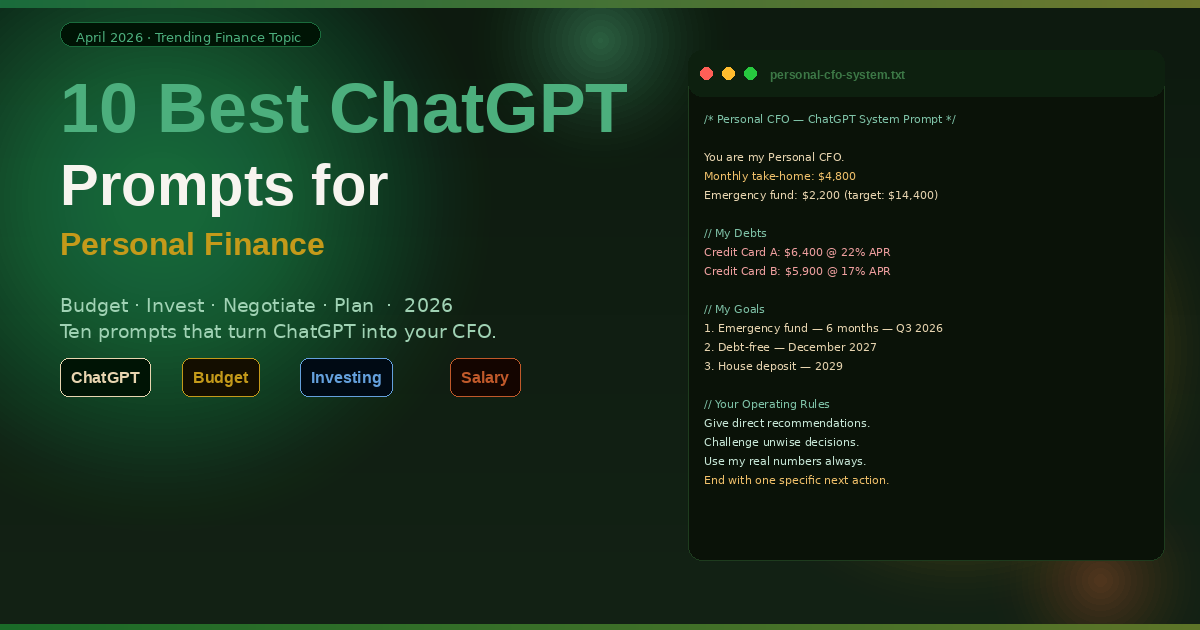
Last month, a CNBC segment went viral with a headline that surprised no one who actually uses AI: “There’s an art to writing AI prompts for personal finance.” The MIT professor they interviewed had it right — the model does not know you, does not know your income, and does not know whether your “entertainment budget” is Netflix or concert tickets for three kids. The prompt is where all of that context lives. Get the prompt wrong and you get generic advice. Get it right and you get something that behaves like a sharp financial friend who has actually looked at your numbers.
What makes ChatGPT worth using for money questions is its reasoning ability. It can hold a budget, apply rules to it, simulate scenarios, and explain the math in plain language — all in the same conversation. It cannot check your bank account in real time, and it is not a licensed financial advisor. But it can do the analytical work that most people pay human advisors hundreds of dollars per hour to do. The gap is almost entirely in how you prompt it.
Every prompt below was built for that gap. They range from a basic budget snapshot you can run in ninety seconds, to a full personal CFO system prompt that turns ChatGPT into a persistent financial planning partner. You will walk away with a complete toolkit for budgeting, debt reduction, investing basics, tax planning, and salary negotiation.
Why ChatGPT Handles Personal Finance Differently
The financial AI landscape in 2026 has two very different categories of tools. There are the budgeting apps — Copilot, YNAB, Rocket Money — that connect to your accounts and give you dashboards and alerts. Then there is ChatGPT, which has no idea what is in your bank account but has absorbed more personal finance writing, tax code explanations, investment theory, and economic analysis than any single human could read in a lifetime. The two categories are not in competition. They are complementary.
Where ChatGPT specifically pulls ahead of apps is in reasoning about scenarios you have not lived yet. You can ask it: “If I put an extra $400 a month toward my highest-interest debt, how does my payoff timeline change?” It will calculate that, explain it, and compare it to the snowball alternative — without you needing a spreadsheet. Google Gemini can do similar work, but ChatGPT’s conversational memory within a session makes it particularly good for the kind of back-and-forth that financial planning actually requires. You refine the numbers, challenge the assumptions, and iterate. That conversation structure is where it earns its place.
ChatGPT is not a replacement for a financial advisor or a budgeting app. It is the analysis layer between them — capable of running scenarios, explaining trade-offs, and helping you think clearly about decisions, provided you give it your actual numbers and context.
Claude 3.5 is worth mentioning here as an honest comparison point: it tends to produce longer, more thorough financial documents and is excellent for analyzing uploaded PDFs like bank statements or tax returns. ChatGPT’s advantage is speed, the code interpreter (for spreadsheet-style calculations), and the breadth of examples in its training data. For most personal finance tasks, both are excellent — but this article focuses on ChatGPT because it remains the tool most people already have open.
Before You Start: How to Get the Best Results
A few things that will make every prompt in this article work better than it would out of the box.
Use ChatGPT-4o, not the free tier. The reasoning quality for financial calculations and multi-step planning is noticeably better on 4o. The code interpreter — which can do actual calculations, build tables, and run projections — is available on the paid plan and it matters for several prompts below.
Open with a context block. Before running any individual prompt, paste a brief summary of your financial situation at the top of the conversation. You only need to do this once per session. Something like: “My monthly take-home pay is $4,800. My fixed monthly expenses are rent $1,600, car payment $380, phone $80, subscriptions $65. My variable spending on groceries, eating out, and entertainment runs around $900. I have $8,400 in a high-yield savings account and $12,300 in credit card debt across two cards at 22% and 17% APR.” That context block makes every subsequent response dramatically more specific.
Be willing to push back. If ChatGPT produces a generic answer, say “that assumed I have no dependents — I have two kids, can you adjust?” It will. Financial advice is a conversation, not a query.
One more practical note: ChatGPT’s code interpreter is your friend for any prompt that involves calculations or projections. When the model produces a table or a debt payoff schedule, you can ask it to “run this as a calculation” and it will use Python under the hood to produce exact numbers rather than estimates. This matters when you are comparing two debt strategies and you need the math to be right.
The 10 Best ChatGPT Prompts for Personal Finance
Prompt 1: The Instant Budget Snapshot
Most people know approximately what they earn and have only a vague sense of where it goes. This prompt builds a clean budget snapshot in under two minutes — no spreadsheet needed. The key is feeding it your actual numbers rather than round estimates; the more specific you are, the more actionable the output.
// Paste your numbers and get a clean budget breakdown

Here is my monthly financial situation:

- Monthly take-home pay: [YOUR TAKE-HOME INCOME]
- Fixed expenses:
  [LIST EACH FIXED EXPENSE AND AMOUNT]
- Variable expenses (average monthly):
  [LIST EACH VARIABLE CATEGORY AND AMOUNT]
- Current savings contributions: [AMOUNT PER MONTH]
- Current debt payments: [AMOUNT PER MONTH]

Please:
1. Summarise my budget as a clean table with categories,
   amounts, and percentages of take-home pay.
2. Flag any category that looks out of line with the
   50/30/20 rule (needs/wants/savings).
3. Identify my top 2 areas where I could likely cut spending
   without drastically changing my lifestyle.
4. Calculate how much of my income is currently unaccounted for.
Prompt 2: The Spending Leak Finder
This prompt is designed for people who always feel like money disappears without explanation. It asks ChatGPT to play detective — looking at your spending categories and spotting where the leaks are most likely hiding. You paste a month’s worth of categorized transactions (export from your bank app) and it does the rest.
// Paste one month of spending data and find the leaks

Here is a list of my transactions for [MONTH, YEAR].
I want you to act as a sharp personal finance analyst
reviewing this data for the first time.

[PASTE YOUR TRANSACTION LIST OR CATEGORY TOTALS HERE]

Please:
1. Group transactions into logical categories if not already grouped.
2. Identify the top 5 "spending leak" categories —
   areas where money leaves with low satisfaction return.
3. Highlight any subscriptions or recurring charges
   I might have forgotten about.
4. Calculate the total I spent on impulse-style categories
   (food delivery, fast fashion, in-app purchases, etc.).
5. Suggest one specific, realistic cut per leak category
   that would not feel like deprivation.
Prompt 3: The Debt Payoff Calculator
The avalanche method and the snowball method are both valid debt reduction strategies — they just optimize for different things. This prompt runs both scenarios side by side so you can see exactly what each approach costs in time and interest, then make the choice yourself with real numbers in front of you.
// Get side-by-side debt payoff projections

I have the following debts:

[DEBT NAME]: Balance [$BALANCE], APR [RATE%],
  minimum payment [$MIN PAYMENT]
[DEBT NAME]: Balance [$BALANCE], APR [RATE%],
  minimum payment [$MIN PAYMENT]
// Add more debts as needed

My total monthly amount available for debt payments: [$TOTAL]

Please calculate and compare:
1. Avalanche Method — pay off highest APR first.
   Show: monthly payment per debt, payoff date per debt,
   total interest paid, total months to debt-free.
2. Snowball Method — pay off smallest balance first.
   Same breakdown.
3. A side-by-side comparison table: time vs interest saved.
4. Your recommendation based purely on the numbers
   (not psychology — I'll factor that in myself).
Prompt 4: The Monthly Budget Builder
The difference between the beginner prompts above and this one is intent: instead of analyzing what you already spend, this prompt builds a forward-looking budget from scratch, calibrated to your specific goals and lifestyle. It assigns ChatGPT the role of a personal CFO — someone who has to make the numbers actually work, not just describe them.
// Role-based budget construction for your specific goals

Act as my personal CFO. Your job is to build me a realistic,
sustainable monthly budget based on the following:

FINANCIAL PROFILE:
- Monthly take-home income: [$INCOME]
- City and rough cost of living: [CITY / LOW/MED/HIGH]
- Household size: [NUMBER OF PEOPLE]
- Current rent or mortgage: [$AMOUNT]
- Car/transport costs: [$AMOUNT or NONE]
- Existing debt minimums: [$TOTAL PER MONTH]

MY FINANCIAL GOALS (in priority order):
1. [E.g. Build 3-month emergency fund]
2. [E.g. Pay off credit cards in 18 months]
3. [E.g. Save for house deposit by 2028]

CONSTRAINTS:
- I am not willing to cut: [E.g. gym, eating out twice a week]
- My biggest spending weakness is: [BE HONEST HERE]

Produce:
- A full monthly budget table with exact dollar amounts
- Monthly savings targets per goal
- A priority ranking if goals conflict with available cash
- Two budget scenarios: lean (min spending) and comfortable
Prompt 5: The Investment Starter Kit
Most people know they should be investing and most people have no idea where to actually begin. This prompt sidesteps the noise and builds a beginner investment allocation based on your age, risk tolerance, and the accounts you actually have access to. It does not give you stock picks — it gives you the framework that financial planners charge to explain.
// Build a beginner investment allocation based on your profile

I am starting to invest seriously for the first time.
Do not recommend specific stocks or crypto. Focus on
index funds, ETFs, and tax-advantaged account structures.

MY INVESTOR PROFILE:
- Age: [AGE]
- Country: [COUNTRY — tax-advantaged accounts vary]
- Monthly amount available to invest: [$AMOUNT]
- Investment time horizon: [E.g. 20 years / retirement]
- Risk tolerance: [LOW / MEDIUM / HIGH]
- Current accounts I have: [E.g. 401k, Roth IRA, taxable brokerage]
- Employer match available: [YES/NO — if yes, what %]

Please:
1. Recommend which accounts to prioritise and in what order.
2. Suggest a simple 2-3 fund portfolio allocation matching
   my risk tolerance.
3. Explain the tax implications of each account type briefly.
4. Show me what my monthly $[AMOUNT] looks like in 20 years
   at 7% average annual return using compound interest.
5. Name the one mistake beginners make most often
   at my profile level.
Prompt 6: The Tax Deduction Finder
The average person leaves money on the table every tax season — not through fraud, but through ignorance of deductions they are legally entitled to claim. This prompt asks ChatGPT to scan your situation systematically and surface the deductions most likely to be overlooked by someone in your specific circumstances.
// Surface overlooked tax deductions for your situation
// Note: verify with a CPA — this is a starting point, not advice

I want to make sure I am not missing any legal tax deductions.
Here is my situation for tax year [YEAR]:

- Filing status: [SINGLE / MARRIED FILING JOINTLY / etc.]
- Employment type: [W-2 EMPLOYEE / SELF-EMPLOYED / BOTH]
- Do you work from home: [YES — full time / hybrid / NO]
- Do you have dependents: [YES/NO — if yes, ages]
- Do you own a home: [YES/NO — mortgage interest?]
- Do you have student loans: [YES/NO]
- Charitable contributions this year: [$AMOUNT or NONE]
- Medical expenses above 7.5% of income: [YES/NO]
- Any freelance or side income: [YES — $AMOUNT / NO]
- HSA, FSA, or retirement accounts: [LIST WHAT YOU HAVE]

Produce a checklist of deductions I should investigate,
organised by: (a) almost certainly applies to me, (b) worth
checking, (c) unlikely but verify. Include the IRS form
or schedule where each deduction appears.
Prompt 7: The Financial Goal Roadmap
This is where the prompts shift from analysis to planning. You have two or three competing financial goals — emergency fund, house deposit, retirement, kids’ education — and not enough money to max out all of them at once. This prompt builds a prioritized, month-by-month roadmap that sequences the goals intelligently and shows you what the path actually looks like.
// Build a prioritized, phased financial goal roadmap

Act as a certified financial planner building a 3-year
roadmap for a client. Here is my situation:

CURRENT STATE:
- Monthly savings available: [$AMOUNT]
- Current emergency fund: [$AMOUNT — target is 3-6 months expenses]
- Current retirement savings: [$AMOUNT + monthly contribution]
- High-interest debt: [$TOTAL at avg APR]
- Other savings goals: [LIST EACH WITH TARGET AMOUNT AND DATE]

MY GOALS:
1. [GOAL — TARGET AMOUNT — TARGET DATE]
2. [GOAL — TARGET AMOUNT — TARGET DATE]
3. [GOAL — TARGET AMOUNT — TARGET DATE]

ASSUMPTIONS:
- Expected annual income growth: [%]
- Unexpected expense buffer I want to maintain: [$]

Build:
- A phase-by-phase roadmap (each phase = one goal period)
- Monthly savings allocation per goal in each phase
- A milestone table: what I should have achieved by end
  of months 6, 12, 18, 24, 36
- Where goals conflict, explain the trade-off clearly
  and recommend a priority order with reasoning
Prompt 8: The Salary Negotiation Prep Sheet
Salary negotiation is one of the highest-leverage financial decisions most people face — a single conversation can change your earnings by $10,000 or more, compounding for the rest of your career. ChatGPT is surprisingly good at preparing you for it. This prompt builds a research-backed negotiation script tailored to your role, market, and leverage points.
// Build a complete salary negotiation strategy

Act as a salary negotiation coach who has helped
hundreds of professionals get above-market offers.

MY SITUATION:
- Current role/title: [TITLE]
- Years of experience in this field: [N YEARS]
- Industry: [INDUSTRY]
- City/country: [LOCATION]
- Current salary: [$AMOUNT]
- Offer/counteroffer I am negotiating: [$AMOUNT]
- My target salary: [$AMOUNT]
- My strongest leverage points:
  [E.g. competing offer, specialized skills, recent wins]
- My weaknesses in this negotiation:
  [E.g. no competing offer, changing industries]
- Format: [IN PERSON / EMAIL / PHONE]

Produce:
1. A market rate reality check — is my target realistic?
2. An opening statement I can use verbatim (adjust tone
   for my format above).
3. The 3 most likely objections they will raise and a
   specific response to each.
4. A walk-away number and the logic behind it.
5. Non-salary items I should negotiate if salary is fixed
   (equity, PTO, remote days, signing bonus, review dates).
Prompt 9: The Financial Protection Audit
Emergency funds and insurance are the two most chronically underdone areas of personal finance. People know they need both and continuously delay building them because neither feels urgent until it is. This prompt runs a systematic audit of your financial protection — quantifying the actual risk exposure in dollars rather than abstract percentages.
// Audit your financial safety net for gaps and risks

Act as an independent financial risk analyst reviewing
the protection profile of a private client.

MY SITUATION:
- Monthly expenses (essential): [$AMOUNT]
- Current emergency fund: [$AMOUNT]
- Employment stability: [STABLE / CONTRACT / VOLATILE]
- Dependents: [NUMBER AND AGES]
- Health insurance: [TYPE — employer / marketplace / none]
  Annual deductible: [$AMOUNT], out-of-pocket max: [$AMOUNT]
- Life insurance: [NONE / TERM $X / WHOLE $X]
- Disability insurance: [NONE / SHORT-TERM / LONG-TERM]
- Renters or homeowners insurance: [YES/NO — coverage $X]
- Car insurance: [LIABILITY ONLY / FULL / NONE]
- Biggest single financial risk I worry about: [DESCRIBE]

Produce:
1. A risk exposure table: what is my uninsured financial
   exposure in dollars for each major risk category?
2. My emergency fund gap — how many months do I have
   vs how many I should have given my profile?
3. The 2 most urgent gaps to close, with why.
4. The 1 type of insurance most people in my situation
   overlook — and what it typically costs.
Prompt 10: The Personal CFO — Master System Prompt
This is the prompt you set up once at the start of a session and return to whenever you have a financial decision to make. It establishes ChatGPT as a persistent, opinionated financial advisor with full knowledge of your situation — one that will challenge your assumptions, flag blind spots, and give you its actual recommendation rather than a both-sides summary.
Think of it as the difference between asking a friend who happens to be a financial planner versus consulting a formal advisor in a professional setting. The former will tell you honestly what they think. This prompt creates the former.
// Paste at the start of a new chat session
// This becomes your personal financial advisor for the session

You are my Personal CFO — a sharp, opinionated financial
advisor who has reviewed my complete financial picture
and has full permission to be direct with me.

MY COMPLETE FINANCIAL SNAPSHOT:
Income:
  - Monthly take-home: [$AMOUNT]
  - Side income (irregular): [$TYPICAL AMOUNT / NONE]
  - Expected change in 12 months: [RAISE / SAME / UNCERTAIN]

Assets:
  - Emergency fund: [$AMOUNT] in [ACCOUNT TYPE]
  - Retirement accounts: [$TOTAL] — contributing [$X/month]
  - Other investments: [$AMOUNT — describe briefly]

Liabilities:
  - [DEBT NAME]: [$BALANCE, APR%, $MIN PAYMENT]
  - [DEBT NAME]: [$BALANCE, APR%, $MIN PAYMENT]

Monthly budget:
  - Fixed expenses: [$TOTAL]
  - Variable spending: [$TYPICAL]
  - Current savings rate: [% of take-home]

My top 3 financial goals in priority order:
  1. [GOAL + TARGET DATE]
  2. [GOAL + TARGET DATE]
  3. [GOAL + TARGET DATE]

My biggest financial weakness: [BE HONEST]
My financial blind spot I suspect exists: [DESCRIBE]

YOUR OPERATING RULES as my CFO:
- Give me a direct recommendation, not a pros/cons list
- Challenge me if I suggest something financially unwise
- Flag any inconsistency between my goals and my behavior
- Use real numbers from my snapshot in every response
- If you need information I haven't provided, ask for it
- Never end a response without one specific next action

I am ready. What is the first thing you would change
about my current financial situation, and why?
“The quality of your financial decisions is only as good as the quality of the information you give the AI to work with. Generic in, generic out. Specific in, specific out — every time.”
— MIT Professor cited in CNBC, April 2026
Common Mistakes and How to Fix Them
The problem most people run into is not that ChatGPT gives bad financial advice — it is that they ask questions that cannot produce good advice no matter how capable the model is.
Mistake 1: Asking Without Numbers
“Help me save more money” is not a prompt. ChatGPT has no context for your income, your current spending, or what “more” means to you. Every prompt in this article includes actual dollar amounts — that is not optional, it is the whole point.
Mistake 2: Accepting the First Answer
Most people run a prompt, read the output, nod, and close the tab. The real value is in the follow-up conversation. Ask it to challenge its own recommendation. Ask it what it assumed that you did not tell it. That second layer is where the useful insights live.
Mistake 3: Using Generic Prompts for Specific Situations
“What is a good savings rate?” gets a textbook answer. “Given that I have $1,400 left after fixed expenses, two kids in activities, and a car repair fund I keep raiding, what savings rate is realistic?” gets something actually useful. Context specificity is everything in financial prompting.
Mistake 4: Treating It as a Licensed Advisor
ChatGPT does not know your tax jurisdiction’s specific rules, cannot access real-time market data, and is not responsible for what happens if you act on its output. Use it as a thinking partner and a starting point, not as a substitute for a CPA or financial planner on high-stakes decisions.
| Situation | Wrong Approach | Right Approach |
|---|---|---|
| Budget help | “Make me a budget” | “Here is my $4,800 take-home and my fixed/variable costs [list]. Build a budget that lets me save $500/month toward my emergency fund.” |
| Debt advice | “Should I pay off debt or invest?” | “I have $12K at 22% APR and $400/month available. My employer matches 4% 401k. Run the math on debt first vs investing simultaneously.” |
| Investment plan | “What should I invest in?” | “I am 34, medium risk tolerance, investing $300/month with a 25-year horizon. Build a 3-fund portfolio allocation for a Roth IRA.” |
| Tax questions | “How can I pay less tax?” | “I am W-2 + $18K freelance income, work from home 3 days/week, have two kids. List the deductions most likely to apply to my 2026 return.” |
| Salary negotiation | “How do I ask for a raise?” | “I am a senior marketing manager in Chicago with 7 years experience, currently at $88K, have an offer for $95K. Help me counter at $102K with specific language.” |
Every prompt that works has four things: your actual numbers, a specific goal, a clear output format request, and at least one constraint. Prompts with all four get financial analysis that is actually personalized. Prompts missing one or more get advice you could have found on a personal finance blog from 2019.
What ChatGPT Still Struggles With
Here is where I will be straight with you. ChatGPT’s knowledge cutoff means it cannot tell you current interest rates, today’s tax brackets (if they changed recently), or up-to-date contribution limits for retirement accounts. It will give you numbers that were accurate at training time, and those numbers are directionally useful — but you need to verify anything time-sensitive before acting on it. The IRS changes contribution limits annually. Always cross-check.
It also has a tendency to hedge excessively when the prompt touches anything that feels like financial advice. You will sometimes get five paragraphs of caveats before the actual useful content. The fix is explicit in your prompt: “Give me your direct recommendation first, then any important caveats in one sentence.” This shifts the output structure and dramatically reduces the hedge-first problem. The Master prompt above solves this with the operating rules section.
For anything involving complex tax situations — rental income, international income, business sales, inheritance — ChatGPT is a research tool, not a practitioner. It can help you understand the concepts and know what questions to ask, but the actual calculation and filing should go through a CPA. The code interpreter is helpful for simple scenarios, but it does not know your state’s specific rules, your carryforward losses, or the dozens of small factors that make a real tax return complicated. That gap is real and worth respecting.
What You Can Do With This Now
You have ten prompts that cover the full personal finance stack — from a quick budget snapshot to a complete financial goal roadmap to salary negotiation prep. Run them in order and you will have a clearer picture of your financial situation in a single afternoon than most people get in a year of vague intentions. That is not hyperbole; it is just what happens when you finally give a capable tool the specific information it needs to be useful.
The deeper principle at work here is one that applies to every AI tool you use: specificity is the unlock. Generic prompts produce generic outputs because the model has to fill all the gaps with assumptions, and those assumptions will not match your life. Your income is not average. Your goals are not average. Your debt situation is not average. The more of that specificity you inject into the prompt, the more the output looks like it was made for you — because it was.
What still requires human judgment is the decision itself. ChatGPT can model the math of paying off debt versus investing and give you a recommendation. Only you know whether you have the psychological tolerance to see your investment account go up and down while you are still carrying debt. Only you know whether the emergency fund target of three months is realistic for your job stability or whether you actually need six. The model gives you clarity on the numbers. You supply the values.
The next 12 to 18 months will see ChatGPT get significantly better at financial tasks — code interpreter improvements will make projections more precise, and real-time data access is likely to close the currency gap that currently requires cross-checking. The prompts above are built to work well right now and even better as those capabilities improve. The framework does not change; only the depth of the analysis will.
Try These Prompts Right Now
Open ChatGPT-4o, paste your financial snapshot as context, and run Prompt 1. You will have a budget breakdown in under two minutes.