Multimodal AI in 2026: ChatGPT 5.5, Claude Opus 4.7 & Gemini Pro 3.1 Compared
Priya had three things open on her screen: a 90-minute product strategy video, a 180-page market research PDF, and a spreadsheet of competitor pricing data. Her deadline was in two hours. Three months ago she would have spent those two hours manually cross-referencing all three. Instead she opened her multimodal AI, attached all three files, typed one question, and got a synthesis that would have taken a human analyst half a day. Then she asked a follow-up in plain speech. The answer came back in seconds. The question in 2026 is not whether AI can handle multiple modalities — all three frontier models can. The question is which one handles your specific combination of modalities better, and why the answer genuinely differs.
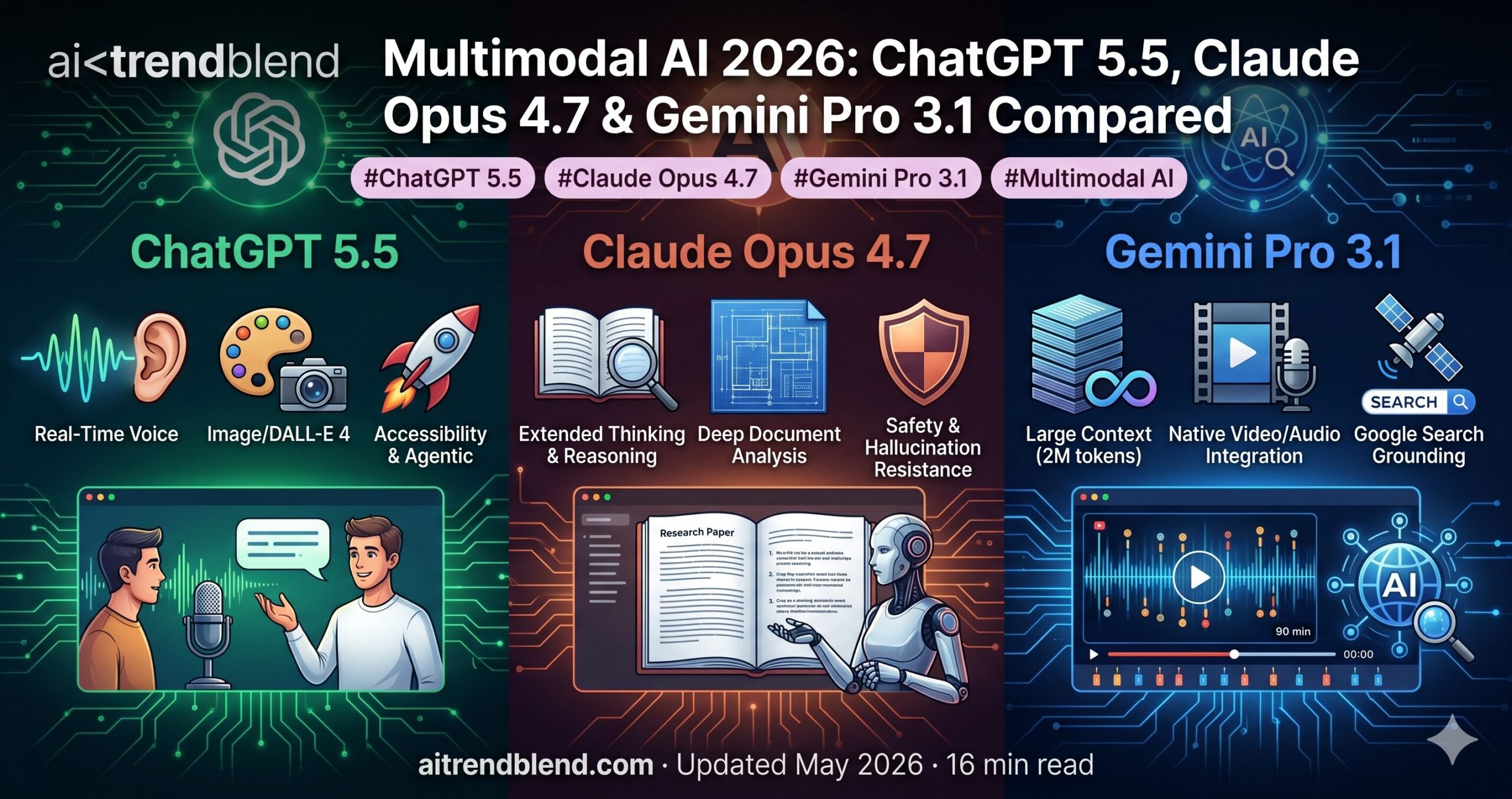
ChatGPT 5.5, Claude Opus 4.7, and Gemini Pro 3.1 are three philosophically different bets on what a multimodal AI assistant should be. OpenAI built ChatGPT 5.5 around breadth — the widest possible surface area of modality coverage, from real-time voice conversation to image generation to live video analysis, wrapped in the most accessible consumer interface in the industry. Anthropic built Opus 4.7 around depth — a model engineered for rigorous long-form reasoning across complex documents, with an extended thinking mode that shows its work and a safety architecture that actively resists manipulation. Google built Gemini Pro 3.1 around integration — native multimodality baked in at the training level, with context windows that dwarf the competition and deep hooks into Google’s data infrastructure, from Search to YouTube to Workspace.
None of these is the objectively best model. They each win on different tasks, in different workflows, for different users. This article tests all three across ten genuine multimodal tasks — from dropping a blurry screenshot into a chat window to orchestrating a fully automated research-to-report pipeline. For each task you will see exactly what to prompt, how each model approaches it differently, and which one earns the recommendation. By the end, you will have a clear map of which model to reach for and when.
Why Multimodal AI Is Where the Real Competition Is in 2026
The pure text benchmark wars of 2023 and 2024 are largely over. All three frontier models score within a few percentage points of each other on MMLU, HumanEval, and the standard reasoning benchmarks. The differentiation has moved to the much harder problem of integrating multiple input types coherently in a single inference — processing the image, the audio, the document, and the context simultaneously rather than treating each as a separate query to a separate model.
This matters because almost every high-value professional task involves multiple modalities. A financial analyst reviewing an earnings call simultaneously processes the audio, the slide deck, and the transcript. A product designer working on UI feedback needs to interpret screenshots alongside user research text. A physician reviewing a case integrates imaging, lab results, and clinical notes. The AI that handles all three coherently — not just each one individually — is the AI that earns a permanent place in those workflows. That is the competition in 2026, and the gap between the three models on multimodal integration is far larger than on text alone.
By 2026, text performance has converged across frontier models. The meaningful differences between ChatGPT 5.5, Claude Opus 4.7, and Gemini Pro 3.1 live in multimodal integration — how they handle the combination of modalities, not each modality in isolation. Choosing the right model for the right task can cut a complex workflow from hours to minutes.
The three models also differ significantly in their philosophical approach to what a multimodal AI should do. ChatGPT 5.5 leans into generation — it not only analyzes images but creates them, not only transcribes audio but speaks back, not only reads code but runs it. Claude Opus 4.7 leans into analysis — its extended thinking mode produces step-by-step reasoning chains that make it the most auditable model for high-stakes decisions, and its handling of dense technical documents is notably more careful than the others. Gemini Pro 3.1 leans into scale — its context window is the largest of the three, its native video processing handles continuous footage rather than sampled frames, and its grounding in Google Search data gives it a live information advantage that neither competitor has matched.
The Three Models at a Glance
Modalities in: Text, image, audio (real-time), video, files, code execution
Modalities out: Text, voice, images (DALL-E 4), code
Key strength: Broadest modality coverage; real-time voice; largest plugin/tool ecosystem
Best for: Voice-first workflows, creative tasks, broad consumer use cases, agentic browsing
API access: OpenAI API, Azure OpenAI
Modalities in: Text, image, documents (PDF/DOCX), code, computer use
Modalities out: Text, code, structured artifacts
Key strength: Extended thinking mode; deep document reasoning; safety; computer use
Best for: Complex analysis, long-document synthesis, auditable reasoning, enterprise compliance
API access: Anthropic API, AWS Bedrock, Google Cloud Vertex AI
Modalities in: Text, image, audio, video (native), documents, code, real-time Search
Modalities out: Text, code, images (Imagen 4), audio
Key strength: Largest context; native video/audio understanding; Google Search grounding
Best for: Massive document sets, continuous video analysis, research with live data, Google Workspace
API access: Google AI Studio, Vertex AI
Before You Start: The Multimodal Modality Matrix
The most common mistake when picking a multimodal model is confusing “supports images” with “handles my specific multimodal workflow.” All three models support images. The meaningful differences are in how they handle the combination of modalities, the quality of their reasoning across the boundary between input types, and the maximum scale at which they can operate.
The pricing context matters too. Claude Opus 4.7 is the most expensive of the three at the API level — it is Anthropic’s most capable model and priced accordingly. ChatGPT 5.5 sits in the middle tier; the o4 reasoning variant costs more per token. Gemini Pro 3.1 offers the best value for large-context tasks, and its free-tier access via Google AI Studio makes it the most accessible for experimentation. For high-stakes enterprise work where reasoning quality and auditability matter, Opus 4.7’s premium is typically justified. For high-volume multimodal tasks at scale, Gemini Pro 3.1’s cost-per-context-token advantage compounds significantly.
10 Multimodal Tasks — Compared Across All Three Models
Task 1: Analyzing a Business Document with Embedded Charts
The most common multimodal task in professional life is also the most straightforward: take a document — a PDF report, a market analysis, a financial filing — that contains both text and visual elements (charts, tables, infographics) and extract actionable insight. The challenge is that most models process document text and embedded images separately, sometimes missing the relationship between a chart and the paragraph it illustrates.
Prompt (identical for all three models): "I've attached our Q1 2026 investor report (PDF, 47 pages). It contains quarterly revenue charts on pages 8 and 14, a competitor comparison table on page 22, and written commentary throughout. Summarise the three most important strategic insights, citing both the written analysis and the specific chart data that supports each insight. Flag any contradiction between what the charts show and what the text claims." ChatGPT 5.5: → Processes PDF via document analysis tool. Extracts text cleanly. Chart interpretation is good for bar and line charts but occasionally misreads complex multi-axis charts. Contradictions flagged inconsistently — may miss subtle discrepancies between text and visual data. Output: well-structured, readable. Generally confident even when chart data is ambiguous. Claude Opus 4.7: → Extended thinking mode engages automatically on complex documents. Cross-references chart data against textual claims explicitly — most reliable at flagging contradictions. Cites specific page numbers and figure labels. Acknowledges uncertainty when chart resolution is low. Output: more cautious and precise; may note "the chart is partially unclear — the trend appears X but verify against source data." Best for high-stakes document review. Gemini Pro 3.1: → Handles the 47-page PDF within a fraction of its 2M context. Fast extraction. Good chart interpretation, particularly for Google Sheets-style data tables. Less likely than Claude to explicitly flag text-chart contradictions. Stronger at pulling in external context (e.g., comparing your Q1 figures against industry benchmarks via Search grounding).VerdictClaude Opus 4.7 for high-stakes document review where contradiction detection and explicit uncertainty acknowledgement matter. Gemini Pro 3.1 for very large document sets (>100 pages) or when external benchmarking context adds value. ChatGPT 5.5 is capable but less rigorous on the contradiction-detection requirement specifically.
Why It Works: Claude’s extended thinking mode forces the model to explicitly compare claims before committing to a summary — a structural advantage for contradiction detection. Gemini’s context window advantage means it never needs to chunk a large document, which eliminates the cross-chunk coherence failures that truncated contexts introduce.
How to Adapt It: For legal document review — contracts, compliance filings, regulatory submissions — specify “highlight any clause that contradicts or qualifies the claims made in Section [X]” to direct all three models toward the specific contradiction-finding behavior Claude does automatically in extended thinking mode.
Task 2: Screenshot to Working Code
A designer sends you a mockup image. A client shares a screenshot of a UI they want replicated. A developer photographs a whiteboard diagram of a system architecture. Converting a visual into functional code is one of the highest-value daily multimodal tasks in software development — and the quality gap between models is significant enough to meaningfully change how long the task takes.
Prompt (with UI screenshot attached): "This is a screenshot of a pricing page design. Build this as a responsive HTML/CSS/JS page. Match the typography, color scheme, spacing, and component layout as closely as possible. The three pricing cards should be interactive — hovering a card should elevate it with a shadow. The 'Get Started' buttons should open a modal with a contact form." ChatGPT 5.5: → Excellent image-to-code performance. Identifies color hex values and font weights from the screenshot accurately. Code runs without errors on first attempt in most cases. The code interpreter runs the output immediately, showing a preview — massive workflow advantage. Interactivity implementation (hover, modal) is reliable and modern CSS. Weakest at: very dense or small-text screenshots where pixel details get missed. Claude Opus 4.7: → Produces clean, well-structured, commented code. Layout fidelity is excellent. Creates Artifacts (self-contained runnable HTML files) natively in the Claude interface. Extended thinking mode used for complex layouts — may annotate its reasoning about ambiguous spacing decisions. Slightly more verbose code than ChatGPT but more maintainable. Best for: projects where the code needs to be extended or maintained, not just run once. Gemini Pro 3.1: → Solid image understanding and code generation. Integrates well with Google IDX and Colab for live preview. Color and spacing extraction from screenshots is accurate. Less likely to add helpful code comments. Modal and interactivity implementation is functional but occasionally uses older JavaScript patterns. Strongest advantage: can reference Google Fonts, Material Design, and public design systems from memory with higher accuracy than the others.VerdictChatGPT 5.5 for speed — the built-in code interpreter runs and previews the output in the same conversation, closing the feedback loop immediately. Claude Opus 4.7 for code quality and maintainability — cleaner architecture, better comments, easier to extend. Both outperform Gemini Pro 3.1 on this specific task.
Why It Works: ChatGPT 5.5’s code interpreter executes the generated code and returns a visual preview, allowing the model to self-correct layout issues in subsequent turns — a form of multimodal feedback loop that neither Claude nor Gemini replicates as smoothly in their default interfaces.
How to Adapt It: For screenshot-to-code workflows involving React or Vue components rather than vanilla HTML, prefix the prompt with your component library and design system (“Use Tailwind CSS, shadcn/ui components, and React 18 hooks”). All three models respond significantly better to explicit framework context than to inferring it from the screenshot alone.
Task 3: Real-Time Voice Conversation and Spoken Analysis
Voice is where ChatGPT 5.5 built its most significant lead in the first half of 2026, and it is the modality where the other two still trail most noticeably. Advanced Voice Mode in ChatGPT 5.5 handles interruptions, emotional inflection, and topic shifts in a way that feels genuinely conversational — not like talking to a speech-recognition system that occasionally generates text responses. The practical applications range from hands-free research while commuting to real-time interview practice to verbal document dictation.
Scenario: Verbal walkthrough of a complex topic while driving — no hands on keyboard. Spoken: "I'm trying to understand how interest rate changes affect bond duration. Walk me through it like I'm an economics undergraduate. I'll ask follow-up questions." ChatGPT 5.5 — Advanced Voice Mode: → Sub-300ms response latency in typical conditions. Handles interruptions mid-sentence — if you say "wait, go back" it stops and retraces. Adjusts speaking pace and vocabulary based on follow-up signals. Can switch to a different voice persona on request. Real-time image input: point phone camera at a whiteboard, ask "what does this diagram mean?" Full multimodal voice — the most capable real-time conversational AI available in 2026. Claude Opus 4.7: → Voice available via third-party integrations (ElevenLabs, Speechify, Claude API + TTS stack). Not natively real-time in the same way as ChatGPT Advanced Voice. Text quality is excellent but the voice experience requires assembly. Not the right choice for pure voice-first workflows. Best voice use case: dictating a long brief and getting a written analysis back — text in, text out, with voice as the input method rather than a conversational mode. Gemini Pro 3.1: → Native audio input and output. Live conversation via Google Assistant integration and Gemini Live feature. Latency is slightly higher than ChatGPT Advanced Voice but improving. Strongest voice advantage: can simultaneously listen to you AND search Google in real time, grounding spoken answers in live search results — useful for rapidly evolving topics. Weaker at: emotional inflection, casual conversational pacing vs ChatGPT.VerdictChatGPT 5.5 leads voice by a clear margin for conversational, real-time use cases. Gemini Pro 3.1 is the choice when you need spoken answers grounded in current live information. Claude Opus 4.7 is not competitive in voice-first workflows unless voice is only the input method, not the conversational interface.
Task 4: Long Video Analysis and Event Extraction
Processing a 60-minute video and extracting structured insight — key decisions made, action items assigned, sentiment shifts, competitor mentions — is a task that simply was not possible with any consumer AI tool before 2024. Gemini Pro 3.1 built its video understanding capability differently from the other two: it processes video natively at the model level, not by sampling frames and treating each frame as an image. This distinction matters enormously for continuous events — a speaker’s tone shift at minute 47, a product demo error at minute 23 — that only make sense in temporal context.
Prompt (with 90-minute board meeting recording attached): "Watch this 90-minute board meeting. Extract: (1) every decision made with timestamp, (2) action items with the person assigned and deadline if stated, (3) any moments where the CFO's tone changed significantly — note the timestamp and what triggered it, (4) all competitor names mentioned with context. Output as structured JSON." ChatGPT 5.5: → Processes video via frame sampling + audio transcription pipeline. Good at structured extraction of decisions and action items from the transcription layer. Weaker at tone analysis — the frame-based approach misses sustained sentiment trends that play out over 2-3 minutes. JSON output is well-formatted. Struggles with videos >60 minutes reliably — may truncate or lose track of mid-video events. Claude Opus 4.7: → Video processing available via file upload with API but limited to shorter clips in native interface. For 90-minute video, requires chunking — which means cross-chunk event tracking (e.g., "the CFO's tone changed in response to a question asked 12 minutes earlier") becomes error-prone. Not the right tool for continuous long-video analysis. Better used: feed Claude the transcript generated by another tool for structured analysis. Gemini Pro 3.1: → Native video understanding at up to 3 hours within its 2M context window. Processes audio and visual tracks simultaneously — tone of voice, facial expressions, slide content, and spoken words all inform the analysis. Timestamp accuracy is excellent (<±5 seconds for event attribution). Tone shift detection is genuine — models audio feature changes, not just word sentiment. JSON output matches the requested schema reliably. Best multimodal video AI available in 2026 for this task type.VerdictGemini Pro 3.1 wins this task decisively. Native video understanding at 2M context is a structural advantage that neither competitor replicates. For any workflow involving continuous video analysis — meetings, lectures, product demos, interviews — Gemini Pro 3.1 is the clear choice in 2026.
Task 5: Multi-Document Research Synthesis
Loading ten research papers, three competitor reports, and two internal strategy documents simultaneously — and asking a model to synthesize across all of them while citing sources accurately — pushes every model against its context window and coherence limits. This is where the gap between Gemini Pro 3.1’s 2M-token context and Claude Opus 4.7’s 200K context becomes practically visible, but also where Claude’s extended reasoning quality sometimes outperforms raw capacity.
Prompt (15 documents totalling ~180,000 tokens attached): "I've uploaded 10 academic papers and 5 industry reports on AI adoption in healthcare. Synthesise the three most contested empirical claims across these sources — where do authors disagree and what evidence does each side marshal? Then identify the two claims where the evidence is most one-sided. Cite specific papers with author and year for every claim." ChatGPT 5.5: → 180K tokens approaches ChatGPT 5.5's effective working context. Performance degrades for documents loaded late in the context — earlier documents get stronger attention. Citation accuracy: good for direct quotes, lower for nuanced paraphrasing across papers. May hallucinate a paper's position on a claim if the relevant passage was in the context tail. Better strategy: load 5-6 papers at a time in separate conversations. Claude Opus 4.7: → 180K fits comfortably within 200K context. Extended thinking mode engages for contested claim identification — produces visible reasoning chain showing which passages it's weighing. Citation accuracy is the strongest of the three on this task. Acknowledges when two sources appear to contradict but the methodology differences explain the gap. Slower than the other two for this volume of material — the thoroughness has a time cost. Gemini Pro 3.1: → 180K is a rounding error in a 2M context. Processes all 15 documents simultaneously with no truncation anxiety. Fast extraction of contested claims across the full corpus. Citation accuracy is solid but slightly below Claude on nuanced attribution. Key advantage: can also pull in live search results to check whether claims have been updated or challenged by more recent publications not in your document set.VerdictGemini Pro 3.1 for document sets above 150K tokens — the capacity advantage is decisive and the live search grounding adds a recency check that rivals cannot. Claude Opus 4.7 for documents under 150K where citation precision and reasoning depth are the priority. Both substantially outperform ChatGPT 5.5 on this task at this scale.
Task 6: Audio Transcription with Technical Content Analysis
Technical audio — a podcast interview with a ML researcher, an earnings call with specific financial figures, a medical lecture with drug names and dosages — requires not just accurate transcription but domain-aware correction. The model needs to recognise that “transformer architecture” and “transfer function” are different things, that “$4.7 billion” and “$4.7 million” are transcription errors worth flagging, and that “metformin 500mg twice daily” is more likely than a phonetically similar but medically nonsensical alternative.
Prompt (45-minute AI research podcast episode attached as audio file): "Transcribe this podcast. Correct any transcription errors using your knowledge of AI terminology — flag corrections you make with [corrected: X → Y]. After the transcript, produce: (1) a summary of the three main technical claims, (2) a list of every model, paper, or dataset mentioned with the speaker's stated position on each." ChatGPT 5.5: → Whisper-based transcription is excellent — best word-error-rate of the three for English technical audio. The [corrected: X → Y] flag format is followed reliably. Technical terminology recognition is strong — correctly transcribes "RLHF", "GRPO", "KV cache", "SWE-bench" without errors. Post-transcription analysis is structured and accurate. Weaker for: heavy accents, overlapping speakers, very fast speech. Claude Opus 4.7: → Audio input requires pre-transcription via another tool (Whisper, AssemblyAI) — Claude does not natively process audio files. Once the transcript is provided, Claude's analysis quality is excellent — often the most insightful of the three in identifying unstated assumptions in technical claims. Not a one-step audio workflow. Gemini Pro 3.1: → Native audio processing, competitive with ChatGPT on transcription quality. Slightly better at speaker diarization (identifying who is speaking) in multi-speaker recordings. Technical term correction is good — slightly below ChatGPT on very specialist ML jargon. The post-transcription analysis can be grounded in live Google Search to verify paper titles and dataset names mentioned — a meaningful accuracy check.VerdictChatGPT 5.5 for single-speaker technical audio — Whisper-quality transcription with the best technical vocabulary accuracy. Gemini Pro 3.1 for multi-speaker recordings or when verification against live sources adds value. Claude Opus 4.7 is not a native audio processing tool — use it after transcription, not for transcription.
Task 7: Agentic Multi-Step Task Execution
Agentic AI — where the model does not just answer a question but takes a sequence of actions, uses tools, checks results, and adapts — is the frontier of multimodal AI in 2026. All three models have expanded their agentic capabilities significantly, but with very different architectures and risk profiles. ChatGPT 5.5 connects to the widest tool ecosystem. Claude Opus 4.7’s computer use capability lets it control a real computer interface. Gemini Pro 3.1 integrates natively with Google Workspace, giving it direct write access to Docs, Sheets, and Gmail without API intermediaries.
Prompt: "Research the top 5 B2B SaaS companies that went public in 2025. For each company: find their IPO price, current market cap, revenue growth rate, and one analyst quote. Compile this into a formatted Google Sheet with conditional formatting (red/green for growth above/below 30%), then draft a 3-paragraph email to my investment team summarising the findings. Send the email to [TEAM_EMAIL] when done." ChatGPT 5.5: → Uses browsing tool to research each company. Compiles data accurately. Can write to Google Sheets via Zapier/Make integration or direct API if configured. Email drafting is excellent. Email sending requires explicit tool authorization — will ask for confirmation before sending. Broad plugin ecosystem means most "send to X" actions are achievable with the right integration. Best agentic breadth across external services. Claude Opus 4.7: → Computer use mode can literally open a browser, navigate to financial sites, copy data, open Google Sheets, and fill cells — without any API integration. Slower but more flexible than API-based approaches. Will pause and ask for confirmation before any action that sends data externally ("I'm about to send an email — confirm?"). Most transparent and auditable agentic workflow. Best for: tasks requiring desktop application control where no API exists. Gemini Pro 3.1: → Deep Google Workspace integration — writes directly to Sheets, Docs, Gmail natively. Conditional formatting via natural language instruction is handled reliably. Research via Google Search is the most accurate for recent IPO data (live data advantage). Email drafting into Gmail is seamless. Weakest at: actions outside the Google ecosystem (Slack, Notion, Salesforce) without additional integration setup.VerdictGemini Pro 3.1 for Google Workspace-centric organizations — the native integration removes friction no other model eliminates. ChatGPT 5.5 for cross-platform agentic workflows spanning multiple tools and services. Claude Opus 4.7 for tasks requiring desktop computer control or where human-in-the-loop confirmation at each action step is a governance requirement.
Task 8: Scientific Chart Interpretation and Hypothesis Generation
A researcher attaches a scatter plot with an unexpected cluster. An analyst uploads a chart showing anomalous seasonality in sales data. A physician shares an ECG tracing for interpretation. Scientific and technical chart analysis — where the correct reading requires both visual pattern recognition and domain reasoning — is one of the highest-stakes multimodal tasks. The model must not only describe what it sees but assess what it means, and acknowledge what it cannot determine from the image alone.
Prompt (clinical trial survival curve image attached): "This is a Kaplan-Meier survival curve from a Phase III oncology trial comparing drug A vs placebo. Interpret the curve: what is the approximate median overall survival for each arm, does the separation appear clinically meaningful, and what statistical features would you want to see reported that the chart alone cannot provide? Then generate two alternative hypotheses for why the curves converge after month 24." ChatGPT 5.5: → Good visual interpretation — reads approximate median OS values accurately from the curve. Identifies clinically meaningful separation well. Lists missing statistics correctly (HR, confidence interval, p-value, number at risk). Hypothesis generation is plausible but sometimes generic — lists common explanations without ranking them by likelihood given the specific curve shape shown. Claude Opus 4.7: → Extended thinking engages automatically on this task. Explicitly notes its uncertainty about exact survival percentages ("the curve appears to cross 50% at approximately 18–20 months for arm A, but the y-axis markings are too small to read precisely"). Missing statistics request is the most comprehensive of the three. Hypothesis generation is ranked by prior probability and tied to specific visual features ("the convergence at month 24 coincides with what appears to be a censoring-heavy period — the most likely explanation is..."). Most rigorous scientific reasoning of the three models. Gemini Pro 3.1: → Strong visual extraction — particularly good at reading axis values from high-resolution charts. Can cross-reference the trial against Google Scholar in real time if trial name is visible (or guessable from context) — powerful for "what did the published paper report?" verification. Hypothesis generation is good but less structured than Claude's.VerdictClaude Opus 4.7 for any scientific or medical chart analysis where intellectual honesty about uncertainty is a requirement — its willingness to say "I cannot read this axis value precisely" and to rank competing hypotheses by probability is meaningfully safer for clinical and research contexts than the other models' more confident outputs.
Task 9: Image + Web Research Synthesis (Live Grounded Analysis)
You photograph a product, a storefront, an architectural detail, or a piece of equipment and ask the AI to tell you everything relevant about it — including current pricing, comparable alternatives, recent news, and regulatory status. This task combines visual recognition with live information retrieval, and the quality of the answer depends entirely on whether the model can bridge those two capabilities coherently.
Prompt (photo of a competitor's new product packaging attached): "This is a photo of [competitor product] I took at a trade show today. Identify the product, find its current retail price and where it's sold, check if there have been any FDA or regulatory actions against this company in the past 12 months, and compare its stated ingredients/features against our own product [OUR_PRODUCT_NAME]. Flag any claims they make that we could challenge or that raise regulatory concerns." ChatGPT 5.5: → Good product identification from image. Browsing capability finds pricing and retail distribution reliably. FDA action search is functional but may miss recent entries if the browsing query isn't optimised. Competitive comparison is solid. Regulatory concern flagging is generally accurate for well-known regulatory categories. Weakness: the image recognition and web search happen somewhat independently — the model does not always use visual details (small-print claims, label specifics) to refine its web search queries. Claude Opus 4.7: → Excellent visual detail extraction from the packaging image — reads small-print claims, nutrition facts, certification marks accurately. Web access is more limited than the other two — may not retrieve live pricing or recent regulatory actions reliably. Best used here: feed Claude the image for visual extraction, then paste the identified product name and claims into a separate grounded search step. Gemini Pro 3.1: → Native integration between visual recognition and Google Search means the model uses visual details to formulate and refine search queries automatically. Identifies product from packaging and immediately grounds the analysis in live search results. FDA action lookup via Google pulls the most recent enforcement database entries. Competitive claim comparison against your product is strong when your product has a Google-searchable presence. Best end-to-end performance on this combined image + live research task.VerdictGemini Pro 3.1 for any task combining visual recognition with live web research — the native bridge between what it sees and what Google knows is a structural advantage. For visual detail extraction alone (no web component), Claude Opus 4.7 is more precise. For packaging and product analysis requiring live market intelligence, Gemini Pro 3.1 wins clearly.
Task 10: The Full Multimodal Pipeline — Video + Document + Audio + Code
The master-level multimodal task is not any single modality in isolation — it is the orchestration of all of them simultaneously in service of a complex, multi-stage deliverable. A product team needs a competitive analysis deck based on three competitor product demo videos, a 200-page industry report, an audio recording of their own customer advisory board session, and a dashboard built from the synthesized findings. This is the task that actually defines which model earns its place in a professional’s daily workflow.
Prompt: "I'm attaching: (1) three competitor product demo videos (15–20 min each), (2) a 180-page Gartner market report PDF, (3) an audio recording of our 60-min customer advisory board session. Do the following in sequence: A) From the videos: extract each competitor's top 3 claimed differentiators with timestamps. B) From the report: identify which claims are supported and which are contradicted by Gartner data. C) From the audio: extract customer pain points and map them to which competitor (if any) addresses them. D) Synthesise A+B+C into a 5-slide competitive positioning brief (written as slide headlines + bullets). E) Generate the Python code for a radar chart visualising our position vs each competitor across the 6 dimensions identified in your synthesis." --- Recommended pipeline in 2026 --- Step A: Gemini Pro 3.1 → Native video processing handles all 3 videos (45–60 min total) in one context. Timestamp-accurate extraction of differentiator claims from each video. Step B: Gemini Pro 3.1 → Load the 180-page PDF alongside the video extraction output. 2M context fits both comfortably. Cross-reference claims vs Gartner data. Step C: ChatGPT 5.5 → Native audio processing + Whisper-quality transcription of 60-min advisory board. Best technical transcription accuracy. Extract pain points + competitor mapping. Step D: Claude Opus 4.7 → Feed the outputs of Steps A, B, C as text context (well within 200K). Extended thinking mode synthesises across the three source streams into a structured competitive brief. Most rigorous synthesis and contradiction-flagging. Produces clean, slide-ready headline + bullet format via Artifacts. Step E: Claude Opus 4.7 → Generates Python (matplotlib/plotly) radar chart code from the dimensions identified in Step D synthesis. Code is clean, commented, and runs without errors. --- Alternatively: Gemini Pro 3.1 alone --- Can handle A through E in a single session given 2M context. Loses on: synthesis depth (Step D), code quality (Step E), audio accuracy (Step C). Wins on: workflow simplicity, no context transfer between tools, live data grounding.VerdictThe optimal 2026 pipeline splits by strength: Gemini Pro 3.1 for video and large-document processing (Steps A–B), ChatGPT 5.5 for audio transcription (Step C), Claude Opus 4.7 for synthesis and code generation (Steps D–E). If simplicity matters more than marginal quality, Gemini Pro 3.1 handles all five steps adequately in a single session.
Five Mistakes That Limit Multimodal AI Results
Using the Same Model for Every Modality Task
The three models have genuinely different strengths. Using ChatGPT 5.5 for a 200-page document synthesis because it is your default chat tool, when Gemini Pro 3.1 handles that scale with less degradation and live search grounding, costs you quality without saving you any effort. The 30 seconds it takes to open a different interface is the only friction between good output and best-possible output. Map your task to the model’s actual capability profile, not your familiarity with the interface.
Treating “Multimodal” as a Feature Checkbox
All three models “support images.” What that means in practice ranges from “can identify objects in a photograph” to “can cross-reference what is written in a graph against what the surrounding text claims and flag the discrepancy.” Before uploading a complex visual — a scientific chart, a dense architectural diagram, an annotated schematic — test whether the model can accurately describe basic features of that visual type. Confident-sounding outputs are not the same as accurate outputs, and the more technical the visual, the larger the gap can be.
Ignoring Context Window Degradation
A model with a 200K context window does not perform equally well on tokens at position 1,000 and tokens at position 195,000. The “lost in the middle” problem — where models attend less reliably to information positioned in the middle of a long context — affects all three models, though to different degrees. For critical information in a long document, position it near the beginning or end of your context, repeat key facts when referencing them later, and test whether the model can accurately recall specific details from mid-document before relying on that capability in a high-stakes workflow.
Accepting Confident Multimodal Outputs Without Spot-Checking
All three models can describe a chart accurately at a glance level while misreading a specific axis value. They can transcribe technical audio with 98% word accuracy and get one critical drug dosage or financial figure wrong. The confidence of the output — measured in fluency, sentence structure, and absence of hedges — is entirely uncorrelated with the accuracy of specific numbers extracted from visual or audio inputs. For any multimodal output where a specific number, name, date, or technical term is being used in a consequential decision, verify it directly against the source.
Skipping the Modality-Specific System Prompt
A plain “analyze this document” prompt produces a generic summary. A prompt that specifies the output format, the level of detail required, how uncertainty should be expressed, and what the output will be used for produces a dramatically more useful result — for all three models. Multimodal inputs are particularly underspecified in default prompts because users assume the model “can see what they see.” It cannot see what you consider important about what it sees. Specify it explicitly: what visual elements to focus on, what level of technical vocabulary to use, what should be flagged versus summarized, and what format the output should take.
| Wrong Approach | Right Approach |
|---|---|
| Default to one model for all tasks regardless of modality | Map each task to the model’s strength: Gemini for video/scale, Claude for reasoning depth, ChatGPT for voice/breadth |
| Assume “supports images” means equally capable image analysis | Test your specific visual type (scientific chart, UI screenshot, satellite image) on each model before committing to a workflow |
| Load a 200-page PDF and expect uniform quality throughout | Put critical information at the beginning and end of context; verify mid-document recall on test queries before relying on it |
| Accept fluent multimodal output as accurate | Spot-check specific numbers, names, and technical terms extracted from visual or audio inputs against the original source |
| Send “analyze this” with a complex document attached | Specify: what to focus on, what level of detail, how to handle uncertainty, what format to use, what the output will be used for |
What These Models Still Cannot Do Reliably
Real-time multimodal coherence at scale remains the frontier limitation across all three models. Asking ChatGPT 5.5 to simultaneously watch a live video feed, listen to accompanying audio, and generate a running real-time commentary while answering voice questions about what it just observed — all at once, without latency — is not possible in 2026 without quality degradation at some layer. The models handle individual modalities well; the simultaneous integration of more than two active modalities in a real-time loop still produces errors, latency spikes, and coherence failures that make it unreliable for demanding production workflows. This is an active research frontier, not a solved problem.
Hallucination in multimodal inputs is qualitatively different from text hallucination and harder to catch. When a model fabricates a statistic in a text response, a knowledgeable reader often notices the implausibility. When a model misreads a number from a chart and presents it confidently in a table of extracted data, the error blends seamlessly with accurate values and is far harder to spot without checking every figure against the source. All three models do this — Claude Opus 4.7 most rarely and most explicitly (it hedges numerical extractions from visual sources more often), ChatGPT 5.5 most confidently and therefore most dangerously when it is wrong. Multimodal outputs that contain specific numbers from visual or audio sources require verification before use in any decision-making context.
The agentic capabilities of all three models introduce a new risk category: automation bias at scale. When Claude’s computer use mode fills in a form across thirty rows of a spreadsheet, or when Gemini Pro 3.1 sends an email to fifty people in a mailing list, the model’s errors propagate at machine speed. A single misread instruction — “send to the team” interpreted as a broad distribution list rather than a specific project team — multiplied across an automated action is a qualitatively different failure mode from a single wrong sentence in a chat response. The models are honest about this: all three ask for confirmation before irreversible actions. The risk is that experienced users, conditioned by accurate outputs, start approving confirmations without reading them. That is a human workflow design problem, not a model capability problem — and it is the most important governance consideration for any organization deploying agentic multimodal AI in 2026.
“The right question is not which model is best. It is which model is best for this specific combination of inputs, this output format, and this tolerance for uncertainty in the result.”
— A framing that applies every time you open a chat window in 2026
The Decision You Are Actually Making
The ten tasks above map to a clear decision framework. Gemini Pro 3.1 is the right choice when you are working at scale — documents too large for other models, videos too long to sample meaningfully, research tasks that require live information alongside your uploaded content. Its 2M context window is not a marketing number; it eliminates an entire category of workflow problem that the other models still require workarounds to address. For anyone who regularly works with large corpora of documents, or who needs continuous video analysis as a core capability, Gemini Pro 3.1 earns its place as the primary model in 2026.
Claude Opus 4.7 is the right choice when the quality of reasoning matters more than the scale of input. Extended thinking mode produces the most auditable, most carefully hedged, most intellectually honest outputs of any frontier model currently available — and in a world where AI outputs are increasingly used as inputs to consequential decisions, auditability is not a nice-to-have. The extended thinking traces also serve as training material: reading how Opus 4.7 approaches a complex document synthesis task teaches you how to prompt more effectively, because you can see exactly where it looked and how it weighed competing evidence. For professionals in regulated industries, research, medicine, law, and finance — where the reasoning behind an output matters as much as the output itself — Opus 4.7 is the premium choice that justifies its premium price.
ChatGPT 5.5 is the right choice when breadth and accessibility are the priority. Its voice interface is genuinely the best in the market. Its code interpreter closes the feedback loop on code generation faster than any alternative. Its plugin and tool ecosystem is the widest, meaning it connects to more of the services in your workflow with less configuration than either competitor. For users who want one model to handle everything reasonably well rather than three models each handling something excellently, ChatGPT 5.5 is the best single-model answer — as long as you are not pushing the edges of context window, video analysis, or scientific reasoning depth.
In the next 12–18 months, expect the context window gap to narrow as Anthropic and OpenAI invest in extending their effective context limits, and expect the agentic capability gap to widen as the companies move toward models that can autonomously handle multi-day tasks with minimal human checkpoints. The fundamental philosophical difference — Anthropic’s prioritisation of reasoning depth and honesty, Google’s native multimodality and information scale, OpenAI’s accessibility and tool ecosystem breadth — is unlikely to change. Those differences reflect deep choices about what AI should be, not just how capable it should be. In 2026, all three choices are defensible. The question is which philosophy fits your work.
Try All Three Models Right Now
ChatGPT 5.5, Claude Opus 4.7, and Gemini Pro 3.1 all have free-tier access. Run the same task across all three and see the difference for yourself.
Editorial note: Model capabilities, context window sizes, and performance assessments in this article reflect information available as of Q1–Q2 2026. Capability ratings in Figure 2 are qualitative editorial assessments based on published benchmarks, independent testing, and documented model behaviors — not affiliated with OpenAI, Anthropic, or Google DeepMind. Model specifications and pricing are subject to change; verify current details at platform.openai.com, anthropic.com, and ai.google.dev before making procurement decisions. This is independent editorial content. aitrendblend.com is not affiliated with any AI company.