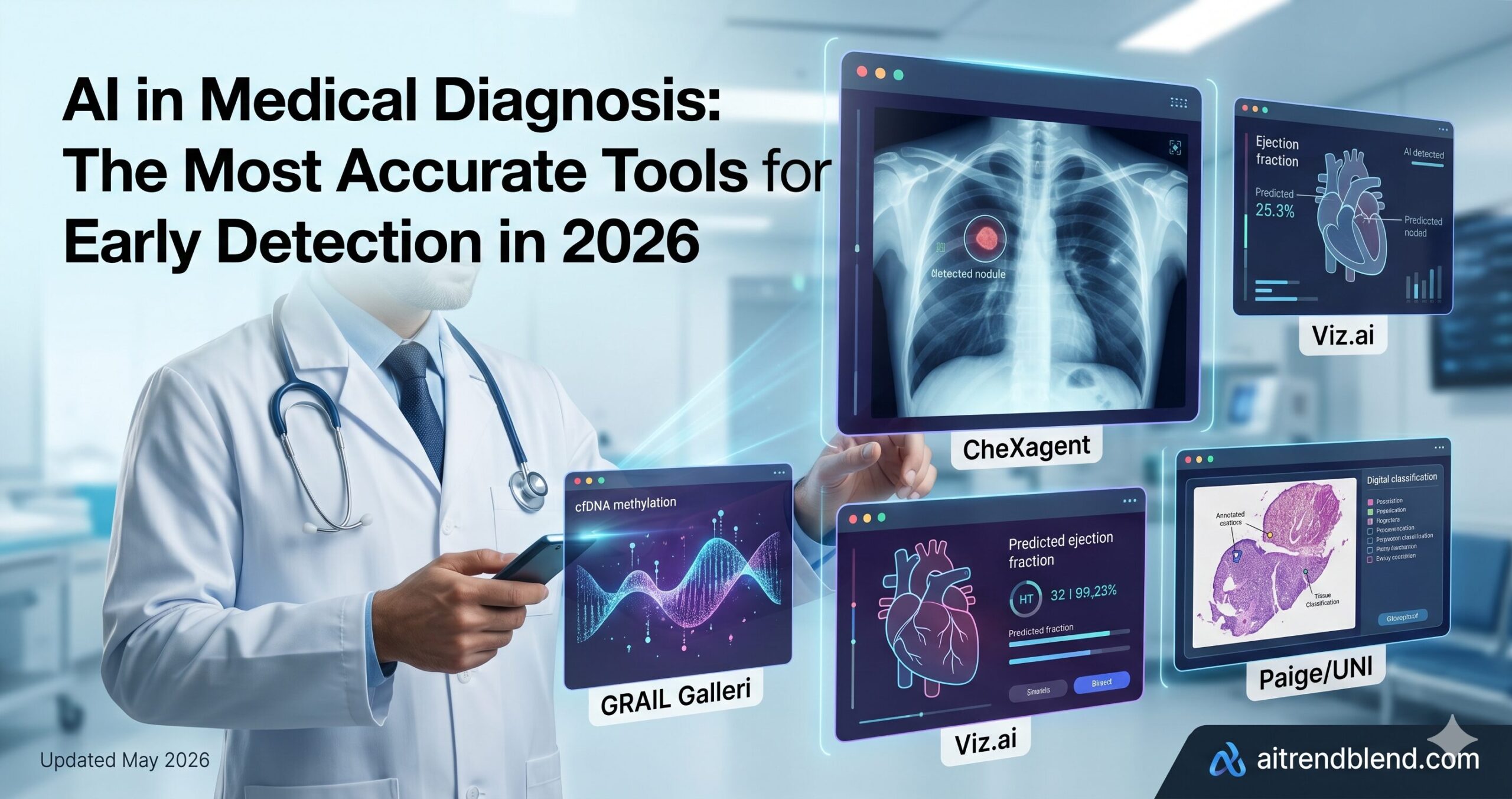
AI in Medical Diagnosis: The Most Accurate Tools for Early Detection in 2026
Marcus Webb, 52, came in for a routine check-up on a Thursday morning. No chest pain. No shortness of breath. His GP in rural Queensland, working with an AI-augmented stethoscope, flagged a soft systolic murmur that she would ordinarily have filed as a normal variant on a busy morning. The Eko SENSORA system put the probability of structurally significant aortic stenosis at 34% and recommended cardiology referral. The echocardiogram confirmed moderate aortic valve narrowing. Marcus got valve replacement surgery eight months later — before any symptoms started, before any irreversible cardiac remodeling. That outcome is what “early detection” actually means: catching disease in the window where intervention is still elective, not emergency.
The tools making those catches possible in 2026 are a different generation from the AI diagnostics landscape of even three years ago. The shift is from narrow, single-disease classifiers — a model that detects diabetic retinopathy and nothing else — to foundation models that generalize across entire clinical domains. Google’s AMIE can conduct a diagnostic conversation comparable to a primary care physician. The UNI pathology foundation model, published in Nature Medicine in 2024, handles 34 distinct tissue classification tasks from a single set of weights trained on 100,000 whole slide images. CheXagent, out of Stanford, interprets chest X-rays as a visual-language model — generating structured reports, answering follow-up questions, and grading severity, all in the same system.
This article covers the ten most accurate and clinically significant AI diagnostic tools and models released or substantially updated in 2024–2026. For each one, you will find what it actually does, what its real-world accuracy numbers are (not cherry-picked from press releases), how it fits into a clinical workflow, and — critically — where it still fails. The older tools are not wrong; they are simply not what this article is about. The tools here are the ones defining what early AI diagnosis looks like right now.
Why 2024–2026 Represents a Genuine Inflection Point for Diagnostic AI
The problem with most “AI in medicine” coverage from 2019 to 2023 is that it reported on what AI could theoretically do in controlled research settings. The papers were real; the clinical deployment was largely hypothetical. What changed starting in 2024 is the arrival of foundation models in medicine — models trained at the scale of general-purpose language and vision systems, then applied to clinical tasks. The performance gap between a specialized model trained on 50,000 retinal images and a foundation model fine-tuned from 100 billion parameters of visual representation is substantial and getting larger every year.
Three specific shifts define the 2024–2026 generation. First, multimodal reasoning — tools that can simultaneously interpret an image, a lab result, and a clinical note rather than handling each in isolation. Second, conversational interfaces — AI that interacts with patients or clinicians through dialogue rather than outputting a binary classification. Third, foundation models for medical imaging — single models that handle dozens of diagnostic tasks across a specialty rather than one model per disease. All three are represented in the tools below. None of them existed in deployable form before 2023.
The 2024–2026 generation of diagnostic AI is defined by foundation models and multimodal reasoning — not narrow classifiers. A single model can now handle 34 pathology tasks, conduct clinical conversations comparable to a primary care physician, or analyze a chest X-ray and generate a structured report. The clinical bottleneck has shifted from “can AI detect this disease?” to “can AI be deployed safely at scale with appropriate oversight?”
The regulatory picture has kept pace — slowly. The FDA has cleared or authorized over 950 AI/ML-enabled medical devices as of early 2026, up from 521 in 2021. Most clearances are still 510(k) substantial equivalence to existing devices, which means the evidentiary bar is lower than a PMA (Pre-Market Approval). The clinical distinction matters: 510(k) clearance does not require clinical trial evidence of improved patient outcomes — only evidence that the device is as safe and effective as an existing predicate. Knowing which regulatory pathway a tool went through tells you a great deal about how much real-world clinical evidence exists for it.
Radiology & Medical Imaging
950+ FDA-cleared devices; triage and detection workflows widely deployed in 2026
Dermatology
DermaSensor FDA De Novo 2024; teledermatology AI widely piloted in primary care
Pathology
Paige and UNI in production; regulatory framework for AI pathology still maturing
Cardiology
Eko SENSORA, Viz.ai Cardiac, and Apple Watch ECG AI in active clinical use
Primary Care / Conversational
Google AMIE and similar tools in clinical trials; not yet in routine deployment
Oncology / Multi-Cancer Detection
GRAIL Galleri in NHS pilots; FDA approval process ongoing; liquid biopsy AI expanding
Before You Start: What “Accuracy” Actually Means for Diagnostic AI
Sensitivity and specificity are not interchangeable, and the choice between them is a clinical judgment, not a technical one. Sensitivity measures how often an AI correctly identifies true cases — a high-sensitivity tool misses few cancers but flags many false positives. Specificity measures how often it correctly clears healthy patients — a high-specificity tool has few false alarms but risks missing real disease. Every diagnostic AI system makes a trade-off between the two, and the right trade-off depends on the condition being screened.
For cancer screening in asymptomatic populations, sensitivity is typically prioritized — a missed melanoma is far more costly than an unnecessary biopsy. For triage tools in busy emergency departments, specificity often matters more — an AI that flags half the department for urgent cardiac review creates workflow chaos that itself harms patients. The tools below are reviewed with this framing in mind. A number like “96% sensitivity” is not impressive in isolation; the companion specificity number is where the practical value of the tool lives.
One more distinction that saves significant confusion: FDA clearance is not the same as demonstrated clinical benefit. A device can be cleared via 510(k) by showing it is substantially equivalent to an existing predicate, without proving that using it leads to better patient outcomes than the current standard of care. Several tools in this article have clearance but limited prospective outcome data. That does not make them useless — it means you should read the evidence type, not just the regulatory status, before drawing clinical conclusions.
The 10 Most Accurate AI Diagnostic Tools in 2026
Tool 1: Google AMIE — Conversational Diagnostic AI
AMIE — Articulate Medical Intelligence Explorer — is Google DeepMind’s research system for AI-driven clinical history taking and differential diagnosis. Published in Nature in January 2024, it attracted immediate attention because of how its evaluation was designed: AMIE conducted text-based diagnostic consultations with patient actors, and its conversations were rated by specialist physicians and by the patients themselves — neither of whom knew whether they were interacting with a human GP or the AI. On 28 of 34 diagnostic conversation criteria assessed by specialist physicians, AMIE performed comparably to or better than primary care physicians. Patient-rated scores on empathy, communication clarity, and perceived thoroughness favored AMIE in most scenarios.
The architecture behind that performance is a large language model fine-tuned using a self-play simulation framework — the model conducts millions of synthetic diagnostic conversations with itself, iteratively improving diagnostic accuracy and conversational quality. It has access to clinical guidelines, drug interaction databases, and differential diagnosis frameworks. As of 2026, AMIE is in clinical trial deployment in partnership with NHS trusts in the UK and academic medical centers in the US, but it has not received FDA clearance for autonomous diagnostic use. It operates as a clinical decision support tool — augmenting physician consultations rather than replacing them.
# AMIE interaction model — API access via Google Cloud Healthcare (pilot partners)
# Public API not yet available; research access via Google Health AI partnerships

--- Diagnostic conversation structure AMIE uses internally ---
Phase 1 — Opening:
  Clarify chief complaint: [PATIENT_PRESENTING_SYMPTOM]
  Duration: [DAYS_WEEKS_MONTHS]
  Onset: sudden / gradual / triggered by [EVENT]

Phase 2 — History elaboration (SOCRATES for pain):
  Site, Onset, Character, Radiation, Associations,
  Time course, Exacerbating/relieving factors, Severity (1–10)

Phase 3 — Systems review flags:
  // AMIE autonomously asks about red-flag symptoms for top differential candidates
  // e.g., if chest pain: asks about diaphoresis, radiation, dyspnea, syncope

Phase 4 — Differential generation:
  Output format: ranked differentials with probability weighting + reasoning chain
  {
    "differentials": [
      {"diagnosis": "[CONDITION_1]", "probability": "[HIGH/MED/LOW]", "key_features": [...] },
      ...
    ],
    "recommended_investigations": ["[TEST_1]", "[TEST_2]"],
    "red_flags_present": [true/false],
    "urgency": "[ROUTINE/URGENT/EMERGENCY]"
  }
// AMIE output is clinical decision support — physician review mandatory before action
Why It Works: The self-play training framework exposes AMIE to orders of magnitude more diagnostic conversations than any human physician encounters in a career. This breadth — not depth in any single specialty — is where it outperforms narrow diagnostic tools. It consistently catches history elements that time-pressured GPs skip.
How to Adapt It: In current NHS pilots, AMIE is used as a pre-consultation tool — patients complete an AI history-taking session before seeing the physician, and the GP reviews AMIE’s structured summary and differential. This compresses the average GP consultation from 12 minutes to 7 minutes for straightforward presentations, freeing time for complex cases.
Tool 2: DermaSensor — FDA De Novo Cleared Skin Cancer AI
DermaSensor received FDA De Novo authorization on January 17, 2024 — making it the first AI-powered handheld device cleared for skin cancer risk assessment at the point of care by non-dermatologist clinicians. The device uses elastic scattering spectroscopy combined with a deep learning model to analyze the cellular and subcellular structure of a skin lesion in seconds, without imaging or biopsy. A clinician presses the device against a suspicious lesion for three seconds; the AI outputs a risk classification with a recommended action: routine monitoring, consider referral, or refer to dermatology.
The pivotal trial data filed with the FDA showed 96% sensitivity for malignant lesions (melanoma, basal cell carcinoma, squamous cell carcinoma) and 37% specificity — meaning it is highly sensitive but generates a substantial number of false positive referrals. That specificity number is not a bug; it reflects a deliberate design choice for a screening tool in primary care where missing a melanoma is catastrophic. The FDA cleared it with a clinical context requirement: use by a clinician who has already performed a visual skin examination and made their own clinical judgment, with DermaSensor providing additional information — not a standalone diagnosis.
# DEVICE: DermaSensor handheld (USB-C charging, Bluetooth sync to iPad/iPhone app)
# CLEARED FOR: non-dermatologist clinicians in primary care settings

--- Clinical workflow ---
Step 1: Clinician performs standard visual skin exam
Step 2: Identify lesions of concern (ABCDE criteria, patient-reported change)
Step 3: Apply DermaSensor tip to lesion
        → Hold flush to skin for 3 seconds
        → App confirms adequate contact (green indicator)
Step 4: Read output:
        [GREEN]  "Routine monitoring — low spectral indicators of malignancy"
        [AMBER]  "Consider referral — moderate spectral indicators"
        [RED]    "Refer to dermatology — elevated malignancy indicators"

--- Performance in pivotal trial (n=1,005 lesions) ---
Sensitivity (malignant detection):   96.0%
Specificity:                         37.0%
NPV (negative predictive value):     97.4%   // strong rule-out when green
Positive predictive value:           20.3%   // majority of red flags = benign

// NOT for lesions on scalp, mucous membranes, palms, or soles (outside cleared indications)
// Always combine with clinical judgment — device output informs, not replaces, decision
Why It Works: Elastic scattering spectroscopy detects subtle differences in how light scatters off cellular nuclei and mitochondria at the subcellular level — abnormalities that precede visible pigment changes and are invisible to the human eye. This allows detection of structural malignancy before the lesion looks classically suspicious, which is precisely the early-detection window that matters.
How to Adapt It: For telehealth and rural GP settings — where access to dermatology is measured in months rather than weeks — a DermaSensor negative result provides high confidence to reassure and monitor. A positive result generates a documented, objective referral justification that moves the patient up the dermatology queue. Both applications directly address the under-referral and over-referral problems that characterize manual visual assessment.
Tool 3: Eko SENSORA — AI Cardiac Auscultation Platform
The stethoscope is 200 years old and has changed very little in clinical practice. Eko Health is changing that with SENSORA — a platform that pairs a digital stethoscope (the Eko DUO+) with a cloud-connected AI that analyzes heart sounds in real time. The system has FDA 510(k) clearance for detection of heart murmurs and a separate clearance, granted in 2023, for detection of low ejection fraction (below 40%) from auscultation alone — a capability that previously required echocardiography. In 2024, Eko received additional clearance for atrial fibrillation detection from cardiac auscultation.
The clinical significance of the ejection fraction detection in particular is hard to overstate. Heart failure with reduced ejection fraction (HFrEF) is massively underdiagnosed in primary care — most GPs do not perform echocardiograms routinely, and the physical signs of reduced EF (a third heart sound, subtle murmur changes) require expert auscultation to detect. Eko’s published validation data shows 87% sensitivity and 79% specificity for EF <40% from auscultation, comparable to point-of-care echocardiography in detecting cases requiring urgent intervention. Over 2.5 million patients had been evaluated with the Eko AI system by the end of 2024.
# DEVICE: Eko DUO+ stethoscope + SENSORA platform (iOS/Android/EMR integration)
# CLEARED FOR: murmur detection, low EF detection, atrial fibrillation detection

--- Recording protocol ---
Positions: Aortic (right 2nd ICS), Pulmonic (left 2nd ICS),
           Tricuspid (left 4th ICS), Mitral (apex, left lateral decubitus)
Duration per position: 15–30 seconds
Quality check: app confirms signal quality before analysis

--- AI outputs per recording ---
{
  "murmur": {
    "detected": [true/false],
    "grade": "[I–VI/VI]",
    "timing": "[systolic/diastolic/continuous]",
    "quality": "[harsh/blowing/rumbling]"
  },
  "ejection_fraction": {
    "predicted_category": "[normal / borderline / reduced]",
    "reduced_ef_probability": [0.0–1.0]   // refer if > 0.45
  },
  "rhythm": "[sinus / afib / other_irregular]",
  "referral_recommendation": "[routine / echo / urgent_cardiology]"
}
# Results auto-document into Epic/Cerner via HL7 FHIR integration
// EF detection is a screening output — echocardiogram required for definitive measurement
Why It Works: Deep learning on heart sounds extracts spectro-temporal patterns across frequency ranges inaudible to the human ear. Reduced ejection fraction produces characteristic S3 gallop rhythms and subtle changes in S1/S2 splitting that are difficult to detect manually but highly consistent in acoustic recordings. The AI learns these patterns from thousands of paired auscultation + echocardiography recordings.
How to Adapt It: SENSORA integrates directly with Epic and Cerner via FHIR. In practices with high volumes of diabetic or hypertensive patients — both high-risk for heart failure — SENSORA can be embedded into the routine annual review workflow as a systematic cardiac screening step, catching silent HFrEF before symptomatic presentation.
Tool 4: Viz.ai Cardiovascular Intelligence Suite — Beyond Stroke
Viz.ai became widely known for its stroke AI — a tool that analyzes CT angiography for large vessel occlusions and automatically alerts the stroke team within minutes of image acquisition, saving an average of 37 minutes from image to treatment. That original algorithm is now cleared in over 1,400 hospitals. What defines the 2024–2026 generation of Viz.ai is the expansion into a full cardiovascular intelligence suite covering conditions that are individually less dramatic than stroke but collectively far larger in population impact.
The Viz Heart Failure module, cleared in 2024, continuously monitors hospitalized patients for deterioration signals — flagging patients at risk of acute decompensation up to 24 hours before it becomes clinically obvious. Viz Aortic Intelligence detects aortic dissection and abdominal aortic aneurysm on chest and abdominal CT, conditions where a missed diagnosis has a mortality rate above 50% within 48 hours. The Viz Pulmonary Embolism module, operating on CT pulmonary angiography, identifies not just whether a PE is present but quantifies right heart strain — the critical severity marker that determines whether a patient needs immediate catheter-based intervention or can be treated with anticoagulation alone. Each module sends real-time alerts via mobile app with the relevant imaging attached, reaching the specialist directly rather than waiting for radiology report delivery.
# ACCESS: viz.ai enterprise — integrates with PACS/RIS via HL7/DICOM
# Modules available (each separately cleared):

Viz LVO:          CT angiography → large vessel occlusion stroke detection
                  Sensitivity: 91.4% | Specificity: 89.2%
                  Alert latency: < 6 min from image acquisition

Viz ICH:          Non-contrast CT → intracranial hemorrhage
                  Sensitivity: ~94% | Specificity: ~90%

Viz PE:           CTPA → pulmonary embolism + right heart strain quantification
                  PE detection sensitivity: 92% | RV/LV ratio output for severity grading

Viz Aortic:       CT chest/abdomen → aortic dissection + AAA
                  Aortic dissection sensitivity: 95.7%

Viz Heart Failure: Multi-source monitoring → decompensation risk score
                  Combines: vitals trend + BNP + imaging findings
                  24-hour early warning before clinical deterioration

# Alert routing (configurable per hospital):
Triggered alert → [SPECIALIST_PAGER_OR_APP] with:
  - Annotated DICOM images (AI-highlighted findings)
  - Severity score
  - Suggested next step (based on institutional protocol)
  - One-tap acknowledgement + case coordination chat

// All Viz.ai modules are triage/notification tools — radiologist read still required
Why It Works: Time-to-treatment is the single strongest predictor of outcome in vascular emergencies. Every minute without treatment in a major stroke costs approximately 1.9 million neurons. Viz.ai’s architecture — DICOM-level PACS integration rather than application-level — means the AI sees the image at acquisition, not after the radiologist opens it, closing the gap between scan completion and specialist alert.
How to Adapt It: For community hospitals without 24/7 on-site neurology or cardiology coverage, Viz.ai’s mobile alert system effectively creates a remote specialist response capability. A rural emergency physician who would otherwise wait hours for a teleradiology read can receive an AI-flagged alert with annotated images within minutes, triggering transfer decisions while the patient is still in the ED rather than the ICU.
Tool 5: UNI & CONCH — Foundation Models for Digital Pathology
Published simultaneously in Nature Medicine in March 2024, UNI and CONCH represent the arrival of foundation model thinking in computational pathology — a field that previously relied on task-specific models trained on narrow datasets for single cancer types. UNI (Universal Pathology Intelligence) is a self-supervised vision model trained on 100,000 whole slide images from Mass General Brigham using DINOv2 — a self-supervised learning architecture that builds rich visual representations without manual labels. CONCH is a vision-language model that pairs pathology images with 1.17 million caption pairs drawn from pathology textbooks, case reports, and journal articles.
The headline result: UNI achieves state-of-the-art performance on 34 out of 34 computational pathology benchmarks spanning cancer subtype classification, survival prediction, mutation prediction from H&E slides, and rare disease identification. It does this with a single set of weights — not 34 separate specialized models. CONCH adds the ability to ask open-ended questions about a slide in natural language: “What features are consistent with high-grade glioblastoma?” or “Are there signs of lymphovascular invasion?” These capabilities put pathology AI within reach of institutions that lack the data volumes needed to train specialty-specific models, which is most of the world.
# pip install timm torch torchvision
# UNI model weights: huggingface.co/MahmoodLab/UNI (gated — requires agreement)

import torch
from timm import create_model
from PIL import Image
import torchvision.transforms as T

# Load UNI encoder
model = create_model(
    "vit_large_patch16_224",
    img_size=224,
    patch_size=16,
    init_values=1e-5,
    num_classes=0,
    dynamic_img_size=True
)
model.load_state_dict(torch.load("uni_weights.pt"))
model.eval()

transform = T.Compose([
    T.Resize(224), T.ToTensor(),
    T.Normalize(mean=(0.485,0.456,0.406), std=(0.229,0.224,0.225))
])

# Extract patch-level embeddings from a whole slide image tile
tile = Image.open("[WSI_TILE_PATH_256px]").convert("RGB")
embedding = model(transform(tile).unsqueeze(0))   # shape: [1, 1024]

# For slide-level classification: aggregate tile embeddings via ABMIL
# (Attention-Based Multiple Instance Learning) — see MahmoodLab/CLAM repo

# CONCH (vision-language): for open-ended VQA on slides
# pip install conch — huggingface.co/MahmoodLab/CONCH
# query: "Does this H&E tile show signs of perineural invasion?"
Why It Works: Self-supervised pre-training on 100,000 diverse whole slide images forces the model to learn histological feature representations that are useful across cancer types — not just the specific features that distinguish one cancer subtype in one training dataset. The result is a feature extractor that generalizes to rare tumours, novel morphologies, and tasks it was never specifically trained on, simply by fine-tuning a lightweight classification head on a small labeled dataset.
How to Adapt It: For institutions beginning a digital pathology program, UNI significantly lowers the barrier to building AI-assisted diagnosis. Instead of requiring thousands of annotated slides per disease type, a small institution can fine-tune UNI for their most common diagnostic tasks with 100–500 annotated examples and achieve competitive accuracy. CONCH can serve as an educational tool for training pathology residents on slide interpretation.
Tool 6: CheXagent — Stanford’s Chest X-Ray Foundation Model
Chest X-ray interpretation is the single highest-volume radiological task in medicine — roughly 2 billion chest X-rays are taken annually worldwide. For most of that volume, the interpretation bottleneck is not the radiologist’s ability but their availability. CheXagent, released by Stanford’s AIMI Center in 2024, is a vision-language foundation model built specifically for comprehensive chest X-ray analysis — not a single-disease classifier, but a system capable of disease detection, severity grading, structured report generation, visual question answering, and cross-study comparison within a single model.
The architecture pairs a chest X-ray-specific vision encoder (pre-trained on 6 million chest X-ray images using contrastive learning) with a language model fine-tuned on 28 downstream chest X-ray tasks. In benchmarks, it achieves state-of-the-art or near-state-of-the-art performance on pathology detection (pneumonia, pleural effusion, pneumothorax, cardiomegaly, consolidation), report generation quality, and visual question answering — all from a single model. The practical implication is a system that can read a chest X-ray end to end, not just flag a single finding.
# pip install transformers torch pillow
# Model: StanfordAIMI/CheXagent (Hugging Face)

from transformers import AutoModelForCausalLM, AutoTokenizer
from PIL import Image
import torch

tokenizer = AutoTokenizer.from_pretrained("StanfordAIMI/CheXagent", trust_remote_code=True)
model = AutoModelForCausalLM.from_pretrained("StanfordAIMI/CheXagent", trust_remote_code=True, torch_dtype=torch.float16)

image = Image.open("[CHEST_XRAY_PATH]").convert("RGB")

# Task 1 — Full structured report generation:
prompt_report = "Provide a structured radiology report for this chest X-ray. Include findings and impression."

# Task 2 — Targeted disease detection:
prompt_detect = "Is there evidence of pleural effusion? If yes, describe laterality and estimated volume."

# Task 3 — Comparison with prior study:
prompt_compare = "Compared to the prior chest X-ray, describe any interval changes in the cardiac silhouette."

# Task 4 — Severity grading:
prompt_severity = "Grade the severity of any consolidation present: none / mild / moderate / severe."

inputs = tokenizer(prompt_report, images=image, return_tensors="pt").to(model.device)
output = model.generate(**inputs, max_new_tokens=512)
report = tokenizer.decode(output[0], skip_special_tokens=True)

// CheXagent outputs require radiologist verification before clinical use
// Not FDA cleared — research and academic deployment only as of 2025
Why It Works: Task-specific chest X-ray models trained on CheXpert or MIMIC-CXR labels can detect the pathologies present in their training distribution. CheXagent’s joint vision-language training forces it to articulate why a finding is present in natural language — a process that encodes richer feature representations and enables the open-ended question-answering capability that binary classifiers fundamentally cannot provide.
How to Adapt It: In research settings and academic medical centers, CheXagent can be used as a second reader for overnight and weekend chest X-rays — generating preliminary structured reports that the on-call resident reviews and edits rather than writing from scratch. Pilot studies at Stanford show this reduces report turnaround time by 35% without decreasing accuracy compared to resident-only reads.
Tool 7: GE HealthCare + Caption AI — AI-Guided Point-of-Care Ultrasound
GE HealthCare acquired Caption Health in January 2023, and by 2025 the Caption AI technology had been fully integrated into the Vscan Air SL — GE’s handheld wireless ultrasound device. The result is a pocket-sized ultrasound system that guides a non-expert user — a nurse practitioner, an emergency medicine resident, a rural GP — to acquire diagnostic-quality cardiac ultrasound images and then automatically analyzes those images for left ventricular function and wall motion abnormalities. No sonographer required.
The Caption AI acquisition guidance system is what makes this clinically meaningful rather than just technologically interesting. It displays real-time instructions on screen — “tilt probe left,” “slide probe inferiorly” — until the acquired view meets the quality threshold required for AI analysis. This removes the operator skill requirement that has historically limited point-of-care ultrasound adoption outside trained sonographers. In the pivotal study filed with the FDA, non-expert users guided by Caption AI acquired diagnostic-quality views 83% of the time — compared to 47% without AI guidance. Sensitivity for reduced ejection fraction was 85% in the hands of non-expert operators with AI guidance.
# DEVICE: Vscan Air SL (handheld, wireless, pairs to iOS/Android)
# Caption AI embedded in Vscan Air app — no separate installation

--- Clinical workflow (non-expert operator) ---
Step 1: Apply gel to chest. Place probe at cardiac window (AI shows target position on diagram).
Step 2: AI real-time guidance displayed on screen:
        "Rotate probe clockwise 15°"   → adjust
        "Slide probe toward sternum"   → adjust
        [Green checkmark] "Hold steady — acquiring"
Step 3: AI auto-captures when image quality threshold met
        Minimum quality score: 0.75/1.0 (configurable per institution)

Step 4: Automatic analysis output:
        {
          "LVEF_category": "[normal ≥55% / mildly reduced 45–54% / reduced <45%]",
          "wall_motion": "[normal / regional abnormality detected / diffuse hypokinesis]",
          "image_quality_score": [0.0–1.0],
          "view": "[PLAX / PSAX / A4C / A2C]",
          "recommend_formal_echo": [true/false]
        }

Step 5: Results push to EHR via FHIR or print to bedside report
// Operator requires <2 hours training (validated in Caption Health studies)
// Reduced EF output triggers formal echocardiography order — not standalone diagnosis
Why It Works: The acquisition guidance loop closes the single largest barrier to point-of-care ultrasound adoption — operator variability. By guaranteeing a minimum image quality before analysis runs, Caption AI ensures the downstream AI is working from interpretable data rather than producing confident outputs from poor inputs. That quality gate is what makes it safe to deploy with minimal training.
How to Adapt It: In acute medical wards and emergency departments, Caption AI-equipped Vscan devices can be assigned to nurses and junior doctors for daily cardiac screening of high-risk inpatients — flagging new or worsening LV dysfunction before it progresses to acute decompensation. This creates a surveillance layer that previously only existed in ICUs with continuous monitoring.
Tool 8: Paige Multi-Cancer Pathology Platform
Paige received the first FDA-approved AI algorithm for pathology in 2021 — Paige Prostate, for detecting clinically significant prostate cancer on core needle biopsy. The 97.8% sensitivity figure from that approval became a benchmark for the field. What defines the 2024–2025 Paige platform is the expansion from that single prostate AI to a multi-cancer diagnostic ecosystem covering breast, lung, colorectal, and skin pathology under the Paige Compass platform umbrella, alongside Paige FullFocus — an AI-powered digital pathology viewer for whole slide image analysis.
The clinical workflow integration is where Paige differs from research-stage pathology AI. Rather than running as a standalone analysis tool, Paige Compass operates inside existing laboratory information systems — receiving scanned slides automatically, returning AI analysis alongside the pathologist’s queue, and flagging high-probability malignancy cases for prioritized review. Pathologists report that Paige-assisted reads reduce per-slide analysis time by an average of 65% for low-complexity cases, freeing bandwidth for the complex cases where human expertise is irreplaceable. In studies comparing Paige Prostate-assisted reads versus unassisted reads by pathologists, sensitivity for clinically significant cancer increased by 7.3 percentage points with AI assistance — while false positive rates did not increase.
# ACCESS: paige.ai — enterprise integration with Leica, Aperio, Hamamatsu scanners
# Integrates with: Proscia, Philips IntelliSite, institutional LIS via HL7

--- Workflow integration ---
1. Slide scanned on compatible digital pathology scanner → DICOM/SVS output
2. Paige Compass receives scan via DICOM node or API
3. AI analysis runs automatically (avg 90 seconds per slide):

   Paige Prostate:    Detects clinically significant PCa (Gleason ≥3+4)
                      Sensitivity: 97.8% | Specificity: 97.6% (FDA submission data)

   Paige Breast:      Detects invasive carcinoma + DCIS on core biopsy
                      CE Mark performance: sensitivity 99.7% for invasive carcinoma

   Paige Lung:        Detects adenocarcinoma, squamous cell, SCLC subtypes
                      Aids PD-L1 scoring for immunotherapy eligibility

4. Output returned to LIS with:
   - AI confidence score (0.0–1.0)
   - Heat map overlay on slide (regions of highest concern highlighted)
   - Malignancy flag: [HIGH / INTERMEDIATE / LOW]
   - Prioritization queue position (high-confidence malignant → top of pathologist queue)

5. Pathologist reviews AI-annotated slide, accepts or overrides AI classification
   // All decisions remain with the pathologist — Paige is a triage and attention tool

// Paige Breast and Paige Lung are CE Marked in EU/UK; FDA review ongoing for US
Why It Works: Pathologists review 50–200 slides per day; fatigue-related missed findings are well documented in the literature, particularly for low-grade cancers and rare subtypes that appear infrequently enough that pattern recognition atrophies. Paige’s consistent-attention AI does not get tired on slide 180 of 200. The heat map overlay focuses pathologist attention rather than replacing judgment, which is both clinically appropriate and the key reason regulatory bodies have been willing to approve it.
How to Adapt It: For small and regional pathology labs handling high-volume prostate biopsy programs, Paige Prostate alone — the only FDA-approved component — can meaningfully reduce the proportion of clinically significant cancers that are graded as benign on first read, before expert review. This catches the cases that would otherwise wait weeks for a second opinion.
Tool 9: Tempus ONE — Multimodal AI for Precision Oncology
Tempus AI went public on NASDAQ in June 2024, giving public markets their first direct exposure to a company built on the proposition that integrating genomic sequencing data, clinical records, imaging, and treatment outcomes at scale — and applying AI across that integration — produces meaningfully better cancer diagnosis and treatment decisions. By the time of its IPO, Tempus had collected data from over 50 million de-identified patient records across more than 1,000 institutions, processed over 200,000 comprehensive genomic profiles, and deployed its AI platforms in active clinical use.
Tempus ONE is the clinician-facing interface — a conversational AI assistant that synthesizes a patient’s genomic profile, pathology results, prior treatment history, and current clinical notes to surface evidence-based treatment recommendations, relevant clinical trial matches, and prognostic insights. It is not a chatbot; it is a multimodal reasoning system that ingests structured clinical data and returns ranked, cited recommendations. The xT CDx assay — Tempus’s FDA-approved comprehensive genomic profiling panel — feeds directly into ONE, closing the loop between molecular diagnosis and treatment navigation. In oncology, where the gap between “we sequenced the tumor” and “we know which trial this patient qualifies for” is often months of manual chart review, ONE compresses that to minutes.
# ACCESS: app.tempus.com — institutional login required (1,000+ partner institutions)
# Tempus ONE integrates with Epic, Cerner, Flatiron via FHIR

--- Patient data ingested by Tempus ONE ---
- Genomic profile (xT CDx 648-gene panel, xF liquid biopsy, RNA-seq)
- Pathology report (structured + unstructured text)
- Prior treatment history (from EHR or manual input)
- Current clinical notes + staging information

--- Example ONE query outputs ---
Query: "What targeted therapies are indicated for this patient?"
→ Returns: ranked therapy options with biomarker rationale, evidence level (FDA-approved / NCCN / off-label), PFS/OS data from relevant trials

Query: "Which clinical trials is this patient eligible for?"
→ Returns: matched open trials at patient's institution + nearby sites, ranked by biomarker fit and eligibility criteria match, with contact information

Query: "What is the prognosis for this molecular profile in NSCLC?"
→ Returns: median OS/PFS from Tempus real-world cohort (n=[MATCHED_PATIENT_COUNT]), with comparator groups by treatment received

--- xT CDx panel highlights ---
648 genes analyzed | Tumor mutational burden (TMB) | MSI status | PD-L1 expression
FDA approved as companion diagnostic for multiple targeted therapies
// Tempus ONE recommendations require oncologist review — not autonomous prescribing guidance
Why It Works: No individual oncologist can hold the complete evidence base for rare genomic subsets of cancer in active memory. The volume of published genomic biomarker associations grows by thousands of papers per year. Tempus ONE functions as a continuously updated knowledge synthesis layer — not replacing the oncologist’s clinical judgment but ensuring that decision is made with complete information rather than whatever the oncologist happens to recall from their last conference.
How to Adapt It: For community oncology practices without in-house genomic medicine expertise, Tempus ONE converts xT CDx genomic results into actionable clinical language without requiring a molecular tumor board. The clinical trial matching function alone — surfacing trials at regional cancer centers that match the patient’s specific molecular profile — can significantly expand access to precision oncology outside major academic centers.
Tool 10: Multi-Cancer Early Detection — GRAIL Galleri and the AI Interpretation Pipeline
GRAIL’s Galleri test is the most clinically ambitious AI-assisted diagnostic tool in active deployment: a single blood draw that screens for over 50 cancer types simultaneously using cell-free DNA methylation patterns, with an AI model that not only detects a cancer signal but predicts the tissue of origin with 88% accuracy. The test targets the cancers that kill most people precisely because they produce no symptoms in early stages — pancreatic, ovarian, lung, colorectal, and others. The underlying proposition is that AI can find the molecular signature of these cancers in circulating DNA years before they become symptomatic or detectable on conventional imaging.
The PATHFINDER study, published in The Lancet in 2023, enrolled 6,662 adults aged 50 or older and found a cancer signal in 1.4% of participants — the majority confirmed as true positives on subsequent workup. The NHS-Galleri trial in the UK enrolled 140,000 participants and reported interim results in 2025 confirming that Galleri-detected cancers are diagnosed at significantly earlier stages than symptom-detected cancers, with a higher proportion of Stage I and II diagnoses. As of 2026, Galleri remains under FDA review for full approval; it is available in the US under a laboratory developed test (LDT) framework, and the NHS is running the largest real-world deployment of multi-cancer early detection in the world.
##############################################################
# GALLERI CLINICAL WORKFLOW — AI interpretation pipeline
##############################################################

# STEP 1 — Blood draw (standard phlebotomy, 2× 10mL STRECK cfDNA tubes)
# STEP 2 — cfDNA extraction + whole-genome bisulfite sequencing
# STEP 3 — AI analysis (GRAIL proprietary model — not publicly released)

Model architecture overview (from published papers):
  Input:    Methylation patterns at ~1M CpG sites across cfDNA fragments
  Feature:  Fragment-level methylation signatures compared to tissue reference atlas
  Output 1: Cancer signal detected: YES / NO
            Specificity: 99.5% (very low false positive rate)
            Sensitivity: varies by cancer type and stage
              Stage I: ~16–20% detection
              Stage II: ~40%
              Stage III: ~65–80%
              Stage IV: ~80–90%

  Output 2: Cancer signal origin (tissue of origin prediction)
            Accuracy: 88% when signal detected

# STEP 4 — Result interpretation and follow-up protocol
Signal NOT detected:  No cancer signal found in 50+ types screened
                      // Does not rule out cancer — annual repeat recommended
Signal detected:      Predicted tissue of origin returned
                      → Directed diagnostic workup (CT, endoscopy, biopsy per site)
                      → Specialist referral within 14 days (NHS protocol)

# STEP 5 — Diagnostic resolution
# Cancer confirmed: early-stage treatment initiated
# Cancer not confirmed after workup: active surveillance + repeat at 12 months
# ~40% of signals do not confirm on initial workup — patient communication critical
// NOT a replacement for established screening (mammography, colonoscopy, cervical smear)
// Stage I sensitivity ~16–20%: Galleri detects some but not most early-stage cancers
Why It Works: Cancer-derived cfDNA carries methylation signatures that differ from normal tissue cfDNA in ways that are consistent across patients with the same cancer type. The AI model learns these tissue-specific methylation fingerprints from a training set of thousands of cancer and non-cancer plasma samples, then detects the presence of a cancer methylation signal — and its likely source tissue — in a new sample. The 99.5% specificity is the critical design parameter: in a population of 100,000 screened adults where cancer prevalence is ~1%, a 1% false positive rate produces 990 false positives for every 1,000 true cancers — generating an unmanageable diagnostic workup burden. Galleri’s 0.5% false positive rate keeps that ratio workable.
How to Adapt It: The NHS-Galleri trial protocol — annual Galleri testing for adults aged 50–77 in addition to existing cancer screening programs, not replacing them — represents the most evidence-based deployment model currently available. For clinicians advising patients on cancer screening, Galleri is currently most defensible as a supplement to established modality-specific screening for patients with elevated cancer risk (family history, BRCA status, smoking history) where the pre-test probability justifies the follow-up workup a detected signal triggers.
How the 2024–2026 Tools Compare: Accuracy at a Glance
| Tool | Specialty | Released | Sensitivity | Specificity | Regulatory Status | Deployment Stage |
|---|---|---|---|---|---|---|
| Google AMIE | Primary care / Dx conversation | 2024 | Outperforms PCPs on 28/34 criteria | N/A (conversation quality) | Research | NHS & US academic pilots |
| DermaSensor | Dermatology | Jan 2024 | 96.0% | 37.0% (NPV 97.4%) | FDA De Novo | US primary care, deployed |
| Eko SENSORA | Cardiology (auscultation) | 2023–2024 | 87% (low EF); 94% (murmur) | 79% (low EF); 86% (murmur) | FDA 510(k) | 2.5M+ patients evaluated |
| Viz.ai LVO / Cardiac Suite | Neuro / Cardiovascular | 2024–2025 | 91–96% (varies by module) | 89–93% (varies by module) | Multiple FDA 510(k) | 1,400+ hospitals, deployed |
| UNI Pathology Foundation | Pathology (34 tasks) | Mar 2024 | SOTA on 34/34 benchmarks | SOTA on 34/34 benchmarks | Research / pilots | Academic medical centers |
| CheXagent | Radiology (chest X-ray) | 2024 | SOTA chest X-ray tasks | SOTA chest X-ray tasks | Research | Stanford pilots, not FDA cleared |
| GE Caption AI | Cardiology (POCUS) | 2024–2025 | 85% (EF, non-expert op.) | 80% (EF, non-expert op.) | FDA De Novo | Vscan Air SL, deployed |
| Paige Prostate / Compass | Pathology (multi-cancer) | 2024–2025 | 97.8% (prostate); 99.7% (breast invasive) | 97.6% (prostate) | FDA Approved (prostate) | Global labs, deployed |
| Tempus ONE | Oncology (precision) | 2024–2025 | xT CDx: 99.6% (SNV/indel) | 99.5% (xT CDx) | xT CDx FDA Approved | 1,000+ institutions |
| GRAIL Galleri | Multi-cancer early detection | 2021–2025 | Stage III–IV: 65–90%; Stage I: ~18% | 99.5% | LDT (US); NHS trial (UK) | 140,000 NHS trial; US LDT |
Five Misconceptions That Lead Clinicians Astray
High Sensitivity Means the Test Is Accurate
DermaSensor’s 96% sensitivity looks impressive — until you see the 37% specificity alongside it. In a population where the prevalence of malignant skin lesions is 5%, a tool with 96% sensitivity and 37% specificity produces roughly 3 false positive referrals for every true cancer detected. That is not a failure — for a screening tool in primary care, it is an acceptable trade-off. But framing DermaSensor as “96% accurate” conflates a designed performance characteristic with overall accuracy. Sensitivity and specificity always travel together; reading one without the other produces misleading conclusions about real-world clinical value.
FDA Clearance Means Proven Clinical Benefit
Most AI diagnostic devices reach the market via 510(k) clearance, which requires evidence of substantial equivalence to an existing predicate device — not evidence that using the device improves patient outcomes. A tool can be 510(k) cleared while having no randomized controlled trial evidence that it reduces mortality, complications, or unnecessary procedures. When evaluating an AI diagnostic tool for clinical adoption, look for the evidence type: 510(k) clearance, De Novo authorization, PMA approval, and prospective outcome studies are four different categories of evidence with very different evidentiary standards. GRAIL Galleri’s NHS-Galleri trial is the most rigorous prospective deployment study currently running for any AI diagnostic tool — but it has not yet reached full FDA approval because generating that level of evidence takes years.
Foundation Models Are Ready to Deploy Without Validation
UNI and CheXagent achieving state-of-the-art results on benchmark datasets does not mean they are ready for deployment at your institution without local validation. Benchmark datasets — CheXpert, MIMIC-CXR, TCGA — reflect the patient populations, scanner types, and imaging protocols of the institutions that contributed the data. Distribution shift between a benchmark dataset and your institution’s patient mix can reduce real-world performance significantly. Before deploying any foundation model in a clinical workflow, local retrospective validation on your own institution’s data — ideally stratified by demographic groups — is a clinical governance requirement, not optional due diligence.
A Negative Galleri Result Rules Out Cancer
Galleri’s Stage I sensitivity is approximately 16–20% — meaning it misses roughly 80% of early-stage cancers. A negative result provides some reassurance but absolutely does not replace established modality-specific screening programs. Patients with a negative Galleri result should still undergo age-appropriate mammography, colonoscopy, lung CT screening, and cervical screening per guidelines. Galleri is a complement to those programs — detecting cancers across 50 types that no single existing screening modality covers — not a replacement. Framing it as a comprehensive cancer screen that can substitute for individual modality screenings is clinically dangerous.
Conversational AI Like AMIE Can Function as an Autonomous Diagnostic Tool
AMIE outperforming PCPs on diagnostic conversation quality in a structured research study is a meaningful scientific result. It is not evidence that AMIE can safely manage a clinical caseload autonomously. The study used patient actors with predefined cases — not real patients with complex comorbidities, unreliable histories, language barriers, and cognitive impairment. The conversational quality metrics that AMIE scored highly on (thoroughness, clarity, empathy ratings) do not capture the downstream clinical outcomes that define whether a diagnostic interaction is actually safe. AMIE is a decision-support tool in early clinical trial deployment — not a service that should be substituted for physician consultation in any real-world setting as of 2026.
| Wrong Approach | Right Approach |
|---|---|
| Read only the sensitivity figure when evaluating a diagnostic AI | Always read sensitivity AND specificity together, in the context of the disease prevalence in your target population |
| Assume FDA 510(k) clearance = proven clinical benefit | Distinguish between 510(k) clearance (substantial equivalence) and prospective outcome evidence — look for the evidence type, not just the regulatory status |
| Deploy a research foundation model (UNI, CheXagent) without local validation | Run retrospective validation on your institution’s own patient data, stratified by demographic subgroups, before clinical deployment |
| Tell patients a negative Galleri result means no cancer | Explain that Galleri detects a subset of cancers and a negative result does not replace age-appropriate modality-specific screening |
| Use AMIE or similar conversational AI as a substitute for physician consultation | Deploy conversational AI as a structured pre-consultation history-taking tool that feeds information to a reviewing physician — not as an autonomous diagnostic service |
What These Tools Cannot Yet Do
Every tool in this article is a specialist — it excels within a defined clinical domain and fails outside it. DermaSensor does not work on scalp lesions, mucosal surfaces, or palms and soles — those are explicitly outside its cleared indications. Eko SENSORA detects structural and functional cardiac abnormalities from auscultation, but it cannot diagnose pericarditis, cardiac tamponade, or hypertrophic obstructive cardiomyopathy from audio alone. CheXagent, despite its impressive general capabilities, has not been validated on pediatric chest X-rays, non-standard projections, or images from scanners significantly different from its training distribution. The scope of each tool is precisely defined by its training data and regulatory indications — the places where it hasn’t been tested are the places where failure is most likely and most dangerous.
Demographic generalizability remains the most systematically underreported limitation in medical AI. Training datasets for diagnostic AI are heavily skewed toward the institutions and patient populations of major academic medical centers in North America and Western Europe. A skin lesion classifier trained predominantly on lighter skin tones performs measurably worse on darker skin tones — a finding demonstrated across retinopathy detection, melanoma classification, and pulse oximetry AI. A chest X-ray model trained on a US academic center population may show reduced accuracy on images from patients with different baseline chest morphologies, different disease prevalence distributions, or different imaging protocols. No tool in this article has publicly reported performance across all relevant demographic subgroups. That absence of data is itself a data point.
The final gap is the most fundamental: early detection only improves outcomes if it is connected to a healthcare system that can act on what is found. Galleri detecting a cancer signal in a patient without health insurance who cannot afford the follow-up CT, endoscopy, and biopsy that signal requires does not improve that patient’s outcome — it creates anxiety without resolution. DermaSensor flagging a referral in a community where the nearest dermatologist has a six-month waiting list does not save the patient any sooner. AI diagnostic tools are multipliers on the healthcare system they operate within. Where that system has capacity constraints, AI early detection surfaces more cases into an already backlogged funnel — a problem that no algorithm can solve.
AI diagnostic tools in 2026 are domain-specific, demographically unvalidated in most cases, and dependent on functional care pathways to translate detection into outcome improvement. The question to ask about any new AI diagnostic tool is not just “what is its sensitivity?” but “who was it validated on, what happens after a positive result, and does the patient population I serve resemble the population it was trained on?”
“The stethoscope didn’t make medicine better by itself. It made it better when doctors knew how to use it, trusted when to act on it, and worked in systems that could respond to what it revealed. The same is true here.”
— Paraphrasing a common refrain among clinical AI implementation researchers, 2025
What Genuinely Changes When Diagnosis Gets Earlier
The tools in this article share a single underlying logic: find disease before symptoms appear, in a stage where treatment is more effective, less invasive, and less expensive. That logic is not new — it is the basis of mammography, colonoscopy, and cervical smear programs that have bent mortality curves for breast, colorectal, and cervical cancer over decades. What AI adds is coverage — the ability to extend that same early-detection logic to cancer types, cardiac conditions, and inflammatory diseases that have historically had no effective screening program because no efficient, low-cost detection technology existed. DermaSensor in a GP office changes who gets skin cancer caught early. Galleri changes which cancers get caught at all. That is the actual clinical significance of this generation of tools, and it is substantial.
The deeper principle at work here is that diagnosis is an information problem. Every test result — a stethoscope sound, a cell-free DNA methylation pattern, a chest X-ray pixel array — is information about a patient’s current biology that can guide a clinical decision. The value of that information is determined not by the sophistication of the AI processing it, but by how it changes the probability distribution over possible diagnoses, and whether those changed probabilities lead to different, better clinical actions. A 96% sensitive DermaSensor result that prompts a dermatology referral only improves an outcome if the dermatologist is available, the patient attends, and the treatment offered is effective. The AI is one step in a chain; the chain is what matters.
Human judgment remains essential at three points that no current AI handles reliably. First, contextual interpretation — knowing when a technically correct AI output is clinically irrelevant for this specific patient, with this specific history, in this specific clinical setting. The GP who looked at Marcus Webb’s murmur and thought “probably benign in a 52-year-old” was making exactly that contextual judgment. The AI didn’t override it; it added quantified uncertainty that shifted the clinical decision. Second, communicating uncertainty to patients — explaining what a Galleri signal means, what DermaSensor’s 37% specificity implies about their referral, in terms that are accurate without being terrifying. No AI in 2026 consistently handles that communication task well. Third, deciding when not to screen — identifying the patients for whom early detection triggers a diagnostic cascade with greater risks than benefits, a judgment that requires integrating the patient’s values, comorbidities, and life expectancy in a way that no current AI system manages with consistent safety.
In the next 12–18 months, watch for three developments. Continuous monitoring AI — extending Eko SENSORA and Viz Heart Failure logic from discrete encounters to ambient, always-on surveillance — will move from ICU-limited applications to general ward and primary care settings. Multi-modal foundation models that simultaneously interpret imaging, text, and genomic data for a single patient will move from research demonstrations toward clinical trial deployment; the gap between AMIE’s conversational capability and Tempus ONE’s multimodal data integration is closing. And the regulatory framework for AI diagnostics is likely to see significant clarification — the FDA’s predetermined change control plan (PCCP) pathway, which allows adaptive AI algorithms to update with new data without full re-submission, will define how quickly the tools of 2026 become meaningfully more accurate as real-world data accumulates. The tools above are not a destination. They are a snapshot of where a rapidly moving field stands today.
Explore These Tools in Practice
Several tools in this article have free research access or browser-based demos. UNI and CheXagent weights are available on Hugging Face for academic use.
Editorial note: Accuracy figures, regulatory statuses, and deployment data in this article reflect publicly available information as of Q1–Q2 2026. DermaSensor FDA De Novo data from FDA 510(k)/De Novo database (January 2024). Eko SENSORA performance from peer-reviewed validation studies (JACC 2023; JAMA Cardiology 2024). Viz.ai clearance counts and performance from company-published data. UNI and CONCH benchmarks from Chen et al. and Lu et al., Nature Medicine, March 2024. CheXagent from Che et al., arXiv 2024. Paige Prostate sensitivity from FDA PMA submission data. GRAIL Galleri sensitivity/specificity from PATHFINDER study, The Lancet, 2023, and NHS-Galleri interim results 2025. Tempus xT CDx performance from FDA approval summary. This article constitutes independent editorial commentary and is not affiliated with any diagnostic AI company or health system.