
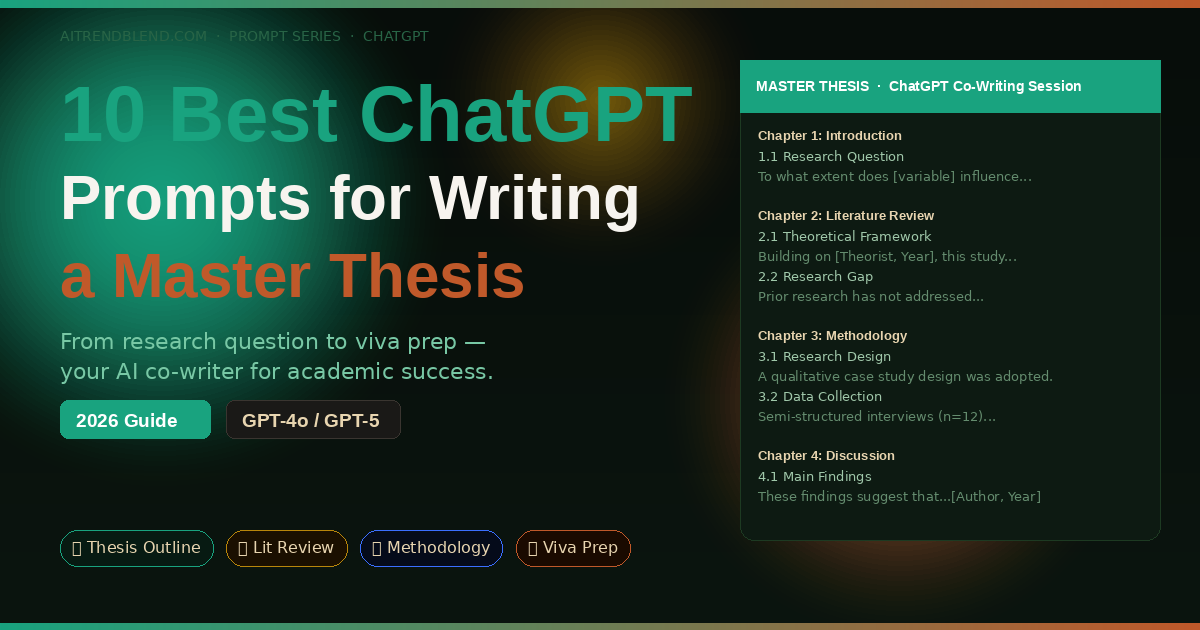
10 Best ChatGPT Prompts for Writing a Master Thesis
It is 11 PM, your thesis is due in six weeks, and you are staring at a blinking cursor under a chapter heading you have already rewritten four times. Every sentence you type sounds either too casual for an academic committee or so stiff it reads like a legal contract. Sound familiar? This is exactly the gap ChatGPT closes — not by writing your thesis for you, but by being the tireless thinking partner who never judges your rough drafts, never runs out of patience, and never lets you spiral into a blank page again.
The prompts in this guide are not generic “write me an essay” requests. Each one is designed specifically for master’s-level academic writing — accounting for the fact that your thesis needs original argumentation, proper citation scaffolding, a defensible methodology, and the kind of careful hedging language that academic committees actually expect. A prompt that works beautifully for a blog post will produce embarrassingly vague output for a literature review. That’s the distinction this guide keeps in focus.
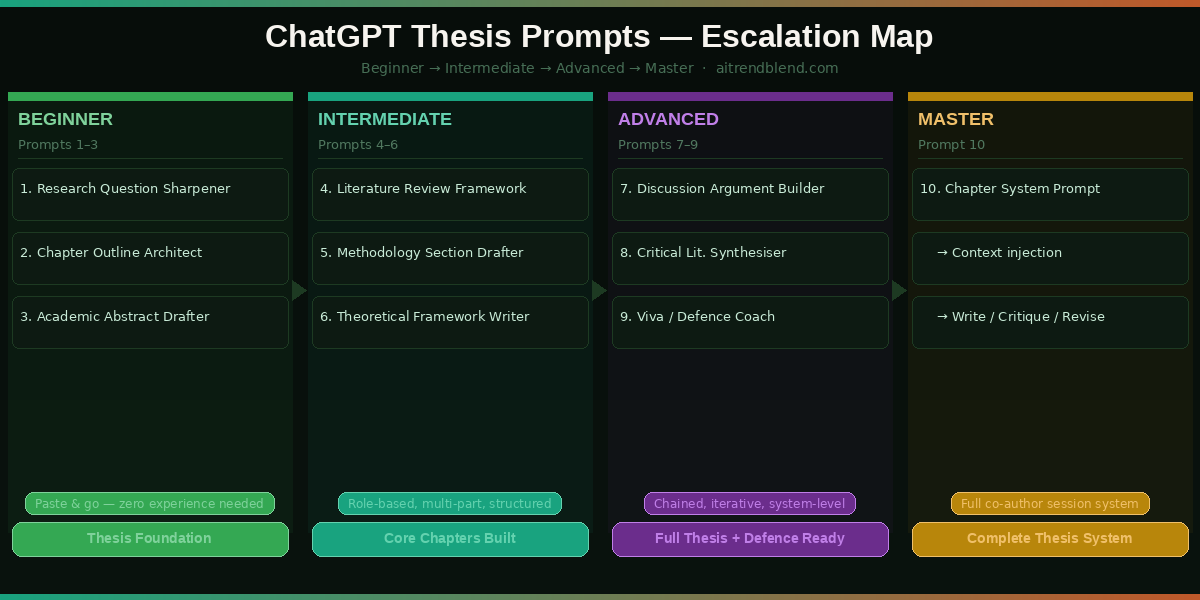
Whether you are three months out from submission or staring down a two-week deadline, these prompts will help you move. From sharpening your research question to drafting your methodology chapter, from building a literature review framework to preparing your defence talking points — there is a prompt here for every phase of the thesis process. By the time you reach Prompt 10, you will have a system, not just a tool.
Why ChatGPT Handles Thesis Writing Differently Than Other AI Tools
Most AI writing tools are optimised for speed and marketability — they produce polished-sounding text that is good for landing pages, product descriptions, and newsletter copy. Academic writing requires something different. It demands hedging (“this suggests” rather than “this proves”), consistent citation awareness, logical argument threading across thousands of words, and an understanding of disciplinary conventions that vary by field.
ChatGPT — particularly on GPT-4o and GPT-5 — handles this unusually well for one reason: it has processed an enormous volume of academic text and learned the structural patterns that distinguish a graduate thesis from a university essay. Ask it to write a methodology section for a qualitative study and it will naturally reach for terms like “thematic analysis,” “reflexivity,” “purposive sampling,” and “member checking” — not because you told it to, but because those are the words that belong there. Gemini produces solid academic output too, but ChatGPT’s Custom Instructions feature lets you lock in your thesis context permanently, which means you stop re-explaining your research question with every new conversation.
There is one more thing worth naming. ChatGPT’s Advanced Data Analysis tool — the one that runs Python in a sandboxed environment — can actually help you run and describe your statistical results, not just write about them. If you are doing quantitative research, that is a meaningful edge over tools that can only describe data you paste in as text.
ChatGPT’s advantage for thesis writing comes from three things working together: its deep training on academic text, the Custom Instructions feature for persistent thesis context, and the Data Analysis tool for quantitative chapters. Use all three deliberately.
Before You Start: How to Get the Best Results
Before you paste a single prompt, there are three setup steps that will dramatically improve your results. Skip them and you will spend half your time correcting output that does not know what your thesis is actually about.
Set your Custom Instructions. Go to Settings → Personalization → Custom Instructions in ChatGPT. In the first box, write two to three sentences about your thesis: your field, your research question, your methodology, and your target audience (your committee). In the second box, tell ChatGPT to write in formal academic English, use hedging language, avoid bullet points in prose sections, and cite sources as “[Author, Year]” placeholders. You set this once and every conversation inherits it automatically.
Use GPT-4o or GPT-5 only. The older GPT-3.5 model is not suited to academic writing at the master’s level. GPT-4o handles complex multi-part prompts reliably. GPT-5 is even stronger on long-form reasoning and argument coherence. If you are on the free tier, consider upgrading at least for the month of heavy writing — the quality difference in thesis-specific tasks is real.
Upload your sources. ChatGPT with file uploads enabled allows you to attach PDFs of your key papers. When you do, the model reads them and can help you identify arguments, extract relevant quotes, and compare methodological approaches across sources. This is particularly useful for the literature review prompts in this guide (Prompts 4 and 5).
The 10 Best ChatGPT Prompts for Writing a Master Thesis
Prompt 1: The Research Question Sharpener
Most master’s students begin with a topic, not a question — and that distinction trips up more people than almost any other part of the process. “Climate change and urban policy” is a topic. “To what extent have municipal flood-risk disclosure requirements in post-2020 coastal cities influenced residential property investment patterns?” is a research question. ChatGPT can bridge that gap faster than three meetings with your supervisor, as long as you give it the right scaffold to work from.
Prompt 2: The Chapter Outline Architect
Before you write a single paragraph, you need a map. An outline that your committee would recognise as structurally sound, not a rough list of section ideas you jotted down at 2 AM. This prompt gives you a full, field-appropriate chapter structure in under two minutes — complete with word counts per section, which is something most students never think about until they are 8,000 words in and have barely touched their methodology.
Prompt 3: The Academic Abstract Drafter
The abstract is the last thing most people write and the first thing everyone reads — including your committee, your external examiner, and anyone who might cite your work later. A good abstract is not a summary. It is a precision instrument: 250–300 words that tell the reader exactly what you studied, how you studied it, what you found, and why it matters. Getting those four elements balanced takes more skill than most students expect, and ChatGPT is surprisingly good at it when you give it the right inputs.
Prompt 4: The Literature Review Framework Builder
The literature review is where most master’s students lose weeks. The problem is not lack of sources — it is not knowing how to organise what you have found. Do you structure it chronologically? Thematically? By methodology? By theoretical framework? The answer depends on your field and your research question, and the wrong choice produces a chapter that reads like an annotated bibliography rather than a scholarly synthesis. This prompt helps you build the skeleton before you write a single sentence.
Prompt 5: The Methodology Section Drafter
The methodology chapter intimidates people because it requires confident justification. You are not just describing what you did — you are arguing for why you did it that way and why the alternatives were less appropriate. That argumentative structure is what separates a defensible methodology from a flat procedural description. ChatGPT writes this structure naturally when you give it the right information and tell it to write with justification, not just description.
Prompt 6: The Theoretical Framework Explainer
The theoretical framework section is one of the most misunderstood parts of a master’s thesis. Students often confuse it with the literature review, or they write a theory summary that floats disconnected from the rest of the thesis. Your theoretical framework should do one thing clearly: explain which lens you are using to look at your research problem, why that lens is appropriate, and how it will shape your analysis. This prompt produces exactly that — a section that connects your chosen theory to your specific research question in a way that feels organic rather than bolted on.
Prompts 1–6 give you your question, structure, abstract, literature review framework, methodology, and theoretical grounding. Before moving to the advanced prompts, check your outline is approved by your supervisor. Everything from Prompt 7 onward builds on that foundation.
“The difference between a thesis that passes and one that excels is almost never the quality of the data. It is the quality of the argument built around the data — and that argument lives in the writing.”
— Common advice in graduate writing centres across top universities
Prompt 7: The Discussion Chapter Argument Builder
The discussion chapter is where your thesis either comes alive or falls flat. It is not a place to restate your findings — it is the place to tell the reader what your findings mean, how they connect to or challenge what you found in the literature, and what implications they carry. Most students write discussion chapters that are too descriptive and not interpretive enough. This prompt is structured specifically to produce an argumentative discussion that your committee will recognise as intellectually independent.
Prompt 8: The Critical Literature Synthesiser (Chained Prompt)
Most literature reviews summarise sources one by one. Good literature reviews synthesise them — finding the debates between scholars, the methodological disagreements, the patterns across decades of research, and the gap your thesis fills. This is the cognitive work that separates a graduate-level review from an undergraduate one. The chained approach below teaches ChatGPT to do this properly: first analyse, then compare, then synthesise.
Prompt 9: The Viva / Defence Preparation Coach
Writing the thesis is one challenge. Defending it is another. In a viva voce or thesis defence, examiners are not just testing whether you know your material — they are probing whether you understand the limits of your own work and can defend your choices under pressure. This prompt turns ChatGPT into a simulated examiner who asks exactly the uncomfortable questions you need to have good answers for before you walk into that room.
Prompt 10: The Master Thesis Chapter System Prompt
This is the prompt you use when you are sitting down to draft a complete chapter from scratch and you want ChatGPT to function as a true co-author rather than an autocomplete engine. It integrates every technique from the previous nine prompts — role assignment, context injection, structural scaffolding, justification requirements, hedging instructions, and iteration protocol — into a single system-level prompt that you can use for any chapter of your thesis. This is what expert-level academic prompt engineering actually looks like.
Common Mistakes and How to Fix Them
These are the five most consistent mistakes I see when students use ChatGPT for thesis writing — not because the tool is bad, but because the prompts are under-specified. Each one has a straightforward fix.
Mistake 1 — Asking for the whole chapter at once. Prompting “write my literature review” produces generic, unfocused text. ChatGPT needs constraints: themes, word count, your specific argument. Break the request into sections and give it one at a time.
Mistake 2 — Accepting the first draft. ChatGPT’s first output is a starting point, not a finished product. The command “critique this for argument strength, then rewrite it” almost always produces a measurably better second draft. Most students do not ask for the second draft.
Mistake 3 — Not specifying the writing register. Without instructions, ChatGPT defaults to a semi-formal tone — acceptable for a blog, wrong for a thesis. Always include “formal academic English, third person, hedging language” in every prompt.
| Mistake | ❌ Wrong Approach | ✅ Right Approach |
|---|---|---|
| Too vague | “Write my methodology chapter” | “Write a 1,800-word methodology for a qualitative case study using semi-structured interviews. Justify each choice against alternatives.” |
| No register instruction | “Explain my theoretical framework” | “Write in formal academic third person. Use hedging. No bullet points. 800 words. Connect the theory to my research question explicitly.” |
| One-shot drafting | Accept the first draft as final | “Now critique this section for argument strength. Then rewrite it addressing your own critique.” |
| No context carried forward | Start every chat with a vague question | Use Prompt 10’s system context at the start of every session so ChatGPT always knows your thesis |
| Trusting citations | Use ChatGPT’s suggested references verbatim | Ask for [?] flags and verify every citation independently — ChatGPT still occasionally hallucinate publication details |
What ChatGPT Still Struggles With for Thesis Writing
Honest review means naming real limitations — and there are several worth knowing before you rely on ChatGPT heavily for your thesis.
The most significant one is citation reliability. Even in 2026, ChatGPT will occasionally generate a plausible-looking reference that does not exist. The author may be real, the journal may be real, and the paper title may sound exactly right — but when you search for it, you find nothing. This is not common, but it happens, and the consequences of citing a hallucinated source in an academic thesis are serious. The rule is simple: every single reference ChatGPT provides needs to be verified against a real database (Google Scholar, PubMed, JSTOR) before it appears in your bibliography.
The second limitation is original argument. ChatGPT synthesises existing knowledge brilliantly but generates genuinely novel theoretical contributions poorly. If your thesis requires an original conceptual model, a new typology, or a theoretical intervention that is not already present in the literature, ChatGPT can help you articulate it once you have conceived it — but it will not conceive it for you. The intellectual originality that earns distinction marks is still yours to supply. Think of the tool as an exceptionally well-read research assistant: it knows the field, but the insight comes from you.
Finally, there is the discipline-specificity gap. ChatGPT performs unevenly across academic fields. It is excellent for social sciences, business, education, and humanities. It is considerably weaker in highly specialised scientific domains, clinical research, and fields where the literature is primarily published in languages other than English. If your thesis sits at the intersection of a niche subdiscipline and a non-English corpus, expect to do significantly more editorial work on the output.
Start Writing — One Prompt at a Time
What you have walked away with is not just ten prompts. It is a working philosophy for using AI in graduate-level academic work — one that keeps you in the driver’s seat while dramatically reducing the friction that makes thesis writing feel so isolating. The prompts escalate deliberately: from sharpening your question to building your outline, from drafting your methodology to synthesising your literature, from preparing your defence to running a complete chapter system. Each one builds on the last, and together they cover every major phase of the thesis process.
There is a broader principle underneath all of this. The quality of your output from ChatGPT is directly proportional to the quality of your thinking going into the prompt. That means the tool actually rewards students who understand their own thesis well — and exposes those who do not. In that sense, it is an honest mirror for your academic preparation. Students who use it lazily get generic, forgettable text. Students who use it with the kind of specificity these prompts model get something much closer to a genuine intellectual scaffold.
None of this replaces the human judgment that thesis writing ultimately requires. Your committee will ask questions that no prompt can anticipate. Your data will produce surprises that no framework can pre-empt. Your supervisor’s feedback will send you back to chapters you thought were finished. The final synthesis — the argument that runs through your thesis like a thread — is yours to construct, and it requires the kind of sustained, disciplined thinking that only you can do. ChatGPT cannot defend your research question on the day of your viva. You can.
The tools available to researchers in 2026 are meaningfully better than what existed two years ago, and the gap between students who use them strategically and those who use them naively is growing. GPT-5’s ability to maintain long-form academic context, reason about methodology, and engage with theoretical nuance is already at a level that would have seemed implausible in 2023. Where this heads in the next eighteen months — particularly around real-time literature retrieval and structured argument evaluation — will reshape how postgraduate research is conducted. Use these prompts now, build the habits, and you will be positioned to adapt as the tools do.
Try These Prompts Right Now
Open ChatGPT with GPT-4o or GPT-5, set your Custom Instructions, and paste Prompt 10’s system context to get started. Your thesis will not write itself — but it will move a lot faster.
Prompts tested on ChatGPT (GPT-4o and GPT-5) as of March 2026. Results may vary by model version and topic complexity. Always verify all citations and factual claims independently. This article represents original editorial content by AITrendBlend and is not affiliated with OpenAI.