
AI Governance for Enterprise Teams: Frameworks That Actually Work
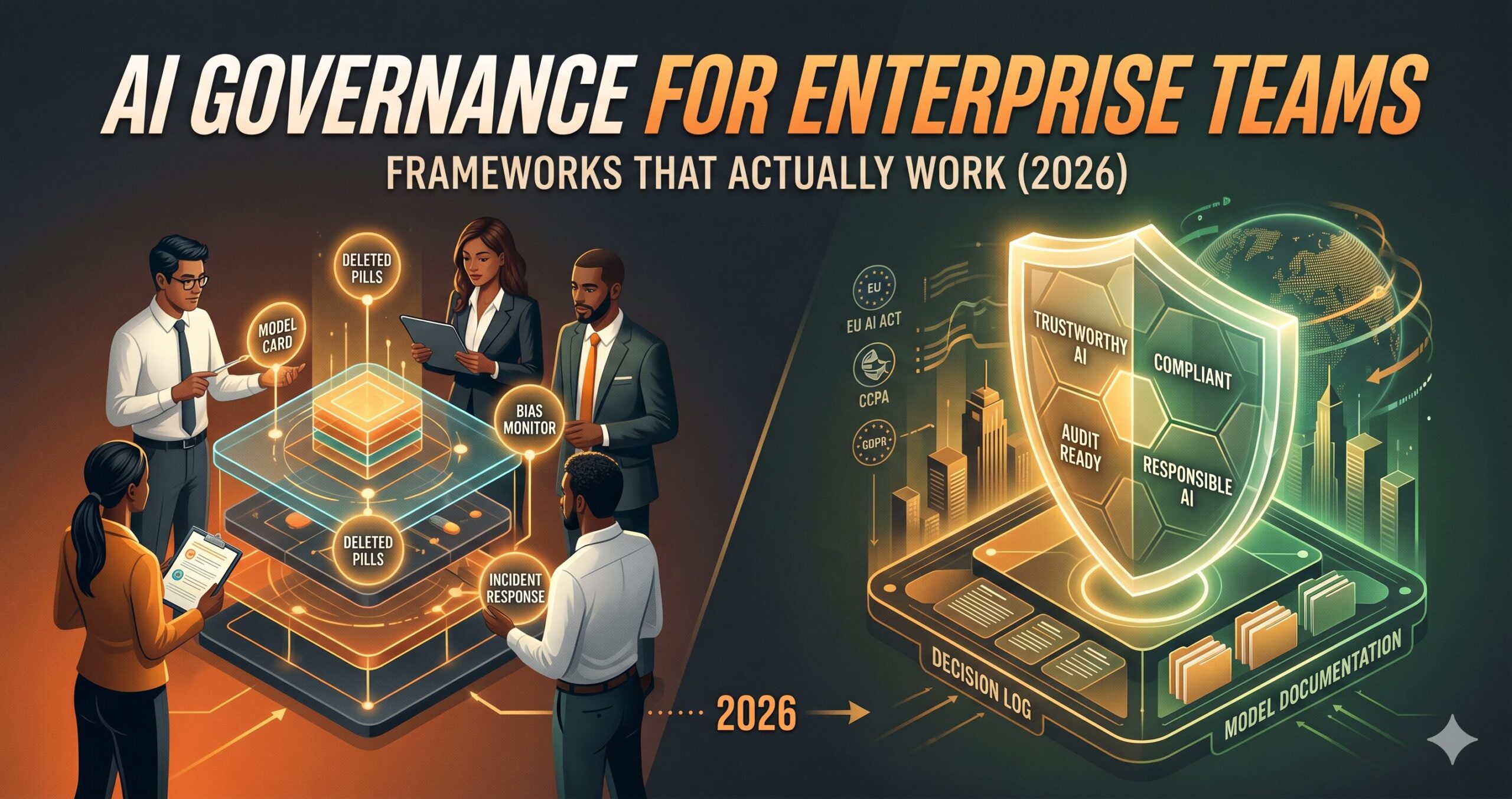
Most enterprise AI governance programs consist of a policy PDF in SharePoint that nobody reads, a quarterly review meeting that gets canceled half the time, and a “Responsible AI Principles” page on the website that Marketing wrote. When regulators, auditors, or a plaintiff’s attorney show up asking questions about a specific AI decision made fourteen months ago, none of that helps.
Marcus Chen got the call on a Tuesday afternoon. He was VP of Engineering at a regional financial services company — the kind of organization that had quietly deployed AI for a lot of things over the past two years: a loan application scoring system, a customer churn prediction model, an automated document review tool. Legal called to tell him that a customer’s attorney had filed a discovery request. They wanted documentation showing exactly how the AI system had made decisions affecting the customer’s credit over the previous fourteen months.
There was no documentation. There was no decision log. There was no model card. The system had been deployed by a team that has since been restructured, and nobody remembered which version of the model was running when. Marcus had thirty days to produce records that had never been created.
The discovery request is one of the worst ways to learn you needed an AI governance framework. The better ways — a near-miss bias incident flagged internally, a proactive regulatory inquiry, a competitor’s public scandal that makes the board ask questions — still hurt, but at least you have time to respond thoughtfully. Marcus had none of that time. What he needed was the governance infrastructure that would have prevented the problem entirely, and he needed it retroactively, which is impossible.
This article is about building that infrastructure before it’s too late — not as compliance theater, but as the operational discipline that makes AI deployments trustworthy, auditable, and defensible.
Why Most Enterprise AI Governance Programs Don’t Actually Work
The failure mode of enterprise AI governance is well-documented by now. An organization assembles a working group, produces a principles document (“We commit to fairness, transparency, and accountability”), sets up a governance committee that meets quarterly, and considers the job done. When something goes wrong — a biased output, a regulatory inquiry, a harmful decision — the principles document cannot produce an audit trail, the quarterly committee has no record of ever reviewing the specific system in question, and the accountability line points nowhere useful.
The gap is between policy and operations. A governance policy is a statement of intent. Operational governance is the infrastructure that enforces that intent automatically, continuously, and in ways that produce evidence. The distinction matters because intent is not auditable and evidence is.
Here is the real test. Pick any AI system your organization has in production right now and try to answer these six questions without looking anything up: What is the system trained to do, and what is it explicitly not designed for? Who approved its deployment, and when? What version of the model is currently running? When was it last validated against production data? What happens when it produces a low-confidence output? And who can be held accountable if it makes a harmful decision?
Most organizations cannot answer all six for most of their AI systems. That is not a policy problem — those organizations probably have perfectly adequate AI principles documents. It is an operational infrastructure problem. The policy says the system should be documented; the infrastructure for creating, storing, versioning, and retrieving that documentation does not exist.
The question to ask about any AI governance program is not “do we have a policy?” but “can we answer an auditor’s questions about any AI system we have deployed, within 24 hours, with documented evidence?” If the answer is no, the governance exists on paper only.
The Four-Layer Governance Stack
Operational AI governance is not one thing — it is four distinct layers that build on each other. The layers are sequential: you cannot effectively monitor what you have not documented, you cannot enforce access controls without knowing what systems exist, and you cannot respond to incidents without pre-defined procedures. Organizations that skip to the top layer — “let’s set up monitoring” — without the layers below it are building on sand.
Layer 1 — Model Documentation
Model cards, risk tier classifications, intended and out-of-scope uses, known limitations, training data provenance. The foundation every other layer builds on.
Layer 2 — Deployment Controls
Who can deploy AI systems, under what conditions, with what sign-off chain. Approval requirements scale with risk tier. Unapproved deployments are detectable.
Layer 3 — Monitoring & Audit Trails
Continuous performance tracking, decision logging for high-risk systems, drift detection, bias monitoring at defined intervals. Evidence generation is automated.
Layer 4 — Incident Response
Pre-defined response procedures for AI failures classified by severity. Communication templates. Recovery criteria. Lessons-learned loops that feed back into Layer 1.
AI Risk Classification Matrix — Autonomy Level vs. Business Impact
Human reviews outputs
No human in loop
Enhanced monitoring
Bias testing required
Human approval gates
Regulatory notification
Standard logging
Basic documentation
Performance tracking
Model card required
The maturity model that underlies this stack has five levels. Most organizations discover they are at Level 1 (policy exists on paper) when they encounter their first serious governance challenge. The goal for most enterprises in 2026 should be Level 3 — operational governance with continuous monitoring — within twelve months, with a path to Level 4 for high-risk systems.
Before You Start: The Governance Prerequisites Most Teams Miss
Two prerequisites consistently separate governance programs that work from governance programs that produce paperwork. Neither is complicated, but both require deliberate organizational decisions that do not happen automatically when an AI team ships its first model.
Conduct an AI Inventory Before Writing Any Policy
You cannot govern systems you do not know exist. The shadow AI problem — consumer AI tools used on company data, departmental tools procured without IT visibility, AI features embedded in SaaS subscriptions — is almost universally underestimated. Before your governance framework has a single policy, run an inventory. Ask every department head: what AI tools does your team use, including tools they didn’t procure through IT? The answers are almost always surprising. One financial services firm running this exercise found 23 AI-adjacent tools in active departmental use that IT had no record of — including three that were processing customer data through consumer-grade API endpoints with no DPA in place. Governance starts with inventory, not policy.
Assign Model Owners Before Assigning Compliance Obligations
Every AI system in production needs a named human who is accountable for it. Not a team, not a department — a person. That person is responsible for ensuring the model card is current, for reviewing monitoring alerts, for initiating bias audits on schedule, and for being the first call when an incident occurs. Without named model ownership, governance obligations diffuse across the organization and nobody acts on them. The model owner does not need to be a senior executive — a mid-level engineer or product manager is often the right choice — but the role must be explicit, documented, and reflected in that person’s performance goals. Governance without accountability is decoration.
Map Your Regulatory Obligations Before Designing Your Framework
The EU AI Act, GDPR’s automated decision-making provisions, CCPA, HIPAA, FCRA, EEOC disparate impact requirements, SEC AI guidance — the regulatory landscape for enterprise AI in 2026 is layered, jurisdiction-specific, and changing faster than most governance frameworks can track. Before designing your internal framework, map which regulations actually apply to each of your AI systems. A loan scoring model deployed in California for EU citizens triggers FCRA, CCPA, and potentially GDPR Article 22 simultaneously. A hiring AI tool is subject to EEOC disparate impact analysis. A medical documentation tool is in HIPAA scope. Your governance framework should be designed around the most demanding regulatory requirement that applies to each system — not around an average or a lowest-common-denominator standard.
10 Prompts for Building Enterprise AI Governance
These prompts build the actual artifacts of an operational governance program — the inventory, the model cards, the risk classifications, the policies, the audit trail architecture, and the incident response playbooks. Use them in sequence when standing up governance for the first time, or individually to fill specific gaps in an existing program.
Prompt 1: AI System Inventory Audit
The governance program starts here. Before any documentation or policy work, you need to know what AI systems your organization actually has in production — including the ones that were deployed quietly by individual teams and the ones embedded in SaaS tools that nobody thought to flag. This prompt produces a structured inventory template and forces the uncomfortable question about shadow AI.
Why It Works: The shadow AI section is what makes this prompt valuable. Most governance efforts focus on known, formally deployed systems and leave the informal AI usage entirely ungoverned. A data analyst pasting customer records into ChatGPT to generate summaries is using AI on company data with no oversight — and that use case will not appear in any IT asset registry. Surfacing it is the first act of real governance.
How to Adapt It: Run this prompt with each department head individually rather than once for the whole organization. Department-specific prompts surface more honest answers because they focus on tools that team members actually use rather than asking about a universe of possibilities.
Prompt 2: Model Card Generator
A model card is the foundational governance document for any AI system — the record that answers the most important questions about what a system is, what it is designed to do, what it is not designed to do, and what is known about its limitations and failure modes. Most teams do not create model cards because nobody has told them what to include. This prompt produces a complete, audit-ready model card from basic system information.
Why It Works: Section 2’s explicit out-of-scope use definition is the most legally protective field in the entire model card. When a system is used for a purpose its model card explicitly states it was not designed for, accountability shifts from the AI system to the person who made that deployment decision. Without the out-of-scope definition, the model card cannot draw that line.
How to Adapt It: For third-party models (models you license from a vendor), use the same prompt but replace training data and evaluation fields with a “Vendor-Provided Documentation” section noting what the vendor has and has not disclosed — and a gap analysis of what is missing for your governance requirements.
Prompt 3: AI Risk Classification Framework
Not every AI system needs the same governance intensity. A low-stakes content recommendation tool and a fully autonomous loan application decision engine cannot be governed identically without either over-burdening low-risk deployments or under-protecting high-risk ones. This prompt classifies any AI system across five risk dimensions and produces a tiered governance recommendation with justification.
Why It Works: The regulatory exposure dimension catches the systems that look low-risk from an engineering perspective but carry significant legal obligations. A low-volume, low-automation tool that processes health data is a HIPAA compliance obligation regardless of how benign its outputs seem. The scoring forces that exposure into the classification rather than letting it be treated as a detail for Legal to handle separately.
How to Adapt It: Create a batch version that classifies your entire AI inventory in one pass: paste the full inventory table from Prompt 1 and ask for a risk tier for each row, then sort by tier to produce a prioritized governance roadmap.
Prompt 4: Governance Policy Drafter
Once systems are inventoried and classified, you need policy documents that are actually usable by the people who deploy and operate AI systems — not documents written for lawyers that engineers ignore. This prompt produces a governance policy that is detailed enough to be enforceable and plain enough to be read.
Why It Works: Section 8 is where most governance policies fail — they state requirements without specifying what happens when those requirements are ignored. An enforcement clause that names an investigation process and a documentation requirement for violations changes the policy from aspirational to operational. Engineers who know that unapproved deployments are investigated behave differently from engineers who know that unapproved deployments are mildly discouraged.
How to Adapt It: Generate separate policies for each risk tier — LOW, MEDIUM, HIGH, CRITICAL — with requirements that scale appropriately. A four-tier policy architecture is cleaner than one catch-all policy with exceptions carved out for every scenario.
Prompt 5: Bias Audit Protocol Designer
Bias auditing is required for any AI system that makes decisions affecting people in protected categories — which, in practice, is most enterprise AI that touches customers, employees, or applicants. The protocol is not optional in regulated industries; it is the evidence that demonstrates due diligence when a disparate impact claim is raised. This prompt designs a complete, statistician-grade audit protocol from scratch.
Why It Works: The pass/fail criteria section is the hardest part to write without a template, and the most important part to have in writing before the audit runs — not after. An organization that runs a bias audit and then decides the threshold based on whether they passed has not conducted a bias audit. They have conducted a public relations exercise. Pre-specified thresholds with documented justification is what makes an audit legally defensible.
How to Adapt It: Schedule bias audits in advance by adding them to your AI system’s model card as a recurring obligation — “bias audit required semi-annually” — and building the protocol into the monitoring layer of the governance stack. Ad hoc auditing is better than none, but scheduled auditing is what survives regulatory scrutiny.
Prompt 6: AI Incident Response Playbook
The question is not whether an AI system will produce a harmful or unexpected output. It will. The question is whether the organization has a pre-specified response that moves quickly, communicates appropriately, and contains the damage — or whether it improvises under pressure and makes every decision worse. This prompt produces a complete incident response playbook before the first incident occurs.
Why It Works: The communication templates are the part most teams discover they need only when an incident is actively happening and someone is asking “what do we tell customers?” Writing templates under pressure, with Legal hovering and a clock ticking, produces bad communications. The templates need to exist before the incident, reviewed by Legal in advance, with the blanks already identified. The playbook is the pre-work that buys you clear thinking when you need it most.
How to Adapt It: Create a Tier 3 war game once a year — run a tabletop exercise where a senior team simulates a critical incident response using the playbook. Every exercise will reveal at least two gaps in the document. Update it after each exercise. A playbook that has been war-gamed is worth ten times a playbook that has only been written.
Prompt 7: Decision Audit Trail Architecture
For high-risk AI systems, particularly those making decisions that affect individuals — credit, hiring, healthcare, legal — the ability to reconstruct any decision from any point in the past is not optional. This prompt designs the technical architecture for decision logging that satisfies both auditability requirements and data minimization obligations simultaneously.
Why It Works: Component 3 is where most audit trail implementations fail in practice. Teams either log everything — including raw PII — and create a privacy liability, or log nothing sensitive — and produce an audit trail that cannot actually reconstruct decisions for individuals. The right design separates the decision record from the personal data, links them with an encrypted identifier, and allows retrieval only through a controlled interface with appropriate access logging. That design satisfies both the auditor and the privacy officer.
How to Adapt It: For very high volume systems (millions of decisions per day), add a tiered logging strategy: full decision records for a statistical sample (say, 10%), lightweight records for the rest, and full records automatically triggered for any output in the high-confidence anomaly range or that triggers an escalation rule.
Prompt 8: Regulatory Compliance Gap Analysis
The EU AI Act, GDPR’s automated decision provisions, CCPA, FCRA, HIPAA, and US state AI laws create an overlapping web of requirements that most enterprise AI deployments have never been formally mapped against. This prompt produces a regulation-by-regulation compliance gap analysis and a prioritized remediation roadmap.
Why It Works: The multi-regulation analysis is what makes this prompt genuinely useful in enterprise settings, where it is rare for a single framework to be the only applicable one. A customer-facing AI tool processing California resident data for a US financial services company almost certainly triggers CCPA, FCRA, and potentially CFPB guidance simultaneously. Seeing all three sets of requirements in a single gap analysis — rather than analyzing each in isolation — surfaces conflicts and redundancies that each analysis alone would miss.
How to Adapt It: Run this prompt annually for every HIGH and CRITICAL tier system, since the regulatory landscape changes faster than most governance programs update. A compliance gap analysis that was accurate when the EU AI Act enforcement began may not reflect subsequent guidance or national implementing legislation.
Prompt 9: Third-Party AI Vendor Assessment
When you purchase an AI tool, integrate an AI API, or embed an AI-powered SaaS product into a business-critical process, the governance obligations do not transfer to the vendor. Your organization remains responsible for how AI affects your customers, employees, and data subjects — regardless of who built the model. This prompt produces a vendor due diligence framework that surfaces the governance gaps in third-party AI before procurement rather than after deployment.
Why It Works: The “can our data be used to train future models” question in Dimension 2 is the one that catches most procurement teams off guard. Many consumer-grade AI APIs and SaaS products include terms that allow training on customer-submitted data by default. For enterprise deployments processing personal data, that training data clause creates a GDPR secondary processing problem that no DPA can retroactively fix. Finding it before signing the contract costs nothing. Finding it after a year of production use is expensive.
How to Adapt It: Create a vendor registry that stores completed assessment reports alongside procurement decisions. When a vendor’s product is up for renewal, run a delta assessment — what has changed since the last assessment — rather than a full reassessment. Governance debt in vendor relationships compounds quietly; catching it at renewal cycles prevents it from accumulating.
Prompt 10: Enterprise AI Governance Program Blueprint
The master prompt. This produces a complete governance program specification — not a policy document, but the full operational architecture including structure, processes, monitoring, incident response, training, and a twelve-month maturity roadmap. Use it to stand up a governance program from scratch, or to audit an existing program against a comprehensive standard.
Why It Works: Component 7 — training and culture — is the one most governance programs treat as optional, and it is the one that determines whether the program is self-sustaining or dependent on a small team of governance specialists who become bottlenecks. A governance culture where engineers voluntarily flag concerns early is worth more than any monitoring system. You build that culture through training, through visible leadership commitment, and through making the governance process easy enough that compliance is the path of least resistance rather than an obstacle to shipping.
How to Adapt It: After using this prompt to generate an initial blueprint, run it again in six months with an updated “Current Governance State” field reflecting what you have actually implemented. Use the gap between the two outputs as your next sprint’s governance backlog. Governance programs that improve iteratively are more durable than ones that attempt to build the final state all at once.
Five Governance Failures That Sink Enterprise AI Programs
Enterprise AI governance programs fail in recognizable patterns. The failures below are the ones that appear most consistently in post-incident reviews — each is predictable, each is preventable, and each has been the proximate cause of at least one significant regulatory action or public incident in the past two years.
| Failure Pattern | What It Looks Like | How to Prevent It |
|---|---|---|
| Governance as theater |
WRONG Policy documents exist and are reviewed annually. There is no mechanism to verify compliance, no audit trail of what was checked, and no consequence for non-compliance. The program demonstrates effort without producing evidence. |
RIGHT Governance produces verifiable artifacts: model cards, signed approval records, monitoring dashboards, audit reports. Every governance obligation has an associated artifact that proves it was met — not a verbal assurance. |
| One-size risk treatment |
WRONG Every AI system goes through the same review process regardless of risk tier. High-risk systems get insufficiently scrutinized; low-risk systems create unnecessary bureaucratic friction. Teams route around the governance process to ship faster. |
RIGHT Risk tier classification determines governance intensity. LOW systems have a lightweight review. CRITICAL systems require external audit before deployment. The process scales with the stakes — not with the team’s patience for process. |
| Ignoring third-party AI |
WRONG The governance program covers internally built models but treats purchased AI tools as the vendor’s responsibility. Third-party AI making decisions about customers is treated as out of scope. Regulatory obligations do not recognize this distinction. |
RIGHT All AI making consequential decisions — whether built internally or purchased — is in governance scope. Third-party AI goes through vendor assessment (Prompt 9) and is added to the AI registry with appropriate risk classification. |
| No pre-specified incident response |
WRONG When an AI system produces a harmful output, the organization improvises its response under pressure — with Legal, Engineering, Comms, and Leadership each wanting to take a different action and no agreed decision framework. Response is slow, inconsistent, and incomplete. |
RIGHT Every HIGH and CRITICAL system has a completed incident response playbook before it goes to production. Communication templates are drafted, reviewed by Legal, and stored where everyone who needs them can find them at 2:00 a.m. |
| Governance divorced from engineering |
WRONG The governance program is managed by a risk or compliance team with no integration into the engineering workflow. Engineers learn about governance requirements at deployment review — too late to address structural issues without a costly rewrite. |
RIGHT Governance checkpoints are embedded in the engineering workflow — as early as the design phase, not at deployment review. Model cards and risk classifications are started when a system is designed, not filed after it ships. |
The most expensive governance failures are the ones that were known risks and not addressed. Post-incident reviews almost always surface a monitoring alert that fired without triggering action, a model card that was never created, or a bias audit that was scheduled and then deferred. Governance infrastructure only protects you if it runs.
What Enterprise AI Governance Still Cannot Solve in 2026
Every honest governance article has to include the limitations — not as a disclaimer, but because overstating what governance can achieve creates complacency in the exact situations where vigilance matters most.
Governance frameworks assume you can anticipate failure modes in advance. Emergent AI behaviors — outputs or decision patterns that were not predictable from the model’s design or training data — are definitionally difficult to govern proactively. The best-designed audit trail in the world captures what happened; it does not prevent unexpected behavior from happening in the first place. Governance is a detection and response capability, not an elimination capability. Teams that treat it as the latter are surprised when their well-governed system produces a genuinely novel failure.
The global regulatory landscape is fragmenting faster than frameworks can track. What satisfies the EU AI Act’s High Risk requirements for a biometric system may not satisfy Colorado’s AI consumer protections or New York City Local Law 144’s specific requirements for automated employment decision tools. A governance framework designed for one jurisdiction is not automatically compliant in another, and the laws are being written faster than the legal guidance needed to implement them clearly. Regulatory compliance mapping (Prompt 8) needs to be a living document, not a one-time analysis.
The hardest part of AI governance is not writing the policy. It is getting engineering teams to treat the audit trail as load-bearing infrastructure rather than optional documentation — something you build before you ship, not after the regulator asks for it.
— Enterprise compliance director, financial services, 2026
Explainability remains a genuine technical limitation for certain model architectures. A governance framework can require that AI decisions be explainable to affected individuals — and should. But for some model types, the explanation produced is an approximation of the decision process, not a true reconstruction of it. Governance can require explanation; it cannot require that explanation to be technically accurate in every case. Any governance program that relies on self-generated explanations as its primary audit mechanism is depending on a capability that current AI cannot fully deliver.
Third-party model opacity is perhaps the most structurally intractable problem. When you consume a frontier LLM API, you do not have full visibility into training data, alignment techniques, behavioral changes between model versions, or the basis for specific outputs. You can govern your use of the model; you cannot govern the model itself. As enterprise AI increasingly depends on vendor-provided foundation models, governance programs need to account for the structural gap between the governance they can implement and the governance that would be required if the model were fully inspectable. Vendor assessment (Prompt 9) and contractual protections are the best available mitigations — but they are mitigations for opacity, not cures for it.
Marcus Chen’s organization eventually built the governance infrastructure that would have answered the discovery request in hours rather than requiring a desperate retroactive effort. The model cards, the decision logs, the risk classifications, the audit trail — none of it is technically complex. What made it hard was doing it across 23 AI systems that had been deployed over two years, retroactively, while the legal clock was running.
The organizations that get governance right in 2026 are not the ones with the most sophisticated governance committees or the most detailed policy documents. They are the ones that treated governance as an engineering discipline from the beginning — building documentation, logging, and monitoring into AI systems at design time rather than auditing for their absence after deployment. The cost of that up-front investment is measured in engineer-days. The cost of its absence is measured in legal fees, regulatory fines, and the specific, irreplaceable damage of having harmed people whose trust you were supposed to have earned.
Governance is not a constraint on building AI. It is the infrastructure that makes AI trustworthy enough to deploy at scale — and trustworthy enough to defend when the questions come, as they always eventually do.
Build Your AI Governance Program
Start with Prompt 1 — an AI inventory audit. Knowing what you have is the prerequisite for governing any of it.