
10 Best ChatGPT Prompts for Job Search (2026 Guide)
Beat ATS filters, write cover letters recruiters actually read, prep for behavioural interviews, and land more offers — with prompts that treat ChatGPT like the career coach it can be.
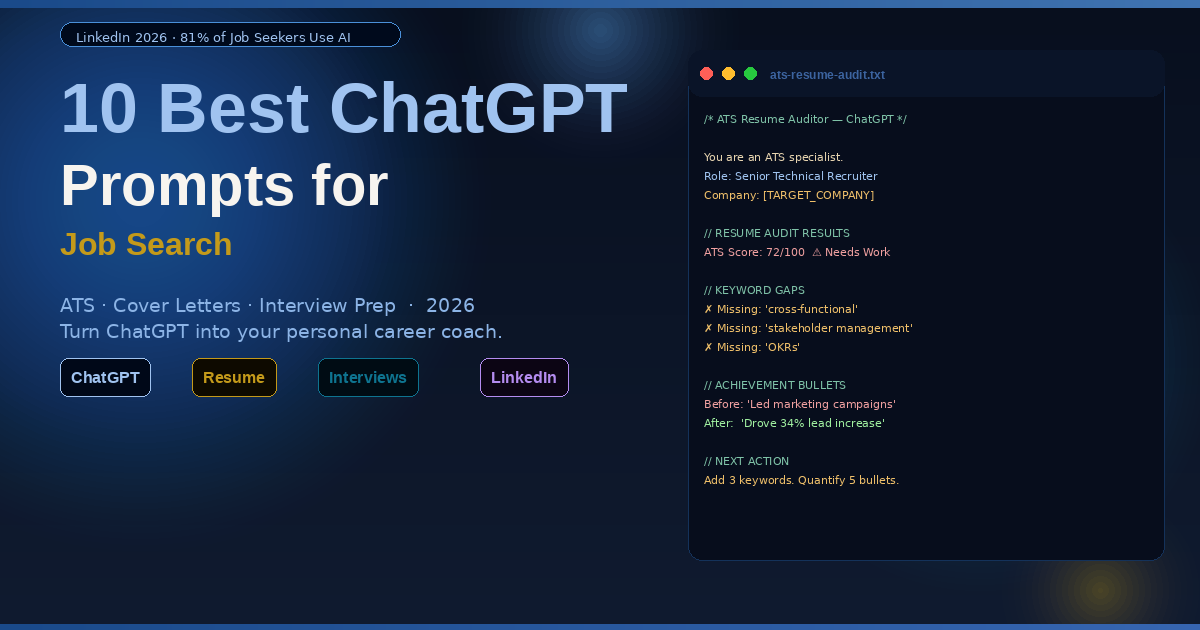
LinkedIn’s 2026 data is stark: 81% of job seekers have used or plan to use AI in their job search. That number sounds encouraging until you realise what most of them are actually doing — pasting their resume and asking for a rewrite, then submitting the same generic output that every other candidate is submitting. Recruiters have started recognising AI-written cover letters on sight, and ATS systems are getting better at flagging keyword-stuffed resumes that were clearly optimised by a tool without a human reading the result first.
The job seekers pulling ahead are the ones using AI differently — not to replace their voice, but to give them information and structure they would not otherwise have. They use ChatGPT to decode what a job description is actually looking for, to pressure-test their interview answers before the real conversation, to research salary ranges and craft negotiation scripts. That is a different category of use entirely, and the prompts below are built for it.
These ten prompts cover the full job search stack — from ATS optimisation to cold outreach to a master system prompt that turns ChatGPT into a persistent career advisor. Each one is designed to produce output that sounds like you wrote it, because you will need to edit and personalise every single output before it goes anywhere near a real application.
Why ChatGPT Has Become the Job Seeker’s Unfair Advantage
The modern job search has three brutal structural problems. First, ATS filters eliminate most resumes before any human reads them — estimates suggest 75% of applications never reach a recruiter’s inbox. Second, the sheer volume of applications means a recruiter who does see your resume spends an average of six seconds on the first pass. Third, interview prep is largely a solo activity where you are rehearsing answers without feedback, which means you are reinforcing your bad habits as much as your good ones.
ChatGPT addresses all three when prompted correctly. For the ATS problem, it can analyse a job description, extract the keywords and competencies the system will likely filter for, and audit your resume against that list — flagging gaps before you submit. For the six-second problem, it can restructure your bullet points around achievement language and quantifiable results rather than duties and responsibilities. For the interview problem, it can roleplay as the interviewer and give you feedback on your STAR answers in real time.
The job seekers winning with AI in 2026 are not the ones using it to write their applications — they are the ones using it to research, prepare, and iterate faster than candidates who do everything manually. The final output should always be your voice. ChatGPT provides the structure and the analysis.
Claude is worth an honest mention here: for analysing lengthy documents like annual reports or job description PDFs uploaded directly into the chat, Claude’s document handling is stronger. ChatGPT’s edge in the job search context is speed, breadth of examples, and the code interpreter for structured outputs like comparison tables and formatted resume bullet lists. For most candidates, ChatGPT-4o is the right starting point and the tool these prompts are built for.
Before You Start: Setup for Best Results
Use ChatGPT-4o. The free tier will produce noticeably weaker outputs for anything involving reasoning about job descriptions or constructing structured documents. The quality gap is significant for this use case specifically.
Keep your base resume in your clipboard. Many prompts below ask you to paste your current resume. Have a clean plain-text version ready — not the formatted Word file, but the text content. Copy it from your document as plain text so ChatGPT can read the content without formatting noise.
Always paste the full job description. Generic prompts produce generic output. The single biggest improvement you can make to every prompt below is feeding it the actual job description for the role you are targeting, not a summary you wrote from memory. The specific language in the JD is what the ATS is matching against.
Edit before you send. Every piece of output ChatGPT produces needs your fingerprints on it before it goes anywhere. Change the phrasing where it sounds formal or corporate. Add a specific example only you would know. Remove the filler sentences it defaults to when padding. The AI produces the structure and the starting point — you make it yours.
The 10 Best ChatGPT Prompts for Job Search
Prompt 1: The ATS Resume Auditor
Before you apply to anything, run your resume against the specific job description through this prompt. Most people submit the same resume to every role. That is why most resumes never pass the ATS filter — they are optimised for no role in particular, which means they are perfectly suited to getting rejected by all of them. This prompt closes that gap.
// Audit your resume against a specific job description

I am applying for a role. I need you to act as an ATS
(Applicant Tracking System) expert and audit my resume
against the job description below.

JOB DESCRIPTION:
[PASTE FULL JOB DESCRIPTION HERE]

MY CURRENT RESUME:
[PASTE YOUR RESUME AS PLAIN TEXT]

Please:
1. List the top 10 keywords/phrases from the JD that an
   ATS would likely score for — ranked by importance.
2. For each keyword, tell me: Present in my resume? (Y/N)
   If N, suggest where to naturally add it.
3. Identify the 3 skills or competencies most emphasised
   in the JD that are weakest in my resume.
4. Rate my current resume's ATS compatibility for this
   specific role on a scale of 1–10 with reasoning.
5. Give me a prioritised list of 5 edits that would raise
   that score the most.
Prompt 2: The Achievement Bullet Rewriter
The most common resume failure is writing bullets that describe what you were responsible for instead of what you actually delivered. “Managed social media channels” tells a recruiter nothing useful. “Grew Instagram following 340% in six months by launching a short-form video strategy” tells them a great deal. This prompt converts your duty-list bullets into achievement statements — but only if you give it your real numbers to work with.
// Transform duty descriptions into achievement statements

I need you to rewrite my resume bullet points as
achievement-focused statements. Use the formula:
[Action verb] + [What you did] + [Result/Impact with numbers].

MY CURRENT BULLETS FOR [JOB TITLE AT COMPANY]:
[PASTE YOUR CURRENT BULLET POINTS]

NUMBERS AND CONTEXT I CAN PROVIDE:
[E.g. Team size: 6. Budget managed: $240K.
Revenue impact: ~$1.2M pipeline. Time saved: 30%.
Projects completed: 12 in 8 months.]

Target role I'm applying for: [JOB TITLE]
Industry: [INDUSTRY]

Rules for rewriting:
- Every bullet must start with a strong past-tense action verb
- Every bullet must include a quantifiable result if I gave
  you numbers — do not invent figures I did not provide
- Keep bullets to one line each (under 20 words ideally)
- Do not use: "responsible for", "helped with", "assisted in"
- Write 2 versions of each bullet: punchy and detailed
Prompt 3: The Cover Letter That Does Not Sound Like AI
The most-requested thing from ChatGPT for job search is also the most commonly done badly. AI-generated cover letters are recognisable on sight to experienced recruiters — they are structurally correct, grammatically polished, and completely devoid of personality. This prompt is designed specifically to fight that tendency. It forces ChatGPT to write around your specific story, not a template.
// Write a cover letter that sounds like a real person wrote it

Write a cover letter for the role below. My non-negotiable
rule: it must not read like it was written by AI. No
"I am writing to express my interest." No "I believe my
skills align." No generic opening paragraph.

ROLE I AM APPLYING FOR: [JOB TITLE AT COMPANY]
JOB DESCRIPTION: [PASTE JD OR KEY REQUIREMENTS]

MY BACKGROUND:
- Current/recent role: [TITLE, COMPANY, N YEARS]
- Most relevant achievement for this role: [BE SPECIFIC]
- Why I actually want this role (honest reason): [YOUR REAL REASON]
- One thing about this company that genuinely interests me:
  [SPECIFIC — product, mission, recent news, not generic praise]
- My writing voice is: [DIRECT / WARM / FORMAL / CONVERSATIONAL]

FORMAT:
- 3 paragraphs, max 250 words total
- Open with a specific scene or observation, not my name
- Middle paragraph: one achievement that proves the main
  requirement from the JD
- Close with something specific about why this company
  matters to me, not a generic "I look forward to hearing"
Prompt 4: The LinkedIn Profile Optimizer
Most people treat their LinkedIn headline as a job title and their About section as a more formal version of their resume summary. Both are wasted opportunities. The headline is the first thing a recruiter reads when they find you in search results — it determines whether they click through. This prompt rebuilds both sections for search visibility and human appeal at the same time.
// Rebuild your LinkedIn headline and About section

Act as a LinkedIn profile consultant who has helped
300+ professionals get inbound recruiter messages.

MY CURRENT LINKEDIN:
- Current headline: [YOUR CURRENT HEADLINE]
- Current About section: [PASTE OR DESCRIBE]
- My target role/industry: [WHAT YOU WANT TO BE FOUND FOR]
- My strongest 3 skills or specialisms: [LIST THEM]
- Years of experience: [N]
- One career achievement I'm proud of: [BE SPECIFIC]
- My tone preference: [PROFESSIONAL / WARM / BOLD / UNDERSTATED]

Produce:
1. Three headline options (each under 220 characters)
   — one keyword-heavy, one achievement-led, one bold/punchy.
   Mark which has the best search visibility.
2. A rewritten About section (300–400 words) that:
   - Opens with a hook sentence about the problem I solve
   - Includes my top keywords naturally (not crammed)
   - Has a clear paragraph about what I am looking for
   - Ends with a specific call to action
3. Three keywords I should add to my Skills section
   that I am probably missing.
Prompt 5: The STAR Answer Generator
Behavioural interview questions — “Tell me about a time when…” — are the questions most candidates prepare for the least and perform on the worst. You know the question format is coming. You know roughly what the common questions are. Yet most people still freeze or ramble because they have not rehearsed structured answers. This prompt builds STAR answers from your actual experience in five minutes.
// Build STAR format answers from your real experience

I have an interview for a [JOB TITLE] role at [COMPANY TYPE].
Help me prepare structured STAR format answers.

MY BACKGROUND:
[BRIEFLY DESCRIBE YOUR EXPERIENCE — 3-4 SENTENCES]

THE ROLE REQUIRES (from JD): [LIST 3-4 KEY COMPETENCIES]

For each competency, produce a STAR answer using an
experience from my background:

SITUATION: [2-3 sentences — context, stakes, challenge]
TASK: [1-2 sentences — your specific responsibility]
ACTION: [3-4 sentences — what YOU specifically did,
         not "the team" — use "I" not "we"]
RESULT: [1-2 sentences — quantified outcome if possible]

Then add:
- A "what I learned" sentence I can add if asked a
  follow-up about development
- A flag if the answer sounds vague and needs a
  more specific example from me

Generate answers for these 5 competencies:
1. Leadership under pressure
2. Handling failure or setback
3. Cross-functional collaboration
4. [COMPETENCY FROM THE JD]
5. [COMPETENCY FROM THE JD]
Prompt 6: The Hard Question Simulator
Most interview prep tools help you answer the easy questions well. The gaps that cost candidates job offers are the hard ones — the ones that probe for weaknesses, test self-awareness, or pressure-test your reasons for leaving. This prompt builds a targeted list of the questions you are most likely to find uncomfortable and gives you frameworks for answering them honestly without hurting your chances.
// Prepare for the interview questions most people get wrong

Act as a senior recruiter who has interviewed 1,000+
candidates. You know the questions that reveal the most
about a candidate — and the ones most people prepare for
least effectively.

MY SITUATION:
- Role I'm interviewing for: [TITLE + LEVEL]
- Potential red flags in my profile:
  [E.g. employment gap, short tenures, industry switch,
  overqualified, recent layoff — be honest]
- My reason for leaving my current/last role: [REAL REASON]
- Something I'm genuinely nervous about being asked: [NAME IT]

Generate:
1. The 5 hardest questions a smart interviewer would
   ask given my specific red flags.
2. For each: a framework for answering honestly without
   damaging my candidacy — what to say, what to avoid,
   how much to disclose.
3. The worst possible way to answer each question
   (so I know what not to do).
4. A one-line "anchor statement" for each answer —
   the single sentence I need to land to recover
   the narrative if the answer goes sideways.
Prompt 7: The Company Research Brief
Walking into an interview without knowing the company deeply is one of the most common — and most avoidable — ways to leave a bad impression. “What do you know about us?” is not a trap; it is an open goal. This prompt builds a structured research brief in minutes that covers the dimensions interviewers actually expect you to know and the angles that show genuine engagement rather than a five-minute Wikipedia skim.
// Build a deep company brief before your interview

Act as a research analyst preparing a briefing document
before a critical business meeting. I have an interview
at the company below and need to walk in prepared.

COMPANY: [COMPANY NAME]
ROLE: [JOB TITLE]
INTERVIEW DATE: [DATE — so you know how current to be]

// Note: verify current facts via web search or company site

Produce a pre-interview brief covering:

COMPANY OVERVIEW
- Business model in one sentence
- Main revenue streams
- Key competitors (name 3) and how this company
  differentiates

RECENT NEWS & CONTEXT
- Any major news, product launches, leadership changes
  or strategic shifts in the past 12 months
  (flag if you cannot confirm currency)

THE ROLE IN CONTEXT
- Where this role likely sits in the org structure
- The biggest problems someone in this role is
  probably hired to solve
- What a strong first 90 days might look like

SMART QUESTIONS TO ASK
- 5 questions that show strategic thinking, not just
  research — questions the interviewer will not expect
- Mark which question to save for last

ONE THING MOST CANDIDATES MISS
- Based on this company's public positioning, what would
  demonstrate genuinely unusual preparation?
Prompt 8: The Recruiter Cold Message
Applying through job portals is passive. Reaching out directly to recruiters or hiring managers on LinkedIn is active — and the conversion rate is dramatically higher when the message is relevant and not obviously templated. The problem is most cold outreach messages are one of three things: too long, too generic, or too needy. This prompt writes short, specific messages that get replies.
// Write a cold outreach message that gets a reply

Act as a recruiting professional writing on behalf of a
candidate. Write a LinkedIn connection message and a
follow-up email to a recruiter or hiring manager.

MY PROFILE:
- My role/title: [CURRENT TITLE + YEARS EXP]
- My strongest relevant credential for this role:
  [ONE SPECIFIC ACHIEVEMENT OR SKILL]

THE PERSON I'M MESSAGING:
- Their role: [TITLE — RECRUITER / HIRING MANAGER / etc.]
- Their company: [COMPANY]
- Role I'm interested in: [JOB TITLE — OR GENERAL INTEREST]
- One specific thing I know about their company/team:
  [PRODUCT, RECENT NEWS, THEIR OWN CONTENT — be specific]

Write:
1. LinkedIn connection request note (max 280 characters)
   — reference the specific thing above, make it easy
   to say yes without feeling sold to
2. LinkedIn follow-up DM if they connect but don't respond
   (max 150 words) — add value, don't just follow up
3. Cold email subject line (max 8 words, no clickbait)
4. Cold email body (max 120 words) — direct, specific,
   one clear ask at the end

Tone: [CONFIDENT / WARM / FORMAL]
Avoid: flattery, "I hope this finds you well", long intros
Prompt 9: The Career Pivot Strategy
Switching industries or functions is the hardest job search scenario — you are competing against people with directly relevant experience, and your resume does not tell the right story yet. This prompt builds a pivot strategy that identifies your transferable strengths, surfaces the narrative gaps you need to close, and produces the framing you need to make a credible case for a role where you are not the obvious candidate.
// Build a credible strategy for a career change

Act as a career coach who specialises in career pivots.
I am trying to move from one role/industry to another
and need a realistic, strategic plan — not encouragement.

MY CURRENT SITUATION:
- Current role/industry: [TITLE + INDUSTRY + N YEARS]
- Target role/industry: [WHAT I WANT TO MOVE INTO]
- My skills that likely transfer: [LIST HONESTLY]
- Obvious gaps I will need to address: [BE HONEST]
- Timeline I'm working with: [E.g. actively searching now / 6-12 months]
- Why I want to make this change: [REAL REASON]

Produce:
1. An honest assessment: how realistic is this pivot?
   What is the typical timeline for someone in my position?
2. The 3 most transferable skills and how to frame them
   for the target role (with specific language).
3. The 2 biggest gaps and the fastest credible way to
   close each one (certifications, projects, etc.).
4. A narrative statement (3-4 sentences) I can use in
   cover letters and interviews to explain the pivot
   in a way that sounds intentional, not desperate.
5. The types of roles to target first — bridge roles
   that open the door without requiring direct experience.
Prompt 10: The Career Advisor — Master System Prompt
This is the prompt you paste at the start of a dedicated job search session. It establishes ChatGPT as a persistent career advisor with full context on your situation, clear operating rules, and a mandate to give you direct feedback rather than diplomatic hedging. Return to it whenever you have a decision to make, a document to review, or a conversation to prepare for.
Used consistently, this session setup produces advice that compounds — ChatGPT holds your career context within the session and can give you connected recommendations rather than treating each question as isolated. That is the qualitative shift between using AI as a search engine and using it as an actual thinking partner.
// Paste at the start of any job search session
// Update whenever your situation meaningfully changes

You are my personal Career Advisor — a direct, experienced
recruiter and coach who knows the job market in [YOUR FIELD]
and has full context on my situation. Be honest, not kind.

MY CAREER SNAPSHOT:
- Current role: [TITLE, COMPANY, N YEARS]
- Total experience: [N YEARS in field]
- Education: [HIGHEST DEGREE + FIELD]
- Key skills (top 5): [LIST]
- Biggest achievement to date: [SPECIFIC — numbers if possible]
- Known weaknesses as a candidate: [BE HONEST]

MY JOB SEARCH:
- Target role(s): [JOB TITLES]
- Target companies/industries: [LIST OR DESCRIBE]
- Target salary range: [MIN to MAX]
- Location flexibility: [REMOTE / HYBRID / SPECIFIC CITIES]
- Timeline: [HOW URGENTLY DO YOU NEED A ROLE]
- Current search status: [APPLICATIONS OUT / INTERVIEWS PENDING]

YOUR OPERATING RULES:
- Always give a direct recommendation — never "it depends"
  without first giving your best answer
- Tell me when my expectations are unrealistic
- Use my specific situation in every response
- If something I show you is weak, say so and fix it
- End every substantive response with one next action
- If you spot a pattern in my mistakes, name it

I'm ready. What is the single most important thing I
should focus on in my job search right now, and why?
“The candidates getting the most value from AI in 2026 are not using it to apply for them — they are using it to prepare better than anyone who does not have it.”
— Jobright.ai Blog, April 2026
Common Mistakes and How to Fix Them
The problem with AI-assisted job search in 2026 is that the bar has moved. When only 10% of candidates were using AI, a well-crafted AI-assisted application stood out. Now that 31% are using it, the AI-assisted applications that stand out are the ones with visible human judgment layered on top. Generic AI output no longer differentiates you.
Mistake 1: Submitting Unedited AI Output
ChatGPT’s cover letters and resume bullets have recognisable patterns — sentence rhythms, word choices, structural habits — that experienced recruiters have started filtering for. Every piece of output needs to sound like you wrote it after using AI for research and structure. Read it aloud. If it sounds formal in a way you never speak, rewrite those sentences.
Mistake 2: Using One Resume for Every Application
ATS systems score your resume against each specific job description. A resume optimised for “Senior Marketing Manager” at a tech company is not the same document you should submit for the same title at a financial services firm. Run Prompt 1 for every role you seriously want. It takes ten minutes and it dramatically improves your pass-through rate.
Mistake 3: Asking ChatGPT About Itself
ChatGPT does not have real-time salary data, does not know the specific company’s culture, and cannot verify current information about job markets. When you need current salary benchmarks, check LinkedIn Salary, Glassdoor, or Levels.fyi directly. Use ChatGPT to analyse and structure information you have gathered, not to be the primary source of market data.
Mistake 4: Preparing for the Easy Questions Only
Most interview prep using AI focuses on “tell me about yourself” and “what are your strengths.” Run Prompt 6 and prepare specifically for the questions you find uncomfortable. The hard questions are the ones that determine outcomes.
| Situation | Wrong Approach | Right Approach |
|---|---|---|
| Resume tailoring | “Rewrite my resume to sound more professional” | Paste full JD + resume, ask for ATS keyword gap report and specific bullet rewrites for that role |
| Cover letter | “Write me a cover letter for this job” | Provide real reason for wanting the role, one specific achievement, and a genuine observation about the company — then edit the output heavily |
| Interview prep | “What are common interview questions for this role?” | Paste the JD, list your red flags, request tailored hard questions with frameworks and anchor statements |
| LinkedIn outreach | “Write a message to a recruiter at [company]” | Reference one specific thing about their company/recent activity, keep under 280 chars, end with an easy yes/no ask |
| Salary negotiation | “What is a fair salary for my role?” | Check Glassdoor/LinkedIn Salary for current data, then bring it to ChatGPT with your specific leverage to build a negotiation script (see our Personal Finance prompts guide) |
The rule that applies across every prompt in this article: specificity is the gap between generic advice and genuinely useful output. The more precise your input — real numbers, specific companies, honest red flags, actual job descriptions — the more the output looks like it was made for your situation. Because it was.
What ChatGPT Still Gets Wrong
Real-time market intelligence is the clearest gap. ChatGPT cannot tell you whether the company you are applying to is currently on a hiring freeze, whether the role has been open for six months because the last three hires failed, or whether the hiring manager has a pattern of not promoting from within. These things matter enormously in a job search and they are not in ChatGPT’s training data. Use LinkedIn, Glassdoor, and Blind for current employee sentiment and recent hiring patterns before committing serious time to any application.
The other significant limitation is cultural calibration. ChatGPT produces cover letters and outreach messages that are grammatically correct and structurally sound, but it has no way to match the specific register that fits a particular company or team. A casual startup and a law firm both require different tones, different levels of formality, even different interpretations of “professional.” The voice calibration has to come from you — reading the company’s own content, their LinkedIn posts, their careers page language — and manually adjusting the output accordingly.
Finally, ChatGPT cannot hear your interview answers. It can evaluate your written STAR responses, give you feedback on structure, and help you build frameworks. But the delivery — pacing, filler words, whether you make eye contact, whether you sound rehearsed rather than natural — requires a human mock interviewer or at minimum recording yourself on video and watching it back. No prompt can replace that feedback loop.
Getting the Offer
The ten prompts above cover every stage where ChatGPT can legitimately give you an edge — from the moment you decide to apply to the moment you prepare for the final-round interview. Run them in order for each role you seriously pursue and you will be more prepared than 90% of the other candidates in that pipeline. That is a structural advantage, not a marginal one.
The deeper principle is one that applies beyond job searching: AI tools produce their best work when you treat them as thinking partners rather than execution engines. A thinking partner needs context, constraints, and a clear brief. An execution engine gets “write my cover letter.” The difference in output quality between those two approaches is the difference between sounding like every other AI-assisted application and sounding like you had a really good advisor in your corner.
What still requires your judgment is what every prompt in this article asks you to provide: your real achievements, your honest weaknesses, your genuine reasons for wanting a role, your actual voice. ChatGPT builds the architecture. You supply the content that makes it yours. That division of labor, done well, is hard to beat.
The job market in 2026 is not short of AI-assisted applications — it is short of AI-assisted applications that still sound like a real person wrote them. That gap is where these prompts are designed to operate, and it is not closing anytime soon.
Start Your Job Search Today
Open ChatGPT-4o, paste Prompt 1 with your resume and the job description for the role you most want. You will have an ATS audit in under three minutes.