
When Equations Break at Zero: A New Unified Theory for Singular p-Laplacian Problems
Mathematicians Pasquale Candito, Giuseppe Failla, and Bruno Vassallo have devised a single variational framework that simultaneously handles bounded, mildly singular, and wildly oscillating reaction terms in quasilinear elliptic equations — proving existence, uniqueness, and multiplicity of positive solutions under one roof.
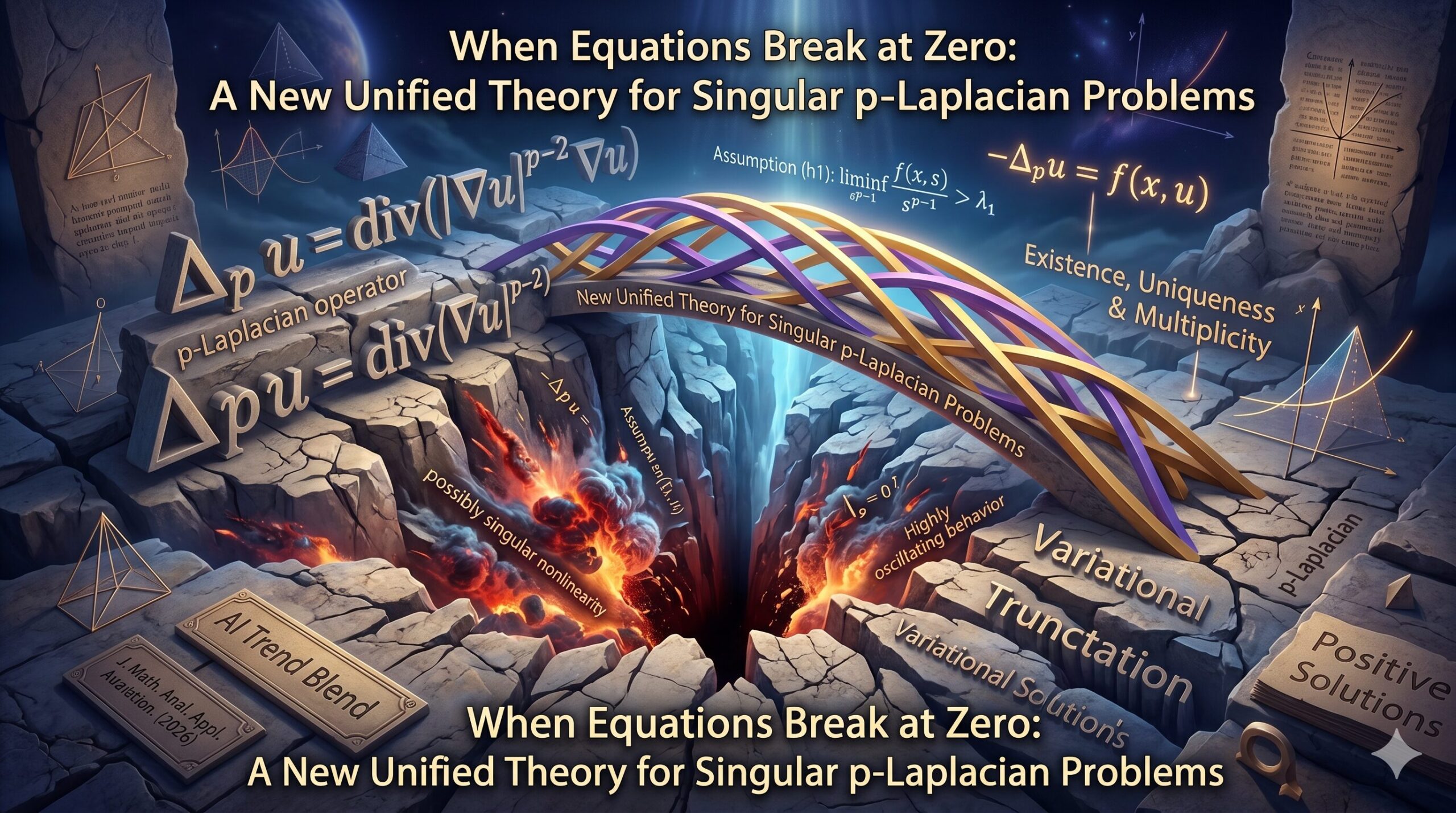
There is a category of differential equation that polite mathematics would rather not discuss at dinner: the kind whose right-hand side blows up, or collapses to zero, or oscillates without bound, the moment the unknown solution approaches the origin. These are singular problems, and for decades they have required their own bespoke toolkits — separate arguments for the bounded case, separate arguments for the singular case, and essentially no tools at all when the nonlinearity does something stranger still. A new paper from the University of Palermo and the University of Messina closes much of that gap, unifying the treatment under a single flexible assumption that is broad enough to include functions nobody had previously dared try.
The Problem That Would Not Stay Still
The central object of study is a deceptively compact Dirichlet problem. On a bounded domain \(\Omega \subseteq \mathbb{R}^N\) with smooth boundary, the authors investigate:
where \(\Delta_p u := \mathrm{div}(|\nabla u|^{p-2} \nabla u)\) is the p-Laplacian operator with \(p \in (1, N)\). The p-Laplacian is the natural nonlinear generalisation of the ordinary Laplacian. When \(p = 2\) you recover the classical Laplacian of potential theory; for \(p \neq 2\) you enter the territory of non-Newtonian fluids, turbulent filtration through porous media, and biological pattern formation — all physical phenomena where the classical linear model simply does not fit.
The real difficulty does not lie in the operator. It lies in \(f(x, u)\) — the reaction term. In classical elliptic theory, \(f\) is assumed to be a well-behaved continuous function. Here the authors allow \(f(x, s)\) to be singular as \(s \to 0^+\), meaning it can blow up to infinity as the solution approaches zero from above. This kind of singularity arises naturally in the same physical models: boundary layer theory, pseudo-plastic fluids, models of heat generation in electric conductors. The solution must remain strictly positive inside \(\Omega\), but near the boundary — where \(u\) approaches zero — the equation is genuinely ill-posed in the classical sense.
Here is what makes this hard. Standard variational methods require building an energy functional and looking for its critical points. But if \(f\) explodes at zero, the energy integral may not even be well-defined for functions that touch zero, which is exactly the boundary condition being imposed. You cannot simply write down a functional and minimise it. Every existing approach carves out a special case: purely singular terms of power type \(s^{-\gamma}\), or bounded terms with a jump discontinuity, or specific concave-convex combinations. Each case needs its own proof.
The p-Laplacian with a singular reaction term cannot be analysed with standard variational tools because the energy functional breaks down near the boundary. Prior work handled singular and non-singular cases separately. This paper builds a framework that works for both — and for a new class of highly oscillating nonlinearities that neither prior approach could touch.
One Condition to Rule Them All: The New Assumption (h1)
The conceptual heart of the paper is a single new condition on the reaction term near the origin. The authors label it (h1), and it reads:
where \(\lambda_1\) is the first eigenvalue of the p-Laplacian on \(\Omega\). Read carefully, this says only that the lower limit of \(f(x,s)/s^{p-1}\) must exceed \(\lambda_1\) as \(s \to 0^+\). Not the limit itself. The lower limit. This is a substantially weaker demand than any condition that appears in the prior literature on this class of problems.
What had been studied before? Two older conditions bracket (h1) from above. The first is \((h_1)’\): \(\liminf_{s \to 0^+} f(x,s) > 0\), meaning the reaction term stays positive near zero. The second is \((h_1)”\): \(\lim_{s \to 0^+} f(x,s) = +\infty\), meaning the term is genuinely singular. Both are strictly stronger than (h1). As the authors spell out: \((h_1)” \Rightarrow (h_1)’ \Rightarrow (h_1)\). So every problem previously solved under those conditions is automatically a special case of the new framework.
The gain from this generalisation is not just theoretical tidiness. Assumption (h1) allows functions where both
$$f_0^- := \liminf_{s \to 0^+} f(x,s) = 0 \quad \text{and} \quad f_0^+ := \limsup_{s \to 0^+} f(x,s) = +\infty$$
simultaneously — a function that oscillates infinitely many times near zero, dipping to zero and spiking to infinity, never settling. This class of functions is genuinely new. Nobody had shown existence results for p-Laplacian problems with this kind of behaviour at the origin. The paper does. And it provides a concrete example, equation (3.3), to prove the class is nonempty.
“Thanks to assumption (h1), the research developed herein has led us to consider broader classes of functions, which include the more familiar form that portrays f as a purely singular component perturbed by a subcritical term — and also allow treating functions which exhibit a highly oscillating behavior at zero.” — Candito, Failla & Vassallo, J. Math. Anal. Appl. (2026)
The Truncation Strategy: Sidestepping the Singularity
Knowing what kind of functions you want to handle and actually building a workable proof are different things. The strategy the team chose is classical in spirit but requires careful calibration: truncation.
The first step is to establish a subsolution. Under condition (h1), one can show that a small multiple of the first positive eigenfunction \(u_1\) of the p-Laplacian — call it \(\underline{u} = c u_1\) for sufficiently small \(c\) — is a strict subsolution of problem (D). This subsolution satisfies a crucial pair of sandwich estimates:
where \(d(x) = \mathrm{dist}(x, \partial\Omega)\) is the distance to the boundary. Near the boundary, \(\underline{u}\) behaves like the distance function — going to zero, but doing so in a controlled and quantifiable way.
With the subsolution in hand, the authors define a truncated reaction term \(f_*(x, s)\) that agrees with \(f(x, |s|)\) whenever \(|s| \geq \underline{u}(x)\), and replaces \(f(x, |s|)\) with the bounded value \(f(x, \underline{u}(x))\) when \(|s| < \underline{u}(x)\). This is the truncation: below the subsolution level, the singularity is simply cut off and replaced with a bounded quantity that is perfectly integrable.
The truncated problem \((D^*)\) is now well-posed from a variational standpoint. One can define the energy functional \(I = \Phi – \Psi\) on the Sobolev space \(W^{1,p}_0(\Omega)\), where \(\Phi(u) = \frac{1}{p}\|\nabla u\|_p^p\) is the p-Laplacian energy and \(\Psi(u) = \int_\Omega F(x, u)\, dx\) is the potential associated with \(f_*\). The key lemma then shows: any weak solution to \((D^*)\) satisfies \(u \geq \underline{u} > 0\), meaning the truncation was never actually active — the solution stayed above the subsolution everywhere, and \(f_*(x, u) = f(x, u)\) throughout. Every solution of the regularised truncated problem is automatically a genuine solution of the original singular problem.
This is a genuinely elegant move. You avoid the singularity not by treating it directly but by constructing a barrier that no solution can pass through from above. The singularity lives below the barrier, where it is safely out of reach.
The Variational Engine: A Local Minimum Theorem
Finding critical points of \(I = \Phi – \Psi\) on the truncated problem requires a variational theorem suited to the structure at hand. Standard mountain pass theorems or direct minimisation on the whole space would not obviously work here, because the coercivity and subcriticality conditions on \(f_*\) create a delicate interplay between the sublinear and superlinear regimes of \(f\).
The authors invoke a local minimum theorem due to Bonanno and Candito (2008). The result says: if \(\Phi\) is coercive and weakly lower semicontinuous, \(\Psi\) is weakly upper semicontinuous, both vanish at zero, and there exists some \(r > 0\) for which
then \(I\) has a critical point inside the sublevel set \(\{\Phi < r\}\). This is condition (2.13) in the paper. The bulk of the proof of the main existence theorem (Theorem 3.1) is devoted to finding explicit conditions on \(f\) — specifically the conditions labelled \((Q_p)\) and \((Q_+)\) depending on whether the growth exponent \(q\) equals \(p\) or lies in \((p, p^*)\) — under which this inequality holds for some \(r > 0\).
The computation is detailed but follows a clean arc. Using the Sobolev embedding \(W^{1,p}_0(\Omega) \hookrightarrow L^q(\Omega)\) and the best Sobolev constant \(S_q\) (whose explicit form via Talenti’s inequality is plugged in), one bounds \(\sup_{\Phi < r} \Psi(u)/r\) by a function \(h(r)\) of the sublevel radius. For \(q < p\), \(h(r) \to 0\) as \(r \to \infty\), so the condition is automatically satisfied — no extra constraint on the domain is needed. For \(q \geq p\), finding the minimum of \(h\) and demanding it be less than 1 yields explicit, computable conditions on the domain size \(|\Omega|\) or the coefficient norms of \(f\). These are the geometric constraints that appear in Theorem 1.1 and Corollary 3.1 — inequalities involving \(|\Omega|\), \(\lambda\), and the exponents of the concave-convex nonlinearity.
By combining the Bonanno-Candito local minimum theorem with sharp Sobolev embedding constants from Talenti’s inequality, the authors convert an abstract existence condition into explicit, checkable constraints on the domain geometry and problem parameters. For concave-convex problems, this means you can compute a lower bound on the bifurcation threshold λ* directly from the size of the domain and the exponents of the nonlinearity.
Three Main Results: Existence, Multiplicity, and Uniqueness
Theorem 3.1 — Existence of a Positive Weak Solution
The main existence result guarantees at least one weak solution to problem (D) under conditions (h1), (h2), and the growth conditions \((Q_p)\) or \((Q_+)\). The solution inherits Hölder regularity \(C^{1,\alpha}(\bar\Omega)\) when the bounded part of \(f\) — the function \(a(x)\) in the subcritical bound — belongs to \(L^\infty(\Omega)\). This regularity result is proved via a singular boundary value estimate due to Hai (2011), which controls the \(C^{1,\alpha}\) norm of solutions to problems with right-hand sides growing like \(d(x)^{-\gamma}\) near the boundary.
The scope of Theorem 3.1 is broad. It covers subcritical growth \(q \in [1, p^*)\), it does not require the reaction term to be purely singular or purely bounded, and it applies to the oscillating functions of class \(\mathcal{I}\) described in Remark 3.2 — the ones no prior framework could reach. Example 3.1 in the paper provides a worked instance: a reaction term for the \(5/2\)-Laplacian that oscillates between zero and infinity infinitely often near the origin via a \(\cos(\pi/u)\) factor, and yet admits a \(C^{1,\alpha}\) positive solution on any bounded domain satisfying the appropriate size constraint.
Theorem 3.2 — A Second Solution via Mountain Pass
The second result steps up to multiplicity. Under the same setup as Theorem 3.1, if the reaction term additionally satisfies an Ambrosetti-Rabinowitz type condition — meaning there exist constants \(k > p\) and \(s_1 > 0\) such that
then there exist at least two weak solutions to problem (D). The first solution comes from Theorem 3.1 as a local minimum of the energy functional. The condition (AR) then ensures that \(I\) is unbounded below and satisfies the Palais-Smale compactness condition at every level. These are precisely the hypotheses of the mountain pass theorem, which produces a second critical point at a saddle point geometry distinct from the local minimum.
The Ambrosetti-Rabinowitz condition is a standard mechanism for controlling the behaviour of the functional at large values of \(u\). Its role here is to ensure the functional does not flatten out at infinity in a way that would trap the mountain pass algorithm without delivering a genuine critical point. The condition is satisfied by classical concave-convex nonlinearities of the form \(f(x, s) = \lambda s^{r-1} + s^{q-1}\) with \(1 < r < p < q\), which is exactly why Theorem 1.1 in the introduction — announced as an application — guarantees two solutions for such problems.
Theorem 3.4 — Uniqueness via a Díaz-Saá Argument
Uniqueness for singular p-Laplacian problems is genuinely hard. The singularity at zero can prevent solutions from being classical, the strong maximum principle may fail when regularity is insufficient, and comparison-based uniqueness arguments require a level of differentiability the problem does not always provide. The paper tackles this under an additional Brezis-Oswald type monotonicity condition: the ratio \(s \mapsto f(x,s)/s^{p-1}\) must be nonincreasing on \((0, +\infty)\).
The proof uses the Díaz-Saá functional: a convex integral functional \(j\) defined by
Suppose two solutions \(u\) and \(v\) exist, both in \(W^{1,p}_0(\Omega) \cap C^1(\bar\Omega)\). Define perturbed versions \(u_\varepsilon = u + \varepsilon\), \(v_\varepsilon = v + \varepsilon\) for small \(\varepsilon > 0\), and test the convexity inequality for \(j\) against the direction \(h = u_\varepsilon^p – v_\varepsilon^p\). After a careful dominated convergence argument that uses the distance function sandwich estimates, one finds that the Brezis-Oswald monotonicity forces the integral inequality
$$0 \leq \int_\Omega \left(\frac{f(x,u)}{u^{p-1}} – \frac{f(x,v)}{v^{p-1}}\right)(u^p – v^p)\, dx \leq 0,$$
which immediately gives \(u = v\). The uniqueness is established in the natural class of \(C^1\) solutions — the regularity that Theorem 3.3 guarantees exists under the \(L^\infty\) assumption on \(a\).
From Abstract Theory to Concrete Numbers: The Concave-Convex Application
The most immediately applicable result in the paper is Theorem 1.1, announced in the introduction and proved as a consequence of Corollary 3.1. It concerns the classical concave-convex problem:
with \(\lambda > 0\), \(r \in (0, p)\), and \(q \in (p, p^*)\). This problem has been studied since the foundational work of Ambrosetti-Brezis-Cerami (1994) and García-Peral-Manfredi (2000), where it was shown abstractly that there exists a threshold \(\lambda^*\) above which the problem has two solutions and below which it may have none. The prior literature gave no explicit formula for \(\lambda^*\).
The new paper delivers explicit, computable domain-dependent conditions. For \(r \geq 1\), two positive Hölder-continuous solutions exist whenever
Equivalently, for fixed \(\Omega\), there is an explicit lower bound for \(\lambda^*\) in terms of \(|\Omega|\). Example 3.2 works this out in full for \(\Omega \subseteq \mathbb{R}^3\), \(p = 2\), \(r \in [1,2)\), giving two positive \(C^{1,\alpha}\) solutions to \(-\Delta u = \lambda u^{r-1} + u^3\) whenever
or equivalently \(\lambda < \frac{1}{16}\left[\sqrt{1 + 9\pi^{8/3} / (2^{2/3}|\Omega|^{4/3})} – 9\right]\). This is a concrete, checkable formula — something you can actually evaluate for a given domain. The prior existence results could not do this.
| Result | Conditions Required | Conclusion | Regularity |
|---|---|---|---|
| Theorem 3.1 | (h1), (h2), \((Q_p)\) or \((Q_+)\) | At least one positive weak solution | \(C^{1,\alpha}(\bar\Omega)\) if \(a \in L^\infty\) |
| Theorem 3.2 | (h1), (h2), \((Q_+)\), (AR) | At least two positive weak solutions | \(C^{1,\alpha}(\bar\Omega)\) |
| Theorem 3.4 | (h1), (h2), \((Q_p)\), Brezis-Oswald | Unique positive solution in \(W^{1,p}_0 \cap C^1\) | \(C^{1,\alpha}(\bar\Omega)\) |
| Theorem 1.1 | Concave-convex, explicit \(|\Omega|\) bound | Two \(C^{1,\alpha}\) solutions for all \(\lambda > 0\) | \(C^{1,\alpha}(\bar\Omega)\) |
Table 1: Summary of the four main results. All solutions are positive and satisfy zero Dirichlet boundary conditions. The conditions \((Q_p)\) and \((Q_+)\) are explicit inequalities involving Sobolev constants, domain size, and the growth parameters of \(f\).
Why Uniqueness Is Genuinely Difficult Here
A brief digression on why the uniqueness result (Theorem 3.4) deserves particular attention. In the non-singular case — where \(f\) is continuous and bounded near zero — uniqueness for elliptic problems can often be deduced from the strong maximum principle, which says that if \(u \geq v\) and \(u \neq v\) solve the same equation, then \(u > v\) everywhere in \(\Omega\), allowing a contradiction to be derived. When \(f\) is singular, the strong maximum principle may fail near the boundary because the solution may not be differentiable enough at \(\partial\Omega\) for the argument to go through.
Previous uniqueness results in this territory — notably Canino-Sciunzi (2016) and Canino-Sciunzi-Trombetta (2016) — applied to purely singular terms of the form \(f(x, s) = s^{-\gamma} + g(x, s)\) for a subcritical perturbation \(g\). The present paper extends uniqueness to the full class covered by (h1) and (h2), including the genuinely oscillating functions that prior work excluded entirely. This is, as the authors acknowledge, the first uniqueness result for problem (D) in this generality. The Díaz-Saá functional provides the right convexity structure to overcome the obstacle that prevents direct comparison arguments from working.
The Physical Models Behind the Mathematics
Problems of this type do not exist in a vacuum. The p-Laplacian operator has been a workhorse of applied mathematics since the 1970s precisely because it models physical phenomena that the classical Laplacian cannot. The exponent \(p\) characterises the type of fluid described in non-Newtonian fluid theory: \(p < 2\) corresponds to pseudo-plastic (shear-thinning) fluids, \(p = 2\) recovers Newtonian viscosity, and \(p > 2\) models dilatant (shear-thickening) fluids. Both pseudo-plastic and dilatant fluids appear in industrial processing, polymer engineering, and biological systems.
Singular reaction terms — terms that blow up as \(u \to 0^+\) — arise in at least four classes of physical problem. In boundary layer theory (Callegari-Nachman, 1978 and 1980), the thinning of a fluid boundary layer as it approaches a wall produces a \(u^{-\gamma}\)-type singularity. In heat generation models (Cohen-Keller, 1967), the temperature dependence of electrical resistance creates a reaction term that diverges at zero temperature. In biological pattern formation (Gierer-Meinhardt, 1972; Turing, 1952), morphogen concentration gradients produce strongly nonlinear localised reactions. And in communication models (Nowosad, 1966), signal intensity functions exhibit similar behaviour near zero.
Each of these applications had previously required a specialised mathematical treatment. The unified framework developed here means that a single existence theorem covers all of them, as long as the bounding condition (h2) — a subcritical upper bound on \(f\) — is satisfied.
What This Unlocks, and What Remains Open
The conceptual contribution of this paper is a shift in how the singular p-Laplacian problem is framed. Rather than treating singularity as an exceptional complication that requires special handling, the new assumption (h1) makes it a default case — the weakest natural condition near the origin that still supports a subsolution construction. The bounded and singular cases become special instances of the same theory rather than parallel theories requiring separate proofs.
Four open directions are identified explicitly in the conclusion. The case \(p \geq N\) is excluded from the current analysis because the Sobolev embedding into \(L^\infty\) used in the Hölder regularity argument requires \(p < N\); handling \(p \geq N\) would require different tools. The case \(N = 2\) has special logarithmic Sobolev embeddings that change the nature of the critical exponent \(p^* = Np/(N-p)\), which diverges as \(N \to 2\) for fixed \(p\) near 2. Sign-changing reaction terms — where \(f(x,u)\) may be negative for some \(x\) — are outside the current scope because the subsolution construction relies on positivity of \(f\) near zero; extending to sign-changing \(f\) would require a different barrier argument.
Perhaps the most technically intriguing open question is the extension to variable exponent spaces, where the p-Laplacian is replaced by the \(p(x)\)-Laplacian with a spatially varying exponent. In that setting, the first eigenvalue may not be positive, and the assumption (h1) as written would need to be replaced by a spatially dependent condition. The authors flag this explicitly as a challenging problem — the most technically demanding of the four — because it would require rebuilding the subsolution construction from scratch without the eigenvalue comparison that makes (h1) work.
A Framework Built to Last
Papers in pure mathematics are sometimes criticised for solving problems that nobody outside the specialty cares about. This one is harder to dismiss on those grounds. The p-Laplacian models real physical systems. Singular reaction terms arise in those systems naturally, not artificially. The existing mathematical toolbox was genuinely fragmented — different papers for different special cases, with no unified treatment — and that fragmentation had practical consequences: each new application required a new bespoke analysis, with no guarantee that methods developed for one type of singularity would transfer to another.
The framework constructed by Candito, Failla, and Vassallo changes that. By widening the class of admissible nonlinearities under a single assumption, providing explicit domain-size conditions for the concave-convex case, and establishing uniqueness for the first time under this general class, the paper creates a reference result that future work in this area will build on rather than work around.
The explicit computability of the conditions in Theorem 1.1 and Example 3.2 is particularly valuable. Abstract existence theorems are necessary but not sufficient for applications — an engineer or a physicist working with a specific domain geometry needs numbers, not just guarantees. The bound \(|\Omega| < \sqrt{27/128} \cdot \pi^2 / (16\lambda^2 + 18\lambda + 5)^{3/4}\) for the cubic-concave problem in three dimensions is the kind of concrete result that can actually be checked.
The treatment of uniqueness — achieved via the Díaz-Saá convexity argument under a Brezis-Oswald monotonicity condition — is the most technically novel piece. Uniqueness for singular p-Laplacian problems has historically been out of reach except in narrow special cases. The argument here, which works by studying the directional derivatives of a convex functional on a shifted solution space, sidesteps the failure of classical comparison principles in a clean and reusable way.
What the paper does not do is equally honest. It does not claim that (h1) is the weakest possible condition for existence — only that it is weaker than anything previously used in this context. It does not handle the \(p \geq N\) or \(N = 2\) cases, and it does not address sign-changing nonlinearities. These are real limitations, acknowledged without evasion. The four open directions listed at the paper’s end are not boilerplate future-work filler; they are genuine mathematical obstacles, two of which — sign-changing terms and variable exponent spaces — are actively being worked on in the broader community, as the citations to recent preprints indicate.
Singular equations at the boundary of what analysis can handle have a way of concentrating fundamental difficulties. The fact that a nonlinearity behaving badly at zero — oscillating without limit, never settling — can still be tamed into admitting Hölder-continuous positive solutions says something worth pausing over. The mathematics here is not just technically impressive; it is telling us that the physical models it represents are more robustly well-posed than their apparent ill-posedness at the origin would suggest. That is good news for everyone who needs those models to describe something real.
Read the Full Paper
The complete study — including all proofs, explicit constants, and worked examples — is published open-access in the Journal of Mathematical Analysis and Applications under CC BY 4.0.
Candito, P., Failla, G., & Vassallo, B. (2026). Remarks on positive solutions to a p-Laplacian problem with a possibly singular nonlinearity. Journal of Mathematical Analysis and Applications, 563, 130767. https://doi.org/10.1016/j.jmaa.2026.130767
This article is an independent editorial analysis of peer-reviewed mathematical research. All theorems, conditions, and equations are cited from the original paper. The editorial commentary and interpretations are the author’s own. Readers wishing to apply these results should consult the full paper and its references.
Explore More on AI Trend Blend
From mathematical analysis and precision agriculture to deep learning and adversarial robustness — here is what else we cover across the site.