Cybersecurity

As cyber threats grow more sophisticated, traditional security rules are no longer enough. This category breaks down how artificial intelligence is transforming the cybersecurity landscape. We cover the latest research and real-world applications in AI-driven defense, including predictive analytics for network security, automated malware classification, adversarial machine learning, and phishing detection. Stay updated on how neural networks are learning to predict and neutralize cyber attacks before they happen.

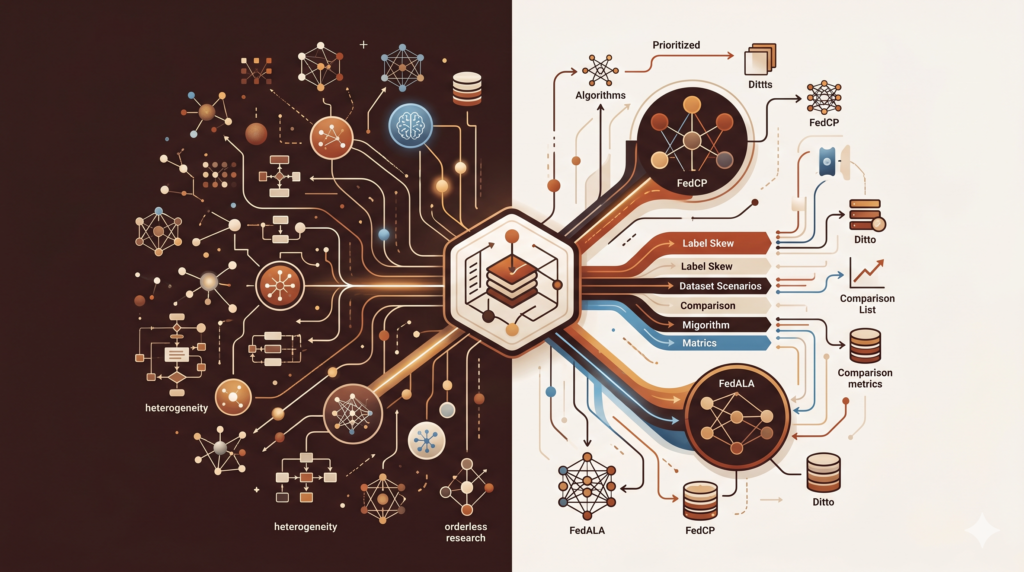
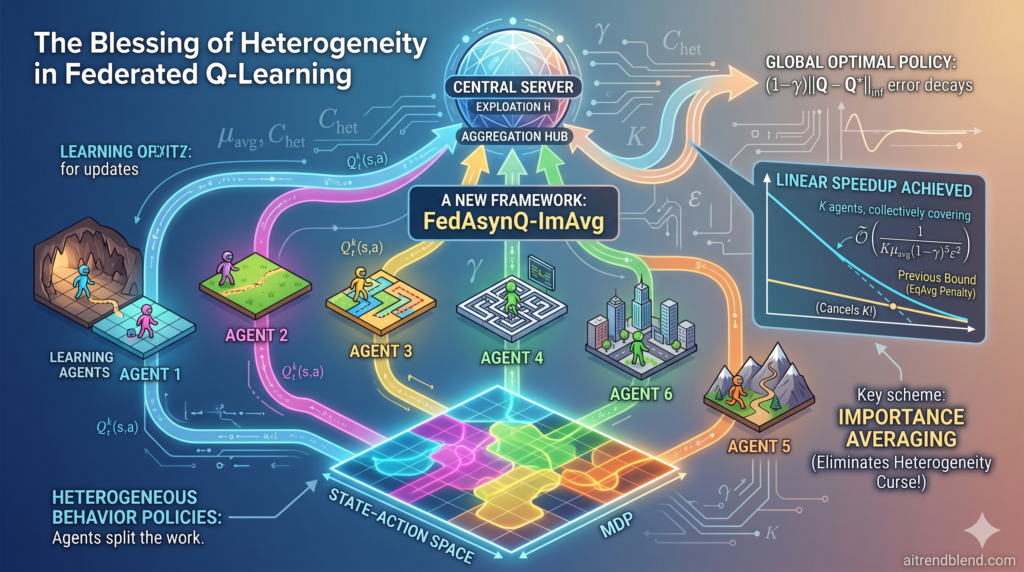
The Blessing of Heterogeneity in Federated Q-Learning: Linear Speedup and Beyond.

The Blessing of Heterogeneity in Federated Q-Learning: Linear Speedup and Beyond

The Blessing of Heterogeneity in Federated Q-Learning: Linear Speedup and Beyond | Research Breakdown AITrendBlend Machine Learning Agent AI About Federated RL · Journal of Machine Learning Research 26 (2025) 1–85 · 22 min read When Different Agents Learn Different Things: Why Heterogeneity Is Actually a Gift in Federated Q-Learning A team from Carnegie Mellon […]

The Blessing of Heterogeneity in Federated Q-Learning: Linear Speedup and Beyond Read More »

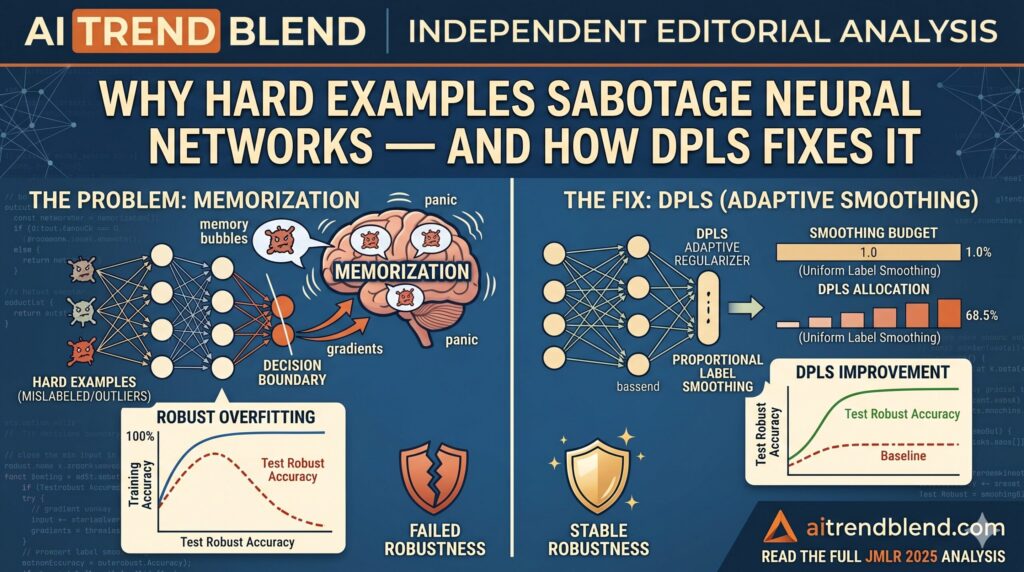
Why Hard Training Examples Hurt Neural Networks — And How DPLS Fixes It.

Why Hard Training Examples Hurt Neural Networks — And How DPLS Fixes It

Why Hard Training Examples Hurt Neural Networks — And How DPLS Fixes It | AI Trend Blend AITrendBlend Machine Learning Adversarial AI About Adversarial Robustness · Journal of Machine Learning Research 26 (2025) 1–48 · 16 min read Why Hard Training Examples Are Secretly Sabotaging Your Neural Network’s Robustness A team from Seoul National University

Why Hard Training Examples Hurt Neural Networks — And How DPLS Fixes It Read More »

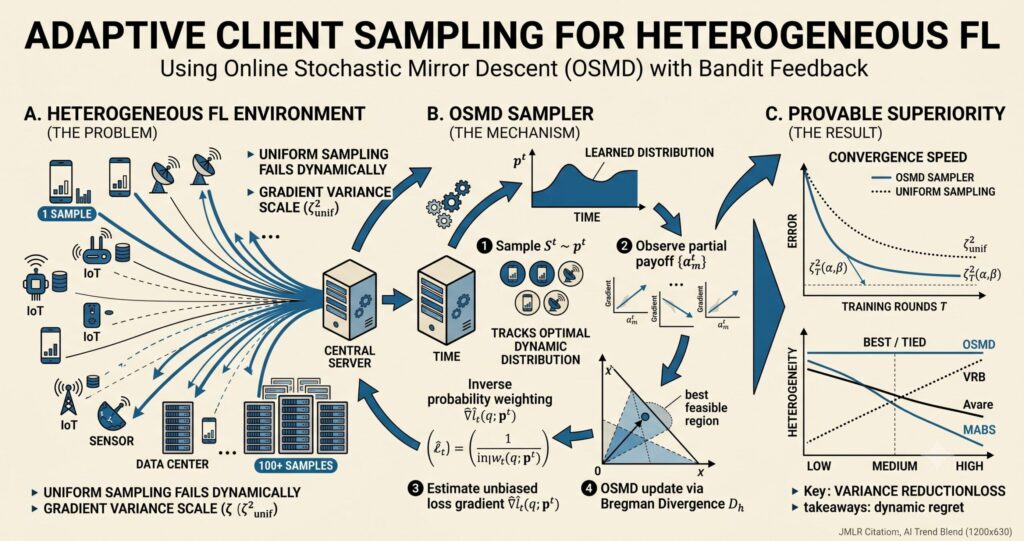
Adaptive Client Sampling in Federated Learning via Online Learning with Bandit Feedback.

Adaptive Client Sampling in Federated Learning via Online Learning with Bandit Feedback

Adaptive Client Sampling in Federated Learning via Online Learning with Bandit Feedback | AI Trend Blend AITrendBlend Machine Learning Computer Vision About Federated Learning · Journal of Machine Learning Research 26 (2025) 1–67 · 18 min read The Sampling Problem Federated Learning Has Been Ignoring — and How OSMD Finally Fixes It A multi-institution team

Adaptive Client Sampling in Federated Learning via Online Learning with Bandit Feedback Read More »

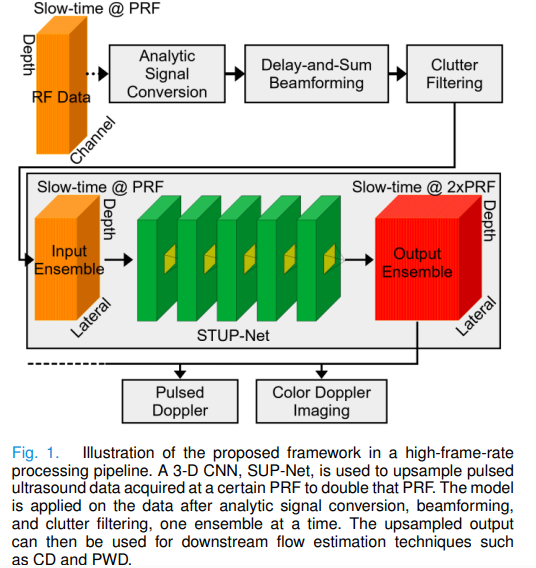
SUP-Net: Deep Learning Fixes Doppler Ultrasound Aliasing by Upsampling the Raw Signal

SUP-Net: Deep Learning Fixes Doppler Ultrasound Aliasing by Upsampling the Raw Signal

SUP-Net: Deep Learning Fixes Doppler Ultrasound Aliasing by Upsampling the Raw Signal | AI Trend Blend AITrendBlend Machine Learning Computer Vision About Medical AI · IEEE Transactions on Medical Imaging, Vol. 45, No. 1 (Jan 2026) · 18 min read The Aliasing Problem That Breaks Blood Flow Ultrasound — and How SUP-Net Solves It Without

SUP-Net: Deep Learning Fixes Doppler Ultrasound Aliasing by Upsampling the Raw Signal Read More »

FCUCR: Federated Continual Recommendation That Remembers You Without Storing. Your Data.

FCUCR: Federated Continual Recommendation That Remembers You Without Storing Your Data

FCUCR: Federated Continual Recommendation That Remembers You Without Storing Your Data | AI Trend Blend AITrendBlend Machine Learning Computer Vision NLP Recommenders System About Recommender Systems · Federated AI · ACM Web Conference 2026 (WWW ’26) · arXiv:2603.17315 · 16 min read FCUCR: The Recommender System That Learns Who You’re Becoming — Without Ever Seeing

FCUCR: Federated Continual Recommendation That Remembers You Without Storing Your Data Read More »

The architecture of our Conditional GAN (c-GAN) framework for Stealthy Deception. The Generator (G) is conditioned on the Ground-Truth History (𝐻𝑟𝑒𝑎𝑙) to synthesize a visually similar but malicious Adversarial History (𝐻𝑎𝑑𝑣). The framework is trained via a multi-objective loss function, which includes: (1) an Adversarial Loss derived from a Critic (C) that distinguishes real from fake trajectories; (2) a Similarity Loss to enforce ste.

The Invisible Threat: How a Conditional GAN Learned to Fool Self-Driving Cars by Mimicking Human Driving

The Invisible Threat: How a Conditional GAN Learned to Fool Self-Driving Cars by Mimicking Human Driving | AI Security Research AISecurity Research Machine Learning About Adversarial Machine Learning · arXiv:2509.XXXXX [cs.CV] · 16 min read The Invisible Threat: How a Conditional GAN Learned to Fool Self-Driving Cars by Mimicking Human Driving Researchers at Zhengzhou University

The Invisible Threat: How a Conditional GAN Learned to Fool Self-Driving Cars by Mimicking Human Driving Read More »

ACCF: Adversarial Contrastive Collaborative Filtering.

ACCF: Adversarial Contrastive Collaborative Filtering

ACCF: Adversarial Contrastive Collaborative Filtering | AI Security Research AISecurity Research Machine Learning About Recommender Systems · Knowledge-Based Systems 2026 · 14 min read ACCF: Teaching Recommender Systems to Learn from Adversity Through Contrastive Learning A novel training paradigm that integrates adversarial perturbations with instance-sensitive optimization to enhance robustness and generality in graph neural network-based

ACCF: Adversarial Contrastive Collaborative Filtering Read More »

The FedDRLPD system architecture.

FedDRLPD: Deep Reinforcement Learning Defense Against Poisoning Attacks in Federated Learning

FedDRLPD: Deep Reinforcement Learning Defense Against Poisoning Attacks in Federated Learning | AI Security Research AISecurity Research Machine Learning About Federated Learning Security · Knowledge-Based Systems 2026 · 16 min read FedDRLPD: Teaching AI to Defend Itself Against Poisoning Attacks Through Deep Reinforcement Learning A novel defense framework that integrates Deep Q-Network algorithms with Mahalanobis

FedDRLPD: Deep Reinforcement Learning Defense Against Poisoning Attacks in Federated Learning Read More »

PDF: PUF-based DNN Fingerprinting for Knowledge Distillation Traceability.

PDF: PUF-based DNN Fingerprinting for Knowledge Distillation Traceability

PDF: PUF-based DNN Fingerprinting for Knowledge Distillation Traceability | AI Security Research AISecurity Research Machine Learning About Model Security · DAC 2026, Long Beach, CA · 15 min read The Hardware Fingerprint That Traces Stolen AI Models Back to Their Source A novel PUF-based framework embeds unclonable hardware signatures into teacher models during knowledge distillation,

PDF: PUF-based DNN Fingerprinting for Knowledge Distillation Traceability Read More »

Skin Cancer Detection Model

Revolutionizing Skin Cancer Detection: How Multimodal AI and Federated Learning Are Transforming Dermatological Diagnostics

Introduction: The Critical Need for Intelligent, Privacy-Preserving Skin Cancer Diagnosis Skin cancer remains one of the most pervasive and life-threatening health conditions globally, with over 5 million new cases reported annually in the United States alone. Among the various types, malignant melanoma stands out as particularly alarming—accounting for approximately 4% of global cancer-related deaths and

Revolutionizing Skin Cancer Detection: How Multimodal AI and Federated Learning Are Transforming Dermatological Diagnostics Read More »

Follow by Email
Tiktok