Quantum Machine Learning

Quantum Machine Learning covers research at the intersection of quantum computing and artificial intelligence. Articles here explore quantum self-attention in vision transformers, photonic quantum-enhanced knowledge distillation, quantum-inspired uncertainty and evidence models, and quantum approaches to medical image diagnosis — with a focus on how quantum circuits reduce parameter counts and computational cost compared with classical deep learning.

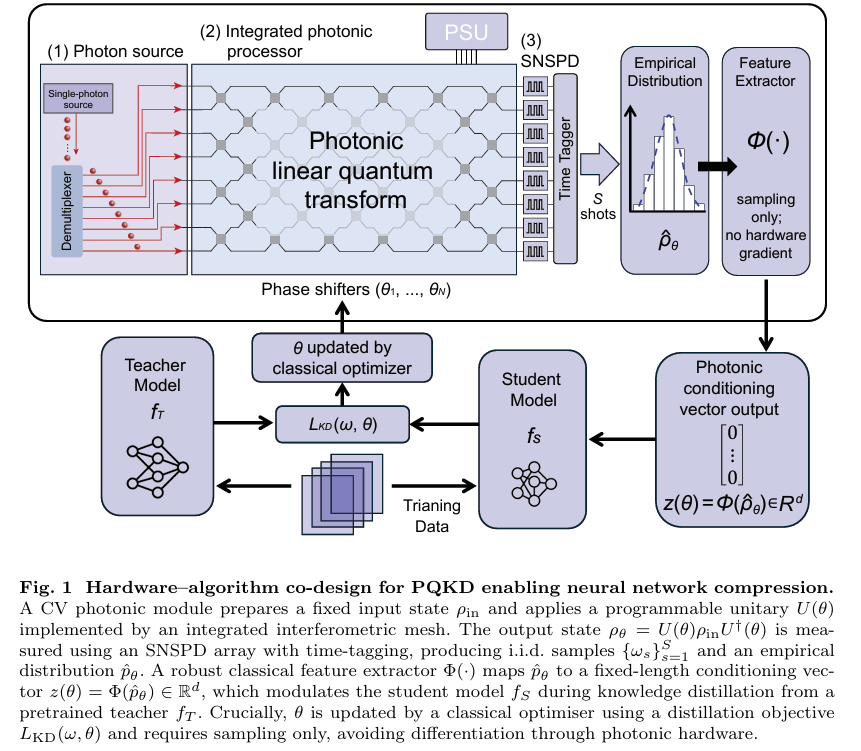
PQKD: How a Beam of Light Is Teaching AI to Learn Smarter — Photonic Quantum-Enhanced Knowledge Distillation Explained

PQKD: How a Beam of Light Is Teaching AI to Learn Smarter — Photonic Quantum-Enhanced Knowledge Distillation Explained

A research team spanning Imperial College London, Brookhaven National Laboratory, NVIDIA, and ORCA Computing just showed that quantum light circuits can replace thousands of trainable neural network parameters — and the AI still works just as well. Here’s why that…

PQKD: How a Beam of Light Is Teaching AI to Learn Smarter — Photonic Quantum-Enhanced Knowledge Distillation Explained Read More »

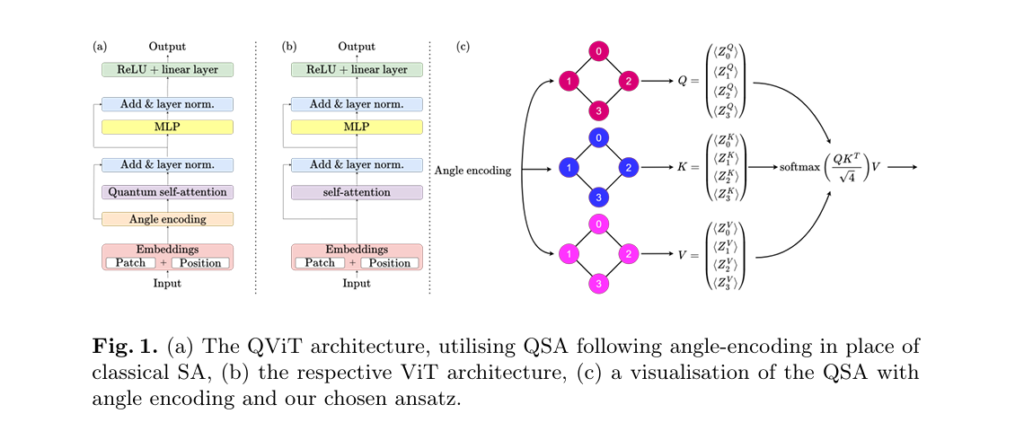
Diagram showing Quantum Vision Transformer (QViT) architecture with Quantum Self-Attention (QSA) replacing classical Self-Attention (SA) in a biomedical image classification model.

Quantum Self-Attention in Vision Transformers: A 99.99% More Efficient Path for Biomedical Image Classification

In the rapidly evolving field of biomedical image classification, deep learning models like Vision Transformers (ViTs) have set new performance benchmarks. However, their high computational cost and massive parameter counts—often in the millions—pose significant challenges for deployment in resource-constrained clinical…

Quantum Self-Attention in Vision Transformers: A 99.99% More Efficient Path for Biomedical Image Classification Read More »