
Key points
- The paper introduces QDKT, a knowledge tracing framework built around quantum focal elements borrowed from Dempster Shafer evidence theory.
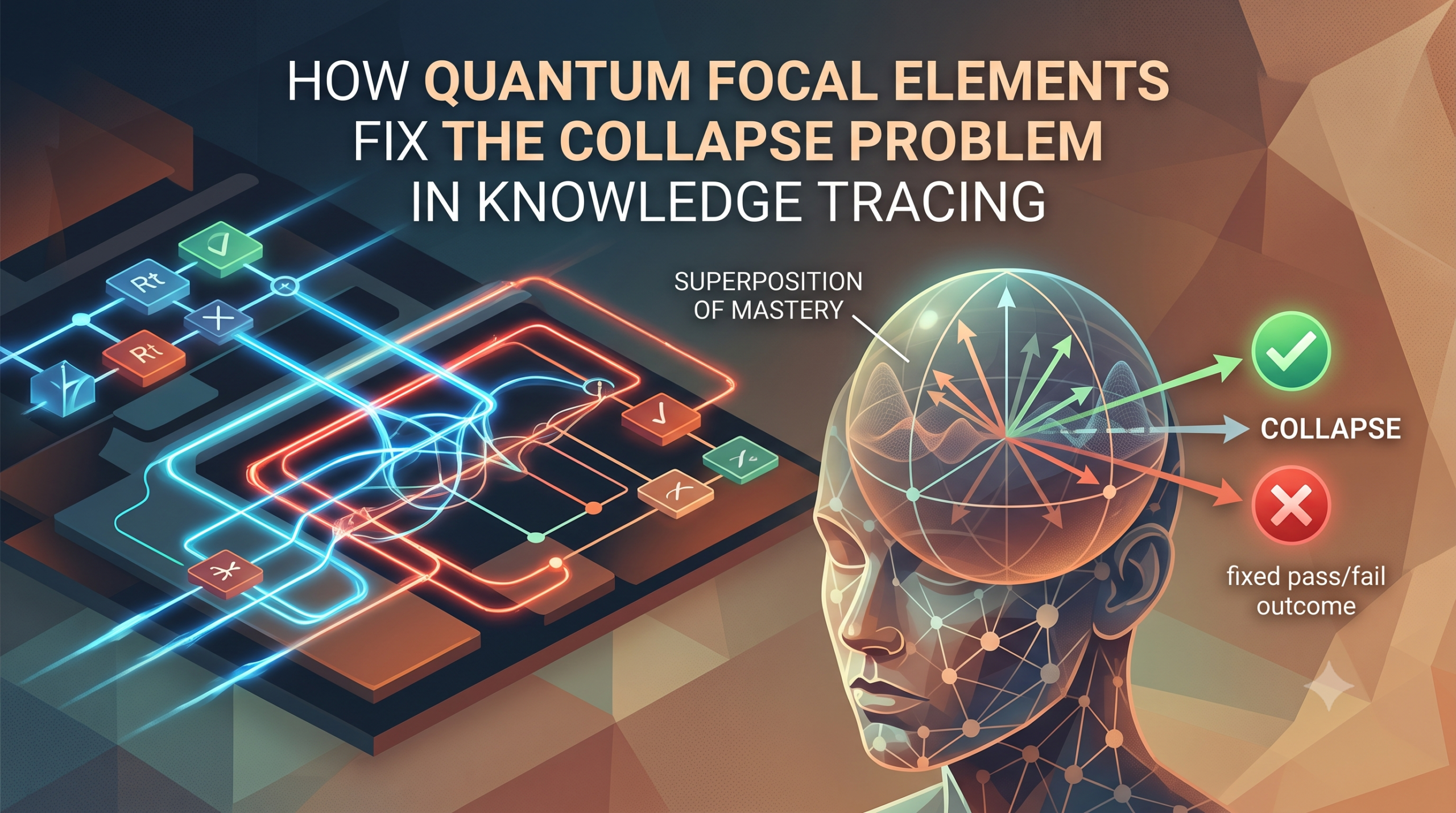
- It targets a specific failure mode called quantum collapse, where a student’s rich superposition of possible mastery states gets forced into one rigid outcome during measurement.
- Two model variants were tested, QDKT-R with a quantum convolution and GRU combination, and QDKT-L built from a full variational quantum circuit.
- QDKT-R reached AUC scores of 0.845 on ASSISTments2009, 0.826 on KDD Cup 2010, and 0.842 on Statics2011, ahead of every baseline tested including the prior quantum model QCE-KT.
- The simpler architecture beat the more complex one on all three datasets, a result the authors attribute to sample sparsity clashing with the larger circuit’s higher dimensional space.
The problem underneath every knowledge tracing model
Knowledge tracing sounds like a narrow academic exercise until you notice how often it quietly runs underneath the tools students already use. Every time an intelligent tutoring system decides which problem to show next, or a course dashboard flags a learner as behind, some model is guessing at the internal, unobservable thing we call mastery. The field started with Bayesian knowledge tracing, which represents a skill as one of two states, mastered or not mastered, and updates a probability of mastery through a hidden Markov model as a student answers questions (Corbett and Anderson, 1994). Deep knowledge tracing replaced that hand built probabilistic structure with a recurrent neural network that learns temporal patterns directly from sequences of right and wrong answers (Piech et al., 2015), and from there the field branched into memory networks, attention based transformers, and graph based approaches that try to model how skills relate to one another.
All of these methods share one assumption that the authors of this paper push back against. They collapse a student’s actual, messy learning process into a single number or a binary label. A student who half understands a concept, who can apply it in one context but not another, or who is guessing correctly out of luck rather than genuine understanding, gets flattened into the same representation space as a student who fully gets it or one who has no idea. The paper argues that this flattening is not a minor approximation error. It is baked into the mathematics of how most models represent knowledge, and it becomes especially visible once you try to use quantum computing to represent cognitive states, because quantum measurement makes the flattening literal rather than metaphorical.
What quantum collapse actually means for a student model
Quantum knowledge tracing is a newer branch of the field. A prior system called QCE-KT represents a learner’s knowledge using quantum bits, letting a student exist in superposition across multiple possible mastery levels rather than being pinned to one value (Bao et al., 2024). That is genuinely useful for handling sparse data, since a quantum system can lean on interference and entanglement to infer a student’s likely state even when direct evidence for a particular skill is thin. The trouble is a phenomenon the paper calls quantum cognitive state collapse. When you measure a quantum system, its superposition of possible states gets forced into a single definite outcome. Applied to a learner, that means the moment you check in on a student through a quiz or exercise, the gradual, layered picture of partial understanding the model had been carrying gets crushed into one fixed answer, and the model loses the very nuance that made quantum representation attractive in the first place.
The authors describe three compounding issues that make this worse in practice. First, different assessment formats for the same skill, say a multiple choice question versus an open ended one, can produce contradictory readings once collapse has already occurred, and a student sitting in a genuine grey zone between mastery and non mastery gets forced into an artificial either or judgment. Second, quantum entanglement is supposed to capture dependencies between related skills, but designing circuits that actually encode those dependencies correctly is difficult, and a poorly designed circuit fails to model prerequisite relationships or cross topic transfer at all. Third, quantum neural networks are sensitive to small amounts of parameter noise, so the same student can receive noticeably different mastery estimates across similar tests, particularly early in a course when data is still sparse.
Quantum focal elements, explained without the circuit diagrams
In Dempster Shafer theory, a focal element is a subset of possible hypotheses that carries some amount of belief mass. Applied to knowledge tracing, a focal element might represent the hypothesis that a student has mastered two related skills together, rather than forcing the model to judge each skill in isolation (Dempster, 2008). The paper’s contribution is to lift that idea into quantum state space. Instead of a classical probability distribution over subsets of skills, each focal element becomes a quantum state built from qubits, one qubit per knowledge point, using rotation gates and entanglement gates to encode how those points relate.
The mathematical link between the two frameworks is tidy. Dempster Shafer theory requires that the belief mass assigned across all subsets of hypotheses sum to one. Quantum mechanics requires that the squared magnitudes of a quantum state’s complex amplitudes also sum to one. The paper defines the mass of a focal element as the squared modulus of its quantum amplitude, so the normalization that Dempster Shafer theory demands falls out automatically from the physics rather than needing an extra layer like a softmax function bolted on afterward.
There is a second benefit that classical Dempster Shafer theory cannot offer on its own. Because quantum amplitudes carry phase information in addition to magnitude, two focal elements can interfere with one another the way light waves do, reinforcing or canceling depending on their relative phase. The joint mass of two combined focal elements A and B works out to the sum of their individual masses plus an interference term that depends on the cosine of their phase difference.
When that cosine term is positive, the two pieces of evidence reinforce each other, which the paper frames as one knowledge point helping a student grasp a related one. When it is negative, the combination actively works against the reading, a kind of interference the authors tie to prior misconceptions getting in the way of new learning. That is a genuinely different mechanism from the orthogonal sum rule used in classical Dempster Shafer combination, and it gives the model a way to represent facilitation and interference between skills that a purely additive framework cannot express.
Deng entropy as the model’s uncertainty dial
Once belief mass is spread across focal elements, the framework needs a way to measure how spread out or concentrated that mass actually is. Shannon entropy, the classical go to measure, only captures randomness within a fixed set of outcomes and cannot account for ambiguity about which subset of skills a piece of evidence even applies to. Deng entropy, introduced by Deng in 2016, extends the idea to handle exactly that kind of structural ambiguity, weighting each focal element by how many possible states its subset could represent (Deng, 2016).
When a focal element covers only a single knowledge point, Deng entropy reduces exactly to Shannon entropy. When belief mass spreads across a larger combination of knowledge points, the entropy measure grows accordingly, capturing genuine ambiguity about which skills are actually driving the observed behavior. In the framework, this entropy value does real work. It feeds a gating mechanism that decides how much weight to give a cautious, uncertainty aware prediction versus a direct, confident one, and it also acts as one of three signals the model uses to detect that collapse has started to happen.
Two ways to build the same idea
The paper does not commit to a single architecture. It builds two working models, QDKT-R and QDKT-L, that implement the same conceptual framework through different circuit designs, and comparing the two turns out to be one of the more interesting parts of the paper.
QDKT-R, a lighter touch with quantum convolution and a GRU
QDKT-R encodes each interaction as an angle fed into a rotation gate, applies a chain of controlled not gates to entangle neighboring qubits, then measures the Pauli Z expectation value on each qubit to get a quantum feature vector. That feature vector gets concatenated with the original classical input and passed into a gated recurrent unit whose reset and update gates now operate on this combined representation rather than on raw input alone. The quantum piece here functions almost like a specialized convolution layer sitting in front of a fairly ordinary recurrent network, which keeps the overall parameter count modest at roughly 163 thousand parameters, lower than a standard deep knowledge tracing baseline at around 210 thousand.
QDKT-L, a full variational quantum circuit
QDKT-L goes further. It adds Hadamard gates to put qubits into superposition from the start, uses Toffoli gates to encode three way conditional relationships such as mastering two prerequisite skills increasing the odds of mastering a third, and adds SWAP gates so that conceptually related but physically distant qubits can interact directly. The sequence modeling stage replaces the GRU with a fully quantum variational circuit that mimics the forget, input, update, and output gates of a long short term memory network, but implemented as parameterized quantum operations rather than classical matrix multiplications. It is a more ambitious design on paper, and it comes with a much steeper computational cost, at roughly twelve times the training time of a standard deep knowledge tracing baseline compared to about three times for QDKT-R.
Catching collapse before it corrupts a prediction
The paper is careful to separate two things that can look similar on the surface but come from very different places. Real learning fluctuation happens when a student who does not actually know a skill guesses correctly, or slips up on something they do know, and that noise is sparse, informative, and something the model should learn from. Quantum collapse is different. It is a systematic breakdown where the model’s internal quantum representation loses its superposition structure entirely, and it needs to be detected and corrected rather than learned from.
To tell the two apart, the framework watches the internal quantum feature tensors and hidden states rather than the output predictions themselves, using three separate signals. Low volatility in a qubit’s measured value across time steps suggests it has settled into something close to a fixed classical state. Measurement values sitting persistently near the extremes, close to zero or close to one, rather than fluctuating through a middle range, suggest the model has lost the ability to represent genuine uncertainty. And a Deng entropy value that stays extremely low over time suggests belief has become overly concentrated on one outcome. The framework only flags collapse when at least two of these three signals agree, and even then only if the share of collapsed samples in a training batch crosses twenty percent, which keeps a handful of unusual students from triggering a false alarm across the whole batch.
What the experiments actually show
The authors tested both models against a long list of baselines across three widely used public datasets. ASSISTments2009 covers more than four thousand students across over one hundred skills with a fairly sparse average number of responses per student. KDD Cup 2010 has far fewer students but the richest set of knowledge components at 436, with long individual sequences averaging over a thousand answers per student. Statics2011 comes from a university engineering mechanics course, with only 333 students but dense, long response histories.
| Model | ASSISTments2009 AUC | KDD Cup 2010 AUC | Statics2011 AUC |
|---|---|---|---|
| DKT | 0.724 | 0.737 | 0.739 |
| AKT | 0.783 | 0.737 | 0.787 |
| SIMPLEKT | 0.774 | 0.816 | 0.820 |
| HIN-CKT | 0.829 | 0.802 | not reported |
| QCE-KT | 0.843 | 0.821 | 0.838 |
| QDKT-L | 0.832 | 0.800 | 0.810 |
| QDKT-R | 0.845 | 0.826 | 0.842 |
QDKT-R comes out ahead everywhere, and the margin over QCE-KT, the closest quantum baseline, holds up under a paired t test at a ninety nine percent confidence level on all three datasets, with p values below 0.05 in every comparison the authors report. That is a real, if modest, improvement, and it comes from a model that is actually cheaper to run than its more elaborate sibling QDKT-L.
What the ablation study reveals
Stripping out pieces of the framework one at a time makes clear how much work each component is doing. Removing the quantum entanglement gates and replacing them with independent per skill representations dropped QDKT-R’s AUC on ASSISTments2009 from 0.845 down to 0.799, and QDKT-L fell from 0.832 to 0.758. Removing the Deng entropy uncertainty module produced a smaller but still real drop, to 0.839 for QDKT-R. The single biggest hit came from removing quantum focal elements entirely and reverting to a conventional architecture, which dragged QDKT-R down to 0.724, roughly back to plain deep knowledge tracing territory, and QDKT-L down to 0.738.
A separate set of experiments swapped Deng entropy for Shannon entropy and Tsallis entropy inside the same architecture. Deng entropy came out ahead in every case, with QDKT-L reaching 0.800 AUC against 0.777 for Shannon entropy and 0.779 for Tsallis entropy, a gap the authors attribute to Deng entropy’s ability to capture ambiguity about which subset of skills is involved, not just randomness within a fixed set of outcomes.
How the model holds up when the data gets noisy
The team also injected synthetic label noise at three levels, flipping between two and five percent of answer records for mild noise, five to ten percent for moderate noise, and ten to twenty percent for severe noise. QDKT-L’s AUC on ASSISTments2009 slipped only slightly under mild noise, from 0.832 to 0.823, held reasonably well under moderate noise at 0.805, then fell more sharply under severe noise to 0.764, an eight percent relative drop from the clean baseline. The authors credit the quantum focal element structure with filtering out inconsistent answer patterns up to a point, but they are candid that once noise crosses roughly twenty percent of the data, the adaptive filtering mechanism can no longer reliably separate genuine learning signal from random disturbance.
The honest limitations here
A few things are worth sitting with before treating this as a settled result. Every experiment in the paper runs on a classical simulator, specifically PennyLane’s default qubit backend, not on real quantum hardware, so the reported performance reflects an idealized, noise free simulation rather than what would happen on a noisy intermediate scale quantum device today. The circuits themselves are also small by necessity, fixed at four qubits, since the simulation cost of a quantum circuit grows exponentially with qubit count on classical hardware. Statics2011 involves only 333 students, a genuinely small sample for drawing strong conclusions, and while five independent runs with different random seeds is a reasonable step toward stability, it is on the lower end for a claim this specific. Training time for QDKT-L runs about twelve times longer than a standard deep knowledge tracing baseline, which is a real cost that has to be weighed against a performance gain that, in this paper, actually favors the cheaper model instead.
Why this matters past knowledge tracing specifically
The broader interest here goes beyond education technology. The paper is a fairly clean case study in a tension that shows up across quantum machine learning generally, between representational richness and the practical difficulty of training a more complex quantum circuit on realistically sized, sparse, real world data. QDKT-L’s more elaborate circuit should, in principle, capture more nuanced relationships between skills, yet it underperformed the simpler QDKT-R on every single dataset tested, and the authors trace that back to a mismatch between the low dimensional structure of real behavioral data and the much higher dimensional Hilbert space the more complex circuit constructs. That is a useful cautionary note for anyone assuming that adding qubits and gates to a quantum model is a straightforward path to better results.
Full conclusion
The core achievement of this paper is a genuinely new way to represent partial, ambiguous knowledge inside a quantum system without losing that ambiguity the moment you try to measure it. By tying quantum focal elements to Dempster Shafer evidence theory and using Deng entropy as a live uncertainty gauge, the authors give a quantum knowledge tracing model a principled way to detect when its own superposition is collapsing into an artificially confident answer, and a mechanism to correct course when that happens.
The conceptual shift worth noticing is subtler than the headline AUC numbers. Rather than treating quantum superposition purely as a computational trick for squeezing more representational capacity out of a model, the paper treats collapse itself as a measurable, correctable failure mode, with its own detection signals and its own repair pathway through the uncertainty enhanced prediction path. That framing could transfer well beyond education. Any sequential modeling task involving genuinely graded, ambiguous states rather than clean binary outcomes, medical risk trajectories or fraud likelihood over time come to mind as obvious candidates, could plausibly benefit from the same idea of tracking collapse as a first class signal rather than an unavoidable side effect of measurement.
The honest remaining limitations are real and worth repeating rather than glossing over. Everything here runs on a classical simulation of quantum circuits, the datasets involved range from modest to quite small in the case of Statics2011, and the more architecturally ambitious model actually lost to the simpler one, which should temper any assumption that more quantum complexity automatically buys more accuracy.
Future directions the authors themselves flag include adaptive focal element structures that adjust to how dense or sparse a particular knowledge domain is, clearer theoretical guidance for choosing circuit depth rather than the current largely empirical tuning process, and pruning or knowledge distillation techniques to shrink QDKT-L’s computational footprint without losing its representational advantages. None of that is fully solved yet, and the paper is refreshingly upfront about saying so.
What stands out most after sitting with the full set of results is how much of the performance gain traces back to a single idea, representing partial knowledge as a genuine superposition rather than forcing an early binary choice, and how little of it depended on maximizing quantum circuit complexity. That is a good reminder for the wider quantum machine learning field, where it is easy to assume that adding qubits and gates is inherently progress. Sometimes the more interesting engineering question is not how much quantum machinery you can add, but how little you actually need to capture the thing that matters.
Reference implementation in PyTorch
The code below is an independent, simplified implementation of the QDKT-R architecture, built to run end to end on dummy data as a smoke test. It simulates the rotation and entanglement gates described in the paper using standard tensor operations rather than a dedicated quantum simulator, since the point here is to make the architecture’s logic runnable and inspectable rather than to reproduce the exact PennyLane circuit. It is not the authors’ original code, which the paper does not publish, and any part left unclear in the source paper was filled in with a reasonable, clearly commented choice rather than guessed statistics.
# qdkt_r_reference.py
# Independent reference implementation of QDKT-R
# Simulates rotation gate encoding and CNOT entanglement with plain tensor math
# rather than a dedicated quantum simulator, then feeds the result into a GRU
# with a belief mass layer and a Deng entropy gated output, following the
# structure described in the source paper.

import torch
import torch.nn as nn
import torch.nn.functional as F
import math


class QuantumFeatureBlock(nn.Module):
    """Simulates the RX rotation and CNOT entanglement stage from Section 3.2.

    Each input feature is treated as a rotation angle. We build the RX
    rotation matrix explicitly for a single qubit subspace, apply it, then
    apply a simplified entangling operation across neighboring feature
    channels, and finally take the Pauli Z style expectation value as the
    output feature, matching Equations 1 through 3 in the paper."""

    def __init__(self, n_qubits=4):
        super().__init__()
        self.n_qubits = n_qubits
        # learnable linear map from raw input to n_qubits rotation angles
        self.angle_proj = nn.LazyLinear(n_qubits)

    def forward(self, x):
        # x has shape batch, time, features
        theta = torch.tanh(self.angle_proj(x)) * math.pi
        # RX rotation expectation value on the Z axis simplifies to cos(theta)
        # for a qubit that starts in the zero state, so we use that closed form
        z_expect = torch.cos(theta)
        # simulate CNOT style entanglement as a learnable mixing matrix
        # across neighboring qubit channels rather than a literal unitary
        entangle_weight = torch.eye(self.n_qubits, device=x.device)
        entangle_weight = entangle_weight + torch.roll(entangle_weight, 1, dims=0) * 0.3
        z_out = torch.matmul(z_expect, entangle_weight)
        return z_out


class BPALayer(nn.Module):
    """Belief mass assignment layer from Section 3.4.

    Maps a hidden state to support values for three focal elements,
    mastered, not mastered, and uncertain, then normalizes with softmax
    so the values sum to one, matching Equation 10."""

    def __init__(self, hidden_dim):
        super().__init__()
        self.to_support = nn.Linear(hidden_dim, 3)

    def forward(self, h):
        support = self.to_support(h)
        m = F.softmax(support, dim=-1)
        return m


def deng_entropy(m, focal_sizes=(1, 1, 2)):
    """Computes Deng entropy from Equation 11.

    focal_sizes gives the number of knowledge points each focal element
    covers, one for mastered, one for not mastered, two for the uncertain
    element that spans both."""
    sizes = torch.tensor(focal_sizes, dtype=m.dtype, device=m.device)
    denom = torch.pow(2.0, sizes) - 1.0
    eps = 1e-8
    ratio = m / (denom + eps)
    entropy_terms = -m * torch.log(ratio + eps)
    return entropy_terms.sum(dim=-1)


class QDKTR(nn.Module):
    """Full QDKT-R model, quantum feature block feeding a GRU, with a
    belief mass layer, Deng entropy gate, and a two path fused output
    matching Section 3.5."""

    def __init__(self, n_skills, embed_dim=32, hidden_dim=64, n_qubits=4):
        super().__init__()
        self.skill_embed = nn.Embedding(n_skills, embed_dim)
        self.answer_embed = nn.Embedding(2, embed_dim)
        self.quantum_block = QuantumFeatureBlock(n_qubits=n_qubits)
        self.gru = nn.GRU(
            input_size=embed_dim * 2 + n_qubits,
            hidden_size=hidden_dim,
            batch_first=True,
        )
        self.bpa = BPALayer(hidden_dim)
        self.base_head = nn.Linear(hidden_dim, n_skills)
        self.unc_head = nn.Linear(4, n_skills)  # 3 belief values plus entropy
        self.gate = nn.Linear(hidden_dim + 4, 1)

    def forward(self, skill_ids, answers):
        # skill_ids and answers both have shape batch, time
        skill_vec = self.skill_embed(skill_ids)
        answer_vec = self.answer_embed(answers)
        x = torch.cat([skill_vec, answer_vec], dim=-1)
        quantum_feat = self.quantum_block(x)
        x_tilde = torch.cat([x, quantum_feat], dim=-1)
        h_seq, _ = self.gru(x_tilde)

        m = self.bpa(h_seq)
        entropy = deng_entropy(m).unsqueeze(-1)
        fused_belief = torch.cat([m, entropy], dim=-1)

        base_logits = self.base_head(h_seq)
        unc_logits = self.unc_head(fused_belief)

        gate_input = torch.cat([h_seq, fused_belief], dim=-1)
        g = torch.sigmoid(self.gate(gate_input))

        fused_logits = (1 - g) * base_logits + g * unc_logits
        return fused_logits, m, entropy


def next_step_loss(logits, target_skill_ids, target_answers):
    """A simplified version of the interaction comparison loss in Equation 17.
    Gathers the predicted logit for the specific skill answered at the next
    time step, then applies binary cross entropy against the actual result."""
    batch, time, n_skills = logits.shape
    logits = logits[:, :-1, :]
    target_skill_ids = target_skill_ids[:, 1:]
    target_answers = target_answers[:, 1:].float()

    gathered = torch.gather(logits, 2, target_skill_ids.unsqueeze(-1)).squeeze(-1)
    loss = F.binary_cross_entropy_with_logits(gathered, target_answers)
    return loss, gathered, target_answers


def evaluate_auc(logits, target_skill_ids, target_answers):
    """Simple AUC computation without external dependencies, using the
    rank based Mann Whitney formulation, useful for a quick smoke test."""
    _, gathered, target_answers = next_step_loss(logits, target_skill_ids, target_answers)
    probs = torch.sigmoid(gathered).detach().flatten()
    labels = target_answers.detach().flatten()

    pos = probs[labels == 1]
    neg = probs[labels == 0]
    if len(pos) == 0 or len(neg) == 0:
        return float("nan")

    # count how often a random positive outranks a random negative
    diff = pos.unsqueeze(1) - neg.unsqueeze(0)
    wins = (diff > 0).float().mean()
    ties = (diff == 0).float().mean() * 0.5
    auc = (wins + ties).item()
    return auc


def run_smoke_test():
    """Runs a short training loop on random dummy data to confirm the model,
    loss, and evaluation function all execute correctly end to end."""
    torch.manual_seed(0)
    n_skills = 50
    batch_size = 16
    seq_len = 20

    model = QDKTR(n_skills=n_skills)
    optimizer = torch.optim.Adam(model.parameters(), lr=2e-3)

    for epoch in range(3):
        skill_ids = torch.randint(0, n_skills, (batch_size, seq_len))
        answers = torch.randint(0, 2, (batch_size, seq_len))

        logits, m, entropy = model(skill_ids, answers)
        loss, gathered, targets = next_step_loss(logits, skill_ids, answers)

        optimizer.zero_grad()
        loss.backward()
        optimizer.step()

        auc = evaluate_auc(logits, skill_ids, answers)
        print(f"epoch {epoch} loss {loss.item():.4f} auc {auc:.4f} mean entropy {entropy.mean().item():.4f}")

    assert logits.shape == (batch_size, seq_len, n_skills), "unexpected output shape"
    assert m.shape[-1] == 3, "belief mass should have three focal elements"
    print("smoke test passed")


if __name__ == "__main__":
    run_smoke_test()
Read the full study for the complete circuit diagrams, hyperparameters, and statistical tests
Read the paper on Neural Networks [DATASET OR CODE REPOSITORY NEEDED, owner to confirm and link if the authors release one]Frequently asked questions
What is quantum knowledge tracing
It is a branch of knowledge tracing that represents a student’s mastery of a skill using quantum bits rather than a single probability or a binary label, so a learner can exist in a superposition across several possible mastery levels rather than being forced into one fixed value.
What is the quantum collapse problem in knowledge tracing
It refers to the moment a quantum system’s superposition of possible mastery states gets forced into a single fixed outcome during measurement, which happens every time a student is tested, and which strips away the gradual, layered picture of partial understanding the model had been carrying.
What is a quantum focal element
It is a quantum state built from qubits that represents a hypothesis about which combination of knowledge points a student has mastered, built by lifting the classical focal element concept from Dempster Shafer evidence theory into quantum state space using rotation gates and entanglement.
Why did the simpler QDKT-R model outperform the more complex QDKT-L
The authors attribute this to a mismatch between the low dimensional, sparse structure of real student behavioral data and the much higher dimensional Hilbert space that QDKT-L’s fuller variational circuit constructs, which made the more complex model prone to overfitting specific sequence patterns in training.
Does any of this run on real quantum hardware
No, every experiment in the paper runs on a classical simulator, specifically PennyLane’s default qubit backend, which simulates ideal, noise free quantum circuit behavior rather than reflecting the noise and limited qubit counts of current quantum hardware.
Which datasets did the authors use to test the framework
They used ASSISTments2009, KDD Cup 2010, and Statics2011, three widely used public knowledge tracing benchmarks that differ in student count, number of knowledge components, and the length of individual student response sequences.
Related reading in this pillar
Wang, H. and Ji, W. (2027). Knowledge tracing framework based on the cognitive state of quantum focal element uncertainty. Neural Networks, 205, 109303. https://doi.org/10.1016/j.neunet.2026.109303
This analysis is based on the published paper and an independent evaluation of its claims.