
Key points
- Multi-agent reinforcement learning systems that rely on communication commonly waste bandwidth on redundant links and treat every channel as bidirectional, drowning useful signals in low-value traffic.
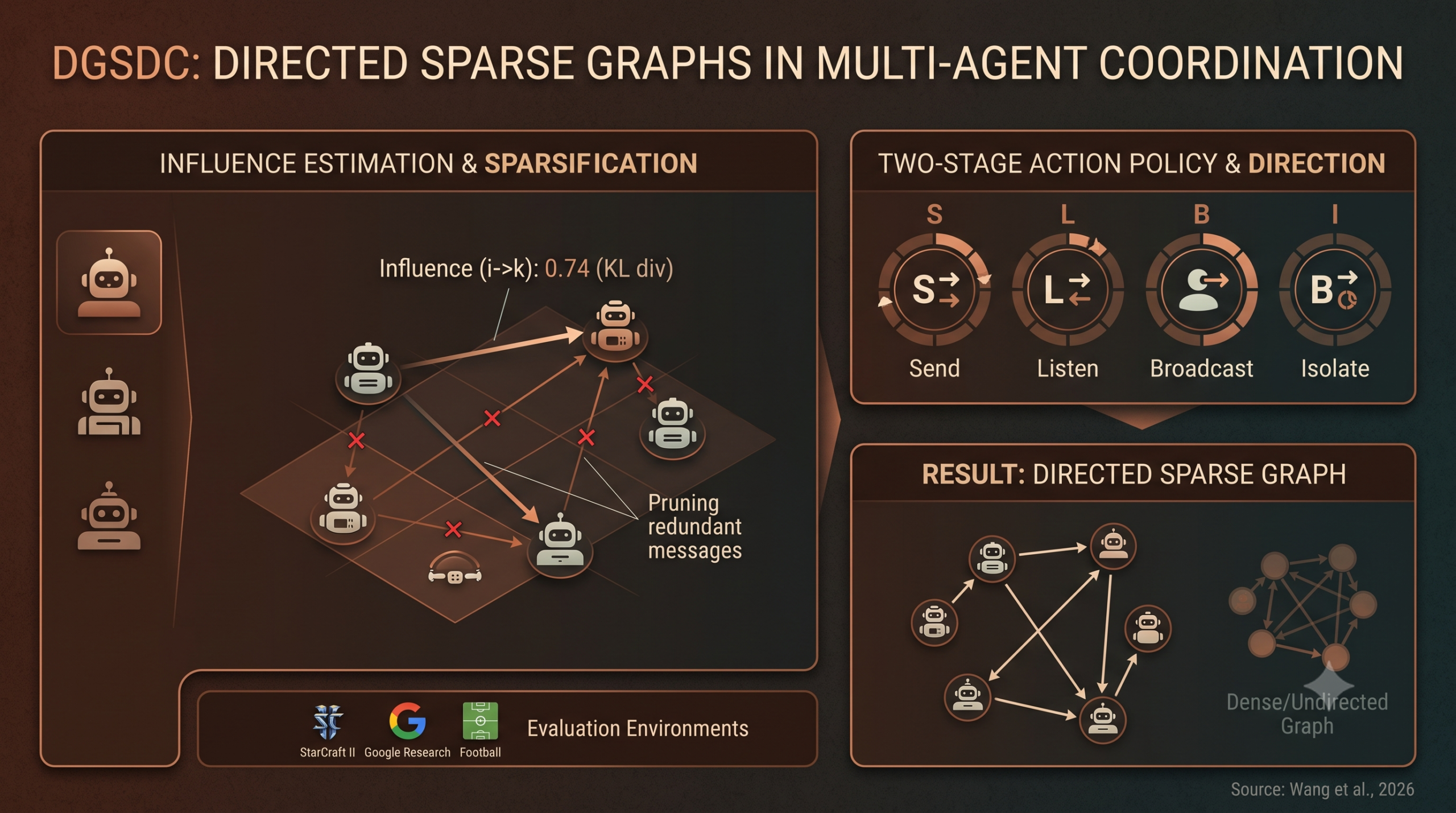
- DGSDC scores how much one agent’s action actually influences another agent’s decision using a KL divergence between two conditional action distributions, one with and one without conditioning on that other agent, an idea borrowed from causal intervention thinking.
- Only the highest scoring links survive a sparsification step, and each agent then learns a discrete action, send, listen, broadcast, or isolate, that gives the resulting sparse graph an explicit direction rather than leaving every kept edge symmetric.
- A graph convolutional module reconstructs an approximate global state purely from these local, directed messages, trained to match the true global state via KL divergence, so the value decomposition backbone gets a useful global signal without ever seeing the real one during execution.
- Across StarCraft II, a communication dependent hallway task, and Google Research Football, DGSDC generally converges faster and performs better than seven baselines, though the paper is candid that a simpler communication-heavy baseline actually learns faster in at least one narrow, locally-driven map.
Why more communication is not automatically better coordination
Multi-agent reinforcement learning trains a team of agents to act well together under partial observability, each one seeing only a slice of the environment and having to guess at what its teammates know or plan to do. Communication is the obvious fix, letting agents share information beyond their own local view, and a large body of work builds on this idea, from early approaches that let every agent broadcast to the whole team, to attention based methods that try to learn when communication should happen, to more recent graph neural network approaches that represent agents as nodes and their information exchange as edges.
The paper identifies two specific, persistent problems that keep showing up across this line of work even as the methods have gotten more sophisticated. First, sparsifying a communication graph usually happens edge by edge, at each individual time step, without any real mechanism for tracking which relationships actually matter consistently over time, so redundant or low value connections tend to survive anyway. Second, and more fundamentally, most graph based communication architectures build undirected graphs, which quietly assumes that if agent A’s information matters to agent B, then agent B’s information matters just as much to agent A. Real coordination rarely works that way. A player holding the ball genuinely needs updates from nearby teammates, but those same teammates mostly just need to know where the ball is, not a constant stream of updates about each other, an asymmetry the undirected graph assumption simply cannot express.
Measuring influence the way an intervention would
The most conceptually interesting piece of DGSDC is how it decides which communication links are actually worth keeping. Rather than learning an attention weight or some other implicit relevance score, the method borrows a specific idea from causal reasoning, that you can measure how much one variable matters to another by asking what happens if you take it away.
For agent \(i\) at a given time step, the method compares two conditional distributions over agent \(i\)’s own action. The first conditions on the full joint action of every other agent. The second conditions on the joint action of every other agent except agent \(k\), essentially asking what agent \(i\) would predict about its own best action if it never got to see what agent \(k\) was doing at all. Both distributions are derived from the same underlying joint action-value function through a Boltzmann policy, so no separate network needs to be trained just to compute this score.
A large value here means that removing agent \(k\)’s action from the conditioning set meaningfully changes what agent \(i\) would do, direct evidence that agent \(k\)’s behavior genuinely carries decision-relevant information for agent \(i\). A small value means agent \(k\) barely matters to agent \(i\)’s choices, regardless of how close together the two agents happen to be spatially or how often they have historically exchanged messages. Crucially, this score is asymmetric by construction, since nothing about computing \(C_i^k\) constrains \(C_k^i\) to come out the same way, which is exactly the kind of asymmetry a symmetric attention weight or an undirected graph edge could never capture.
Because a single time step’s influence score can be noisy, the method smooths it temporally rather than trusting any one snapshot.
Only after this smoothing does the score get compared against a threshold to decide whether the link survives into the sparse candidate graph each agent builds locally, using only information it can already observe within its own field of view.
Keeping the cost manageable
Computing this influence score for every possible pair of agents would scale quadratically with the number of agents and the size of the action space, which would defeat the purpose of building an efficient communication mechanism in the first place. The paper sidesteps this by only ever computing the score for candidates within an agent’s local observable field of view rather than the entire team, bringing the per-step cost down from a full all-pairs computation to something that scales with the number of locally observable candidates instead, and the authors note that for tasks with especially large action spaces, the same approach can be combined with sampled action subsets or factorized value approximations to keep the cost bounded further still.
Giving the kept links an actual direction
Sparsification alone still leaves every retained edge symmetric, so DGSDC adds a second mechanism specifically to control which direction information should flow along the links that survive. Each agent learns to select one of four discrete communication actions at every time step.
| Action | Meaning |
|---|---|
| S, standard | Send and receive messages with neighbors |
| L, listen | Receive messages only |
| B, broadcast | Send messages only, without receiving |
| I, isolate | Neither send nor receive |
This turns the sparse but still undirected graph from the influence-scoring stage into something closer to what the ball holder example actually needs, a graph where information genuinely flows in one direction more than another depending on each agent’s current role. The mechanism runs in two stages at every time step. First, a feature update network aggregates incoming messages from whichever neighbors are currently in a sending state, standard or broadcast, and folds that information into each agent’s latent representation.
Second, using that freshly updated latent representation together with its neighbors’ features, each agent predicts a categorical distribution over the four communication actions for the next step. Because sampling a discrete action is not differentiable by default, the method uses the Gumbel-softmax reparameterization trick to keep gradients flowing through this discrete choice during training, letting the whole communication policy be learned end to end alongside the rest of the system rather than needing some separate, hand-designed scheduling rule.
Approximating the global state from nothing but local messages
Value decomposition methods like QMIX, the backbone DGSDC builds on, typically rely on access to a true global state during centralized training even though agents only get local observations during decentralized execution. DGSDC’s third component tries to close that gap using exactly the directed sparse graph the first two stages already built, treating each agent’s local observation as a node feature and running a graph convolutional network over the learned adjacency structure to produce an approximate global representation.
One detail worth pausing on, the underlying communication graph is directed, but the graph convolution step applies the standard symmetric normalization used in ordinary GCNs anyway, for the practical reason that it keeps feature propagation numerically stable, following common GCN practice. The directional information is not thrown away in this process, it gets baked into the adjacency matrix itself, since that adjacency was constructed directly from the learned communication actions, but the propagation step around it uses the familiar symmetric normalization machinery rather than a bespoke directed variant.
Adding self-loops here matters for a subtle but important reason, since it guarantees that even an agent choosing the isolate action at a given moment still contributes its own local observation to the global state estimate rather than disappearing from the representation entirely. After stacking three layers of this graph convolution to capture multi-hop interaction information, a self-attention style gate reweights node features to emphasize the more informative agents, and the final graph level representation combines both mean pooling and max pooling over all agent nodes before being compressed into the approximate global state.
Training this component to minimize the KL divergence between the true global state distribution and the approximated one, rather than a simple pointwise distance like mean squared error, turns out to matter quite a bit in the paper’s own ablation, a result covered in detail below.
The full training objective
Alongside the ordinary temporal difference loss from the QMIX-style mixing network and the global state approximation loss, the objective includes a term built from the summed influence scores of the currently retained links, subtracted rather than added, which pushes training to keep the influence captured by the surviving edges high rather than letting the sparsified graph drift toward low-value connections over time.
How well it actually performs
The team tested across three quite different cooperative settings, six maps from the StarCraft Multi-Agent Challenge covering both homogeneous and heterogeneous agent compositions, a communication-dependent Hallway environment where agents must coordinate to a shared goal purely through information exchange, and two scenarios from Google Research Football, comparing against seven baselines spanning value decomposition, attention-based coordination, and graph-structured communication methods.
StarCraft II, and an honest exception
Across the six SMAC maps tested, DGSDC generally converges faster and reaches strong final win rates, reaching competitive performance before 0.6 million training steps on the smaller 8m map and before 3 million steps on the remaining, harder maps. On 8m_vs_9m and MMM2 specifically, it beats a strong recent baseline called CADP on both convergence speed and final win rate. The paper is refreshingly direct about where this pattern breaks, though. On the corridor map, CADP actually achieves higher win rates earlier in training than DGSDC does. The explanation offered is a genuinely useful one, corridor is a narrow-path environment where decision-making is highly sensitive to purely local, immediate interactions, and CADP’s approach of directly aggregating global information during centralized training lets it form effective strategies quickly under exactly that kind of tight, locally driven dynamic. DGSDC’s sparse, directed communication graph needs time to stabilize into a useful structure, so its advantage only shows up once training has progressed far enough for that structure to settle, which is a real cost in scenarios where fast early learning matters more than eventual asymptotic performance.
Computational cost, a real tradeoff rather than a free lunch
| Method | Time per million steps, hours | GPU memory, GB |
|---|---|---|
| QMIX | 1.35 ± 0.24 | 1.55 |
| QMIX-attention | 2.29 ± 0.36 | 2.07 |
| RIIT | 1.81 ± 0.15 | 1.88 |
| MAGIC | 2.61 ± 0.28 | 2.74 |
| GACG | 3.44 ± 0.22 | 3.50 |
| CADP | 3.25 ± 0.26 | 3.16 |
| CommFormer | 3.68 ± 0.31 | 3.86 |
| DGSDC | 2.74 ± 0.33 | 3.29 |
DGSDC is not the cheapest method to train, plain QMIX with no communication at all is unsurprisingly the fastest and lightest option here, but it sits in a reasonable middle position among the communication-based approaches specifically, faster than GACG, CADP, and CommFormer despite doing genuinely more per-step work through the influence estimation, while using less GPU memory than three of those same communication-heavy baselines.
Hallway and Google Research Football
Hallway is specifically designed so that agents cannot succeed without communicating, and DGSDC consistently posts higher returns than CADP and QMIX-attention across all three tested configurations, four, six, and eight discrete positions, converging after roughly 1.2 million training steps. On the Google Research Football scenarios, a similar pattern to corridor shows up, DGSDC learns more slowly than CADP in the early stages but reaches a better and more stable final policy, with the gap growing larger on the harder of the two tested scenarios, which the paper attributes to the sparse directed structure taking real time to converge into something genuinely useful, the same tradeoff already visible on corridor.
What the ablations isolate
Replacing the intervention-inspired sparsification with either a fully connected graph or an attention-based sparsification scheme, while keeping everything else in DGSDC identical, shows the intervention-inspired version converging fastest and reaching the highest final win rate on both a homogeneous map, 8m, and a heterogeneous one, 1c3s5z. Notably, on the same 8m comparison, DGSDC’s version actually used the least GPU memory of the three despite computing an extra influence score per candidate pair, which the paper attributes to the sparser resulting graph more than offsetting that computational overhead during message passing.
Comparing a sparse-undirected variant against the full sparse-directed design isolates the value of directionality specifically, holding the sparsification strategy constant. The directed version converges faster and reaches a higher final win rate on both tested maps, while the undirected version shows larger training fluctuations and settles at inferior final performance, direct evidence that even with an identical set of retained edges, treating every kept connection as bidirectional still leaves real performance on the table.
The global state approximation module gets its own targeted ablation too, comparing training with no consistency loss at all, a Euclidean L2 distance instead of KL divergence, and the original KL divergence formulation. Removing the consistency loss entirely causes a significant performance drop, confirming that the ordinary temporal difference signal alone is not enough to teach the model a genuinely informative global state surrogate. Replacing KL with L2 distance helps somewhat but underperforms the full KL version, since a pointwise distance metric does not capture the same distribution-level alignment that KL divergence does.
A separate communication cost analysis compares four configurations directly, dense-undirected, dense-directed, sparse-undirected, and the full sparse-directed design, and finds that dense variants maintain consistently high communication frequency essentially regardless of whether any given message actually contributes to a decision, while sparsification substantially cuts the number of active links, and adding directionality on top of sparsification cuts communication cost further still by preventing the retained edges from carrying redundant traffic in both directions at once. A related comparison of graph construction strategies, random edges, attention-based edges, and the influence-based DGSDC approach, finds DGSDC posting the highest median win rate with the tightest spread across repeated runs, evidence that the improvement genuinely traces back to modeling task-relevant, directional dependency rather than just having some sparse graph structure at all.
Tuning the sparsification threshold
| Threshold, delta | Effect observed |
|---|---|
| Too low, around 0.1 | Excessive communication survives, reintroducing redundant information and overhead |
| Moderate, around 0.7 | Balanced tradeoff, adopted as the default across all experiments |
| Too high, around 0.9 | Overly sparse structure, insufficient information sharing, weaker cooperation |
The paper reports the optimal threshold shifts slightly between environments depending on task structure and interaction patterns, which is a reasonable thing to expect given how differently, say, a tight corridor map and an open hallway coordination task actually demand information sharing, and settles on a single shared default value of 0.7 across all experiments as a practical compromise rather than tuning it per environment.
Honest limitations
The authors flag a real scalability concern directly in their own conclusion rather than only listing it as a vague future direction, the cost of influence estimation scales with the number of candidate communication neighbors each agent can observe, so in genuinely large-scale multi-agent systems with many agents visible to one another simultaneously, this cost could become a real practical constraint even with the local-candidate restriction already built into the method. They propose combining DGSDC with grouping-based or hierarchical communication as one path forward, letting sparse, directed communication get learned within smaller groups rather than across an entire large team at once, though that combination is not tested in this paper.
The corridor and Google Research Football results are worth taking seriously as a genuine limitation rather than a minor footnote. DGSDC’s core advantage, a communication graph that grows more useful as it stabilizes over training, comes with a real cost in environments that reward fast early learning driven by tight, local interactions rather than a slowly maturing global coordination structure. That is not a flaw specific to this paper, it is closer to an honest, expected consequence of the design tradeoff being made, but it does mean DGSDC is not the right tool for every cooperative task, and the paper’s own results say so plainly rather than glossing over it.
A few additional points are worth naming. The symmetric normalization applied to a directed adjacency matrix during the GCN step is a pragmatic engineering choice for training stability rather than a fully principled directed graph convolution, and how much performance might be left on the table by not developing a bespoke directed variant is untested here. The method’s future work section also explicitly limits its current scope to pairwise agent relationships, flagging higher-order or group-level interaction modeling, asynchronous agents, and heterogeneous agent types as unaddressed extensions rather than settled capabilities.
Takeaway for practitioners
If your multi-agent system already struggles with communication overhead or noisy, low-value messages drowning out useful ones, the intervention-inspired influence score here is a genuinely cheap, locally computable signal worth trying even outside this exact architecture, since it needs no extra network beyond the joint action-value function you likely already have.
Takeaway on the theory
Framing communication relevance as an intervention question, how much does removing this agent’s action change what I would do, rather than as a learned similarity or attention weight, is a genuinely different and more causally grounded way to think about which connections in a multi-agent system actually matter, and it is worth considering for other coordination problems well beyond reinforcement learning specifically.
Where this could go next
The specific contribution here targets multi-agent reinforcement learning, but the underlying idea, using a KL divergence between two conditional distributions, one with and one without a candidate variable in the conditioning set, as a cheap, causally motivated relevance score, is not inherently tied to reinforcement learning at all. Any system that needs to decide which of many possible information sources actually matters to a given decision could in principle apply the same intervention-style scoring, feature selection in any model with a probabilistic output being one obvious, untested extension the authors do not explore here.
The honest limitation the paper names in its own conclusion, scalability in genuinely large multi-agent systems, is the natural next problem for anyone extending this work, and the proposed direction, combining sparse directed communication with hierarchical or grouping structures, is a reasonable starting point that has not yet been tested. The corridor and football results are a useful reminder that no single communication design wins everywhere, and that the tradeoff between fast early convergence and a slowly maturing but ultimately stronger communication structure is a real design axis worth being explicit about rather than something any one paper is likely to fully resolve.
What the results already establish reasonably convincingly is that treating communication relevance as asymmetric and directional, rather than assuming every useful connection must be mutually useful in both directions, produces measurably better coordination in the settings where it was tested, and that a causally inspired scoring mechanism can deliver that asymmetry without requiring an entirely separate learned relevance network on top of the value function the system already needs.
Read the full paper for the complete algorithm pseudocode, all six SMAC map results, and the communication frequency and cooperation heatmap case study.
A minimal PyTorch implementation
Below is a compact, runnable sketch of the core ideas, the intervention-inspired influence score, the two-stage discrete communication action policy with Gumbel-softmax, and a simplified GCN-based global state approximation. It favors clarity over matching the paper’s exact network architecture, and it includes a smoke test on small synthetic multi-agent data.
Conclusion
The genuine contribution here is treating two separate, well documented problems in multi-agent communication, redundant links and undirected message flow, as two separate mechanisms to solve rather than expecting one clever architecture to fix both at once. The intervention-inspired influence score gives the method a way to decide which connections matter that is grounded in an actual causal question rather than a learned similarity heuristic, and it comes essentially for free from the joint action-value function the system already needs for value decomposition. The two-stage discrete communication action policy then adds the piece an undirected graph structurally cannot express, letting agents decide not just whether to connect but which direction the connection should actually carry information.
The global state approximation module closes a real, separate gap in value decomposition methods, the reliance on a true global state during centralized training that decentralized execution can never actually provide, by reusing the same directed sparse graph the communication mechanism already built rather than requiring some entirely separate estimation pathway.
What makes this paper worth taking seriously rather than just another incremental communication architecture is how directly it reports where the approach does not win. On the corridor map and in the harder Google Research Football scenario, a simpler baseline that leans on centralized information during training converges faster early on, and DGSDC’s advantage only shows up once its communication structure has had time to mature. That is a real, specific limitation named plainly rather than buried, and it is a genuinely useful signal for anyone deciding whether this approach fits their own task, tight, locally driven coordination problems may simply reward a different design than DGSDC’s slowly-stabilizing but ultimately stronger sparse directed graph.
The scalability concern the authors name for themselves, that influence estimation cost still grows with the number of locally observable candidate agents, is the clearest open problem for anyone building on this work, and their proposed direction, combining sparse directed communication with hierarchical or grouped structures for genuinely large teams, remains untested rather than solved. None of that undercuts the core result. Asymmetric, causally motivated relevance scoring combined with an explicit, learned notion of message direction measurably improves coordination across a genuinely varied set of cooperative tasks, and it does so without requiring agents to give up the decentralized execution that made partial observability a real constraint to work around in the first place.
Frequently asked questions
What problem does DGSDC solve in multi-agent reinforcement learning
It addresses two specific weaknesses in existing multi-agent communication frameworks, redundant or low-value communication links that survive because sparsification is usually done step by step without tracking consistency over time, and the common assumption that communication should be undirected, when in practice one agent’s information often matters much more to a second agent than the reverse is true.
How does the intervention-inspired influence score work
It compares two versions of an agent’s predicted action distribution, one that conditions on every other agent’s action and one that conditions on every other agent’s action except a specific candidate neighbor, then measures the KL divergence between them. A large divergence means removing that neighbor’s information genuinely changes the agent’s decision, indicating a link worth keeping.
What are the four communication actions agents can choose
Standard, which allows both sending and receiving messages, listen, which allows receiving only, broadcast, which allows sending only, and isolate, which disables both sending and receiving for that agent at that time step, giving each agent explicit, learned control over the direction of its communication.
How does the method estimate a global state without accessing it directly
It runs a graph convolutional network over the learned directed sparse communication graph, using each agent’s local observation as a node feature, then combines mean and max pooling over the resulting node representations and trains the result to match the true global state distribution using KL divergence, giving the value decomposition backbone a useful global signal built entirely from decentralized information.
Does DGSDC always converge faster than existing methods
No, and the paper reports this directly. On a narrow-path SMAC map called corridor and on a harder Google Research Football scenario, a baseline called CADP converges faster in the early training stages because it can lean on directly aggregated global information during centralized training. DGSDC’s advantage shows up later, once its sparse directed communication structure has had time to stabilize.
What is the main scalability concern with this approach
The cost of computing the influence score for every candidate agent pair grows with the number of agents each agent can locally observe, so in very large-scale multi-agent systems this could become a real computational constraint. The authors suggest combining the method with hierarchical or group-based communication structures as a potential fix, though that combination has not been tested.
Wang, Z., Wei, T., Liu, Y., Lu, L., Gu, X., and Zhang, W. DGSDC, dynamic graph learning for sparse and directed communication in decentralized multi-agent coordination. Knowledge-Based Systems, volume 349, 2026, article 116484, DOI 10.1016/j.knosys.2026.116484. This analysis is based on the published paper and an independent evaluation of its claims.