
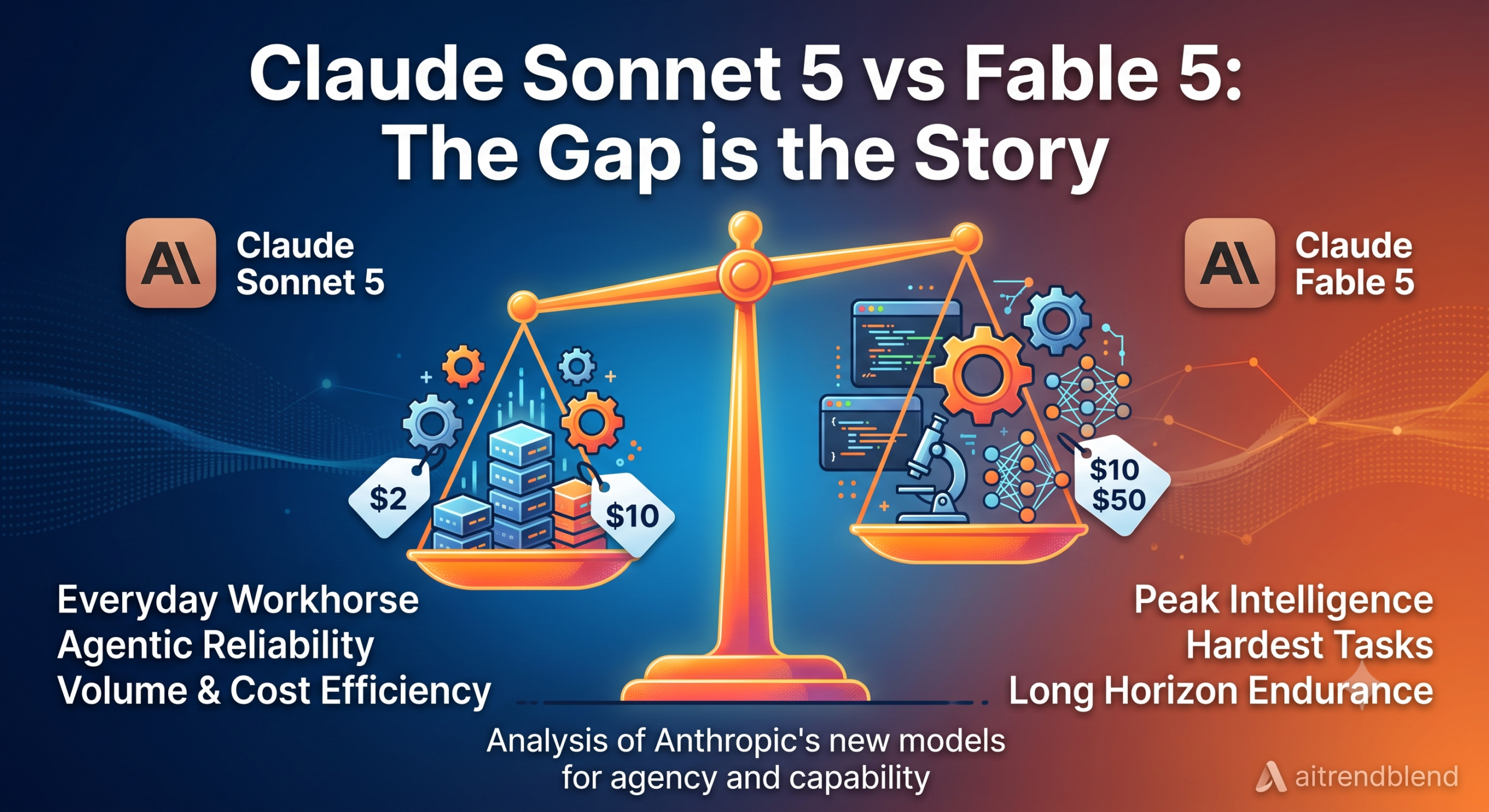
On June 30, 2026, Anthropic announced Claude Sonnet 5. The very next day, Claude Fable 5 returned from its 19 day government mandated pause. Two frontier models, released a day apart, from the same company, with a five times difference in input price. If you build with the Claude API or pay for a Claude plan, you now face a genuinely interesting question. Which one should actually do your work? The answer is less obvious than the price tags suggest, and getting it right can cut your AI bill by 80% or buy you capability no other model offers. Here is the full picture.
Key Points
- Sonnet 5 and Fable 5 sit on different rungs of Anthropic’s ladder. Sonnet 5 is the workhorse tier upgraded to near Opus 4.8 performance. Fable 5 is a Mythos class model, a tier above Opus, wrapped in heavy safeguards.
- Pricing is the loudest difference. Sonnet 5 costs $2 per million input tokens and $10 per million output tokens through August 31, then $3 and $15. Fable 5 costs $10 and $50.
- Sonnet 5 is the default model on Free and Pro plans and is available everywhere without restrictions. Fable 5 access on subscriptions is staged and capacity limited.
- Fable 5 runs behind safety classifiers that reroute cybersecurity, biology, and distillation requests to Opus 4.8. Sonnet 5 carries only the lighter standard safeguards because its dangerous capabilities measure far lower.
- Sonnet 5 introduces effort levels that let it match Opus 4.8 on some tasks at high effort, giving one model a wide range of cost and performance options.
- The practical rule. Sonnet 5 for volume and everyday agents, Fable 5 for the hardest long horizon work where its lead actually pays for itself.
Two Different Rungs on the Same Ladder
Anthropic’s model line has been a capability ladder for years. Haiku is small and fast, Sonnet is the balanced middle, Opus is the heavyweight. In 2026 the company added a rung above Opus called the Mythos class, and that is where Fable 5 lives. We covered the full story of that model, including why the US government paused it for 19 days, in our Claude Fable 5 explainer. The short version is that Fable 5 is the most capable model Anthropic has ever released to the public, sharing its weights with the restricted Claude Mythos 5 and differing only in safeguards.
Sonnet 5 is a different kind of release. It does not push the frontier upward. It pushes the frontier downward in price. Anthropic’s own framing is precise on this point. The clearest recent gains in agentic capability had been landing in Opus class models, and Sonnet 5 narrows that gap, delivering performance close to Opus 4.8 at a fraction of the cost. For many developers the agentic era began with Sonnet 3.5 back in 2024, so there is a pleasing symmetry in the workhorse line catching up again.
One model raises the ceiling. The other raises the floor. That is the entire comparison in two sentences, and everything below is the practical detail.
The Numbers Side by Side
| Dimension | Claude Sonnet 5 | Claude Fable 5 |
|---|---|---|
| Tier | Sonnet class, the balanced workhorse | Mythos class, above Opus |
| Launch | June 30, 2026 | June 9, 2026, relaunched July 1 after export controls |
| Input price | $2 per million tokens until August 31, then $3 | $10 per million tokens |
| Output price | $10 per million tokens until August 31, then $15 | $50 per million tokens |
| Plan access | Default on Free and Pro, available on all plans | Staged. Included up to 50% of weekly limits through July 7, then usage credits |
| Safeguards | Standard real time cyber safeguards, same as Opus 4.7 and 4.8 | Strict classifiers for cyber, biology and chemistry, and distillation, with fallback to Opus 4.8 |
| Cyber capability | Never produced a full working exploit in the Firefox evaluation | Mythos level, which is why the heavy safeguards exist |
| Signature strength | Cost efficient agentic work with adjustable effort levels | Long horizon endurance, memory across millions of tokens, 1M context |
| Data retention | Standard policies | Mandatory 30 day retention on all traffic |
| API identifier | claude-sonnet-5 | claude-fable-5 |
The pricing asymmetry deserves a second look. At standard rates, Fable 5 costs 3.3 times more per input token and 3.3 times more per output token than Sonnet 5. During the introductory window the multiple is five times on both sides. For a workload processing a hundred million tokens a month, that is the difference between a $300 bill and a $1,500 bill before output costs even enter the math.
One subtlety hides in Sonnet 5’s fine print. It uses an updated tokenizer that maps the same text to roughly 1.0 to 1.35 times more tokens depending on content. Anthropic set the introductory price so the transition from Sonnet 4.6 stays roughly cost neutral, but if you are comparing per token prices across providers, remember that a Sonnet 5 token is slightly smaller than it used to be.
What Sonnet 5 Actually Brings
The headline feature is agentic reliability at a new price point. Early access testers kept describing the same behavior pattern. The model finishes multistep tasks where earlier Sonnets stalled halfway, and it verifies its own work without being asked. One engineer at Ramp reported handing it a bug investigation and watching it write a reproducing test, implement the fix, then stash the change to confirm the bug returned without it. All in one pass, unprompted.
Claude Sonnet 5 is a strong agentic coding model, delivering top tier accuracy comparable to Opus class models and a clear step function improvement over Sonnet 4.6.Deepak Singh, VP at Kiro, from Anthropic’s launch post
The second feature matters more for budgets. Sonnet 5 exposes effort levels, a dial that trades tokens for quality. At medium effort it delivers substantially better cost efficiency than Sonnet 4.6 ever managed. At extra high effort it can match Opus 4.8 on some agentic search and computer use tasks. In practice this means one model now covers the range that previously required switching between two, and Anthropic’s own cost performance charts show Sonnet 5 covering a wider span of the curve than any previous Claude.
Safety wise, Sonnet 5 measured lower rates of hallucination, sycophancy, and misaligned behavior than Sonnet 4.6 in Anthropic’s automated audits, though somewhat higher than Opus 4.8 and Mythos Preview. On the Firefox exploit development evaluation it never produced a full working exploit. That weakness is exactly why it ships with only the standard cyber safeguards rather than Fable’s strict ones. There is nothing Mythos level to contain.
What Fable 5 Offers That Sonnet 5 Cannot
Fable 5’s case rests on the tasks where model quality compounds. Stripe’s early testing saw it complete a codebase wide migration in a day that a full team had scoped at over two months. Hex measured it as the first model to clear 90% on their suite of long running analytical tasks. Anthropic’s internal testing showed its file based memory improving performance three times more than the same memory setup improved Opus 4.8. The pattern repeats across every early report. The longer and messier the task, the wider Fable’s lead grows.
It also carries a 1 million token context window by default with up to 128k output tokens per request, and it stays coherent across sessions that run for hours. For agents that must hold an entire codebase, a legal corpus, or a research archive in view while working, that endurance is the product.
The costs go beyond the price sheet. Fable 5 runs behind strict safety classifiers, and requests touching cybersecurity, biology and chemistry, or model distillation get answered by Opus 4.8 instead, which Anthropic says affects fewer than 5% of sessions. All Fable traffic carries a mandatory 30 day retention policy. And subscription access remains staged while capacity catches up with demand. None of these are dealbreakers, but they are real operational differences that Sonnet 5 simply does not have.
A Practical Decision Framework
Here is the rule we would apply, having read both system cards and every early access report published so far.
Reach for Sonnet 5 when volume matters more than peak difficulty. Customer support agents, document processing pipelines, routine coding assistance, data extraction, content workflows, and any agent fleet running hundreds of tasks a day belong here. Start at medium effort, escalate to high effort only where quality complaints appear, and the economics stay comfortable. This is also the obvious choice for anyone on a Free or Pro plan, where Sonnet 5 is now the default model. If you are building your first agent, our guide on how to create an AI agent for your website pairs naturally with Sonnet 5’s price point.
Reach for Fable 5 when a single task’s success is worth real money. Large migrations, deep research synthesis across massive document sets, gnarly debugging sessions that have defeated other models, and long horizon autonomous projects where restarting costs more than tokens do. The pattern from early adopters suggests treating Fable 5 as a specialist you call in, not a default you route everything through.
The hybrid pattern is already emerging in production stacks. Route by difficulty. Let Sonnet 5 handle the flow and escalate to Fable 5 when a task fails or when a planner flags it as hard. A routing layer like that is a few dozen lines of code and captures most of Fable’s value at a fraction of its cost. Teams evaluating the wider tooling market can see how fast this tier is moving in our roundup of the best AI tools to build a full website.
Routing Between Both Models in Code
A minimal escalation pattern on the Claude API looks like this.
# pip install anthropic
import anthropic

client = anthropic.Anthropic()

def run_task(prompt, hard=False):
    """Route to Sonnet 5 by default, escalate to Fable 5 for hard tasks."""
    model = "claude-fable-5" if hard else "claude-sonnet-5"
    response = client.messages.create(
        model=model,
        max_tokens=4096,
        messages=[{"role": "user", "content": prompt}],
    )
    return response

# First pass on the cheap workhorse.
result = run_task(task_prompt)

# Escalate if the cheap pass failed your own validation.
if not passes_validation(result):
    result = run_task(task_prompt, hard=True)
Honest Limitations of This Comparison
A caveat worth stating plainly. Both models are weeks old, and nearly all published numbers come from Anthropic and its early access partners, who have commercial relationships with the company. Independent benchmarking of Sonnet 5’s effort levels and of Fable 5’s post relaunch classifier behavior is still thin. Sonnet 5’s tokenizer change makes naive price comparisons slippery, and Fable 5’s subscription access rules have already changed twice since launch, so any specifics here may age quickly. The capability gap on long horizon tasks is directionally clear from multiple independent testers, but its exact size on your workload is something only your own evaluation can settle. Treat this framework as a starting hypothesis, not a verdict.
Conclusion
The simplest way to hold the two launches in your head is this. Anthropic spent June proving it could ship the most capable public model in the world, and then spent the last day of June making sure almost nobody needs it for daily work. Sonnet 5 near Opus quality at $2 per million input tokens is arguably the more disruptive release of the two, precisely because it is the one most workloads will actually touch.
The deeper shift is that model choice is becoming a routing problem rather than a loyalty decision. Effort levels inside Sonnet 5 and the capability gap up to Fable 5 turn Anthropic’s lineup into a continuous dial from cheap and good to expensive and exceptional. Production systems will increasingly move along that dial automatically, task by task.
The safeguard asymmetry also tells a story about where AI regulation is heading. Capability now determines the wrapper. Sonnet 5 walks around with light safeguards because it measurably cannot build working exploits. Fable 5 lives behind classifiers because it measurably can. Expect that pattern, restrictions proportional to demonstrated capability, to become the industry norm.
For readers deciding today, the decision tree is short. Default to Sonnet 5, measure where it falls short, and buy Fable 5 only for those specific gaps. Run the introductory pricing window through August to benchmark both cheaply. And keep an eye on our Anthropic Claude coverage as independent numbers arrive, because the picture will sharpen fast.
Two models, one day apart, five times apart in price. The right answer for most people is both, in the right proportions.
Frequently Asked Questions
What is the main difference between Claude Sonnet 5 and Fable 5?
They sit on different capability tiers. Sonnet 5 is Anthropic’s workhorse model upgraded to near Opus 4.8 performance at low cost, while Fable 5 is a Mythos class model above Opus with the strongest capabilities Anthropic has publicly released, wrapped in strict safeguards.
Which is cheaper, Sonnet 5 or Fable 5?
Sonnet 5 is far cheaper. It costs $2 per million input tokens and $10 per million output tokens through August 31, 2026, then $3 and $15. Fable 5 costs $10 per million input tokens and $50 per million output tokens.
Is Fable 5 smarter than Sonnet 5?
Yes, especially on long and complex tasks where Fable 5 leads every model Anthropic has shipped. But at high effort levels Sonnet 5 can match Opus 4.8 on some agentic tasks, so for everyday work the practical gap is smaller than the price gap.
Why does Fable 5 have stricter safeguards than Sonnet 5?
Because its dangerous capabilities measure far higher. Fable 5 has Mythos level cybersecurity skill, so classifiers reroute risky requests to Opus 4.8. Sonnet 5 never produced a working exploit in Anthropic’s evaluations, so it ships with only standard safeguards.
Which model should I use for coding agents?
Start with Sonnet 5, which testers describe as finishing multistep coding tasks that earlier Sonnets stalled on. Escalate individual hard tasks, such as large migrations or stubborn bugs, to Fable 5 where its long horizon endurance justifies the cost.
Can I use both models together?
Yes, and that is the emerging best practice. Route routine tasks to Sonnet 5 by default and escalate to Fable 5 when a task fails validation or is flagged as hard. A simple routing layer captures most of Fable’s value at a fraction of its cost.
Sources. Anthropic, “Introducing Claude Sonnet 5,” June 30, 2026. Anthropic, “Claude Fable 5 and Claude Mythos 5,” June 9, 2026. Anthropic, “Redeploying Fable 5,” June 30, 2026. This analysis is based on the published announcements and an independent evaluation of their claims.