
GLM 5.2
Anthropic
Zhipu AI / Z.ai
Model Comparison
2026
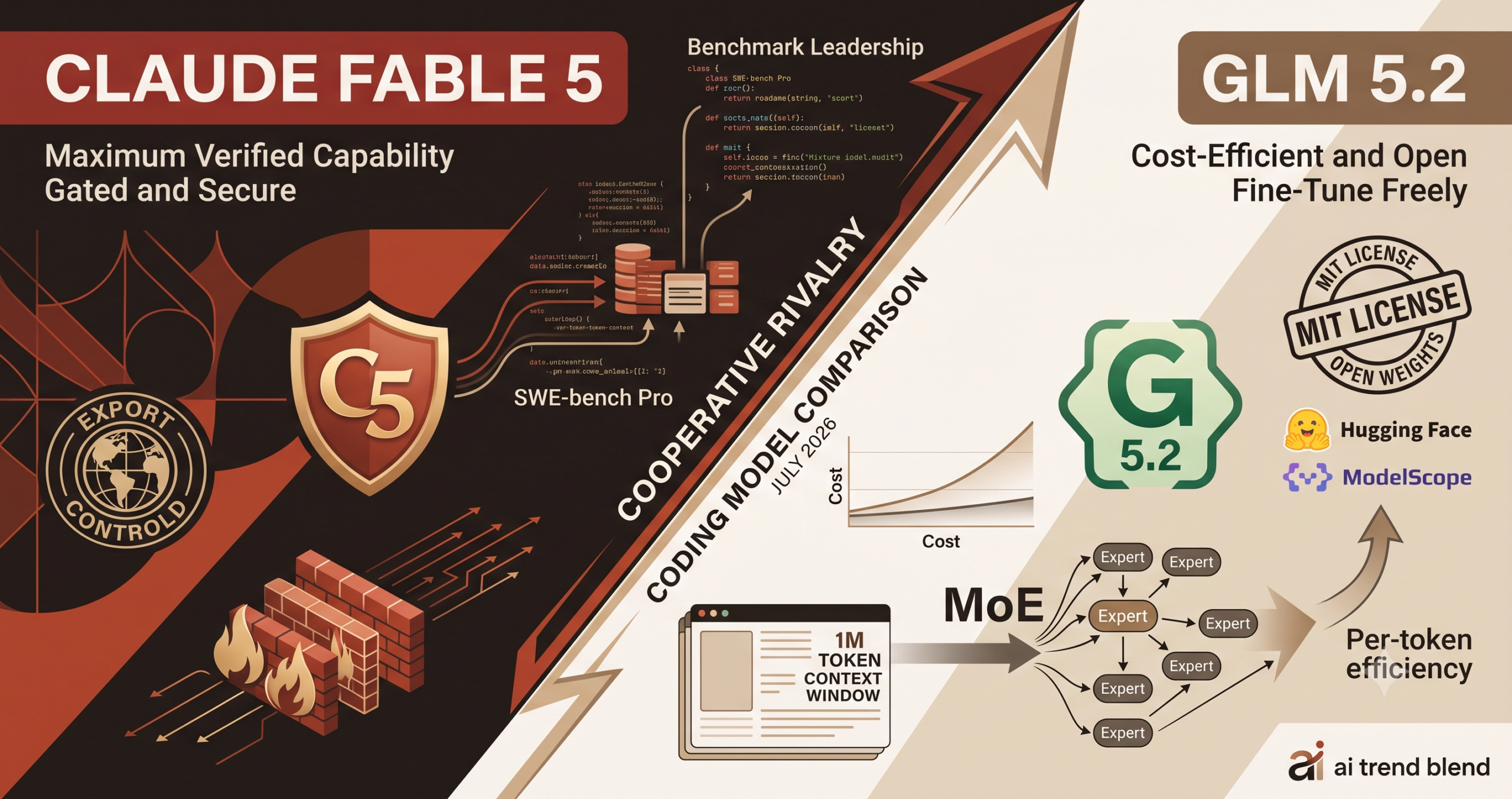
Somewhere in a Discord for indie developers last week, someone posted their monthly API bill next to a screenshot of a benchmark leaderboard and asked a simple question. Why am I paying Anthropic ten dollars per million input tokens when a model with open weights is scoring within a percentage point of Opus 4.8 on real coding tasks for a fraction of the cost. That question is the whole story of Claude Fable 5 against GLM 5.2 right now. One is Anthropic’s most capable model ever shipped, gated behind export controls that were lifted only days ago. The other is a 744 billion parameter Mixture of Experts model from Zhipu AI, released with open weights under an MIT license, that a growing number of teams are quietly routing production traffic through.
Key points
- Claude Fable 5 posts 95.0 percent on SWE-bench Verified and 80.0 percent on SWE-bench Pro, leading nearly every benchmark Anthropic has published for a generally available model.
- GLM 5.2 scores 62.1 on SWE-bench Pro against GPT 5.5’s 58.6, and lands within about a point of Opus 4.8 on FrontierSWE, all while shipping with open weights.
- Fable 5 costs 10 dollars per million input tokens and 50 dollars per million output tokens. Direct Z.ai pricing for GLM 5.2 runs about 1.40 dollars input and 4.40 dollars output, and some third party hosts go lower still.
- Both models now support a 1 million token context window, though Fable 5 caps output at 128,000 tokens against GLM 5.2’s 131,072.
- Fable 5 was briefly pulled from global access after the US government applied export controls on June 12, 2026, and only returned worldwide on July 1 with added safety classifiers.
- GLM 5.2 has beaten Claude Code on at least one independent security benchmark, scoring 39 percent F1 on IDOR detection against 32 percent for Claude Code, according to testing published by Semgrep.
Two AI labs making opposite bets
The problem runs deeper than a simple better or worse question. Claude Fable 5 and GLM 5.2 arrived within about a week of each other in June 2026, and they represent two labs making almost opposite bets about what a frontier coding model should be. Anthropic built Fable 5 as a closed, safety gated, premium product. It shares a technical foundation with the more restricted Claude Mythos 5, and Anthropic locked it behind cyber, bio and distillation classifiers that route certain queries to Claude Opus 4.8 instead of answering directly. Zhipu AI, operating internationally as Z.ai, went the other direction entirely. GLM 5.2 shipped with its weights posted to Hugging Face and ModelScope under a permissive MIT license, meaning any team with enough GPUs can download it, fine tune it and run it on their own infrastructure with no per token bill to anyone.
Here is where it gets interesting. Fable 5 is not a small step past its predecessor. Anthropic describes its capabilities as exceeding any model the company has previously made generally available, with leading scores across software engineering, knowledge work, vision and scientific research benchmarks. It briefly disappeared from worldwide access after the US government imposed export controls on June 12, forcing Anthropic to restrict the model to verified domestic users because there was no reliable way to check nationality in real time. Access returned globally on July 1, alongside a public statement that new classifiers would target and block a wider range of cybersecurity tasks going forward. That is not a footnote. It tells you Anthropic sees Fable 5 as capable enough to draw the attention of export regulators, which is a different kind of signal than a marketing claim.
What each company actually shipped
GLM 5.2 builds on the GLM 5 and GLM 5.1 line with a sparse Mixture of Experts design. Reporting from Zhipu puts the model at roughly 744 billion total parameters with only about 40 billion active for any given token, which is the architectural trick that keeps a model this size affordable to serve. The bigger engineering story is a new sparse attention method Zhipu calls IndexShare, which reuses the same indexer across groups of attention layers and reportedly cuts per token compute by close to 2.9 times at the full 1 million token context length. That is what makes a usable million token window financially realistic rather than a marketing number nobody actually runs.
Claude Fable 5 keeps its architecture undisclosed, which is standard for Anthropic. What we do know from the official Anthropic announcement is that Fable 5 supports text and vision input with text output, extended thinking, and a 1 million input token window with a 128,000 token output cap. Unlike some long context pricing schemes, Anthropic charges the same per token rate whether a request uses 9,000 tokens or 900,000, so there is no long context surcharge to budget around.
What the benchmarks actually show
None of this comes for free, and the benchmark tables make the tradeoff concrete rather than abstract.
Coding and long horizon agent work
| Benchmark | Claude Fable 5 | GLM 5.2 |
|---|---|---|
| SWE-bench Verified | 95.0 percent | Not separately reported |
| SWE-bench Pro | 80.0 percent | 62.1 (vs GPT 5.5 at 58.6) |
| Terminal-Bench 2.1 | 84.3 percent mean reward | 81.0 (Opus 4.8 scored 85.0) |
| AIME 2026 (math) | Not directly compared here | 99.2 percent |
| Context window | 1M input / 128K output | 1,048,576 input / 131,072 output |
Fable 5 leads on the headline software engineering benchmarks by a wide margin, and it holds the top spot on FrontierCode with 29.3 percent on the harder Diamond subset. But look at where GLM 5.2 lands relative to its price. Reporting from VentureBeat found GLM 5.2 beating GPT 5.5 on multiple long horizon coding benchmarks for around a sixth of the cost, and separate coverage from Technology.org put it within striking distance of Opus 4.8 at roughly a fifth of that model’s cost. Fable 5 is priced above Opus 4.8, not below it, which stretches the gap between the two models in this article even further than the Opus comparison suggests.
Security tasks and design taste
This is not a small distinction either. A benchmark run published by Semgrep found GLM 5.2 scoring 39 percent F1 on IDOR vulnerability detection against 32 percent for Claude Code, a rare case of an open weight model beating an Anthropic coding product on a security specific task rather than a general one. GLM 5.2 has also climbed to the top of several design focused evaluation leaderboards, outscoring proprietary models including GPT 5.5 on tasks that reward visual and layout judgment rather than raw logic. Anthropic has not published comparable design benchmark numbers for Fable 5, so that comparison currently runs in one direction only, and readers should treat it as GLM 5.2’s strength shown rather than Fable 5’s weakness proven.
The numbers tell a complicated story once you factor in access. GLM 5.2 rolled out to Z.ai’s own Coding Plan subscribers first, on June 13, with open weights and full release notes following three days later on June 16. That staggered release is common for labs trying to reward paying subscribers before flooding the open model ecosystem, and it means the earliest independent benchmarks came from people running the model themselves rather than from a single vendor claim.
Who each model actually suits
Think about what this actually requires in practice rather than in a benchmark table. If your team ships code that gets audited, handles regulated data, or needs the vendor to carry safety and liability responsibility, Fable 5’s closed and classifier gated design is a feature, not a limitation. Anthropic’s routing of sensitive cyber, bio and distillation adjacent queries to Opus 4.8 is exactly the kind of behavior a compliance team wants documented somewhere.
If your team is running a high volume agent pipeline, self hosting for data residency reasons, or building a product where GLM 5.2’s MIT license lets you fine tune on your own codebase without asking anyone’s permission, the open weight path removes a dependency that closed model users cannot remove no matter how good their contract is. The 1.40 dollar per million token input price from Z.ai directly, and the even lower rates available through third party hosts on OpenRouter, change the math on workloads that make thousands of calls per day.
There is a middle case worth naming honestly. Some teams will run both. Fable 5 for the narrow set of highest stakes tasks where the extra correctness margin is worth the price, and GLM 5.2 for the high volume, lower stakes agentic work where cost per call actually determines whether a product is profitable. That is not indecision, it is just matching the tool to the job, and it is what a growing number of engineering teams are already doing based on the coverage this article draws from.
Paraphrased framing from Semgrep’s published cyber benchmark analysis, GLM 5.2 versus Claude, 2026
The honest limitations on both sides
Vendor published benchmarks are not neutral, and both Anthropic and Zhipu have an interest in the numbers they choose to publish. Fable 5’s Terminal-Bench 2.1 result of 84.3 percent mean reward included roughly 20.9 percent of trials hitting a safety fallback rather than completing normally, which is a meaningfully different outcome from a clean pass and one that will not show up if you only glance at the headline percentage. GLM 5.2’s SWE-bench Pro score of 62.1 is genuinely strong against GPT 5.5, but it still trails Fable 5’s 80.0 by a wide margin on the same benchmark family, so anyone reading GLM 5.2 as an outright replacement for Fable 5 on the hardest verified tasks is reading past what the numbers actually show.
Pricing is also a moving target on both sides. GLM 5.2’s third party hosting rates vary widely, from roughly 0.95 to 3.00 dollars per million input tokens across different OpenRouter providers, so the actual price a team pays depends heavily on which host they choose and whether they self host instead. Anthropic’s pricing for Fable 5 has stayed fixed since launch, but Fable 5 itself was pulled from global access once already over export control questions, and nothing rules out further access changes if governments keep treating frontier model capability as an export control category. Anyone building a product around either model should read the access history here as a real operational risk, not a one time news item that already resolved itself.
PyTorch aside
This article compares two shipped products rather than a single research paper with a reproducible method, so there is no proposed model architecture or training code to reimplement here. Readers who want to actually run GLM 5.2 locally should follow Zhipu’s own inference documentation on Hugging Face, since a hand rolled reimplementation of a 744 billion parameter Mixture of Experts model would not meaningfully help anyone and risks getting engineering details wrong that Zhipu’s own repository already gets right.
Conclusion
Claude Fable 5 and GLM 5.2 landing within about a week of each other in June 2026 was not a coincidence so much as a signal that the frontier coding model race has split into two genuinely different games. Anthropic is playing a game of maximum verified capability, wrapped in safety classifiers and export control compliance, sold at a price that assumes buyers value correctness and vendor accountability above raw cost per token. Zhipu is playing a game of open access and cost efficiency, betting that a model good enough to sit within a point of Opus 4.8 on FrontierSWE, released with weights anyone can download, will pull enough volume from cost conscious teams to matter more than winning every single benchmark outright.
The conceptual shift worth sitting with is that open weight models closing the gap on frontier benchmarks used to be a story about smaller labs catching up months later on old techniques. GLM 5.2 arriving within roughly a week of Fable 5, and beating Claude Code outright on at least one security benchmark, is a different and faster kind of catch up than the field saw even a year earlier. That pace has implications well past coding tools. The same pressure toward cheaper, openly licensed alternatives is visible in design evaluation leaderboards, in math benchmarks like AIME 2026, and in the general Intelligence Index rankings where GLM 5.2 now sits ahead of MiniMax M3, DeepSeek V4 Pro and Kimi K2.6.
None of that erases Fable 5’s real advantages. A 15 point gap on SWE-bench Pro, a documented and export controlled level of capability, and safety classifiers that route risky queries elsewhere are not small things, especially for teams whose legal and compliance functions care as much about accountability as about raw accuracy. The honest read is that Fable 5 remains the stronger choice on the hardest, most consequential coding tasks, while GLM 5.2 has become the stronger choice on everything measured mostly by cost per unit of useful output.
What happens next is the more interesting question than what has already happened. If Zhipu keeps closing benchmark gaps at this pace while Anthropic keeps facing export control friction on its own most capable model, the pressure on Anthropic to justify Fable 5’s premium pricing will only grow. If Anthropic instead pushes Fable 5’s safety classifiers and accountability story as the actual product, rather than treating raw benchmark leadership as the whole pitch, the two models may simply keep serving different buyers rather than converging into one winner.
Either way, the team that benefits most right now is the one willing to read past the marketing on both sides and match the model to the job in front of them, rather than picking a side in a rivalry that neither company is actually trying to settle.
Frequently asked questions
Is GLM 5.2 actually better than Claude Fable 5 at coding?
It depends on the task. Fable 5 leads on SWE-bench Verified at 95.0 percent and SWE-bench Pro at 80.0 percent, both well ahead of GLM 5.2’s reported 62.1 on SWE-bench Pro. GLM 5.2 is competitive with GPT 5.5 and lands close to Opus 4.8 on FrontierSWE, and it costs far less per token, which is a different kind of advantage than raw benchmark leadership.
Can I download and run GLM 5.2 myself?
Yes. GLM 5.2 is released with open weights on Hugging Face and ModelScope under an MIT license, and it supports common inference frameworks including transformers, vLLM and SGLang. Claude Fable 5 has no equivalent option since Anthropic does not release model weights.
Why was Claude Fable 5 temporarily unavailable?
The US government applied export controls to Fable 5 on June 12, 2026, requiring Anthropic to restrict access to foreign nationals. Because Anthropic had no reliable real time way to verify user nationality, it suspended access for all users rather than risk a violation. Access returned globally on July 1 with additional safety classifiers targeting cybersecurity tasks.
How much does each model cost to use through an API?
Claude Fable 5 costs 10 dollars per million input tokens and 50 dollars per million output tokens directly from Anthropic. GLM 5.2 costs about 1.40 dollars per million input tokens and 4.40 dollars per million output tokens through Z.ai directly, with some third party hosts pricing it even lower.
Do both models support a 1 million token context window?
Yes. Fable 5 supports 1 million input tokens with a 128,000 token output cap, and Anthropic charges the same rate regardless of request length. GLM 5.2 supports 1,048,576 input tokens with a 131,072 token output cap, made financially workable by Zhipu’s IndexShare sparse attention method.
Which model should a small team pick if budget is the main constraint?
GLM 5.2 is the more budget friendly option by a wide margin given its lower per token pricing and the option to self host under its MIT license. Teams should still test both models against their own real workload before committing, since benchmark leadership does not always predict which model performs best on a specific codebase or task type.
Read the primary sources behind this comparison before making a decision that affects your own stack.
Sources referenced in this analysis include Anthropic’s official announcement and redeployment notice for Claude Fable 5, Z.ai’s official GLM 5.2 model card and blog post on Hugging Face, benchmark reporting from Semgrep, VentureBeat and Technology.org, and pricing data published by Z.ai, OpenRouter and Requesty as of July 2026. This analysis is based on the published vendor announcements and an independent evaluation of their claims.
Related reading on aitrendblend.com
Anthropic Claude
Claude Fable 5. The AI So Capable the US Paused It
Model Comparison
What’s New in Claude Opus 4.8 vs Older Claude Models
Developer Tools
Claude Code CLI. Complete 2026 Developer Guide
Chinese AI Tools
Best Chinese AI Tools for Advanced Coding in 2026
AI Tools
Best AI Tools to Build a Full Website from Scratch
Agent AI
How to Create an AI Agent For Your Website
Prompt Engineering
10 Best ChatGPT Prompts for YouTube Script Writing
AI Tools Comparison
AI Sprite Sheet and Animation Generator 2026 Comparison
Game Dev AI
Best AI Tools to Develop a Full Game from Scratch