
Math Applications

Artificial intelligence is, at its core, applied mathematics. These math applications stands at the intersection of pure math and computer science, diving into the theoretical foundations of modern AI 📐. Explore complex research on gradient descent optimization, high-dimensional linear algebra, probabilistic reasoning, and the calculus of neural networks. From understanding the topology of deep learning models to the statistical theories explaining how massive language models generalize data, discover the mathematical proofs and equations that make artificial intelligence possible.

Why Batch Size Changes What Your Neural Network Learns

Why Batch Size Changes What Your Neural Network Learns

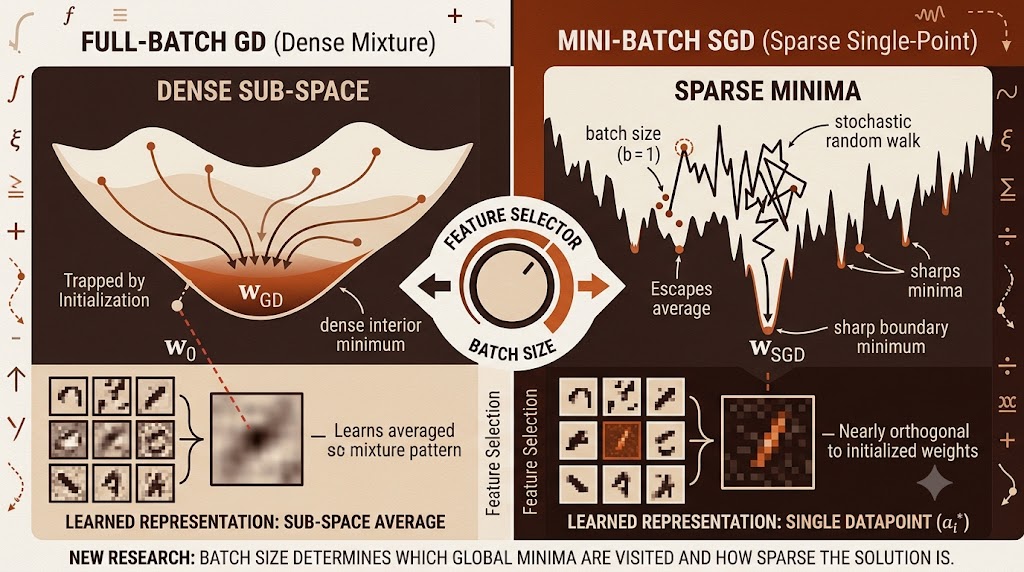
Analysis by the aitrendblend editorial team January 2025 Machine Learning Research Optimization Feature Learning GD (left) settles near a dense interior minimum; SGD with b=1 (right) escapes to a single datapoint on the boundary. From Ghosh et al., JMLR 2025. Pick any mainstream guide to training neural networks and you will read the same advice: […]

Why Batch Size Changes What Your Neural Network Learns Read More »

When Expected Improvement Falls Short and What EIC Does About It.

When Expected Improvement Falls Short and What EIC Does About It

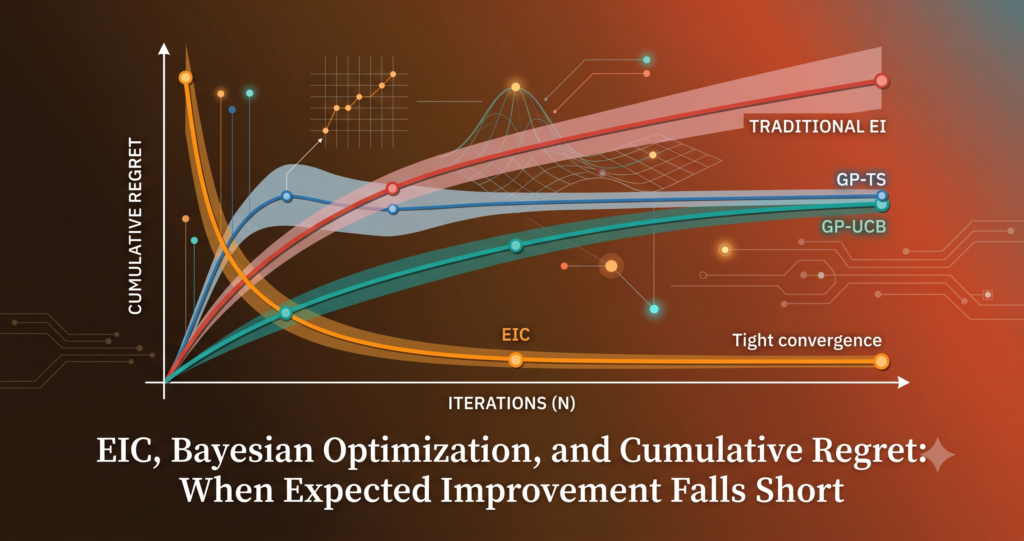
Practical AI Bayesian Optimization Analysis by the aitrendblend editorial team Published in JMLR 26 (2025) Cumulative regret curves from the EIC paper (Hu et al., JMLR 2025). EIC keeps pace with GP-UCB while closing the gap on traditional EI. Every machine learning practitioner who has tuned a neural network with Bayesian optimization has silently trusted

When Expected Improvement Falls Short and What EIC Does About It Read More »

When Enzymes Hit Their Limits — A Rigorous Look at the Total Quasi-Steady State Approximation.

When Enzymes Hit Their Limits — A Rigorous Look at the Total Quasi-Steady State Approximation

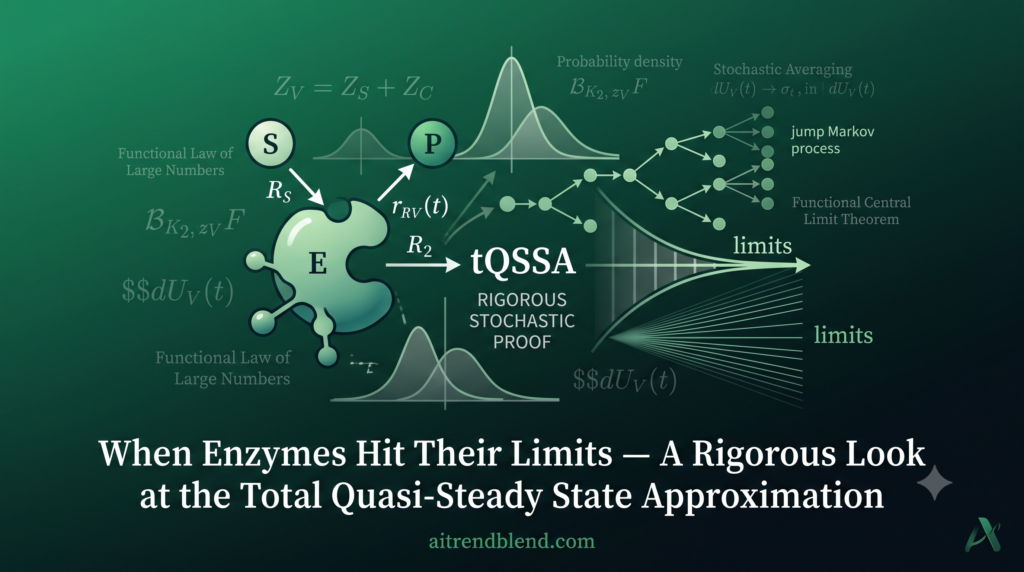
When Enzymes Hit Their Limits — A Rigorous Look at the Total Quasi-Steady State Approximation | AI Trend Blend AITrendBlend Mathematics Deep Learning About Applied Mathematics · Journal of Mathematical Analysis and Applications 561 (2026) · Louisiana State University & University of Nottingham · 15 min read When Enzymes Hit Their Limits — A Rigorous

When Enzymes Hit Their Limits — A Rigorous Look at the Total Quasi-Steady State Approximation Read More »

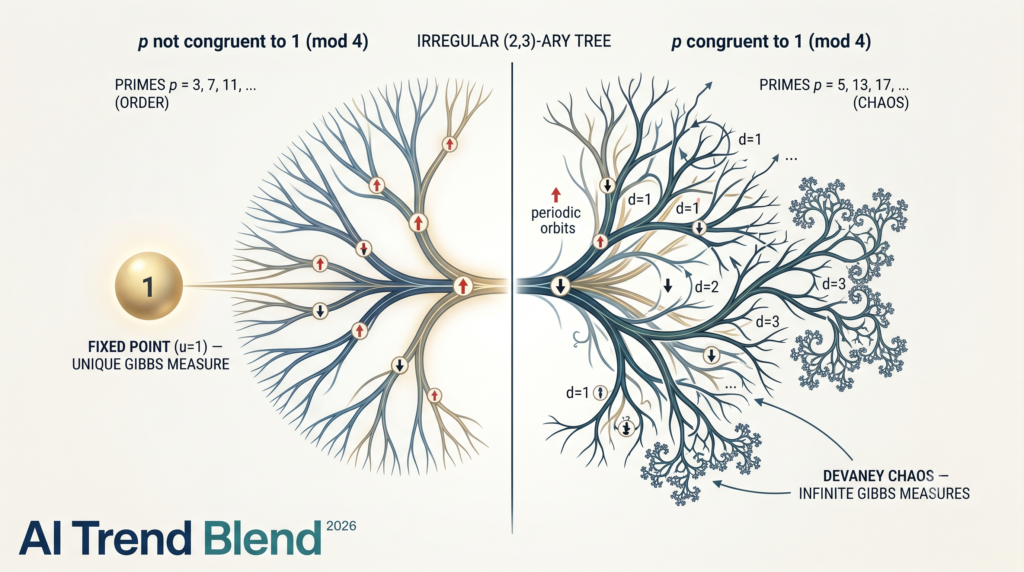
Chaos in the p-adic Ising Model — When Prime Numbers Decide Phase Transitions.

Chaos in the p-adic Ising Model — When Prime Numbers Decide Phase Transitions

Chaos in the p-adic Ising Model — When Prime Numbers Decide Phase Transitions | AI Trend Blend AITrendBlend Machine Learnings Mathematics About Statistical Mechanics · Journal of Mathematical Analysis and Applications 560 (2026) · UAE University & Uzbekistan Academy of Sciences · 14 min read When the Prime Number Decides Everything — Chaos and Phase

Chaos in the p-adic Ising Model — When Prime Numbers Decide Phase Transitions Read More »

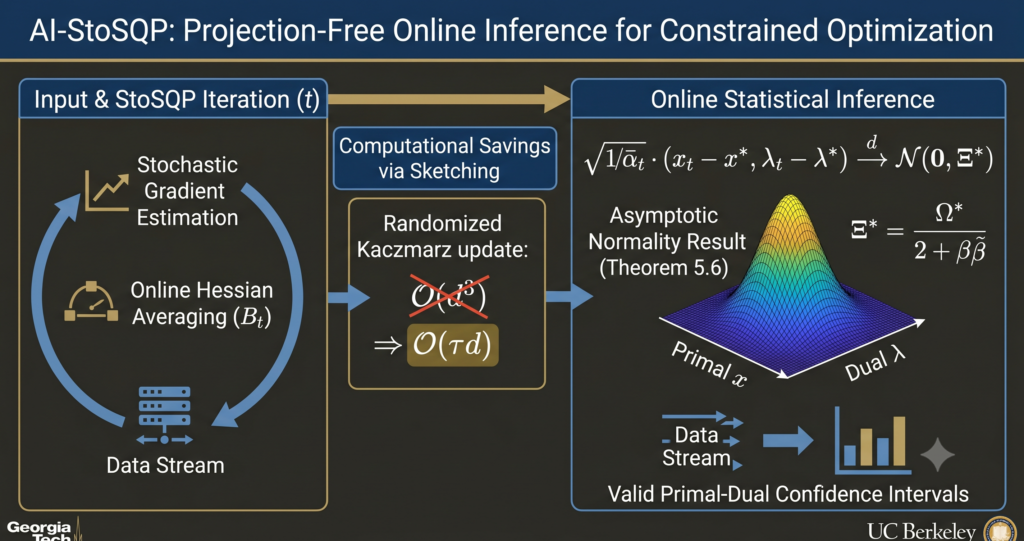
Statistical Inference via Sketched StoSQP: Online Second-Order Methods for Constrained Optimization.

Statistical Inference via Sketched StoSQP: Online Second-Order Methods for Constrained Optimization

Statistical Inference via Sketched StoSQP: Online Second-Order Methods for Constrained Optimization | AI Trend Blend AITrendBlend Machine Learning Cybersecurity About Optimization Theory · Journal of Machine Learning Research 26 (2025) 1–75 · 20 min read The Online Inference Problem That Second-Order Methods Finally Solved — Without Projections Sen Na at Georgia Tech and Michael Mahoney

Statistical Inference via Sketched StoSQP: Online Second-Order Methods for Constrained Optimization Read More »

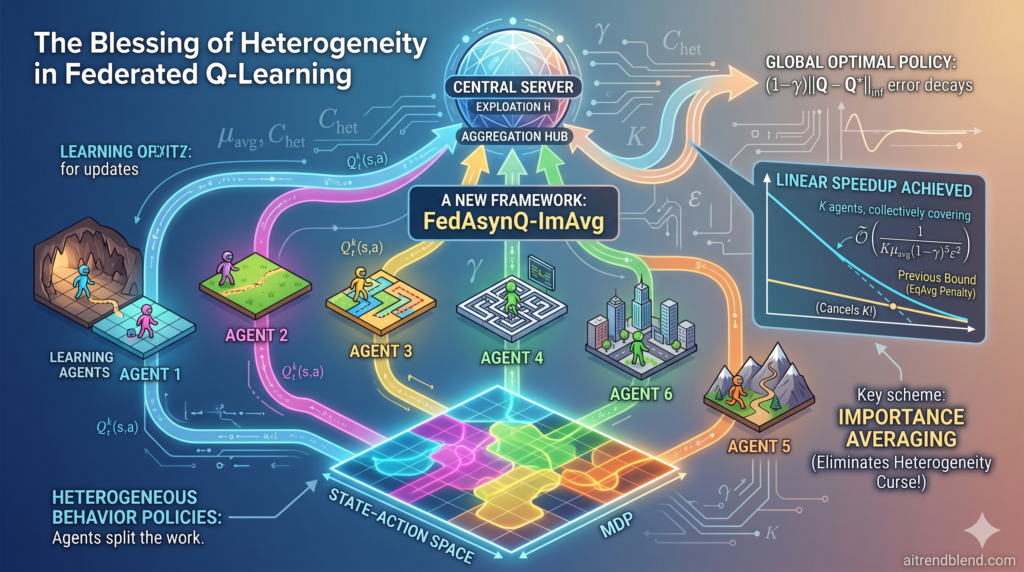
The Blessing of Heterogeneity in Federated Q-Learning: Linear Speedup and Beyond.

The Blessing of Heterogeneity in Federated Q-Learning: Linear Speedup and Beyond

The Blessing of Heterogeneity in Federated Q-Learning: Linear Speedup and Beyond | Research Breakdown AITrendBlend Machine Learning Agent AI About Federated RL · Journal of Machine Learning Research 26 (2025) 1–85 · 22 min read When Different Agents Learn Different Things: Why Heterogeneity Is Actually a Gift in Federated Q-Learning A team from Carnegie Mellon

The Blessing of Heterogeneity in Federated Q-Learning: Linear Speedup and Beyond Read More »

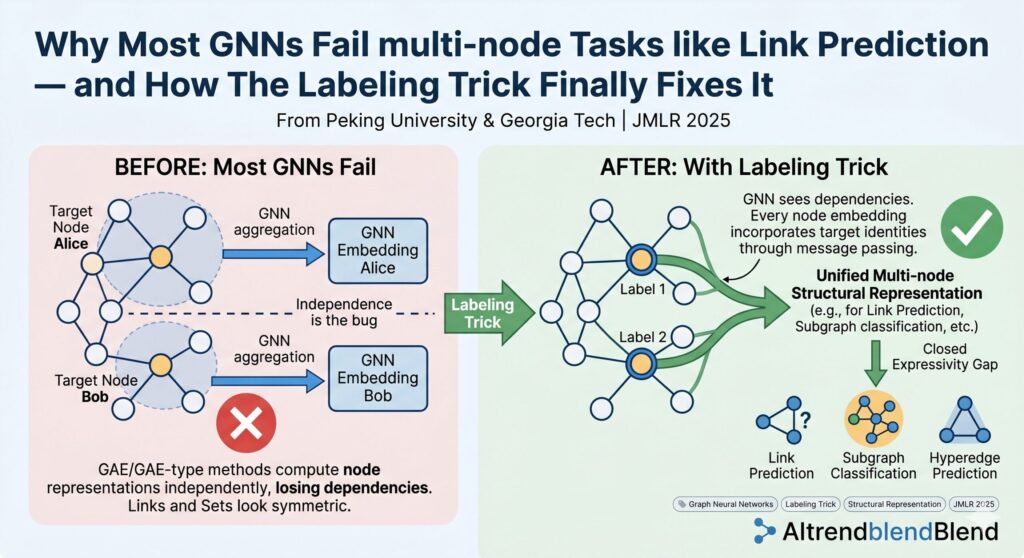
Improving Graph Neural Networks on Multi-node Tasks with the Labeling Trick

Improving Graph Neural Networks on Multi-node Tasks with the Labeling Trick

Improving Graph Neural Networks on Multi-node Tasks with the Labeling Trick | AI Trend Blend AITrendBlend Machine Learning Computer Vision About Graph Neural Networks · Journal of Machine Learning Research 26 (2025) 1–44 · 20 min read Why Most GNNs Fail at Link Prediction — and How the Labeling Trick Finally Fixes It A team

Improving Graph Neural Networks on Multi-node Tasks with the Labeling Trick Read More »

Directed Cyclic Graphs for Causal Discovery from Longitudinal Data.

Directed Cyclic Graphs for Causal Discovery from Longitudinal Data

Directed Cyclic Graphs for Causal Discovery from Longitudinal Data | Research Breakdown AITrendBlend Machine Learning Mathematics About Causal Discovery · Journal of Machine Learning Research 26 (2025) 1–62 · 20 min read How Do You Find Cause and Effect When Everything Influences Everything Else? A New Answer for Longitudinal Data A team from Johns Hopkins

Directed Cyclic Graphs for Causal Discovery from Longitudinal Data Read More »

Taming Chaotic Fluids — How an Energy Method Finally Pins Down Uniqueness for Compressible Euler Equations

Taming Chaotic Fluids — How an Energy Method Finally Pins Down Uniqueness for Compressible Euler Equations | AI Trend Blend AITrendBlend Mathematics Machine Learning About Applied Mathematics · Journal of Mathematical Analysis and Applications 561 (2026) · UNICAMP — Universidade Estadual de Campinas, Brazil · 15 min read Taming Chaotic Fluids — How an Energy

Taming Chaotic Fluids — How an Energy Method Finally Pins Down Uniqueness for Compressible Euler Equations Read More »

Riemannian Bilevel Optimization — When Machine Learning Leaves Flat Space Behind.

Riemannian Bilevel Optimization — When Machine Learning Leaves Flat Space Behind

Riemannian Bilevel Optimization — When Machine Learning Leaves Flat Space Behind | AI Trend Blend AITrendBlend Machine Learning Mathematics About Machine Learning Theory · Journal of Machine Learning Research 26 (2025) · University of Minnesota & Rice University · 20 min read Why Machine Learning on Curved Surfaces Is the Next Big Leap — And

Riemannian Bilevel Optimization — When Machine Learning Leaves Flat Space Behind Read More »