
Math Applications

Artificial intelligence is, at its core, applied mathematics. These math applications stands at the intersection of pure math and computer science, diving into the theoretical foundations of modern AI 📐. Explore complex research on gradient descent optimization, high-dimensional linear algebra, probabilistic reasoning, and the calculus of neural networks. From understanding the topology of deep learning models to the statistical theories explaining how massive language models generalize data, discover the mathematical proofs and equations that make artificial intelligence possible.

Taming Chaotic Fluids — How an Energy Method Finally Pins Down Uniqueness for Compressible Euler Equations

For the first time, a single constructive framework proves that all weak asymptotic solutions of the compressible Euler equations — covering isentropic gases, isothermal gases, and pressureless fluids — converge to the same unique limit whenever a regular solution exists,…

Taming Chaotic Fluids — How an Energy Method Finally Pins Down Uniqueness for Compressible Euler Equations Read More »

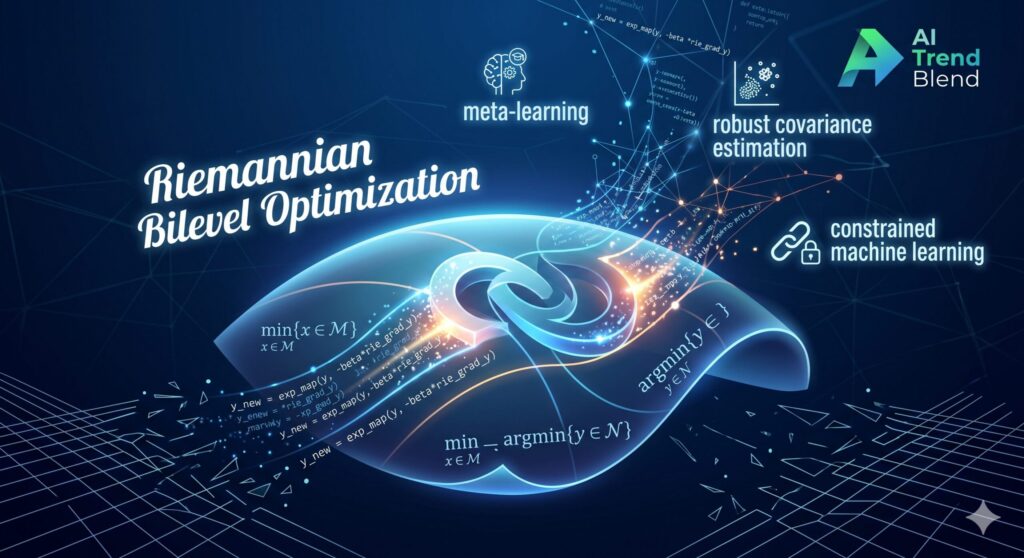
Riemannian Bilevel Optimization — When Machine Learning Leaves Flat Space Behind.

Riemannian Bilevel Optimization — When Machine Learning Leaves Flat Space Behind

Two researchers from the University of Minnesota and Rice University have cracked open a new frontier: bilevel optimization on Riemannian manifolds. Their algorithms, RieBO and RieSBO, achieve the same theoretical complexity as flat-space methods — unlocking meta-learning, robust estimation, and…

Riemannian Bilevel Optimization — When Machine Learning Leaves Flat Space Behind Read More »

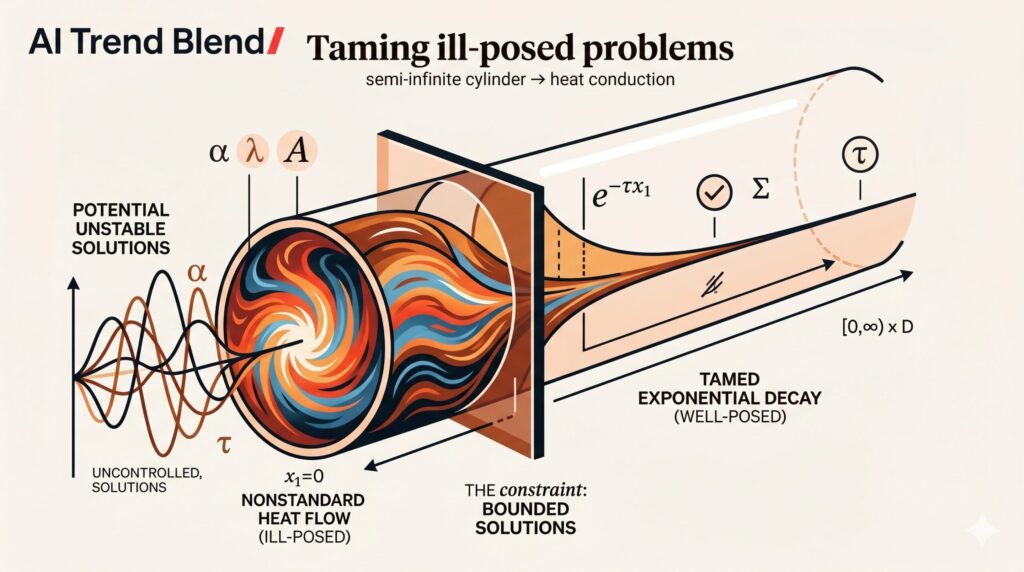
When Heat Refuses to Misbehave — Taming Ill-Posed Problems in Semi-Infinite Cylinders.

When Heat Refuses to Misbehave — Taming Ill-Posed Problems in Semi-Infinite Cylinders

Two mathematicians from Spain have shown that a stubborn class of nonstandard heat-conduction problems — ones that technically admit no unique solution — can be domesticated with a single elegant constraint, yielding solutions that decay neatly in space and behave…

When Heat Refuses to Misbehave — Taming Ill-Posed Problems in Semi-Infinite Cylinders Read More »

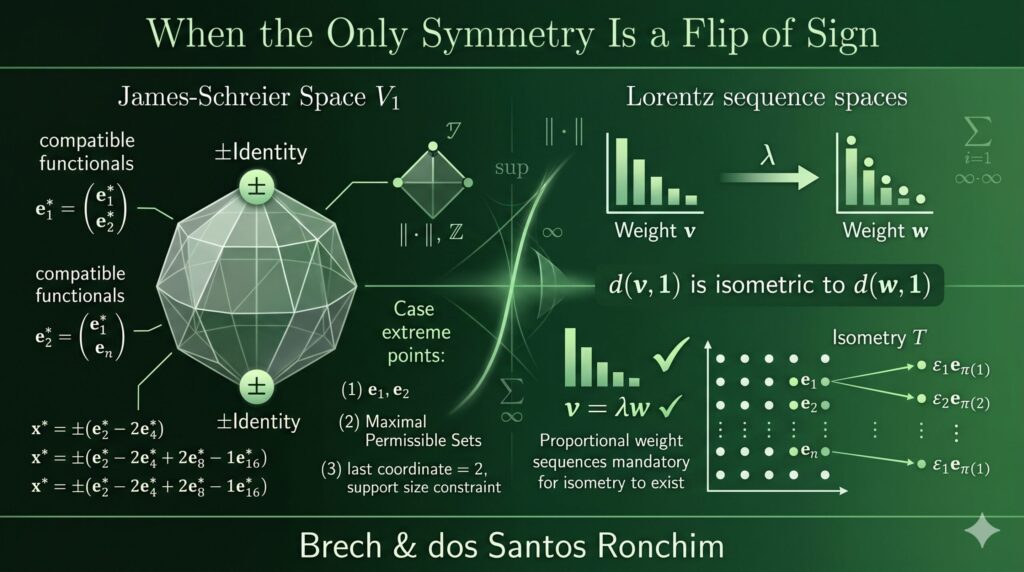
When the Only Symmetry Is a Flip of Sign — Isometries of James-Schreier and Lorentz Spaces

When the Only Symmetry Is a Flip of Sign — Isometries of James-Schreier and Lorentz Spaces

Two Brazilian mathematicians have pinned down the exact symmetries of two classical families of infinite-dimensional spaces — finding that one is so rigid it only admits trivial isometries, while the other obeys a clean Banach-Stone law that forces proportional weight…

When the Only Symmetry Is a Flip of Sign — Isometries of James-Schreier and Lorentz Spaces Read More »

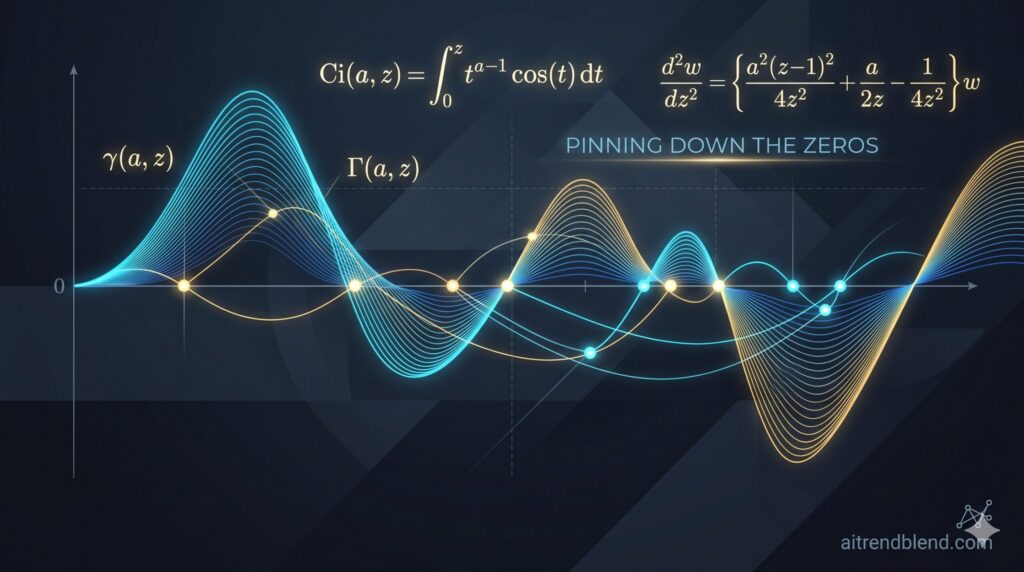
Pinning Down the Zeros — New Uniform Asymptotic Expansions for Generalised Trigonometric Integrals.

Pinning Down the Zeros — New Uniform Asymptotic Expansions for Generalised Trigonometric Integrals

A mathematician at San Diego State University has derived powerful new uniform asymptotic expansions for the generalised trigonometric integrals and — for the first time — their zeros, all at once, for every size of zero, using a beautifully layered…

Pinning Down the Zeros — New Uniform Asymptotic Expansions for Generalised Trigonometric Integrals Read More »

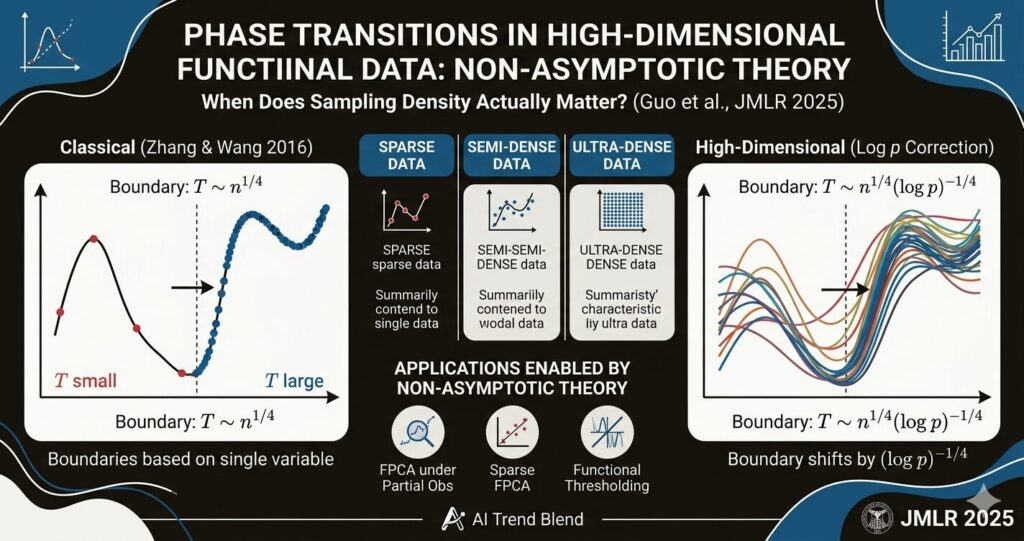
From Sparse to Dense Functional Data in High Dimensions: Phase Transitions Revisited.

From Sparse to Dense Functional Data in High Dimensions: Phase Transitions Revisited

A team from Renmin University of China, Tsinghua University, and the University of Hong Kong proved that the classical sparse-to-dense transition in functional data analysis shifts when the number of functional variables grows large — and derived the exact non-asymptotic…

From Sparse to Dense Functional Data in High Dimensions: Phase Transitions Revisited Read More »

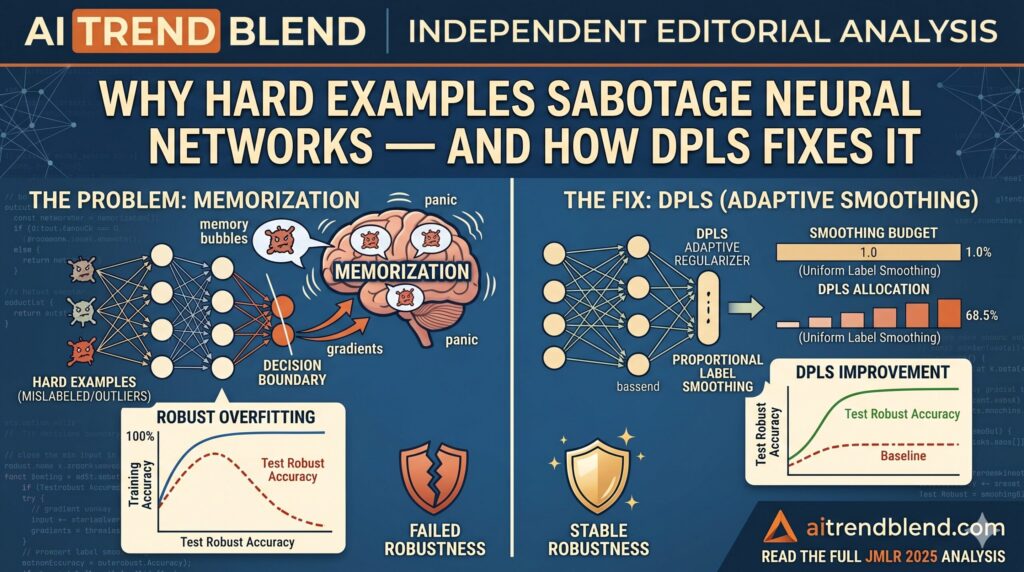
Why Hard Training Examples Hurt Neural Networks — And How DPLS Fixes It.

Why Hard Training Examples Hurt Neural Networks — And How DPLS Fixes It

A team from Seoul National University and Ewha Womans University pinpointed a root cause of robust overfitting — the model memorizes tricky outliers during adversarial training rather than learning from them. Their remedy, difficulty proportional label smoothing, costs almost nothing…

Why Hard Training Examples Hurt Neural Networks — And How DPLS Fixes It Read More »