Math Applications

Artificial intelligence is, at its core, applied mathematics. These math applications stands at the intersection of pure math and computer science, diving into the theoretical foundations of modern AI 📐. Explore complex research on gradient descent optimization, high-dimensional linear algebra, probabilistic reasoning, and the calculus of neural networks. From understanding the topology of deep learning models to the statistical theories explaining how massive language models generalize data, discover the mathematical proofs and equations that make artificial intelligence possible.

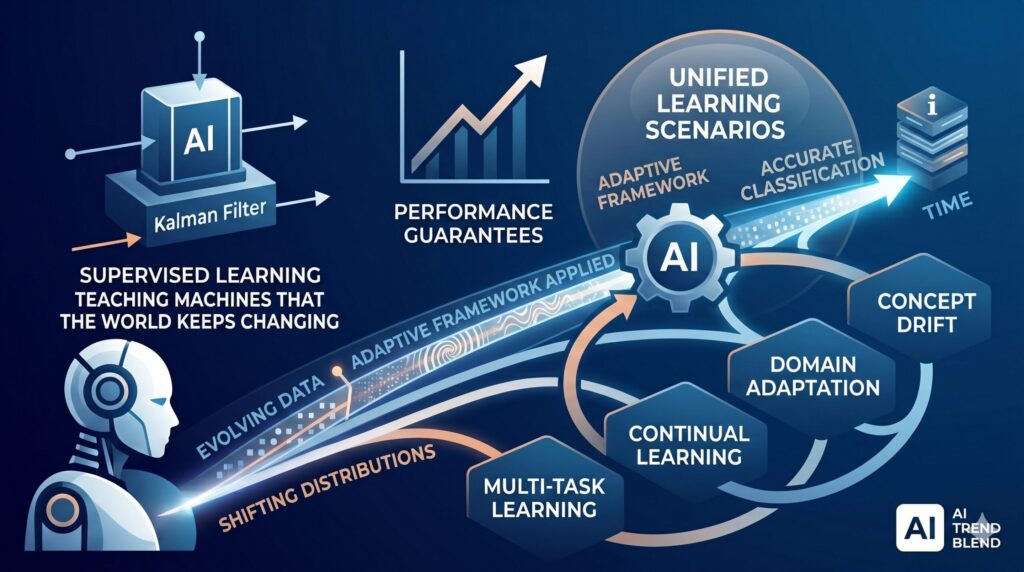
Teaching Machines That the World Keeps Changing: Supervised Learning with Evolving Tasks and Performance Guarantees

Teaching Machines That the World Keeps Changing: Supervised Learning with Evolving Tasks and Performance Guarantees

Verónica Álvarez, Santiago Mazuelas, and Jose A. Lozano show that a single Kalman-filter-based methodology can unify multi-task learning, continual learning, domain adaptation, and concept drift — while being the first to provide computable, tight error-probability guarantees and a closed-form characterization…
Teaching Machines That the World Keeps Changing: Supervised Learning with Evolving Tasks and Performance Guarantees Read More »

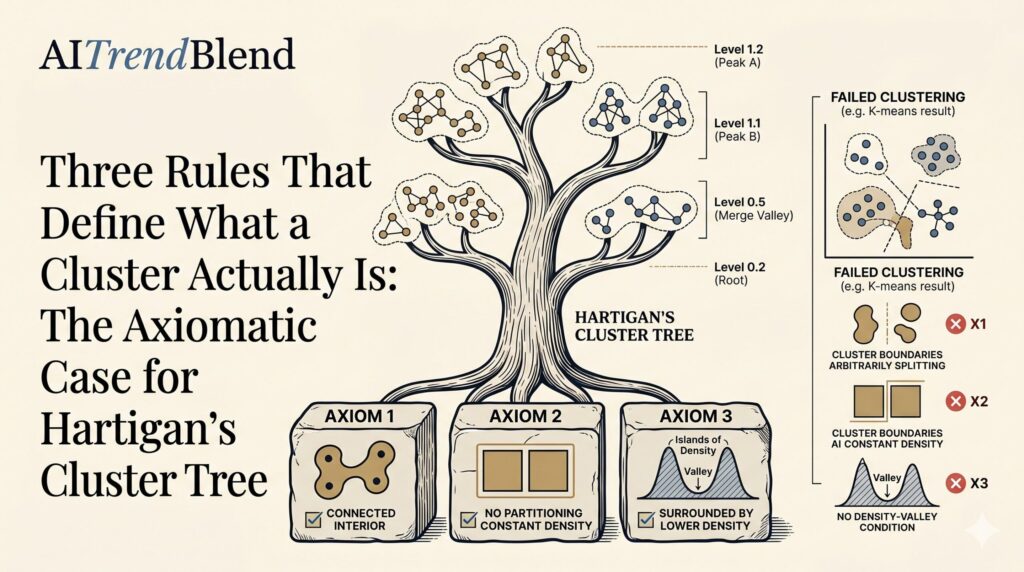
An Axiomatic Definition of Hierarchical Clustering: Why Hartigan Was Right All Along.

An Axiomatic Definition of Hierarchical Clustering: Why Hartigan Was Right All Along

Ery Arias-Castro and Elizabeth Coda from UC San Diego take an approach inspired by Lebesgue integration — starting from first principles — to show that three intuitive axioms about what a cluster ought to be uniquely recover Hartigan’s cluster tree,…

An Axiomatic Definition of Hierarchical Clustering: Why Hartigan Was Right All Along Read More »

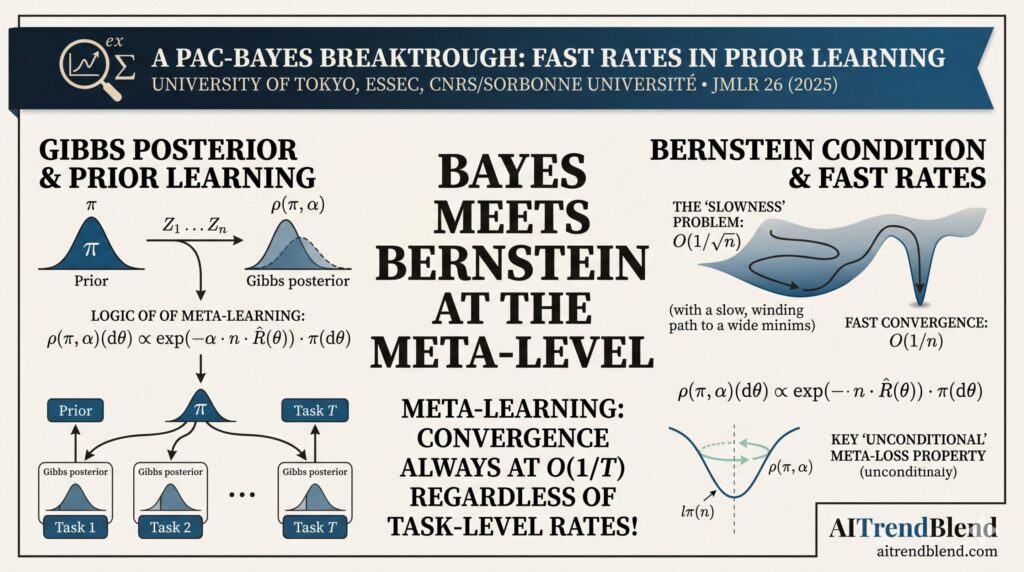
Bayes Meets Bernstein: Why Meta-Learning Finally Gets Fast — A PAC-Bayes Breakthrough.

Bayes Meets Bernstein: Why Meta-Learning Finally Gets Fast — A PAC-Bayes Breakthrough

A research team from three leading institutions has proven something nobody expected: when learning a prior across many tasks using the Gibbs algorithm, fast convergence rates are always guaranteed at the meta level — even when individual tasks refuse to…

Bayes Meets Bernstein: Why Meta-Learning Finally Gets Fast — A PAC-Bayes Breakthrough Read More »

Escaping Saddle Points in Bilevel Optimization — A Breakthrough in Machine Learning Theory.

Escaping Saddle Points in Bilevel Optimization — A Breakthrough in Machine Learning Theory

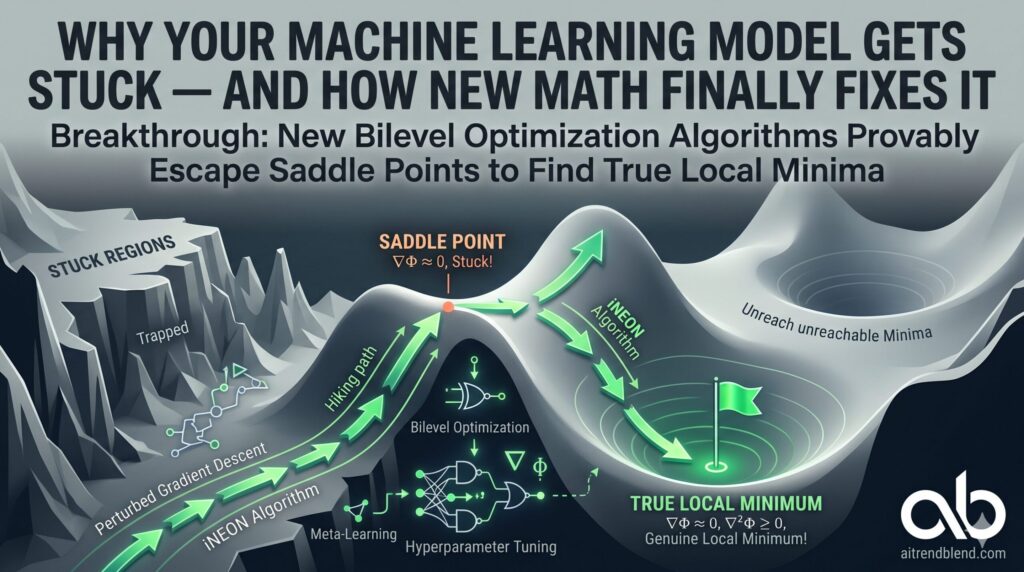
A research team from three major U.S. universities has proven for the first time that bilevel optimization algorithms can reliably escape saddle points and find true local minima — solving a problem that has quietly undermined meta-learning, hyperparameter tuning, and…

Escaping Saddle Points in Bilevel Optimization — A Breakthrough in Machine Learning Theory Read More »

TTGDA: Two-Timescale Gradient Descent Ascent for Nonconvex Minimax Optimization.

TTGDA: Two-Timescale Gradient Descent Ascent for Nonconvex Minimax Optimization

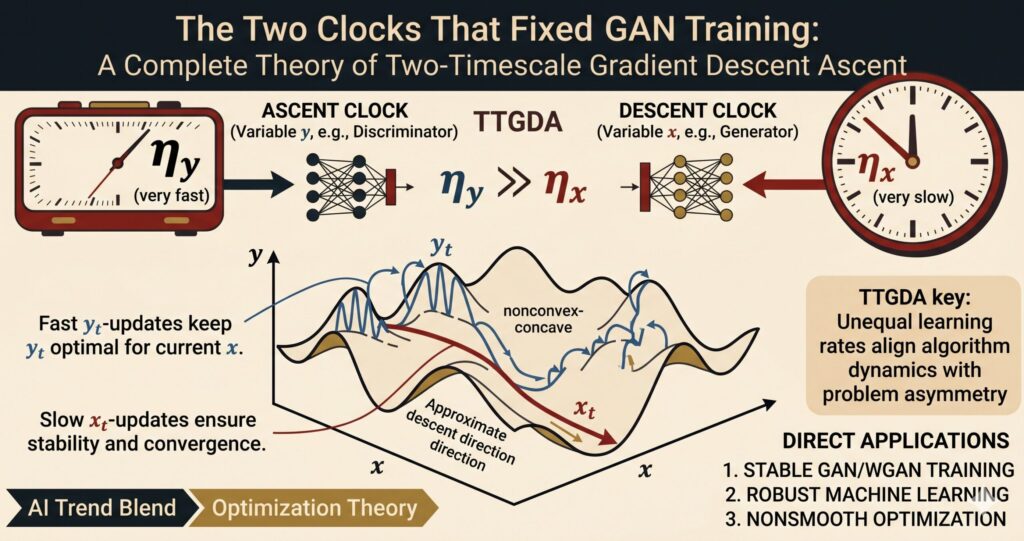
Tianyi Lin, Chi Jin, and Michael I. Jordan from Columbia, Princeton, and UC Berkeley deliver the first rigorous nonasymptotic analysis of two-timescale gradient descent ascent — the algorithm that has powered GAN training in practice for years — establishing tight…

TTGDA: Two-Timescale Gradient Descent Ascent for Nonconvex Minimax Optimization Read More »

How to Tune a Robust Regression Model Without Knowing the Noise: Adaptive Error Estimation for Unregularized M-Estimators.

How to Tune a Robust Regression Model Without Knowing the Noise: Adaptive Error Estimation for Unregularized M-Estimators

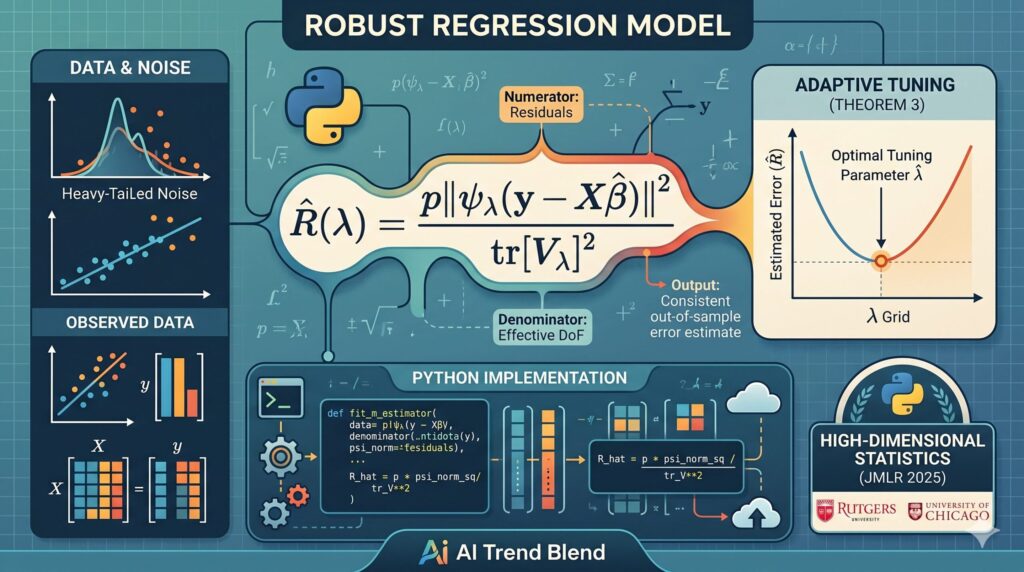
Pierre C. Bellec (Rutgers) and Takuya Koriyama (Chicago Booth) prove that a simple, fully observable formula consistently estimates the prediction error of any Huber-class M-estimator in high dimensions — and that minimizing it over a grid of scale parameters automatically…

How to Tune a Robust Regression Model Without Knowing the Noise: Adaptive Error Estimation for Unregularized M-Estimators Read More »

Dist-SI: Selective Inference with Distributed Data via Randomized Lasso.

Dist-SI: Selective Inference with Distributed Data via Randomized Lasso

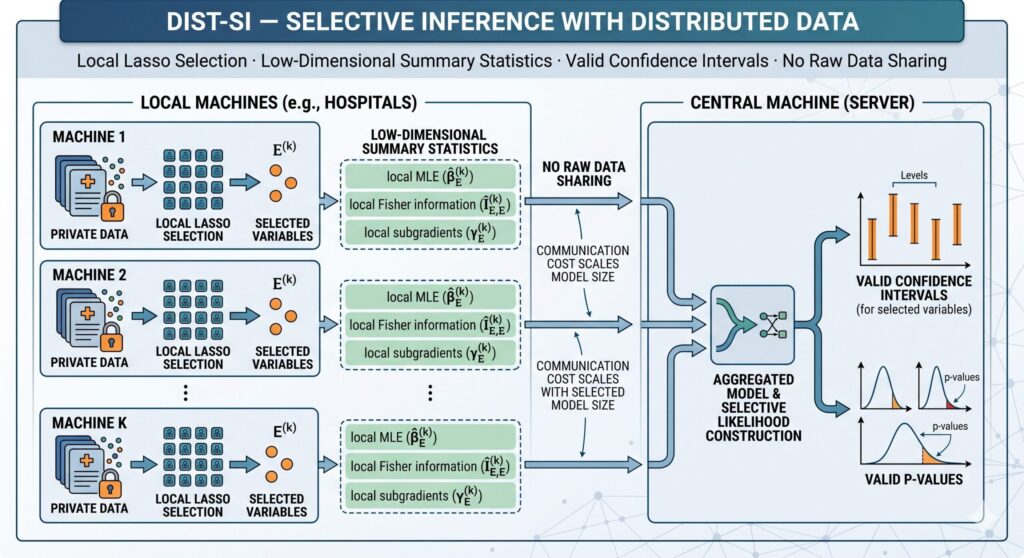
Sifan Liu (Stanford) and Snigdha Panigrahi (University of Michigan) introduce Dist-SI — a procedure that lets distributed machines run lasso independently, share only tiny summary statistics with a central server, and still produce valid confidence intervals and p-values as if…

Dist-SI: Selective Inference with Distributed Data via Randomized Lasso Read More »

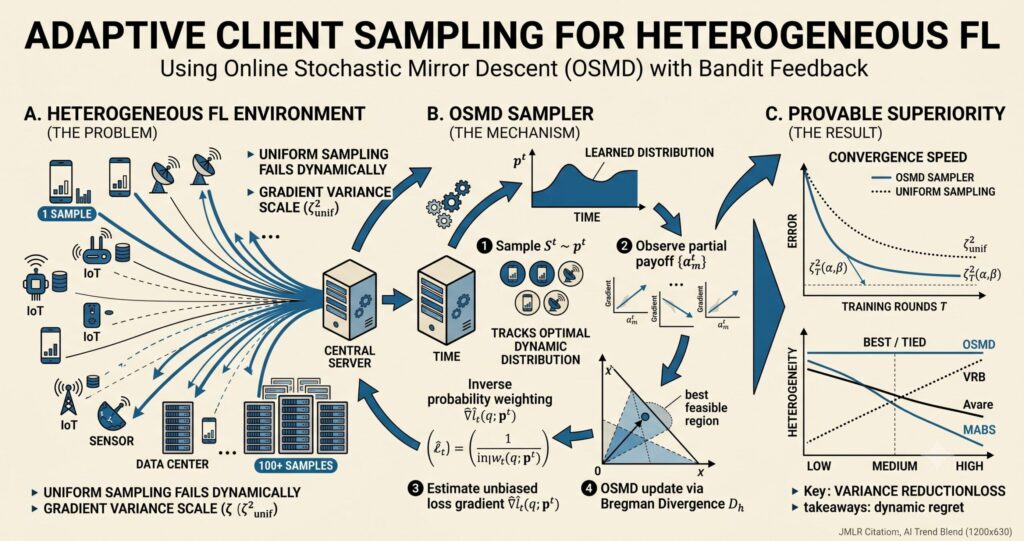
Adaptive Client Sampling in Federated Learning via Online Learning with Bandit Feedback.

Adaptive Client Sampling in Federated Learning via Online Learning with Bandit Feedback

A multi-institution team from the University of Chicago, NJIT, Ant Financial, Zhejiang University, and USC cast client selection as a non-stationary online learning problem — and built an adaptive sampler that provably beats uniform sampling by reducing the gradient variance…

Adaptive Client Sampling in Federated Learning via Online Learning with Bandit Feedback Read More »

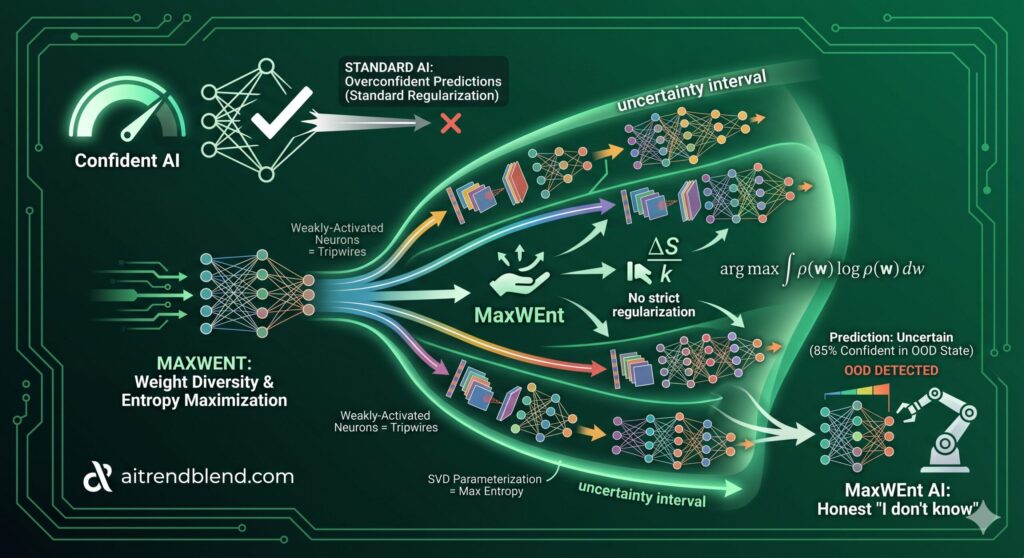
Why Your AI Says It's Confident When It Shouldn't Be — And How MaxWEnt Fixes It.

Why Your AI Says It’s Confident When It Shouldn’t Be — And How MaxWEnt Fixes It

Researchers from Michelin and the Centre Borelli at ENS Paris-Saclay have built a smarter way to make neural networks say “I don’t know” — by maximizing the diversity of possible network weights rather than relying on standard regularization that quietly…

Why Your AI Says It’s Confident When It Shouldn’t Be — And How MaxWEnt Fixes It Read More »