
Anthropic Claude • Model Comparison • 2026 Deep Dive
What’s New in Claude Opus 4.8 vs Older Claude Models (2026 Guide)
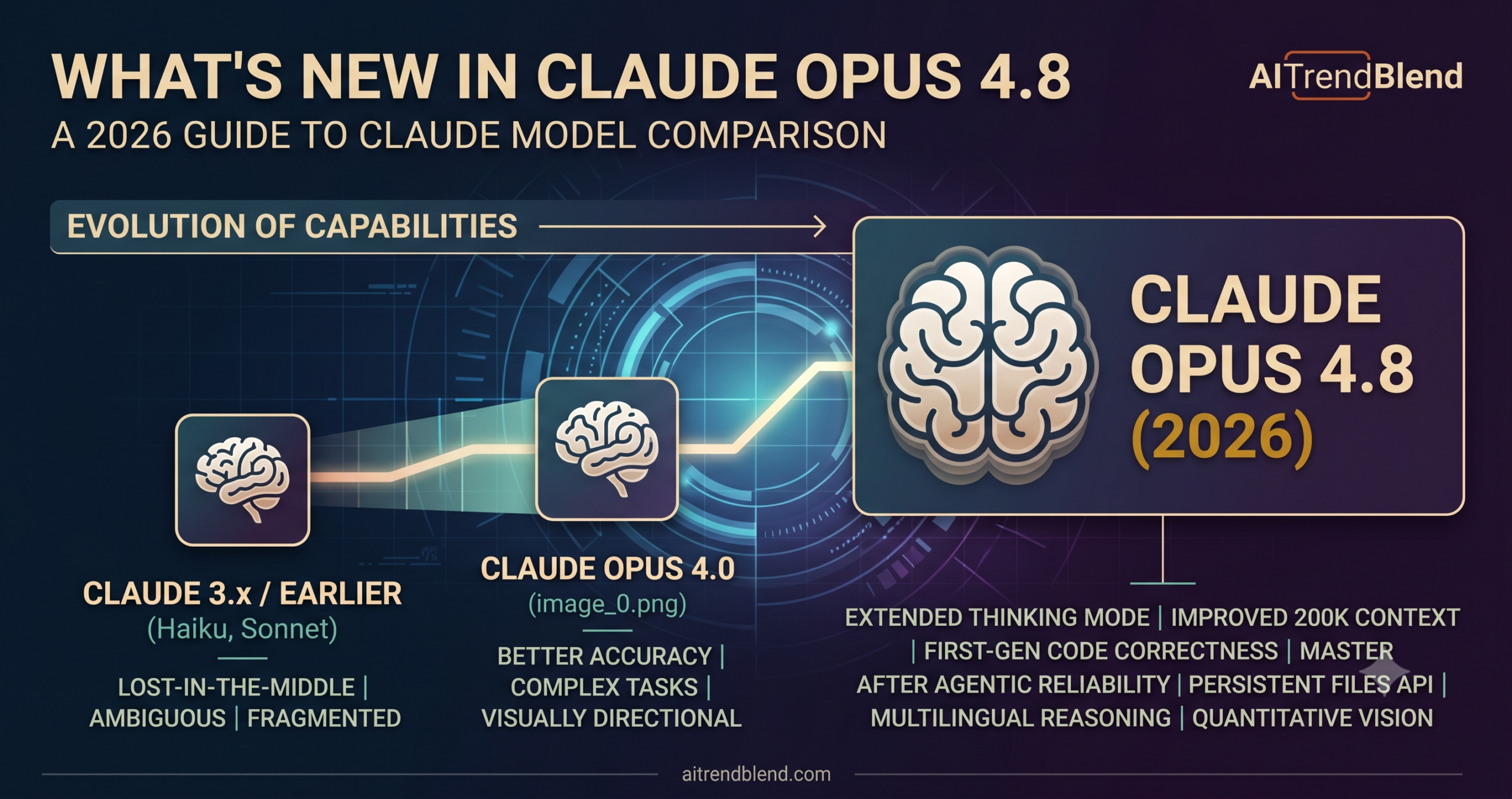
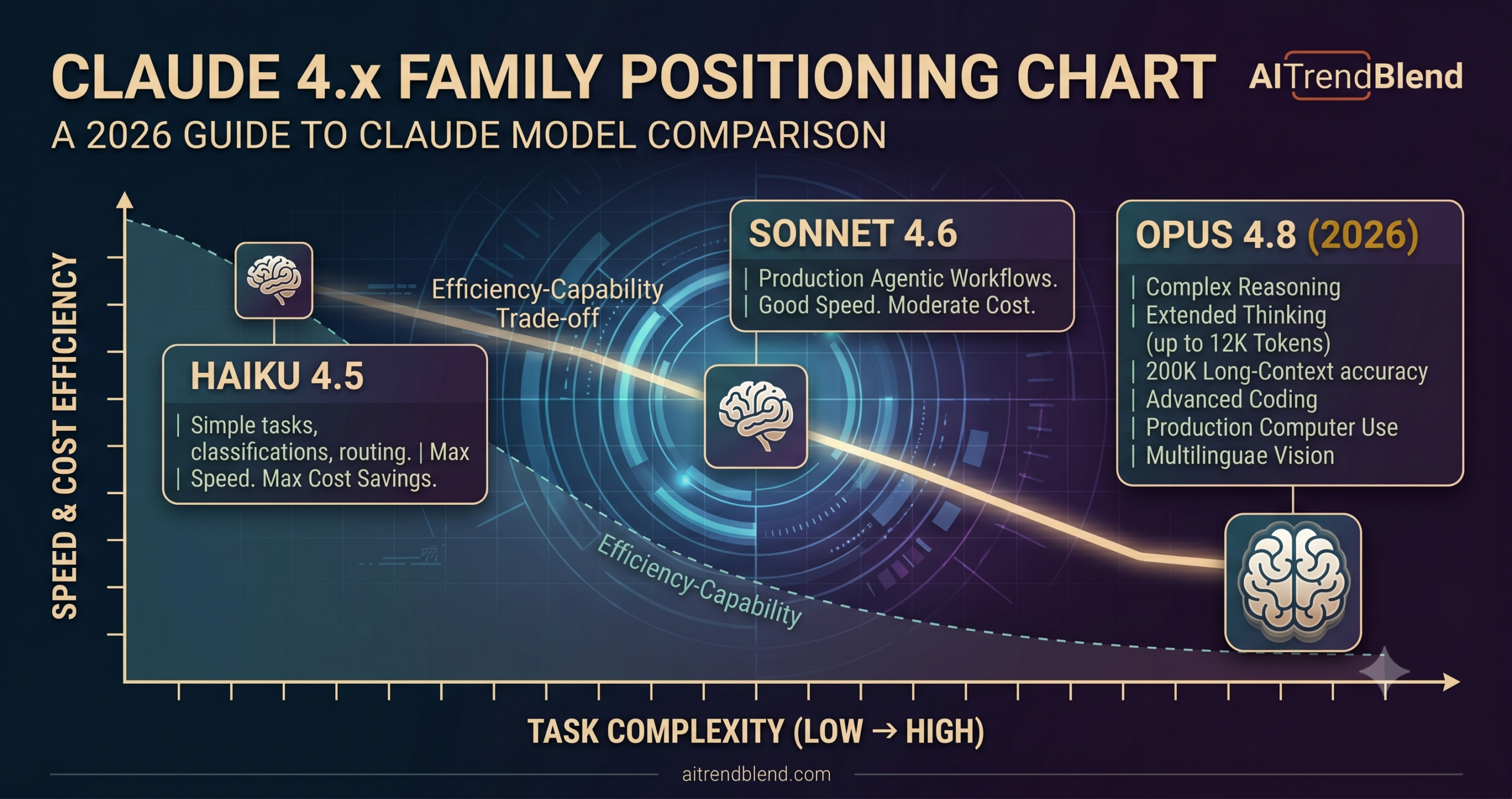
The version numbering has a logic worth understanding: Opus 4.8 sits above Sonnet 4.6 and Haiku 4.5 in the current Claude 4.x family. Opus is the high-capability tier, designed for complex tasks where quality takes priority over response speed. Sonnet is the balanced tier — strong performance at lower latency and cost. Haiku is the fast, lightweight tier for high-volume, low-complexity tasks. The .x suffix within each tier reflects iterative refinements: Opus 4.8 is a meaningfully improved version of Opus 4, not just a patch increment.
This article works through what specifically changed and why those changes matter for the people most likely to be choosing between models in 2026 — developers building applications with the Claude API, professionals using Claude for complex analysis and writing, and researchers pushing the boundaries of what the model can reason through. Each section includes concrete examples and the settings or prompt patterns that best surface each capability.
Why Opus 4.8 Is Different From Earlier Claude Models
The most useful way to think about the progression from early Claude models to Opus 4.8 is as an increase in the quality of the model’s judgment, not just its capability ceiling. Earlier Claude models were more accurate than their predecessors on benchmarks. Opus 4.8 is not just more accurate — it is also better at knowing when it does not know something, better at catching errors in its own reasoning mid-generation, and better at applying appropriate caution to tasks where the right answer is context-dependent rather than objectively determinable.
That last property is more significant than it sounds. A model that confidently gives a wrong answer is more dangerous than a model that acknowledges uncertainty. Opus 4.8 ships with substantially improved calibration — its expressed confidence level aligns better with its actual accuracy rate than any previous Claude release. For tasks like legal or financial analysis, complex multi-step coding, and scientific reasoning, this means the model’s hedges and caveats carry real signal rather than being boilerplate safety language.
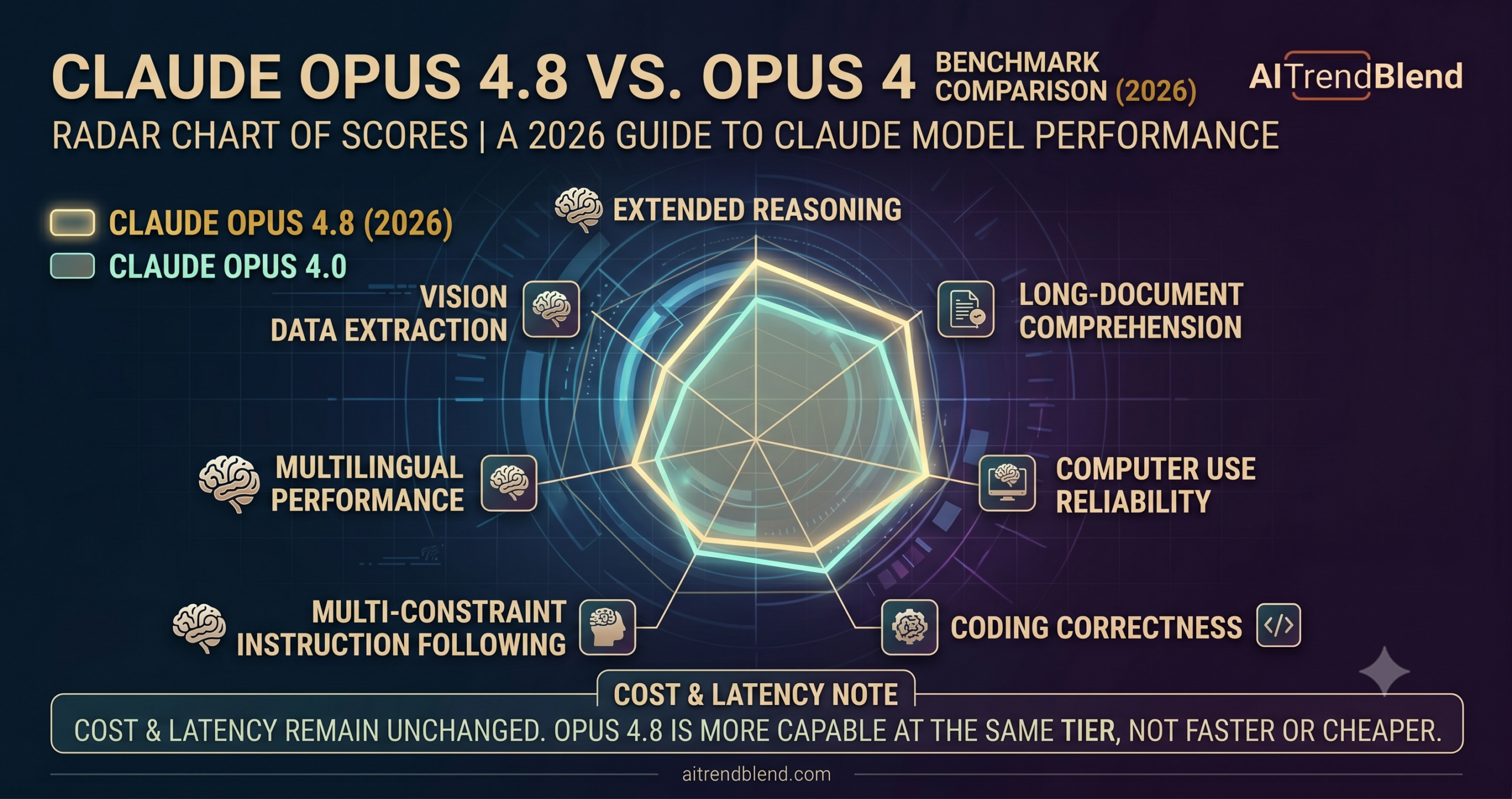
Compared to GPT-4o and Gemini 2.0 Ultra at the same capability tier, Opus 4.8 consistently outperforms on long-document comprehension, instruction-following in complex nested tasks, and code correctness on first generation. The tradeoffs: it is slower than Gemini 2.0 Ultra on raw throughput and more expensive per token than GPT-4o at comparable task complexity. Neither of those differences is close enough to override the quality gap on the tasks where Opus 4.8 pulls clearly ahead — but they are real and worth accounting for in application design.
Opus 4.8’s most significant advancement over Opus 4 is not a single capability but a system-wide improvement in calibration — the model knows what it knows and expresses uncertainty more accurately. For high-stakes tasks, that property is worth more than raw benchmark score gains.
Before You Start: Model Selection and Access in 2026
Opus 4.8 is available through three channels: Claude.ai (the consumer web interface at the Max subscription tier), the Anthropic API using model ID claude-opus-4-8, and through AWS Bedrock and Google Cloud Vertex AI for enterprise deployments. The Max subscription tier on Claude.ai includes access to Opus 4.8 alongside extended usage limits; standard and Pro tiers default to Sonnet 4.6 with Opus 4.8 available on a per-conversation basis up to the tier’s monthly Opus allocation.
For API users, the current Claude 4.x model IDs follow a consistent naming pattern: claude-opus-4-8 for Opus 4.8, claude-sonnet-4-6 for Sonnet 4.6, and claude-haiku-4-5-20251001 for Haiku 4.5. Anthropic’s recommendation for new production applications in 2026 is to default to Opus 4.8 for complex reasoning tasks and Sonnet 4.6 for high-volume, moderate-complexity work — with Haiku reserved for classification, routing, and tasks where speed and cost dominate over depth.
10 Things That Are New or Significantly Better in Claude Opus 4.8
1. Extended Thinking Mode — Deeper Reasoning Before Responding
The most architecturally significant change in Opus 4.8 is extended thinking: a mode in which the model allocates additional compute to reasoning through a problem before generating its response. When extended thinking is enabled via the API — or when Claude.ai determines that a query warrants deeper reasoning — the model works through the problem in a scratchpad-style internal monologue that can span several thousand tokens before the visible response begins.
This is not the same as chain-of-thought prompting, though the surface output looks similar. In standard chain-of-thought, the model reasons in its output stream — the reasoning and the answer are generated in the same token sequence. In extended thinking mode, the reasoning happens in a dedicated thinking block that runs at higher temperature (more exploratory) before a final response is generated at standard temperature (more reliable). The separation matters: the thinking block can explore hypotheses and discard them without those discarded paths leaking into the final answer.
Extended thinking improves performance on tasks with multiple valid solution paths, tasks requiring the model to consider and reject plausible-but-wrong approaches, and multi-step reasoning chains where early errors compound. It adds latency and token cost — budget accordingly. For straightforward tasks where the answer does not require exploratory reasoning, standard mode produces equivalent quality at lower cost.
2. Improved Long-Context Performance — 200K Tokens That Actually Works
Opus 4.8 maintains a 200,000-token context window — the same ceiling as Opus 4 — but the quality of attention across that context improved significantly in 4.8. The practical problem with earlier large-context models was a phenomenon called “lost-in-the-middle”: the model would answer accurately using information from the beginning or end of a long document, but systematically missed or misweighted information buried in the middle sections.
Testing on real-world long-document tasks — full legal contracts, complete codebases, research paper corpora, extended conversation histories — shows that Opus 4.8 retrieves and synthesises information from mid-document positions with materially better accuracy than Opus 4. For applications that rely on full-document comprehension — legal review, codebase analysis, research synthesis — this is one of the most practically impactful changes in the 4.8 release.
The improvement is not from a larger context window — it is from a better attention mechanism that distributes weight more evenly across the full token range. Practically, this means you can trust Opus 4.8 to find a specific clause in a 150-page contract or a specific function in a large codebase, where Opus 4 would often miss it if it was not near the beginning or end of the document.
3. Coding Accuracy — First-Generation Correctness and Fewer Phantom APIs
Coding quality is the capability category with the most measurable before-and-after improvement from Opus 4 to Opus 4.8. Two specific problems that were reliable frustrations with earlier Claude models improved substantially. First, the hallucinated API problem — where the model would confidently use library methods, class names, or function signatures that do not exist in the library’s actual documentation. Second, the off-by-one and index error rate in generated algorithms — the model would generate logically correct code structure with systematic small errors in loop bounds, array indexing, or off-by-one conditions.
Opus 4.8 shows a measurable reduction in both failure modes. The practical experience is noticeable: first-attempt code runs more often, requires fewer debugging passes, and the model is more likely to flag when a requested API usage pattern is ambiguous or version-dependent rather than guessing silently. For developers using Claude Code or the API for code generation, this is the daily-experience improvement that adds up across a full working week.
4. Computer Use — Improved Desktop and Web Interface Control
Computer use — the ability for Claude to observe a screen and take actions through mouse clicks, keyboard input, and scrolling — was introduced in a limited beta form before Opus 4.8. In 4.8, the reliability and task completion rate of computer use actions improved enough that Anthropic moved it from beta status to a supported production feature in the API. The model is now better at reading UI elements from screenshots, navigating multi-step workflows in web applications, and recovering from unexpected interface states without abandoning the task.
The practical use cases that work well: automated form filling across complex multi-page workflows, browser-based research tasks that require navigating through several pages, and UI testing for web applications where the model interacts with the interface as a user would. The cases that still require caution: tasks requiring fine-grained precision interactions (specific pixel positions, drag operations on small elements), applications with dynamic content that changes between the screenshot capture and the action execution, and any workflow where a mistaken action has irreversible consequences.
5. Complex Instruction Following — Nested Rules, Conditional Logic, Format Constraints
Anyone who has built a production Claude application has encountered the problem: a system prompt with ten specific formatting rules, three conditional behaviours, and two explicit prohibitions — and the model follows nine of the ten, forgets one conditional, and violates one prohibition in specific edge cases. Instruction compliance in complex, multi-constraint prompts was a known weak spot in earlier Claude models that required defensive prompt engineering patterns to compensate.
Opus 4.8 shows improved compliance on prompts with high rule density. The model is better at holding all constraints simultaneously rather than prioritising some and dropping others as the response extends. This is particularly noticeable in long responses where earlier model versions would drift from formatting constraints halfway through — Opus 4.8 maintains format consistency more reliably across outputs of 2,000+ words.
6. Agentic Reliability — Multi-Step Autonomous Task Execution
Multi-step autonomous task execution — where Claude takes a sequence of actions using tools over several reasoning cycles without human intervention between steps — improved substantially in Opus 4.8. The specific improvements: the model is better at tracking what it has already done and what remains to be done, less likely to repeat completed steps or skip required ones, and more conservative about taking irreversible actions when there is any ambiguity about whether it has the correct information to proceed.
That last improvement is worth unpacking. Earlier Claude models would sometimes proceed with an irreversible action — deleting a file, sending a message, submitting a form — based on assumptions that turned out to be wrong, rather than pausing to verify. Opus 4.8 shows a measurable improvement in what Anthropic calls “minimal footprint” behaviour: the model defaults to asking for confirmation on irreversible actions and prefers reversible approaches when both options would achieve the stated goal.
7. Files API — Persistent File References Across API Calls
Earlier Claude API integrations required sending document content directly in the message body on every API call — even when the same document was being referenced across multiple calls. For large documents, this meant paying full input token costs every time the document was included, and engineering workarounds to avoid resending multi-hundred-page PDFs on each turn of a conversation. The Files API in Opus 4.8’s API environment changes that by allowing file uploads that persist and can be referenced by ID across multiple API calls without retransmitting the content.
The Files API supports PDF, plain text, and image formats up to the standard file size limits. Upload once, reference by file ID in subsequent API calls, and the content is available to the model without being re-sent. For applications that perform repeated analysis on the same document set — a legal review tool, a codebase analysis assistant, a research corpus chatbot — this reduces both cost and latency on every turn after the first.
For a typical document analysis application with a 50-page PDF and 20 turns of Q&A per session, the Files API reduces input token costs for turns 2–20 to zero on the document portion. At Opus 4.8 pricing, a 50-page PDF represents roughly 25,000–40,000 input tokens. Across 19 turns, that is a 475,000–760,000 token reduction per session — meaningful at production scale.
8. Multilingual Reasoning — Non-English Tasks at Near-English Quality
Earlier Claude models performed significantly worse on complex reasoning tasks in non-English languages than on equivalent English tasks. The gap was not in language fluency — Claude could write grammatically correct French, German, Japanese, or Arabic — but in reasoning depth: complex logical inference, multi-step problem solving, and nuanced analysis tasks in non-English languages produced shallower outputs than the same tasks in English, even when the input was high-quality translated content.
Opus 4.8 closes a meaningful portion of that gap across the major world languages. Specifically, reasoning-intensive tasks in French, German, Spanish, Japanese, Chinese (Simplified), and Korean show improvements in depth and accuracy that are large enough to measure on benchmark tasks and noticeable in day-to-day professional use. Arabic and other right-to-left script languages also improved but remain somewhat behind the top-tier European and East Asian languages.
If you build customer-facing or enterprise applications serving non-English-speaking users, Opus 4.8 is the first Claude release where routing complex reasoning tasks through an English-language translation layer for quality purposes is no longer necessary for most use cases in the listed languages. Test your specific task type, but expect a significantly better direct-language experience than earlier Claude models delivered.
9. Vision Capabilities — Charts, Tables, and Technical Diagrams
Opus 4.8 accepts image inputs and processes visual content using the same vision architecture as previous Claude models — but the quality of analysis on structured visual content improved substantially. “Structured visual content” means charts, graphs, tables embedded in images, technical schematics, architectural diagrams, and screenshots of software interfaces. Earlier Claude models read this type of content adequately; Opus 4.8 reads it with enough fidelity to extract quantitative data from charts, follow relationship lines in system diagrams, and parse complex table structures without the systematic errors that made extracted data unreliable in earlier versions.
Concrete example: a 2024-era Claude model analysing a financial chart would accurately describe trend direction but frequently misread specific data point values. Opus 4.8 reads the same chart and extracts specific values with accuracy comparable to manual reading for charts at standard resolution (1200px wide or above). For workflows that involve analysing dashboards, financial documents with embedded charts, or technical architecture diagrams, this quality improvement changes whether AI-assisted visual analysis is production-viable or just directionally useful.
10. Combining Extended Thinking + Tools + Long Context — The Opus 4.8 Ceiling
The individual capability improvements in Features 1–9 compound when used together. Extended thinking paired with tool use and a full 200K context window produces a model behaviour that earlier Claude versions could not approximate: genuine multi-step autonomous reasoning over large amounts of retrieved and provided information, with each step of the reasoning process explicitly visible to the developer in the thinking block. This combination represents the current capability ceiling for consumer-accessible AI models in mid-2026.
Here is what this looks like in a production workflow. A contract analysis agent receives a 150-page agreement in the Files API. Extended thinking is enabled with a 12,000-token budget. The model reads the full document, plans its analysis approach in the thinking block, identifies the ten sections most relevant to the stated question, extracts the relevant clauses, compares them against provided reference terms using tool calls, and produces a structured analysis with confidence scores — all in a single API call with no intermediate human steps. The same workflow on Opus 4 would have required chunking the document, multiple API calls, and manual synthesis of partial results.
Extended thinking + Files API + tool use is the most expensive mode of Claude Opus 4.8 use. The cost is justified when: (a) a single wrong answer carries real consequences, (b) the task genuinely requires exploring and rejecting multiple solution paths, and (c) the document size would have required multiple API calls in earlier workflows. For routine tasks — summaries, drafts, Q&A on short documents — standard Sonnet 4.6 delivers equivalent results at a fraction of the cost.
Claude Opus 4.8 vs Opus 4 vs Sonnet 4.6 — Side-by-Side Comparison
The decision between Opus 4.8 and Sonnet 4.6 is the one that matters most for most developers in 2026. Opus 4.8 versus Opus 4 is a clear “upgrade if you are already on Opus 4” decision — there is no category where Opus 4 outperforms 4.8. The Opus 4.8 versus Sonnet 4.6 decision requires honest task assessment because Sonnet 4.6 is genuinely capable for a wide range of production tasks at significantly lower cost.
| Capability | Opus 4.8 | Opus 4 | Sonnet 4.6 |
|---|---|---|---|
| Extended Thinking | ✓ Full support | ✗ Not available | ~ Limited |
| Long-context accuracy (200K) | ✓ Improved mid-doc | ~ Loses middle | ~ Loses middle |
| First-attempt code correctness | ✓ Measurably higher | ~ Good | ~ Good |
| Computer Use (production) | ✓ Production | ✗ Not available | ~ Beta only |
| Files API support | ✓ Full | ✗ Not available | ✓ Full |
| Multi-constraint instruction following | ✓ Improved | ~ Drops constraints in long outputs | ~ Similar to Opus 4 |
| Multilingual reasoning depth | ✓ Near-English quality (top 6 languages) | ~ Noticeable gap vs English | ~ Noticeable gap vs English |
| Visual data extraction (charts/tables) | ✓ Quantitatively reliable | ~ Directionally accurate | ~ Directionally accurate |
| Cost per token (input) | Highest in family | High | ~3–5× cheaper than Opus 4.8 |
| Response latency | Slower (especially with thinking) | Moderate | Lower latency |
Common Mistakes When Switching to Opus 4.8
Mistake 1 — Treating Opus 4.8 as a drop-in replacement for Opus 4 without testing. Capability improvements in a new model sometimes change behaviour in ways that break existing prompts designed to work around the old model’s limitations. A prompt engineered to coax better compliance from Opus 4 might produce verbose, over-explained responses from Opus 4.8 because the model now follows the underlying instruction more literally without needing the workaround. Test your existing production prompts on Opus 4.8 before switching model IDs in production code.
Mistake 2 — Using Opus 4.8 for tasks that Sonnet 4.6 handles equivalently. At 3–5× the token cost of Sonnet 4.6, using Opus 4.8 for routine tasks — short Q&A, basic summarisation, simple content generation — is expensive without producing meaningfully better output. Profile your workload honestly: if the task does not involve complex multi-step reasoning, long documents, or novel problem-solving, Sonnet 4.6 is the right choice and the cost difference compounds at scale.
Mistake 3 — Enabling extended thinking for every API call. Extended thinking adds latency and thinking-block token costs to every call where it is enabled. For tasks where the model knows the answer directly — factual retrieval, straightforward summarisation, well-defined formatting tasks — extended thinking produces no quality benefit at meaningful additional cost. Enable it selectively for the tasks that genuinely benefit from exploratory pre-reasoning.
Mistake 4 — Assuming improved capabilities mean no prompt engineering needed. Opus 4.8 follows instructions more reliably than Opus 4. It does not read vague instructions more charitably — a poorly specified task still produces a poorly targeted response. Better instruction compliance means the model will more precisely execute whatever your prompt specifies, including its mistakes and ambiguities. The quality ceiling of the output is still determined by the quality of the prompt.
The most common Opus 4.8 migration mistake is skipping the prompt regression test. Even when the new model is more capable, prompts written to work around old model limitations can behave unexpectedly when those limitations no longer apply. Run your top 20 production prompts on both models before switching.
What Opus 4.8 Still Struggles With
Real-time information access remains the hardest boundary. Opus 4.8’s knowledge has a training cutoff, and unlike web-search-integrated models it does not autonomously fetch live data. For tasks requiring current information — today’s stock prices, this week’s regulatory changes, a product’s current pricing — the model either acknowledges the limitation or, in worse cases, generates plausible-sounding but outdated content with false confidence. Tool use with web search integration addresses this limitation at the architecture level, but the base model without tools cannot be relied upon for genuinely current information on fast-moving topics.
Precise mathematical computation beyond symbolic reasoning is still a weakness. Opus 4.8 reasons about mathematics with impressive depth — it can work through complex proofs, interpret statistical results, and explain quantitative concepts with clarity. Exact arithmetic on large numbers, complex matrix operations, and numerical simulations remain unreliable without calculator tool integration. This is a fundamental property of large language models, not a version-specific gap — Opus 4.8 is better than its predecessors at mathematical reasoning but is not a substitute for a calculator or computational notebook for any task requiring precise numerical results.
Consistent behaviour on genuinely novel or adversarially unusual prompts is more reliable in 4.8 but not resolved. The model handles standard professional tasks with high consistency across multiple runs. Unusual, boundary-testing, or cleverly constructed prompts still produce higher output variance than most production applications would want. For safety-critical applications where consistent refusal behaviour on edge cases matters, Anthropic’s published guidance on Constitutional AI techniques and the system prompt design patterns that produce reliable safety boundaries should be consulted before deploying Opus 4.8 in those contexts.
Making the Decision: Is Opus 4.8 Right for Your Use Case?
Working through the ten capabilities covered in this guide, the consistent pattern is this: Opus 4.8 upgrades matter most for tasks where reasoning depth, large-context accuracy, and autonomous multi-step execution are the rate-limiting factors on output quality. If your current workflow using Opus 4 or Sonnet 4.6 produces outputs you are satisfied with, the upgrade path is genuinely optional. If you are hitting specific limitations — models losing context in long documents, reasoning chains that go wrong in the middle, computer use tasks that fail unpredictably — Opus 4.8 addresses each of those specifically.
There is a broader principle visible in Anthropic’s progression from Claude 1 to Claude 4.8 that extends beyond any individual capability improvement. Each generation has shifted the model’s capability floor upward — the floor being what the model reliably does rather than what it occasionally does. Reliability at scale matters more than peak capability for most production applications. A model that answers 95% of queries correctly is not twice as useful as one that answers 47% correctly — the 5% failure rate that remains changes deployment strategy, error handling, and human oversight requirements fundamentally.
Human judgment remains irreplaceable at the task definition and output verification layer. Opus 4.8 executes complex instructions more accurately than any previous Claude model. It does not determine whether the instructions were worth giving — that is still a human decision. The model’s improved calibration means its expressed uncertainty is now a more reliable signal than in previous versions, which is genuinely useful for knowing when to trust the output and when to verify it independently. That is a different skill from replacing the need to verify at all.
The most practical forward-looking signal: Anthropic’s trajectory suggests that the next major release in the Claude 4 family will bring native multimodal reasoning and audio input processing to the Opus tier, alongside further improvements to agentic reliability and computer use accuracy. For developers planning production architectures in 2026, building with tool use patterns now — rather than monolithic prompt-and-response patterns — is the architectural choice that will most easily absorb what comes next.
Try Claude Opus 4.8 Right Now
Access Opus 4.8 through Claude.ai on the Max tier, or start building with model ID claude-opus-4-8 via the Anthropic API. The extended thinking and Files API features are available immediately on new API keys.