
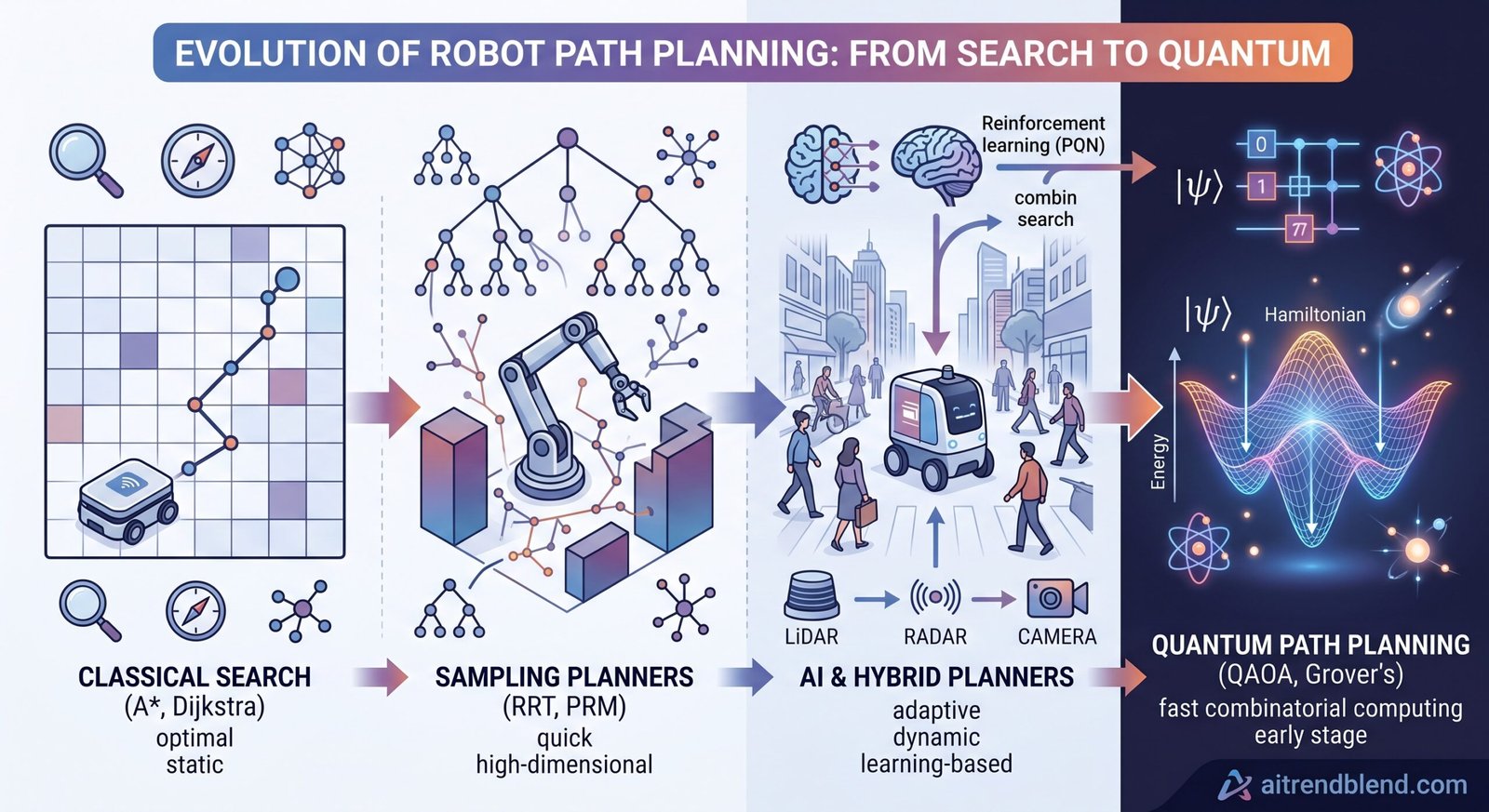
Key points
- The review by Kumar, Rajchandar and Aparna, published in Computer Science Review in 2026, organizes forty years of robot path planning into classical, sampling based, optimization based, AI driven, hybrid and quantum inspired families.
- Its own comparison tables are the most useful part of the paper, and also the most revealing, because they show quantum methods winning on speed while giving up path optimality, a tradeoff the surrounding prose sometimes glosses over.
- Reinforcement learning and graph neural network approaches dominate the recent literature the authors cite, but the paper is candid that generalization beyond the training environment is still an open problem.
- Sensor fusion, cobot safety and cloud edge architecture get their own sections, reflecting how much of real world path planning is actually a perception and infrastructure problem rather than a pure algorithm problem.
- The paper’s own SWOT analysis admits the field lacks standardized benchmarks, which makes several of its cross method comparisons harder to trust at face value.
Why this particular review is worth reading closely
Robot path planning has been reviewed before, more than once, and the authors say so themselves. What makes this paper different is scope rather than depth. It does not stop at classical search and sampling methods the way older surveys tend to. It walks all the way from Dijkstra’s algorithm through the paper’s full taxonomy of reinforcement learning, graph neural networks, hybrid classical AI planners and early stage quantum optimization, then layers on sensor integration, collaborative robots and cloud edge deployment as separate topics. Forty distinct algorithms show up in a single literature table. That breadth is genuinely useful if you need a map of the field. It also means individual claims sometimes get less scrutiny than a narrower paper would give them, and that is where a critical reader earns their keep.
The review methodology section is refreshingly specific about how the search was run, pulling from Scopus, Web of Science, IEEE Xplore, ScienceDirect and SpringerLink across publications mostly from 2015 to 2025. That transparency is worth naming because plenty of surveys skip it entirely.
From graph search to sampling, the classical backbone
Dijkstra’s algorithm and A star remain the two names everyone in robotics learns first, and the paper treats them fairly. Both guarantee an optimal path on a static graph and both fall apart once the map starts moving. D star and D star Lite exist specifically to patch that weakness by replanning incrementally instead of recomputing the whole graph from scratch, which the paper credits as the natural bridge to real time operation in changing environments.
Sampling based planners tell a different story. Rapidly exploring random trees and probabilistic roadmaps trade optimality for the ability to search high dimensional spaces quickly, which matters a lot once you move from a 2D warehouse floor to a robotic arm with six or seven joints. The tradeoff the paper is honest about is that RRT paths tend to be jagged and need smoothing afterward, and PRM needs a heavy upfront investment in building the roadmap before it can answer a single query. Neither is a natural fit for an environment that keeps changing shape, which is exactly why the field kept pushing toward learning based methods.
Where reinforcement learning actually helps, and where it does not yet
Deep Q Networks and Proximal Policy Optimization show up throughout the paper as the workhorses of learned navigation, with PPO getting singled out for continuous control tasks like drone flight and DQN for discrete grid style problems. The appeal is obvious. A trained policy does not need an explicit map or a hand tuned cost function, it just needs enough interaction with an environment, simulated or real, to learn what works.
The catch, which the paper states plainly rather than burying, is that these policies are sensitive to training data quality and volume, and a policy trained in one warehouse layout does not automatically transfer to a different one without further training. That is not a small footnote. It is arguably the central open problem in learned navigation right now, and it is why so much of the hybrid literature discussed later in the paper exists at all, stitching a learned component onto a classical planner that still provides some kind of safety guarantee.
Worth remembering
A reinforcement learning planner that scores well in simulation is not the same claim as a planner that will behave predictably the first time it meets a hallway it has never seen. The paper’s own generalization scores in its comparison chart rate PPO based RL as good for high dimensional tasks but only moderate for real world transfer, a distinction that is easy to miss on a quick skim.
Hybrid planners, the field’s current center of gravity
If there is one theme this review keeps returning to, it is hybridization. A star combined with RRT gives you global optimality from the search side and fast exploration from the sampling side, aimed at semi structured spaces like mines and warehouses. Particle Swarm Optimization paired with Genetic Algorithms improves convergence speed on rough terrain. Reinforcement learning gets used to tune the heuristic weights inside a classical A star planner rather than replacing A star outright, which is a more conservative and arguably more deployable pattern than end to end learned navigation.
The paper’s own comparative table on hybrid classical AI approaches lists RL tuning A star heuristics for dynamic warehouse navigation, GA optimizing RRT for industrial manipulator planning, PSO optimizing D star Lite for autonomous ground vehicles, and deep learning paired with model predictive control for self driving cars. Every single one of these pairings exists because neither half of the combination was good enough on its own, which is a useful reminder that hybridization is less a design philosophy and more an admission that no single family of algorithms currently covers the whole problem.
Quantum path planning, promising math and thin evidence
This is the section where a careful reading of the paper’s own numbers pays off. The authors present the Quantum Approximate Optimization Algorithm and Grover’s search as candidates for speeding up combinatorial path problems, and they include a results table worth sitting with.
| Method | Problem size (nodes) | Computation time (s) | Optimality gap (percent) |
|---|---|---|---|
| Classical A star | 25 | 0.8 | 0 |
| QAOA | 25 | 0.1 | 3 |
| Classical Dijkstra | 50 | 3.2 | 0 |
| Hybrid VQE | 50 | 0.9 | 5 |
Notice what that table actually shows once you read it as an engineer rather than skim it as a summary. QAOA is compared against classical A star on the same 25 node problem, and it is indeed faster, at the cost of a 3 percent optimality gap. That is a fair, like for like comparison and a genuinely interesting result. But the 50 node row compares Hybrid VQE against classical Dijkstra, a different algorithm on the same problem size, not against classical A star scaled up to 50 nodes. Dijkstra is known to be slower than A star on large graphs because it lacks a heuristic, so part of that 3.2 second figure reflects the choice of baseline rather than a fundamental limit of classical computing. The paper never claims otherwise directly, but presenting the two rows side by side invites a reader to draw a cleaner conclusion about quantum speedup than the data actually supports.
The broader Table 6 in the source paper, covering six recent quantum inspired studies, tells a more measured story that lines up with what the authors say in their future directions section. Multi strategy quantum particle swarm optimization reports a 23.8 percent path length reduction against classical QPSO with stronger global search, but every single row in that table also lists a real limitation, from parameter tuning sensitivity to hardware dependence to instability in dense obstacle fields. None of the six methods described there run on actual quantum hardware. They are simulated quantum principles running on classical machines, which the paper itself acknowledges when it notes that decoherence, qubit counts and error correction currently confine the field to hybrid quantum classical simulation rather than real deployment.
The honest summary is that quantum inspired optimization is a legitimate and active research direction with early positive signals, not a technology that is close to running on a robot’s onboard computer. The paper is careful enough to say this in its future directions section. It would have been stronger if that caution showed up earlier, closer to the results table, rather than mainly in the discussion.
\( C(\theta) = \langle \psi(\theta) | H_C | \psi(\theta) \rangle \)
where \( H_C \) encodes the path cost as a problem specific Hamiltonian and \( \theta \) are the variational parameters tuned by a classical optimizer in the loop. The quantum processor evaluates the cost, the classical optimizer proposes the next set of angles, and the two go back and forth until the expected cost stops improving.
Sensor fusion decides how good any planner can actually be
One of the more grounded sections in the review has nothing to do with algorithms at all. LiDAR gives high resolution 3D geometry but struggles in heavy rain or snow and costs real money at scale. RADAR loses spatial resolution but keeps working in fog and dust. Cameras add semantic understanding, reading a stop sign or recognizing a pedestrian crossing, but fail in low light and cannot measure depth on their own without a stereo pair or a depth sensor attached. The paper’s sensor specification table lists LiDAR resolution around two to three centimeters against a one hundred to two hundred fifty meter range, RADAR resolution closer to ten to fifty centimeters but functional through weather that blinds a camera, and ultrasonic sensors limited to about four meters but cheap enough to put on every corner of an indoor robot.
The practical takeaway, which the paper supports with its own fusion level breakdown, is that no single sensor is enough for anything beyond a narrow, controlled task. Low level fusion merges raw data before feature detection, useful for dense semantic maps. Mid level fusion extracts features separately then combines them, which the paper ties to warehouse object detection. High level fusion lets each sensor make its own decision and merges the outputs, which shows up in drone terrain classification. Choosing the right fusion level for a given robot is arguably as consequential as choosing the planning algorithm itself, and it is a decision that gets far less attention in most path planning discussions outside this kind of review.
Cobots and multi robot coordination, safety as a planning constraint
Collaborative robots change the planning problem in a way that is easy to underestimate. A cobot is not just avoiding static obstacles, it is trying to move predictably around people who may not be paying attention to it at all. The paper describes Learning from Demonstration as the dominant way cobots pick up task specific motion, with reinforcement learning layered on top for refinement and human intention prediction models used to anticipate where a person is about to walk.
Its multi cobot coordination table is one of the more concrete pieces of evidence in the whole paper, comparing centralized planning, decentralized planning and multi agent reinforcement learning across average task completion time, collision rate and how many cobots the strategy can scale to. Multi agent reinforcement learning comes out ahead on every metric listed, a completion time of 135 seconds against 180 for centralized planning, a collision rate of 1.2 percent against 2.5 percent, and scalability past twenty cobots where centralized planning tops out around five. That is a genuinely useful data point for anyone deciding how to architect a multi robot deployment, though it is worth remembering it comes from one study rather than an aggregated benchmark across the field.
Cloud edge architecture and the ethics of automated decisions
The final third of the paper moves away from algorithms into system design and governance, and this is where the review earns some credit for breadth even though the material gets thinner. Cloud computing handles resource heavy work like global map building and multi agent coordination, while edge computing handles the low latency local obstacle avoidance a robot cannot afford to wait on. The tension the paper flags, correctly, is that task offloading, security and data privacy across a heterogeneous network of robots and cloud servers remain unresolved engineering problems, not solved ones.
On the ethics side, the paper raises transparency of AI decisions, accountability when something goes wrong, and alignment with human values as the three live concerns in safety critical deployments like autonomous vehicles and UAV traffic control. It cites explainable AI frameworks for UAV navigation and notes their computational cost is still a real barrier to running them in real time. This section is shorter and more citation dense than the algorithmic sections, which makes sense given how young the applied ethics literature in this specific niche still is.
Reading the paper’s own SWOT table
The authors include a SWOT analysis that is unusually candid for a review paper. Under weaknesses, they list a lack of standardized benchmarks and uniform evaluation metrics as hindering cross comparative analysis, and limited interpretability in black box AI models as a trust problem for safety critical use. That admission matters because it applies directly to some of the review’s own comparison tables, including the quantum results discussed above, which draw from different studies using different problem setups.
Honest limitations, both the paper’s and this coverage of it
The paper is a review, not a set of new experiments, so its evidence is only as strong as the forty plus studies it draws from, and those studies were not run under a common benchmark. The authors acknowledge this directly in their own SWOT table, and it shows up again in the quantum results discussed earlier, where different rows compare different baseline algorithms on different problem sizes rather than a single controlled comparison. Readers should treat performance numbers pulled from a single cited study, whether that is a 23.8 percent path reduction from quantum particle swarm optimization or a 1.2 percent collision rate from multi agent reinforcement learning, as a result from one experimental setup rather than a settled fact about the method in general.
The review also leans heavily on citations to other surveys rather than primary experimental papers in several sections, which the reference list makes visible once you look closely. That is a common and reasonable practice in a review of this scope, but it means some claims are effectively secondhand summaries of summaries. Finally, quantum path planning is covered with real technical detail, yet every method discussed runs on simulated quantum principles on classical hardware, a distinction the paper states but a casual reader could easily miss.
Conclusion
What this review gets right is scope. Pulling classical search, sampling planners, metaheuristics, deep reinforcement learning, hybrid classical AI systems, sensor fusion, cobot safety, multi agent coordination, cloud edge architecture and quantum optimization into one taxonomy is genuinely useful groundwork, and the forty algorithm literature table alone is worth bookmarking as a reference. Few single papers try to cover that much ground, and fewer still manage to stay readable while doing it.
The conceptual shift the paper traces, from deterministic graph search toward adaptive, data driven and hybrid frameworks, matches what has actually happened in the field over the past decade, and the emphasis on hybrid classical AI systems as the current center of gravity feels accurate rather than aspirational. Robots deployed today mostly are not running pure reinforcement learning policies with no classical fallback. They are running classical planners with learned components bolted on for the parts that benefit most from adaptation, exactly the pattern this review documents across warehouse, agricultural, defense and healthcare examples.
Where the paper is weaker is in treating its own evidence with the same skepticism it recommends for the field as a whole. The quantum results table mixes baselines in a way that flatters the speed argument without fully addressing it, and several performance claims trace back to single studies rather than a body of converging evidence. None of that makes the review useless. It makes it a strong starting map that still requires a reader willing to open the individual cited papers before repeating any specific number.
The ideas here transfer well beyond mobile robots. Multi agent coordination lessons from cobot warehouses apply to drone swarms and to distributed sensor networks. Sensor fusion tradeoffs between LiDAR, RADAR and vision show up identically in self driving cars. Even the quantum optimization discussion, thin as its current evidence base is, points toward a research direction that combinatorial optimization problems well outside robotics will eventually care about too.
For now, the practical guidance from this review is unglamorous but sound. Use classical planners where the environment is structured and predictability matters more than adaptability. Bring in learned components where the environment genuinely changes in ways no static map can capture. Treat quantum path planning as a research bet worth tracking, not a technology worth planning a product roadmap around yet. That is not a dramatic conclusion, but it is an honest one, and honesty about where a technology actually stands is the most useful thing a review like this can offer.
Frequently asked questions
What is the difference between A star and RRT for robot path planning
A star searches a graph and guarantees the shortest path if its heuristic never overestimates the true cost, but it needs a discretized map and becomes slow in very high dimensional spaces. RRT builds a tree by randomly sampling the space, which scales much better to high dimensional problems like a robotic arm with many joints, but the resulting path is usually not the shortest one and typically needs smoothing afterward.
Is quantum computing actually used in robots today
Not in deployed robots. The methods this review covers, including QAOA and quantum behaved particle swarm optimization, currently run as simulations of quantum principles on ordinary classical hardware. Real quantum processors face qubit count limits, decoherence and error correction challenges that the paper itself says confine the field to hybrid quantum classical simulation for now.
Why do robots combine classical algorithms with reinforcement learning instead of using pure RL
Pure reinforcement learning policies need large amounts of training data and often do not generalize well to environments they were not trained on. Classical planners provide guarantees like completeness or optimality on a known map. Combining the two, for example using reinforcement learning to tune an A star heuristic, keeps the safety net of a classical planner while adding the adaptability of a learned component.
Which sensor is best for outdoor robot navigation
No single sensor covers every condition. LiDAR gives the most accurate 3D geometry but degrades in heavy rain or snow and costs more. RADAR keeps working through fog and dust but has lower spatial resolution. Cameras add semantic understanding like recognizing pedestrians but fail in low light and lack native depth information. Most outdoor systems fuse two or more of these rather than relying on one.
How does multi agent reinforcement learning help multiple robots avoid collisions
It lets each robot learn a policy that accounts for the presence and likely behavior of other robots without needing a single central controller to coordinate every move. The paper’s own comparison found decentralized multi agent reinforcement learning outperformed both centralized and simple decentralized planning on task completion time, collision rate and how many robots the system could scale to.
What is a cobot and how is its path planning different from an industrial robot
A cobot, or collaborative robot, is designed to work directly alongside humans without safety cages. Its path planning has to account for unpredictable human movement, proxemic comfort distance and safe interaction, not just static obstacle avoidance. Techniques like Learning from Demonstration and human intention prediction are far more central to cobot planning than to a traditional caged industrial robot.
Read the full peer reviewed paper for the complete literature tables and reference list.
Read the paper on ScienceDirect Browse the Computer Vision pillarKumar, Y., Rajchandar, K., and Aparna, C. A comprehensive review on path planning for autonomous mobile robots, covering algorithmic paradigms, intelligent systems, and emerging navigation frameworks. Computer Science Review, volume 62, article 100993, 2026. https://doi.org/10.1016/j.cosrev.2026.100993
This analysis is based on the published paper and an independent evaluation of its claims.