
Key points
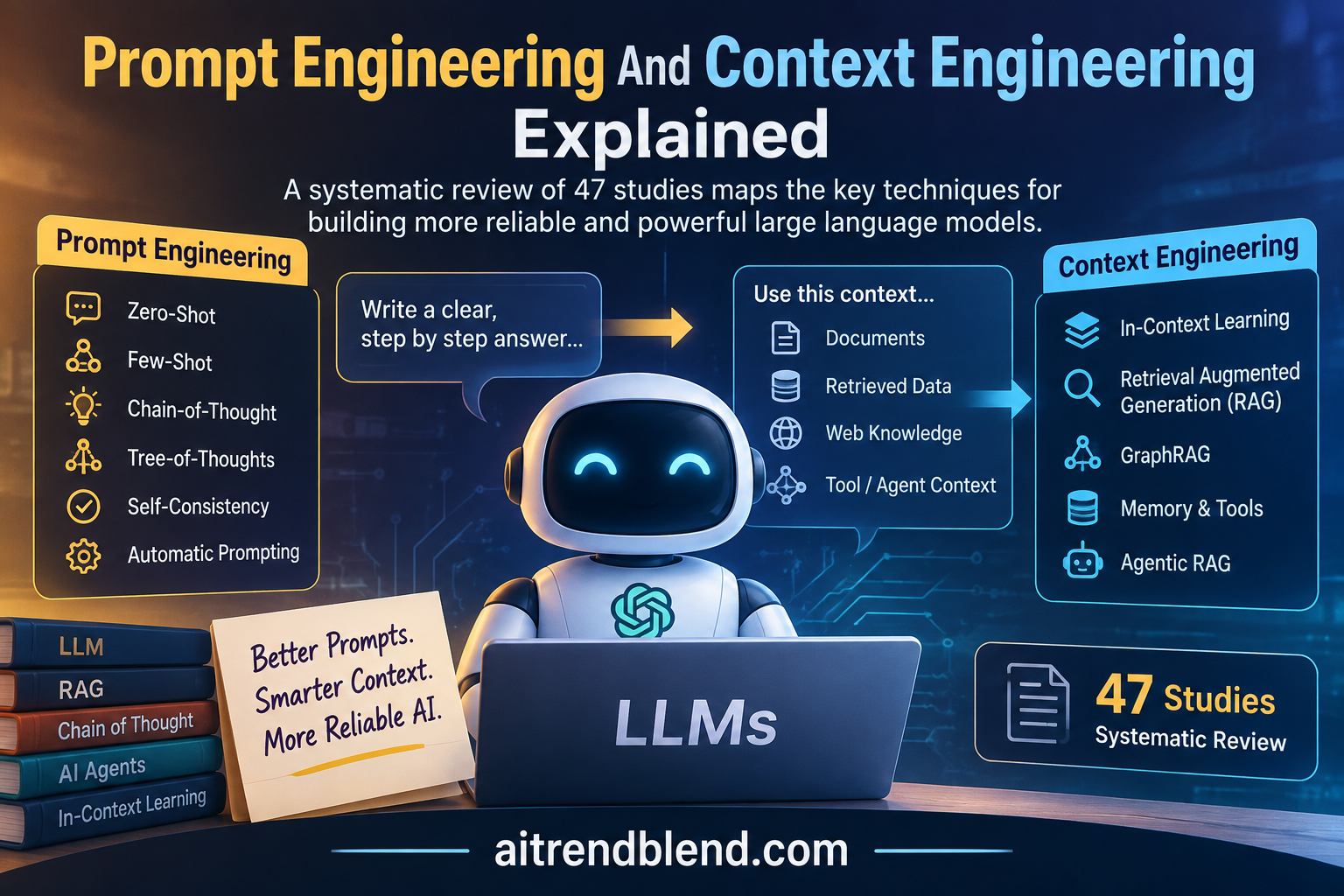
- The survey draws a hard line between prompt engineering, which shapes the wording of a single instruction, and context engineering, which designs the entire information environment an LLM sees, including retrieved documents, memory, and tools.
- Its taxonomy is organized around six yes or no questions about a technique, not an arbitrary list, which is meant to keep new methods from breaking the structure as the field keeps growing.
- Reasoning techniques such as Chain-of-Thought and Self-Consistency measurably improve multi step accuracy but at a real cost in tokens, latency, and sensitivity to exact phrasing.
- Retrieval Augmented Generation reduces hallucinations by grounding answers in retrieved documents, and the survey covers newer variants including Cache-Augmented Generation, GraphRAG, and Agentic RAG.
- Automation is the clear direction of travel, from Active-Prompt’s uncertainty driven example selection to the Automatic Prompt Engineer’s search over candidate instructions to OPRO’s use of an LLM as a general purpose optimizer.
- The review itself is narrow by design, built from a single Boolean search string applied mostly to titles across five databases, then expanded through backward citation tracking, which the authors are candid about as a limitation.
Why prompt engineering needed an actual framework
Large language models are strange collaborators. Ask the same question two slightly different ways and you can get answers that differ not just in style but in correctness. That sensitivity is not a minor annoyance, it is the entire reason prompt engineering exists as a discipline, and yet, as this survey’s authors point out, most of the field has treated it as folklore rather than a study, a pile of tips and tricks passed around without any shared vocabulary for comparing one technique against another.
The paper’s central move is separating two things that get talked about as if they were the same activity. Prompt engineering is about the wording of a single instruction, choosing phrasing, adding examples, specifying format. Context engineering is a bigger job, designing the full information environment an LLM operates inside, including what gets retrieved from outside documents, what gets remembered across turns, what tools the model can call, and how all of that gets ordered and trimmed to fit inside a limited context window. The authors illustrate the first idea with something almost mundane, asking an image model for a photo of a deer. A bare request produces a generic animal in a generic forest. Adding detail about the species, its posture, and its setting produces something a specific audience would actually recognize and want. That is prompt engineering in miniature. Context engineering is what happens when the system also has to decide which of a thousand candidate reference photos to hand the model before it even starts generating.
| Dimension | Prompt engineering | Context engineering |
|---|---|---|
| Level of control | Input level | System level |
| Scope of influence | A single prompt or query | The entire interaction lifecycle |
| Knowledge source | Implicit, model internal | Explicit, external documents, databases, tools |
| Typical failure mode | Ambiguity, prompt sensitivity, hallucination | Context dilution, retrieval noise, window saturation |
| Representative techniques | Zero-Shot, Few-Shot, Chain-of-Thought, role prompting | Retrieval Augmented Generation, ReAct, memory systems, agentic pipelines |
That table matters more than it looks. A lot of practical confusion, and a fair amount of published research, comes from treating a context problem as if better wording would fix it, or treating a wording problem as if it needed a bigger retrieval pipeline. Knowing which layer you are actually working in is most of the battle.
How the survey built its evidence base
The authors ran a formal systematic literature review rather than a narrative summary, following the PRISMA framework used widely in evidence based fields. They searched five databases, IEEE Xplore, ACM Digital Library, ScienceDirect, Springer Nature, and Google Scholar, using a single unified Boolean query built around the terms prompt engineering, context engineering, LLM, and large language model, applied mostly at the title level to keep the search focused and reproducible.
That search returned 468 candidate records. After removing duplicates, 464 unique studies remained. Title screening cut that to 90 papers, and abstract screening narrowed it further to 47, the final corpus that grounds the survey’s taxonomy and comparisons. Because the terms prompt engineering and context engineering only became standardized in the literature after 2023, the authors also ran a backward citation tracking pass to pull in foundational work from venues like NeurIPS, ICML, and ICLR that predates the terminology but clearly belongs in the lineage, things like the original Chain-of-Thought paper and early in context learning results.
Forty seven papers is a small, tightly screened set compared to some literature reviews, and the authors are upfront that this reflects a deliberate choice for topical precision over broad coverage, not an attempt to catalog everything ever written about prompting.
A taxonomy built from six questions, not a fixed list
Instead of grouping techniques by vague similarity, the survey organizes its taxonomy around six yes or no questions asked of every method in the corpus. Each question maps to one taxonomy branch, and answering it determines where a given technique lives.
- Does the prompt rely only on instructions, or does it include demonstrations. This separates Zero-Shot prompting from Few-Shot prompting, the foundational layer everything else builds on.
- Does the prompt enforce step by step reasoning along a single path. This captures Chain-of-Thought and its close relatives, including Auto-CoT and Chain-of-Symbol.
- Does the prompt explore multiple reasoning paths before committing to an answer. This is where Tree-of-Thoughts, Graph-of-Thought, and System 2 Attention live.
- Does the prompt pull in external context, verification, or retrieval. This is the home of Retrieval Augmented Generation, ReAct, and Chain-of-Verification.
- Does the process involve iterative feedback between a human and the model. This covers Active-Prompt and the Automatic Prompt Engineer.
- Does the prompt draw on cognitive or emotional framing, or an explicit optimization objective. This is where emotion prompting and OPRO sit.
The point of building the taxonomy this way, rather than as a static list, is that a new technique can be slotted in later just by answering the same six questions, without disturbing the existing structure. It is a small methodological choice, but it is the kind of thing that makes a taxonomy survive contact with a fast moving field instead of going stale within a year.
The foundational layer, instructions with and without examples
Zero-Shot prompting asks a model to perform a task purely from its pretrained knowledge, with no worked examples in the prompt at all. It is fast, requires no labeled data, and works surprisingly well for a wide range of tasks. Its weakness is consistency. The survey notes that even small changes in phrasing can shift a model’s interpretation, and that performance on multi step tasks such as grade school math word problems is noticeably less reliable than techniques that provide more scaffolding.
Few-Shot prompting sits one step up, embedding a handful of input and output examples directly in the prompt so the model can pattern match its way to the right structure and tone. This measurably improves accuracy and gives the user more control over output format, at the cost of longer prompts, higher token usage, and a real sensitivity to which examples get chosen and in what order.
Teaching a model to slow down, reasoning techniques
Chain-of-Thought prompting is the technique most people mean when they informally say a model is thinking step by step. Instead of jumping straight to an answer, the model is prompted to lay out intermediate reasoning before committing to a final response. The survey traces its impact well beyond toy math problems into legal analysis, medical diagnostics, and scientific research, and credits it with meaningfully improving both accuracy and interpretability on tasks that require several dependent steps. The tradeoff is real. Generating those intermediate steps costs more tokens and more time, and a flawed early step can drag the entire chain toward a wrong answer, a failure mode the survey calls error propagation.
Several variants try to shore up that weakness. Self-Consistency has the model generate multiple independent reasoning paths for the same question and then takes the most common answer among them, trading extra compute for a meaningful accuracy boost on tasks with a single correct answer. Logical CoT adds an explicit think, verify, revise loop borrowed from classical logic, checking each reasoning step against the ones before it rather than trusting a single pass. Tree-of-Thoughts goes further still, letting the model branch into multiple candidate next steps, score them, and backtrack if a branch turns out to be a dead end, which suits planning heavy tasks like puzzle solving or structured creative writing. Graph-of-Thought generalizes that idea again, representing reasoning as an arbitrary graph rather than a tree, so ideas can merge back together rather than only branching apart, which the survey highlights as useful for tasks like connecting disparate pieces of scientific evidence.
Not every reasoning technique pays for itself. System 2 Attention, inspired by the psychological distinction between fast intuitive thinking and slow deliberate thinking, has the model first rewrite its own input context to strip out irrelevant or misleading details before answering. On a modified TriviaQA benchmark cited in the paper, this pushed factual accuracy from 62.8 percent up to 80.3 percent by filtering out planted distracting opinions, a genuinely large jump that shows how much a model’s answer can be dragged around by irrelevant text sitting nearby in the prompt.
When the model needs to look things up
No amount of clever phrasing fixes the fact that a model’s internal knowledge is frozen at training time and can be wrong, outdated, or simply absent for a niche topic. Retrieval Augmented Generation, RAG for short, addresses this by retrieving relevant documents from an external source and folding them into the model’s context before it generates an answer. The survey walks through the mechanics in some detail, retrieval of candidate passages, encoding both the query and the passages into a shared vector space, fusing that retrieved context with the original query, and finally generating a response grounded in what was actually retrieved rather than only what the model happened to memorize during training.
The payoff is a meaningful drop in hallucination for knowledge intensive tasks, along with a degree of explainability that pure generation lacks, since a RAG system can point to the specific passages that informed its answer. The cost side is just as real. Retrieval quality varies with document collection and retrieval method, computation grows with the size of the knowledge source, and biased or noisy source documents can quietly poison an otherwise well designed pipeline.
The survey also tracks where RAG is heading next, and this part is worth lingering on because it maps a fast moving corner of the field.
- Cache-Augmented Generation skips real time retrieval entirely for small, well defined knowledge domains, such as IT support for a specific piece of equipment, preloading the relevant information instead. It is faster than RAG in these narrow cases but weaker against complex, open ended queries.
- GraphRAG organizes retrieved knowledge into a graph structure rather than a flat list of passages, which the survey credits with producing better whole document summaries than standard RAG typically manages.
- GNN-RAG pairs a graph neural network, used as a dense subgraph reasoner, with an LLM’s language understanding to answer questions over structured knowledge graphs.
- Agentic RAG wraps retrieval inside an autonomous, goal directed system that can plan multiple steps, call other tools, and maintain memory across a session, pushing RAG from a single lookup step toward something closer to a small reasoning agent.
ReAct, short for reasoning and acting, sits alongside RAG as a different way of connecting a model to the outside world. Rather than retrieving once up front, ReAct interleaves reasoning steps with actions, letting the model query a search engine or a tool, observe the result, and update its plan before generating the final answer. Chain-of-Verification takes a narrower but related approach, having the model generate an initial answer and then explicitly interrogate its own claims before finalizing a response, which the survey positions as a targeted defense against confidently stated but false information.
Turning prompt design into a system, not a guess
The most forward looking section of the survey covers techniques that stop treating prompt writing as a manual craft and start treating it as something that can be searched, optimized, or delegated back to a model. Active-Prompt uses uncertainty estimation, essentially checking where a model disagrees with itself across multiple sampled answers, to decide which questions most need a human written reasoning example, concentrating expensive human annotation exactly where the model is weakest rather than spreading it evenly.
The Automatic Prompt Engineer treats prompt writing as a search problem outright. One LLM proposes candidate instructions, each candidate is scored against a target behavior, weak candidates are discarded, and the survivors get refined through further rounds, converging on a prompt that often beats what a human would have written by hand. Automatic Reasoning and Tool use, ART for short, goes a step further by having a frozen LLM generate an entire multi step program that calls external tools such as search or code execution as needed, drawing on a library of demonstrations from related tasks rather than requiring any retraining.
OPRO, short for Optimization by Prompting, is perhaps the most conceptually striking entry in this group. It uses an LLM as a general purpose optimizer for problems that have no gradient to follow, feeding it a running history of previously tried solutions and their scores, and asking it to propose the next candidate. The survey applies this to everything from linear regression coefficients to the traveling salesman problem to prompt optimization itself, an LLM optimizing prompts for another LLM using nothing but natural language and a scorecard.
Two smaller but genuinely useful techniques round out this group. Rephrase and Respond has the model restate a potentially ambiguous question in its own words before answering it, which the survey demonstrates concretely with a deceptively simple question about whether a historical figure was born in an even numbered month, a phrase that different runs of the same model interpreted in at least three incompatible ways until the rephrasing step forced a single, explicit interpretation. Take a Step Back does something related but distinct, first asking the model to state the general principle behind a question, such as the ideal gas law behind a specific physics problem, before working through the specific numbers, which reduces the kind of arithmetic slip ups that come from diving straight into details without first anchoring the reasoning in the right framework.
What the survey says actually pays off
Buried in the paper’s closing sections is a blunt cost benefit accounting that is more useful than any single technique description. Reasoning structured prompting, Chain-of-Thought, Self-Consistency, and Tree-of-Thoughts among them, consistently improves multi step accuracy across benchmarks such as GSM8K and MMLU. That gain comes bundled with higher token consumption, added latency, and a persistent sensitivity to exact prompt phrasing that no technique in the survey fully eliminates. Retrieval based methods cut down on hallucination by grounding generation in real documents, but introduce their own failure surface through retrieval noise, unstable ranking, and the risk of simply running out of context window space when too much retrieved material gets stuffed in at once.
The authors are equally direct about what the field still lacks. There is no standardized way to report how stable a technique is under small prompt perturbations, no shared benchmark for token efficiency, and most published results report only task level accuracy rather than any measure of reliability across repeated runs. That gap between what gets measured and what actually matters for a production deployment is one of the survey’s more pointed observations, and it lines up with a broader pattern across the AI research literature, where headline accuracy numbers often crowd out the messier questions of consistency and cost.
Honest limitations
The authors are candid about where their own methodology narrows what the survey can claim, and it is worth taking that seriously rather than reading the taxonomy as exhaustive.
- The search relied on a single Boolean query applied mostly at the title level. This keeps the search reproducible and focused, but it also means papers that discuss prompting techniques without using the exact terms prompt engineering or context engineering in their titles could have been missed, a real risk given how recently those terms standardized.
- The final corpus is 47 papers, a deliberately narrow, quality screened set rather than a comprehensive census. Readers should treat the taxonomy as a strong organizing framework built from a representative sample, not as a claim that every published prompting technique is accounted for.
- Only English language studies published between January 2023 and December 2025 were eligible, which likely underrepresents non English research communities and any influential work published just outside that window.
- Google Scholar results were capped at the top 1,000 ranked matches out of a reported field of more than 57,000, collected through a separate tool rather than the database’s native export options, which introduces its own selection effects on top of the title based filtering used elsewhere.
- The backward citation tracking step, used to pull in foundational pre 2023 work, is inherently less systematic than the primary database search, since it depends on which papers the included studies happened to cite rather than an independent search of the earlier literature.
Conclusion
The real achievement of this survey is not any single technique it describes, most of which have been written up individually elsewhere. It is the framework that finally gives prompt engineering and context engineering separate, comparable vocabularies, backed by a question driven taxonomy specific enough to place forty some techniques without contradiction, and general enough to absorb whatever gets published next without needing a rewrite.
The prompt versus context distinction turns out to matter more in practice than it might sound in the abstract. A team debugging a chatbot that gives inconsistent answers needs to know whether the fix belongs in the wording of the instruction or in how documents get retrieved and ordered before the model ever sees the question. Conflating those two layers, which a lot of informal prompting advice still does, wastes effort chasing the wrong lever.
The clearest trend the survey documents is a shift away from manual prompt crafting and toward automation, whether that is Active-Prompt’s targeted use of human annotation, the Automatic Prompt Engineer’s search over candidate instructions, or OPRO’s use of an LLM as its own optimizer. That shift brings its own overhead, in compute and in the difficulty of evaluating an optimizer that is itself a language model, but it points toward prompt design becoming an engineered pipeline rather than a personal skill passed around informally.The honest gaps matter for anyone building on this literature today. No shared benchmark exists yet for how stable a technique is under small wording changes, and most reported results describe accuracy on a single run rather than consistency across many. Anyone deploying a prompting strategy in a real product should treat published accuracy numbers as a starting point for their own robustness testing, not as a finished guarantee.
Prompt and context engineering sit upstream of nearly everything a language model does in production, quietly shaping whether an answer is useful, grounded, and repeatable long before anyone notices the prompt at all. A taxonomy precise enough to organize that sprawling toolkit, and honest enough to flag where the field still lacks standardized evidence, is exactly the kind of unglamorous groundwork that makes the next wave of applied AI systems easier to build and easier to trust.
Frequently asked questions
What is the difference between prompt engineering and context engineering
Prompt engineering shapes the wording of a single instruction given to a model, things like phrasing, added examples, and specified format. Context engineering is broader, designing the entire information environment a model operates inside across an interaction, including retrieved documents, memory, available tools, and how all of that gets ordered to fit inside the model’s context window.
Is Chain-of-Thought prompting always worth using
Not always. The survey found it meaningfully improves accuracy and interpretability on tasks that require several dependent reasoning steps, such as math word problems or multi hop question answering. For simple tasks that do not need multi step reasoning, the extra tokens and latency it adds may not be worth the cost, and a direct prompt can perform just as well.
How is Retrieval Augmented Generation different from just using a bigger context window
A bigger context window still relies on whatever text gets manually placed inside it. Retrieval Augmented Generation actively searches an external knowledge source for the most relevant passages for a specific query and injects only those into the prompt, which the survey found reduces hallucination and improves factual accuracy without requiring the entire knowledge base to fit in context at once.
How many papers does this survey actually cover
The final analyzed corpus is 47 studies, narrowed down through a systematic PRISMA style review from an initial pool of 468 candidate papers found across five academic databases, followed by a backward citation tracking step to include foundational pre 2023 work.
What does the survey say is the biggest open problem in prompt engineering
A lack of standardized evaluation. Most published results report only task level accuracy, without measuring how stable a technique is under small changes in prompt wording, how much it costs in tokens, or how reproducible it is across repeated runs and different decoding settings.
Where can I read the full survey
The paper is published in Computer Science Review, linked below.
Read the original survey
Published by Debnath, Siddiky, Rahman, Das, Guha, Rahman, and Kabir, spanning institutions in Bangladesh, the United States, and Australia.
Read the paperExplore more on the Practical AI tools hub & Prompt Engineering hub.
Related reading
Academic citation. Debnath, T., Siddiky, M. N. A., Rahman, M. E., Das, P., Guha, A. K., Rahman, M. R., and Kabir, H. M. D. (2026). A comprehensive survey of prompt engineering and context engineering techniques in large language models. Computer Science Review, 62, 100979. https://doi.org/10.1016/j.cosrev.2026.100979
This analysis is based on the published paper and an independent evaluation of its claims.