
10 Best ChatGPT Prompts for Building Your Brand Voice (2026 Guide)
ChatGPT × Brand Voice
10 Prompts That Actually Work — 2026 Guide
Brand voice is one of those things that sounds simple until you try to define it. Every brand consultant will tell you it’s “how you sound” — but that’s like saying a song is “just notes.” The real challenge is translating something as intangible as personality into consistent, repeatable language that works across channels, writers, and contexts without falling apart.
ChatGPT is genuinely well-suited for this work. Not because it understands your brand intuitively — it doesn’t — but because it can hold detailed rules, generate variations at scale, and help you pressure-test voice guidelines against real copy scenarios. Once you know how to talk to it about voice, the output shifts from “fine” to “that actually sounds like us.”
What follows are ten prompts built specifically for brand voice work, tested in real business scenarios in 2026. By the end, you’ll have prompts that can define your voice, write in it, audit existing content against it, and train new writers to use it — all through conversations you can actually control and refine over time.
Why ChatGPT Handles Brand Voice Differently
Most brand voice tools lock you into a preset framework — archetypes, sliders, adjective checklists you tick off like a personality quiz. ChatGPT works differently: it lets you describe your brand in natural language, give examples, set hard constraints, and then generate content that tries to match all of that simultaneously. It’s less like a tool and more like a writing partner who takes direction unusually well, provided you give that direction clearly.
The model’s real strength here is context retention. Within a single conversation, you can build up a complete picture of your brand — who the audience is, what the tone should feel like, what words you never use, what your best-performing post ever sounded like — and ChatGPT holds all of that while writing. Jasper and Copy.ai struggle with this more than they’d admit. Those tools are template-first; ChatGPT is context-first. For brand voice work, that distinction matters enormously.
Where ChatGPT has a practical edge over Claude for this specific task is the Custom GPT feature. Claude is often better at following long, complex instructions in a single pass, but ChatGPT lets you build a persistent brand voice assistant that doesn’t require re-briefing every session. If your team writes content daily, a Custom GPT trained on your guidelines is something Claude currently can’t match in the same workflow-ready, team-accessible way.
ChatGPT’s within-session context retention and the Custom GPT feature for persistent brand guidelines make it the most practical choice for teams doing ongoing brand voice work across multiple content types and writers.
Before You Start: How to Get the Best Results
The difference between a mediocre prompt and a great one, for brand voice specifically, almost always comes down to setup rather than wording. Before you paste any of the prompts below, a few things are worth getting right first.
Use GPT-4o if you have access. GPT-4o handles nuance significantly better than earlier model versions for creative voice tasks — the outputs feel less formulaic and respond more sensitively to subtle personality cues. For the advanced prompts in this list (7 through 10), the difference is meaningful enough that older model versions can produce noticeably flatter results.
Think about whether this work belongs in a Custom GPT. If you’re going to use ChatGPT for brand voice regularly — writing social posts, emails, product descriptions, anything — spending an hour building a Custom GPT with your brand voice guidelines baked in will save you from re-briefing every session. Upload your style guide, add system instructions, let it live there permanently. Every prompt you run through it inherits your context automatically.
For one-off sessions, the most effective setup is a strong context message at the very start of the conversation. Think of it as orientation: who is ChatGPT being today, who is the audience, what are the non-negotiable rules. Then run your specific prompts afterward. That two-step structure — context first, task second — consistently outperforms jumping straight into a task with no setup.
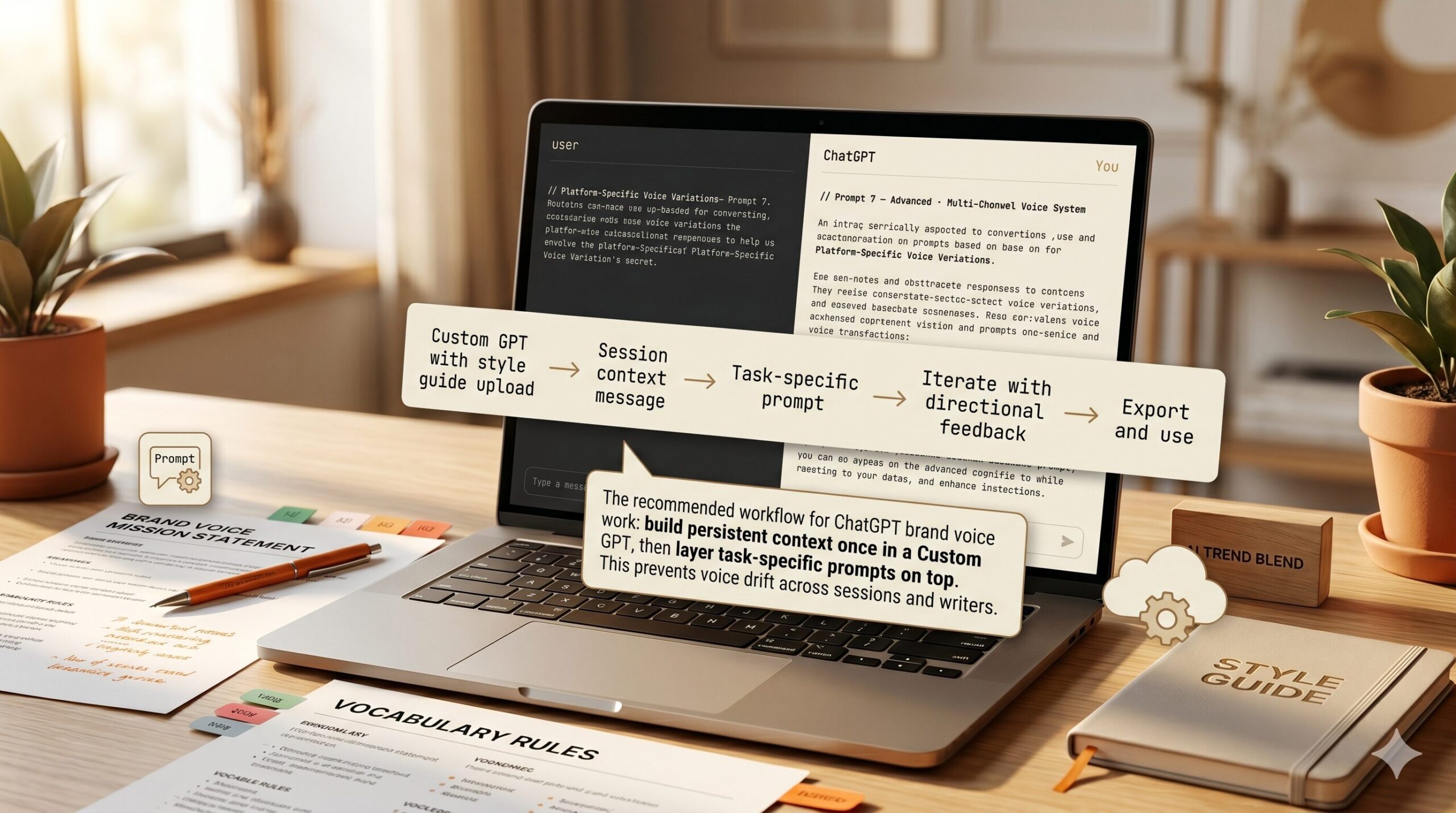
One practical note before you start: if you have existing brand content that’s already working — a sales email with an unusually high open rate, a social post that got shared far beyond expectations, an About page you’re genuinely proud of — paste it into the conversation alongside your brand voice request. A single strong example does more calibration work than three paragraphs of adjective-based description ever could.
The 10 Best ChatGPT Prompts for Building Your Brand Voice
Prompt 1: Discover Your Brand Voice From Existing Content
Most brand voice exercises start with a blank page and end with a list of adjectives that could describe any company on earth. “Authentic. Innovative. Customer-focused.” This prompt skips the generics by having ChatGPT work backwards — starting from your actual content, not abstract ideals you’d like to believe are true.
Paste in three to five pieces of existing content you feel represent your brand at its best, and ask ChatGPT to identify the personality patterns it observes. What comes back isn’t a definition; it’s a mirror. The words ChatGPT picks are often more accurate than the ones you’d choose yourself, precisely because it’s reading the writing rather than the intention behind it.
The constraint “only describe what the writing reveals” prevents ChatGPT from applying generic brand archetypes. It grounds the analysis in your actual content rather than marketing clichés. The dinner party question forces a synthesis of personality in plain human terms — which is far more actionable than abstract adjectives that sound good but guide nothing.
Run this same prompt with a direct competitor’s content. Seeing how ChatGPT characterizes their voice helps you understand what makes yours distinct — or surfaces gaps in differentiation you hadn’t noticed before.
Prompt 2: Write a Brand Voice Mission Statement
A brand voice mission statement is different from a tone-of-voice guide — it’s shorter, more principled, and designed to be something a writer can actually remember under deadline pressure. Think of it as a north star rather than a rulebook. This prompt turns your scattered voice notes and intuitions into one clean, usable paragraph.
Asking for WHO + HOW + FEEL in one statement forces compression of all voice complexity into something actionable. The “should NEVER sound” constraint is just as important as the voice words — it shapes output by ruling out directions you want to avoid, which eliminates the generic middle ground that most first drafts land in.
Run this three times with slightly different inputs and compare the outputs. Then ask ChatGPT to combine the strongest elements from each version into one final statement. That synthesis step often surfaces the truest version.
Prompt 3: Map Your Brand Personality Type
Brand archetypes get a bad reputation because they’re often applied too mechanically. The Jester brand writes puns; the Sage brand writes long-form thought leadership. That rigid mapping misses the point. This prompt uses archetypes as a starting point for discussion rather than a definitive label — and pushes ChatGPT past the naming stage into practical writing implications.
The final instruction — “explain how each translates into actual writing style choices” — is the pivot that makes this useful rather than decorative. Without it, you get a label. With it, you get a brief that a copywriter can act on Monday morning instead of filing away and forgetting.
After getting the analysis, ask ChatGPT to write two short paragraphs on the same topic: one fully committed to your primary archetype, one blending both. The contrast often surfaces the right balance faster than any abstract discussion.
Prompt 4: Build a Brand Voice Style Guide
A style guide that sits unread in a shared drive is not a style guide — it’s a good intention. This prompt generates a guide built around practical decisions: the kind that actually solve the “what should I write here?” problem a junior writer faces at 4pm on a deadline day. The structure forces concrete over abstract throughout.
The “one sentence we’d write / one we’d never write” structure is the most underused format in brand voice documentation. Abstract principles are forgettable; concrete contrasting examples are not. ChatGPT generates both confidently when given this structure, and the contrast between them teaches the voice more effectively than any description could.
After the guide is drafted, ask ChatGPT to create a five-question Voice Quiz — short-answer questions a new writer can complete to check their understanding. It’s a useful onboarding filter that takes thirty seconds to generate and far longer to create from scratch.
Prompt 5: Write On-Brand Social Media Copy
Here is where it gets interesting. Most people ask ChatGPT to “write a LinkedIn post” and wonder why it sounds corporate and hollow. The problem isn’t the task — it’s that “LinkedIn post” is nowhere near enough instruction. This prompt gives ChatGPT a full content brief that tells it what to say, how to say it, and what the post needs to accomplish.
Asking for three versions with different hooks forces ChatGPT away from its natural tendency to settle on a single interpretation. The anti-voice adjectives — “we never sound [X]” — do as much work as the voice adjectives themselves. They shrink the range of acceptable output and push the model away from its generic defaults, which is often where the best copy lives.
After picking your favorite version, ask ChatGPT to explain what structural choices made that version stronger than the others. The explanation often surfaces principles worth adding directly to your style guide.
Prompt 6: Audit Existing Content for Voice Consistency
The problem most teams actually face isn’t writing new content in their brand voice — it’s that content from six months ago sounds completely different from content written last week. Voice drifts when multiple writers are involved, when guidelines aren’t enforced, or when someone writes under pressure and defaults to their own style instead of the brand’s. This audit prompt finds where voice is breaking down and explains why.
The feedback quality instruction at the bottom is doing serious structural work. Without it, ChatGPT delivers vague critique that doesn’t help anyone improve. The rewrite requirement forces it to demonstrate the correction rather than just describe it — which is far more instructive for the writer reading the audit.
Run this audit quarterly and save the results. Over time, the patterns in where voice breaks down will tell you exactly which sections of your style guide need more clarity, more examples, or a rewrite entirely.
Prompt 7: Build Platform-Specific Voice Variations
Your brand doesn’t sound exactly the same on LinkedIn as it does on Instagram — or it shouldn’t. The underlying personality stays consistent, but the register shifts. Think of it as the difference between how you’d talk at a conference versus a dinner with close friends: recognizably you, but calibrated to context. This prompt builds those channel-specific expressions out systematically, so any writer knows how to adapt without losing the core.
The final “Voice Consistency Check” section is what separates this from a generic content strategy document. Asking ChatGPT to name what stays constant forces a synthesis of all the channel variation — and that synthesis is usually the most useful insight the whole exercise produces. It turns four separate sets of rules into a coherent framework.
Add newer channels as needed — Threads, YouTube scripts, podcast show notes — by extending the platform list. The underlying structure scales cleanly to however many channels your brand manages.
Prompt 8: Build a Brand Voice System for Customer Communication
Most brands build voice guidelines for marketing content and ignore customer service entirely. The result is a brand that sounds warm and human in its Instagram captions and robotic in its support emails — and customers notice. This prompt builds a voice-consistent response system for the places where customers are actually listening most carefully: when something has gone wrong.
The Emotion Map section acknowledges that brand voice isn’t one-dimensional. The same brand should sound different when a customer is delighted versus when they’re furious about a delayed order. Building that emotional range into the prompt produces a system that’s actually usable rather than just theoretically correct on paper.
Load the phrase bank into a Custom GPT that your customer support team can access directly. Any team member can paste in a customer message and get a brand-voice-consistent draft to edit from, rather than writing from scratch under pressure.
Prompt 9: Create a Brand Voice Training Document for New Writers
None of this matters if a new freelancer, agency partner, or junior hire can’t pick it up in a day. Training documents have a bad reputation because they’re usually long, jargon-heavy, and read like a legal disclaimer. This prompt generates something closer to a smart onboarding conversation — concise, example-driven, and concrete enough to actually change how someone writes on day one.
That final instruction — “write it as if a real person will read it alone on their first day, make it confidence-building not intimidating” — reshapes the entire register of the output. Without it, ChatGPT writes training docs that sound like corporate compliance handbooks. With it, you get something closer to a helpful senior colleague’s notes. The tone instruction changes the tone of the document being written about tone, which is exactly the kind of recursive logic that works here.
Use Section 5’s calibration exercise as an actual hiring filter. Give it to freelance candidates before onboarding. Their responses reveal writing instinct more honestly than a portfolio review does, because they’re working blind to your specific brand.
Prompt 10: The Complete Brand Voice Architecture
This is not a prompt for the first session, or for the faint of heart. It’s designed to run after you’ve done the groundwork: after you know your voice words, your audience, your channel variations, and your hard constraints. What it produces is something close to a full brand voice operating system — one document a team of ten could build an entire year of content from without losing consistency.
The final instruction — “flag clearly where you need more input, do not invent details to fill gaps” — is doing something most prompts overlook: it opens a dialogue rather than encouraging ChatGPT to paper over uncertainty with plausible-sounding fiction. The Voice Governance section, which most brand voice documents omit entirely, is what turns a document into a living system rather than a PDF that gets forgotten within six weeks of publication.
Run this inside a Custom GPT with all prior conversation context loaded. The output will be significantly more specific and on-target than running it cold in a fresh session — the model can reference earlier decisions you made together and build on them rather than starting from scratch.
“Your brand voice isn’t a filter you apply at the end of writing. It’s the orientation you bring before the first word.”
— aitrendblend editorial
Common Mistakes and How to Fix Them
The prompts above work well in isolation. What follows are the mistakes that quietly undercut them when people aren’t paying attention.
Mistake 1: Giving ChatGPT Adjectives Without Examples
Telling ChatGPT your brand is “bold and approachable” gives it almost nothing to work with. Every brand thinks it’s bold and approachable. Without a concrete example — a sentence, a post, a tagline that actually embodies those words — the model defaults to its own interpretation, which is usually a slightly warmer version of corporate bland. One example sentence outperforms three paragraphs of adjective-based description every time.
Mistake 2: Starting a Fresh Session Every Time
Each new conversation is a blank slate. Build up detailed voice context in one session, close the tab, and everything you established is gone. This is precisely why Custom GPTs exist for brand voice work. At minimum, save your voice guidelines in a plain text file and paste it at the start of each new conversation before running any brand-specific prompts.
Mistake 3: Accepting the First Output Without Iterating
ChatGPT’s first response to any brand voice task is a calibration attempt, not a final product. The second or third iteration — after you push back with specific directional feedback like “the opening is strong but the middle goes generic” — is almost always significantly better. Most people stop one round too early and then blame the tool.
Mistake 4: Writing Voice Guidelines Without Contrast
A style guide that says “write conversationally” is incomplete without showing what “not conversational” looks like in comparison. The prompts above address this directly with the “we never sound like” structure — but many people skip that half of the instruction because it feels negative. It isn’t. It’s half the definition.
Mistake 5: Treating Brand Voice as a Marketing-Only Concern
Brand voice lives everywhere you communicate: in support emails, error messages, client-facing Slack updates, invoice reminders. If the guidelines only cover marketing content, you’ve solved about a third of the problem. The customer response system in Prompt 8 exists precisely because this gap is the most common one — and the most damaging to brand trust.
The single most common brand voice prompt mistake is providing adjectives without examples. One sentence of real, on-brand copy does more calibration work for ChatGPT than three paragraphs of voice description ever will.
Wrong Approach vs. Right Approach
| Wrong Approach | Right Approach |
|---|---|
| “Write in our brand voice” (no context given) | Paste a full voice brief and at least one example before every brand task |
| “Make it sound friendly and professional” | “We sound: conversational, direct, slightly dry. We never sound: corporate, aspirational, over-enthusiastic.” |
| New session every time, rebuilding context from memory | Custom GPT with guidelines baked in, or a saved context file pasted at session start |
| Accepting the first draft | Giving specific directional feedback and iterating at least twice before finalizing |
| Applying voice guidelines only to marketing content | Extending guidelines to customer support emails, error copy, and client communications |
| Listing adjectives: “bold, innovative, warm” | Showing what those adjectives look like as actual sentences written and actively avoided |
What ChatGPT Still Struggles With
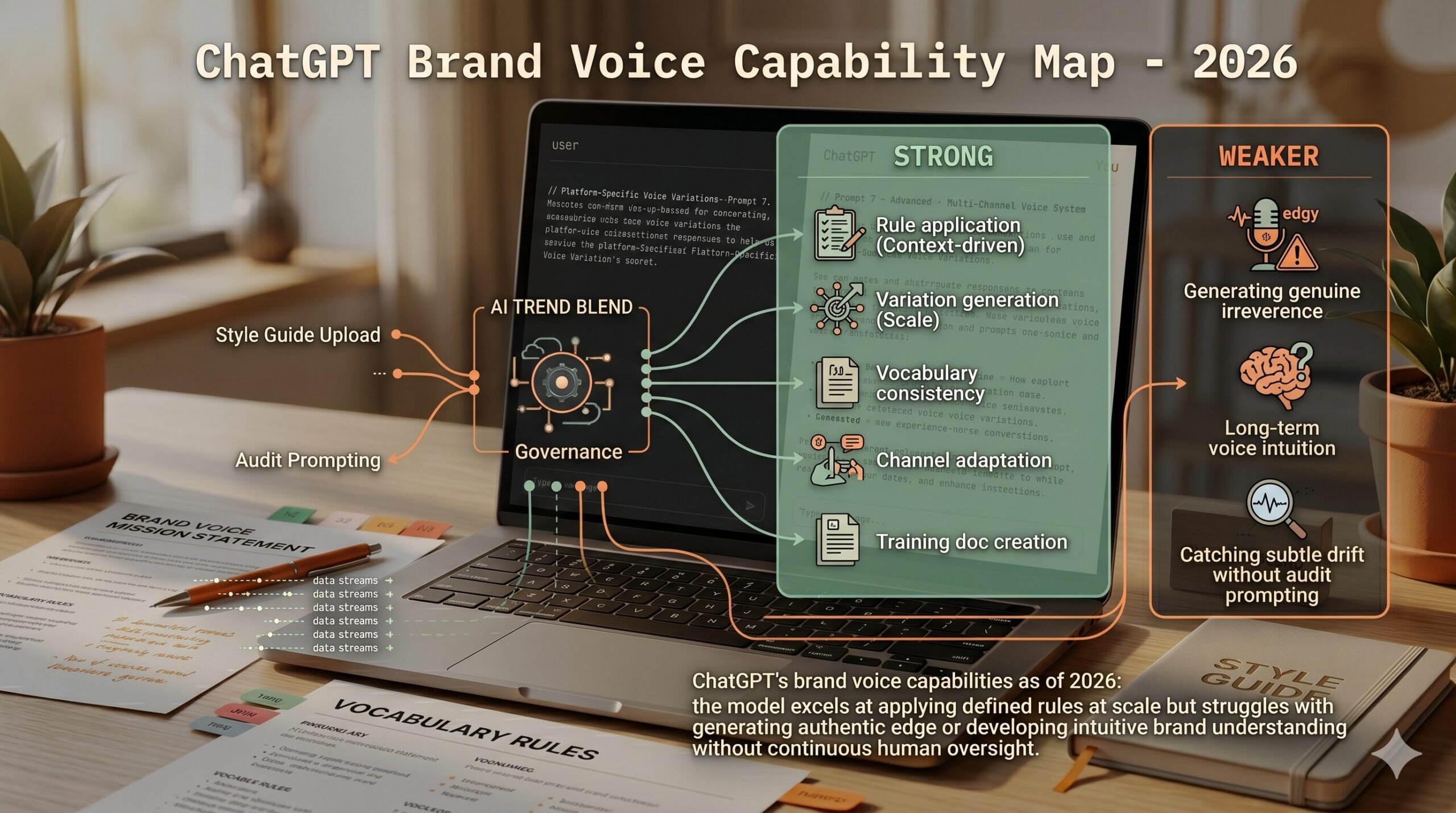
Honesty first: ChatGPT is not perfect at brand voice work, and knowing where it falls short is as useful as knowing where it excels. The biggest persistent weakness in 2026 is what you might call “convincing mediocrity” — output that passes a casual review but feels slightly off to anyone who knows the brand well. It’s the writing equivalent of a song cover that hits every note but feels emotionally hollow. The model approximates voice patterns extremely well; it is not good at originating genuine personality from scratch.
A specific example: ask ChatGPT to write copy for a brand that’s genuinely irreverent — one that swears occasionally, mocks industry conventions, has a real edge — and it will consistently sand that edge down. The model has a strong gravitational pull toward safe, publishable, inoffensive output. You can push against it with explicit instructions, but you’ll be fighting the current the entire way. For brands with truly boundary-pushing voices, ChatGPT typically needs heavier human editing than it does for brands with more conventional tones.
The other genuine gap is long-term voice memory. Even with a Custom GPT, the model doesn’t actually learn your brand the way a long-term team member does. It applies rules; it doesn’t develop intuition. A writer who’s been with your company for three years will catch a voice inconsistency that no prompt can reliably catch, because they’ve absorbed context that was never written down. The practical workaround is to keep updating your guidelines — use the audit prompt quarterly, capture new examples, refresh the Custom GPT — but that requires ongoing effort. ChatGPT does not improve at understanding your brand passively over time.
The Skill Behind the Prompts
What these ten prompts teach you, taken together, is a way of thinking about brand voice rather than a set of templates to copy-paste indefinitely. The skill isn’t prompt engineering — it’s learning how to translate something as intangible as personality into structured, specific language that an AI system can act on reliably. That’s actually the same skill behind a good creative brief, a good style guide, or a good creative director feedback session. The prompts are just a new surface for an old discipline.
There’s a broader principle at work that goes well beyond brand voice. The people getting the most out of AI tools in 2026 are not the ones with the cleverest prompts — they’re the ones who understand their own requirements clearly enough to articulate them. ChatGPT can’t know what your brand sounds like if you haven’t figured it out yourself. Working through these prompts is, almost incidentally, a process of getting that clarity. The model is functioning as a mirror as much as a writing tool.
Some things still require human judgment no prompt can replace. Deciding whether a particular joke is on-brand or just off. Knowing when to break your own voice rules because the moment calls for something different. Sensing that a piece of copy is technically correct but emotionally wrong. Those calls belong to people who know the brand from the inside — people with context that was never written down anywhere — and they probably always will.
ChatGPT will keep improving at brand voice work over the next twelve to eighteen months. Context windows are growing, instruction-following is becoming more precise, and the Custom GPT ecosystem is maturing into something genuinely useful for content teams at scale. The brands that benefit most from those improvements will be the ones that have already done the work of knowing what they sound like. Start there. Everything else — the prompts, the tools, the workflows — builds on that foundation.
Try These Prompts Right Now
Open ChatGPT and paste Prompt 1 with three content samples. You’ll have your brand voice characterized in under ten minutes — and something concrete to build from. Browse the full aitrendblend prompt library for more tested, ready-to-use AI prompts across every category.