ChatGPT Plus handles the language layer of social media — captions, hooks, calendars — better than most people expect, once you learn how to ask.
It’s 10 PM. Your post goes live in two hours and the draft you’ve been staring at since noon still isn’t right. You’ve rewritten the caption three times. The hook feels flat. The hashtags look like they were generated by someone who’s never actually used Instagram. You publish anyway, because the alternative is posting nothing — and nothing is somehow worse.
That cycle — content anxiety, mediocre output, disappointing engagement, repeat — is where most social media creators live. Not because they lack ideas or don’t understand their audience. Most of them understand their audience well. The bottleneck is production: turning what you know into content that actually lands, consistently, across multiple platforms, without spending your entire week on it.
ChatGPT Plus — specifically GPT-4o, which powers it as of 2026 — is genuinely good at this production layer. Not at strategy in the abstract, not at telling you what your brand should stand for, but at the actual writing work: drafting captions that sound human, adapting one idea into five platform-native formats, building a content calendar that has internal logic rather than just random topic scatter. It’s quick, it iterates fast, and when you give it enough context, the output is surprisingly close to what you’d write yourself on a good day.
The ten prompts that follow cover that full range — from the smallest daily task (writing a caption) to the largest strategic move (building a complete content system from scratch). Each one comes with an explanation of the structure and why it produces better output than a simpler version would. By the end of this article, you’ll have a repeatable toolkit, not just a set of one-off templates.
Why ChatGPT Plus Handles Social Media Content Differently
The obvious answer — it’s good at writing — is true but incomplete. What actually makes ChatGPT Plus useful for social media work is how well it handles voice adaptation and platform context simultaneously. You can give it examples of your past posts, describe your audience’s tone, and name the platform — and it will produce content that actually feels native to that combination. Most tools either ignore one of those variables or treat them all equally. GPT-4o doesn’t.
Where it pulls ahead of Claude for this specific use case is in sheer iteration speed and its ability to generate high volumes of variation quickly. Need twelve title options for a carousel? Fifteen caption variations for A/B testing? Twenty hook options for a Reel? ChatGPT Plus delivers those fast, and the variations are genuinely different from each other rather than slightly reworded copies. For high-output social media teams who need quantity alongside quality, that matters. Claude Opus tends to be more analytically rigorous on strategic tasks; ChatGPT Plus tends to be faster and more prolific on pure content production.
The real limitation — and you should know this going in — is that ChatGPT Plus doesn’t know what’s performing on your account. It can’t see your Instagram Insights, your LinkedIn analytics, or your TikTok retention curves. It’s working from what you tell it, not from your actual data. The more context you give it about what has worked and what hasn’t, the better the output. Treat every prompt as a briefing, not just a request.
Key Takeaway: ChatGPT Plus excels at fast, high-volume content production — captions, hooks, calendar planning, platform adaptation, voice matching. It doesn’t replace analytics or strategic judgment, but it dramatically compresses the time between “I have an idea” and “here’s a post worth publishing.”
Before You Start: Getting the Most Out of ChatGPT Plus for Social Media
Two setup habits make an outsize difference before you paste any of these prompts.
First, create a Custom GPT or use ChatGPT’s Memory feature (available to Plus subscribers) to store your brand context. Your niche, your audience, your tone, your platform mix, your posting frequency — put all of that somewhere ChatGPT can access without you repeating it every conversation. The prompts in this article are written assuming you provide that context inline, but if you’ve built it into a Custom GPT or Memory, you can strip the context setup from each prompt and work even faster.
Second, feed it examples before you ask it to write. The single most effective thing you can do to improve ChatGPT’s output quality is paste two or three of your best-performing existing posts and say “match this voice.” That five-second step produces dramatically better results than even the most carefully written prompt without examples. The examples are the instruction.
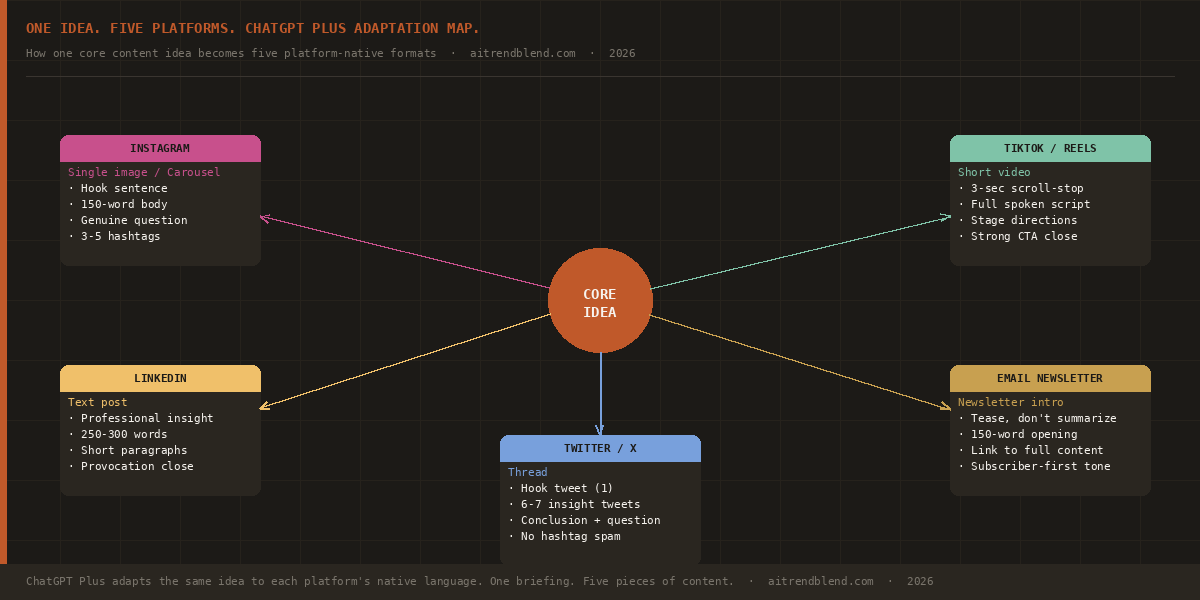
🗺️Platform Adaptation Map One core idea → five native formats 1200×600px · Dark background · Color-coded by platform
One well-written core idea can become five genuinely different pieces of content when you adapt it properly to each platform’s native format and audience expectation.
One more thing worth saying plainly: these prompts work better when you edit the output. Not rewrite it entirely — but read it, find the one or two sentences that sound slightly off, and fix them in your own voice. That small step is what turns AI-generated content into content that actually sounds like you. The goal is not to automate your content — it’s to get to a first draft that’s already 80% there, so your editing time is fifteen minutes instead of two hours.
The 10 Best ChatGPT Plus Prompts for Social Media Content Creation
Prompt 1: The Caption Starter
The simplest place to begin is also the most common bottleneck: you have a photo or a topic, and you need a caption. Most people either write something generic (“love this moment ✨”) or over-engineer it into something that reads like a press release. This prompt gets you to something in the middle — personal, readable, and structured to perform.
Prompt 1 · Beginner · Caption Writing
The Caption Starter
Write 5 Instagram captions for a post about: [DESCRIBE YOUR POST TOPIC OR PHOTO IN 2-3 SENTENCES]
My account is about: [YOUR NICHE — e.g., “sustainable living for young professionals”]
My usual tone is: [E.G., “conversational, warm, occasionally funny — not corporate”]
For each caption:
– Start with a hook sentence that doesn’t begin with “I” or “Are you”
– Keep the body under 150 words
– End with one question that invites a genuine comment (not “what do you think?”)
– Add 3-5 relevant hashtags at the bottom
Write all 5 captions — make each one feel different in angle and energy, not just slightly reworded.
Why it works: Asking for 5 variations forces real differences. The constraint against starting with “I” or “Are you” avoids the two most overused caption openers on the platform. Ending with a specific question — not a generic one — drives comments that trigger the algorithm.
How to adapt: Change “Instagram” to “LinkedIn” and add “professional tone, no hashtags, keep under 200 words” — the same structure works across platforms with minor adjustments.
BeginnerInstagramCaption Writing
Prompt 2: The Content Calendar Builder
Planning content a month at a time sounds obvious. In practice, most creators plan two days ahead and wonder why their feed has no coherent identity. A structured content calendar isn’t just a scheduling tool — it’s a way of ensuring your posts have a reason to exist relative to each other, and that you’re covering different angles of your topic rather than posting the same idea twelve different ways.
Prompt 2 · Beginner · Content Planning
The Content Calendar Builder
Build me a 30-day social media content calendar for [YOUR PLATFORM(S) — e.g., “Instagram and LinkedIn”].
My niche: [YOUR NICHE]
Posting frequency: [HOW MANY TIMES PER WEEK — e.g., “4x per week”]
My audience is: [DESCRIBE YOUR AUDIENCE]
One topic or product I want to focus on this month: [OPTIONAL FOCUS]
For each post, give me:
– Day and date (start from Day 1)
– Content format (carousel, single image, Reel/short video, text-only, poll, etc.)
– Post topic in one sentence
– The angle or hook — what makes this specific post interesting rather than generic?
Group the 30 days into 4 themed weeks. Each week should have a different content focus that adds up to a coherent monthly narrative. The calendar should not repeat the same angle twice in the same week.
Why it works: The four-themed-weeks structure gives the calendar a spine. Without it, ChatGPT produces 30 individual post ideas with no relationship to each other. The “no repeated angle in the same week” constraint forces variety in content type and approach — which is what keeps a feed interesting.
How to adapt: After getting the calendar, pick the three posts you’re most excited about and follow up: “Now write full captions for posts 3, 11, and 22.” Running the writing in batches is faster than generating one at a time.
BeginnerContent CalendarMonthly Planning
Prompt 3: The Hashtag Strategy Builder
Bad hashtag advice is everywhere. “Use 30 hashtags.” “Use only 3.” “Only use niche hashtags.” Most of it misses the point. Hashtags are a discovery mechanism, and a good hashtag strategy is tiered — it mixes broad reach with specific audience targeting, and avoids the hashtags that are so oversaturated you’ll never be seen in them.
Prompt 3 · Beginner · Hashtag Strategy
The Hashtag Strategy Builder
Create a tiered hashtag strategy for my Instagram account.
My niche: [YOUR NICHE]
My account size: [APPROXIMATE FOLLOWER COUNT OR “just starting”]
The post this is for is about: [POST TOPIC]
Build me three tiers of hashtags:
Tier 1 — BROAD (5 hashtags): high-volume tags (1M+ posts) that describe the general topic. I understand I probably won’t rank here, but they help with category classification.
Tier 2 — MEDIUM (10 hashtags): mid-volume tags (100K–1M posts) that are specific to my niche but still have real search traffic.
Tier 3 — NICHE (10 hashtags): low-volume tags (under 100K posts) where I can realistically appear on the Explore or Recent page for my exact audience.
After the three tiers, write one sentence explaining the logic behind Tier 3 specifically — why those tags and not others for someone at my account size.
Why it works: The tiered structure reflects how Instagram’s algorithm actually processes hashtags — as category signals at different scales. Asking for the reasoning behind Tier 3 ensures ChatGPT can’t just list random tags; it has to think about what makes a tag worth using at your specific account size.
How to adapt: Save your Tier 3 tags as a “base set” and use this prompt monthly to refresh them. Niche hashtag performance shifts — what worked six months ago may be saturated now.
BeginnerHashtagsInstagram SEO
Prompt 4: The Platform Adaptation Engine
The problem most people run into when repurposing content is that they treat it like copy-pasting with light editing. You take your Instagram caption and shorten it for Twitter, or paste your LinkedIn post into Facebook and call it done. That’s not repurposing — it’s laziness disguised as efficiency. Platform-native content looks and sounds different on each platform, and audiences can tell the difference immediately.
Prompt 4 · Intermediate · Multi-Platform Content
The Platform Adaptation Engine
You are a social media strategist who understands what performs natively on different platforms.
I have a core content idea: [DESCRIBE YOUR IDEA IN 3-5 SENTENCES — what is the point, the angle, and the audience?]
Adapt this idea into four platform-native formats:
1. INSTAGRAM CAPTION (single image post): Hook in the first line, storytelling body under 200 words, one genuine question at the end. Hashtags optional.
2. LINKEDIN POST: 250-300 words. Open with a professional observation or earned insight — not “I’m excited to share.” Use short paragraphs (2-3 lines max). End with an opinion or provocation, not a call to action.
3. TWITTER/X THREAD (6-8 tweets): Tweet 1 is the hook. Tweets 2-7 are the substance — each one a standalone insight. Tweet 8 is the conclusion with a question.
4. TIKTOK / REEL SCRIPT (60 seconds): First 3 seconds must stop the scroll. Write the full spoken script, including stage direction notes like [cut to] or [text overlay: ___].
After all four, write one paragraph explaining what you changed between each format and why. What you emphasize on LinkedIn is different from what performs on TikTok — show me that you understand the difference.
Why it works: The explanation paragraph at the end is the key. It forces ChatGPT to reason through the differences rather than just changing tone by reflex. The TikTok script with stage directions is practical — it saves you from translating a text script into something filmable, which is where the extra friction usually lives.
How to adapt: If you only use two platforms, remove the others and add more detail to what you need — “give me 3 LinkedIn variations with different angles” produces more value than four mediocre platform adaptations.
Think about what this actually requires. A hook has roughly two seconds to make someone stop mid-scroll. That’s not a metaphor — the average scroll speed on Instagram Reels and TikTok is around two seconds per piece of content. Your hook isn’t competing with other posts in your niche. It’s competing with everything on the platform simultaneously. The writing standard required is different from everything else you produce.
Prompt 5 · Intermediate · Hook Writing
The Scroll-Stopping Hook Generator
You are a direct-response copywriter who specializes in social media video hooks.
I’m making a [VIDEO FORMAT — Reel / TikTok / YouTube Short] about: [TOPIC]
My audience is: [DESCRIBE VIEWER]
Write 15 different hook options for the first 3 seconds of this video. Use the following spread:
3 hooks using CURIOSITY GAP (“You’ve been doing X wrong…”)
3 hooks using A BOLD CLAIM (“Most people will never know this about X…”)
3 hooks using RELATABILITY (“If you’ve ever struggled with X, this is for you”)
3 hooks using A SURPRISING FACT or STATISTIC (make them real — do not fabricate)
3 WILDCARD hooks that don’t fit any pattern above
Rules: Every hook must be under 12 words. No hook should begin with “I” or “Have you ever.” No hook should end with a question mark. Spoken aloud, each hook should feel urgent, not academic.
After the 15, pick your top 3 and explain in one sentence each why you chose them for this specific audience.
Why it works: The 12-word maximum isn’t arbitrary — it maps to roughly what can be read or spoken in two seconds. The instruction against question marks is deliberate: questions feel passive, while statements feel declarative and attention-commanding. The no-fabrication rule on statistics is important — ChatGPT will invent numbers if you don’t explicitly forbid it.
How to adapt: Use this for caption openers too, not just video hooks. The first sentence of an Instagram or LinkedIn caption serves the exact same function as a video hook — stop the scroll, earn the “more.”
IntermediateHooksVideo ScriptReelsTikTok
Prompt 6: The Engagement Content Designer
Most social media creators think about engagement as something that happens to their content — their post either gets comments or it doesn’t. The reality is that engagement is something you design into content deliberately. Questions, polls, “this or that” posts, challenge prompts, fill-in-the-blank captions — these formats exist because they lower the barrier to interaction. You don’t need someone to compose a response; you need them to tap a button or finish a sentence.
Prompt 6 · Intermediate · Engagement Design
The Engagement Content Designer
You are a social media engagement specialist who designs content specifically to generate comments, shares, and saves.
My account niche: [YOUR NICHE]
Platform: [PLATFORM]
My audience profile: [DESCRIBE YOUR FOLLOWERS]
Design 8 engagement-first content pieces. For each one, give me:
– The format (poll, question post, “this or that,” fill-in-the-blank, debate prompt, challenge, etc.)
– The full caption or post copy, ready to publish
– The expected engagement mechanism — what specific action does this content ask the viewer to take?
– One tip on timing: is this better posted on a weekday or weekend, and at what part of the day?
The 8 pieces should cover at least 4 different engagement formats. No two pieces should use the same psychological trigger (curiosity, controversy, aspiration, nostalgia, humor, FOMO, etc.).
Why it works: Naming the psychological trigger for each post is the move that separates this from a generic “engagement content” request. Once ChatGPT has to name the trigger, it can’t lazily repeat the same format eight times. The timing tip adds practical value without requiring a separate research session.
How to adapt: If your account is new and you’re not sure what engagement formats work for your audience, add this line: “Also suggest which 2 of the 8 I should test first to learn what my audience responds to, and explain why.”
Here is where it gets genuinely useful for anyone who’s been posting for a while. You’ve developed a voice — whether you’re aware of it or not. Certain phrases you use, certain rhythms, a particular level of formality. The problem is that most AI tools ignore this and write in their own default voice. This prompt teaches ChatGPT your voice by feeding it examples, then asking it to write new content that matches them.
Prompt 7 · Advanced · Brand Voice
The Brand Voice Trainer
I want to teach you my brand voice so you can write content that sounds like me, not like ChatGPT.
Here are 3 examples of content I’ve written that I’m happy with:
EXAMPLE 1:
[PASTE YOUR BEST POST #1 — caption, LinkedIn post, or email — exactly as written]
EXAMPLE 2:
[PASTE YOUR BEST POST #2]
EXAMPLE 3:
[PASTE YOUR BEST POST #3]
Step 1: Analyze these three examples and describe my voice in specific terms. What sentence patterns do I use? What do I avoid? What’s the rhythm — long sentences or short? Do I use humor, and if so what kind? How formal or casual am I?
Step 2: Identify 3 phrases or patterns that are distinctly mine — things that would be unusual to see in generic content but appear in my writing.
Step 3: Now write a new post on this topic, in my voice: [YOUR NEW TOPIC]
Step 4: After writing it, explain in 2 sentences what specific choices you made to match my voice rather than defaulting to a generic style.
Why it works: The analysis step (Step 1) before the writing step (Step 3) forces ChatGPT to build an explicit model of your voice before it applies it. Most people skip this and go straight to “write in my style” — which produces generic output with slightly adjusted tone. The four-step structure creates accountability at each stage.
How to adapt: Save the Step 1 analysis output. Paste it at the start of future content requests as a “voice brief” — it’s far more effective than writing “match my tone” without context.
AdvancedBrand VoiceVoice MatchingStyle Training
Prompt 8: The Viral Content Reverse Engineer
This is not a prompt about chasing virality. It’s a prompt about understanding structure. When a piece of content performs unusually well — whether that’s a post in your niche, a competitor’s Reel, or something that crossed into mainstream conversation — there’s usually a structural reason why. The emotional trigger was clear. The hook arrived at the right moment. The format matched the message. This prompt unpacks that structure so you can replicate the logic without copying the content.
Prompt 8 · Advanced · Content Analysis
The Viral Content Reverse Engineer
You are a content strategist who specializes in analyzing what makes social media content perform unusually well.
Here is a piece of content that performed very well in my niche (or that I admire for its performance):
[PASTE THE FULL TEXT OF THE POST, VIDEO SCRIPT, OR A DETAILED DESCRIPTION OF THE CONTENT — including its format, platform, and approximately how it performed if you know]
Analyze it across these dimensions:
1. HOOK MECHANICS: What does the first line or first 3 seconds do? Why does it work for this specific audience?
2. STRUCTURAL BLUEPRINT: Break this content into its components. What is the logical sequence? If it were a recipe, what are the ingredients and in what order?
3. EMOTIONAL ARC: What emotion does the viewer feel at the start, middle, and end? How does the content engineer that journey?
4. SHAREABILITY FACTOR: What specific element makes someone want to send this to a friend? Name it precisely.
5. REPLICATION FRAMEWORK: Based on this analysis, write a structural template I can use to create content in the same pattern — but for my own niche ([YOUR NICHE]). Do not copy the original content. Extract the skeleton.
Then, using that template, write one original piece of content for me on this topic: [YOUR TOPIC]
Why it works: The structural blueprint step is what most analysis misses. People describe viral content in terms of vibes (“it was so relatable”) rather than mechanics. Forcing an ingredient-list breakdown reveals the actual structure you can reverse-engineer. The “do not copy — extract the skeleton” instruction prevents ChatGPT from just lightly paraphrasing the original.
How to adapt: Run this on your own top three performing posts. You’ll often find structural patterns you weren’t consciously aware of — and that’s the beginning of a content formula that’s genuinely yours.
One-off posts are the hardest way to grow. They require every piece of content to stand entirely on its own, with no benefit from what came before. A well-designed content series is different — each piece borrows credibility from the others, subscribers have a reason to watch for the next installment, and the algorithm reads consistent topic engagement as a signal to recommend you to similar audiences. Building a series is a strategic decision, not just a content format choice.
Prompt 9 · Advanced · Series Planning
The Content Series Architect
You are a content strategist who builds social media series that compound in reach — each post performing better than the one before it because of accumulated audience investment.
My platform: [PLATFORM]
My niche: [NICHE]
My audience: [DESCRIBE YOUR FOLLOWERS]
Series topic: [THE OVERARCHING THEME]
Number of parts: [E.G., 8-12 posts]
Format: [E.G., carousels, single images, Reels, text posts]
Design the full series:
1. SERIES NAME AND POSITIONING: What is this series called? Write a one-line series description that I can use in every post to signal it’s part of a series.
2. EPISODE ORDER: List all posts with titles and a one-sentence description of each. Explain the sequencing logic — why this order, not another?
3. NARRATIVE TENSION: Each post should leave the audience with one unanswered question that the next post resolves. List those cliffhangers for each transition.
4. LAUNCH STRATEGY: Which post should I publish first — and is it necessarily Part 1? How do I tease the series before it begins?
5. ENGAGEMENT HOOKS: For each post, suggest one specific comment prompt that builds on the series theme and encourages people to share their own experiences.
Think like a showrunner. The series should feel like something worth waiting for, not just a collection of posts with the same hashtag.
Why it works: The “narrative tension” section is the move that separates a real series from a themed content batch. A cliffhanger doesn’t have to be dramatic — it just has to give the audience one unresolved thing they care about. Without that, there’s no pull to keep following. The “think like a showrunner” instruction reframes ChatGPT’s approach from list-maker to narrative designer.
How to adapt: If you already have a series that’s underperforming, swap the design request for an audit: “Here are the 8 posts in my current series [paste titles]. Diagnose what’s missing and tell me what single addition or change would most improve performance.”
Prompt 10: The Complete Social Media Growth System
This is the one that requires the most from you — not in terms of time to run, but in terms of honest self-assessment going in. The quality of the output scales directly with the quality and specificity of what you put in. Every field matters. Fill it in properly and ChatGPT Plus produces something close to a real strategic brief. Fill it in vaguely and you’ll get advice you’ve already read somewhere else.
Prompt 10 · Master · Full Growth Strategy
The Complete Social Media Growth System
# CHATGPT PLUS — SOCIAL MEDIA GROWTH SYSTEM
# Complete all fields before submitting
# Specificity determines output quality
You are a senior social media growth strategist with experience scaling creator accounts from under 1,000 to over 100,000 followers. You are direct, data-informed, and honest about what doesn’t work — even when it’s what the person is currently doing.
## ACCOUNT SNAPSHOT
Platform(s): [LIST ALL PLATFORMS YOU’RE ACTIVE ON]
Niche: [BE SPECIFIC — not “fitness” but “postpartum fitness for new mums in the UK”]
Current followers: [NUMBERS PER PLATFORM]
Average engagement rate: [IF YOU KNOW IT — likes+comments÷followers×100]
How long you’ve been posting: [MONTHS OR YEARS]
Posting frequency: [HOW OFTEN]
Your 3 best-performing posts (describe them): [WHAT THEY WERE AND ROUGHLY HOW THEY PERFORMED]
Your 3 worst-performing posts (describe them): [SAME]## YOUR HONEST ASSESSMENT
What you think is holding your account back: [BE HONEST — this isn’t a pitch, it’s a diagnosis]
What you’ve already tried to fix it: [AND WHAT HAPPENED]
Your available time per week for content: [HOURS]
Whether you have a product, service, or monetization goal: [DESCRIBE OR WRITE “not yet”]## WHAT I NEED
Produce a complete growth system:
1. REAL DIAGNOSIS: Based on the data I’ve given you, what is the actual bottleneck? Not what I said it was — what you infer from the pattern of best and worst performers. Be direct.
2. POSITIONING STATEMENT: In two sentences, define what my account stands for and who it serves. If my current positioning is unclear or too broad, say so and propose a tighter version.
3. CONTENT PILLARS: Define 3-4 content pillars — recurring themes that cover different aspects of my niche. For each pillar, give me 5 specific post ideas.
4. 90-DAY GROWTH PLAN: Week by week (summarized by month), what should I focus on? Month 1: establish. Month 2: optimize. Month 3: scale.
5. THE ONE CHANGE: If I could only change one thing about my account in the next 30 days, what should it be and why?
6. METRICS THAT MATTER: Which 3 numbers should I track weekly, and what should I do if any of them moves in the wrong direction?
After delivering the full plan, ask me: “What’s the hardest part of this plan to execute for you right now?” Then respond to my answer with a realistic workaround — not motivation, but a practical solution.
Do not give me generic social media advice. Every recommendation must be specific to my account situation as described above.
Why it works: The “real diagnosis” section — asking ChatGPT to infer the bottleneck from the pattern of best and worst performers, not just accept what you tell it — is the key structural move. Most people misidentify their own problems. The “ask me” instruction at the end turns the output into a conversation, which is where the genuinely useful follow-up thinking usually lives. The metrics section prevents the common trap of tracking vanity numbers instead of growth signals.
How to adapt: Run this quarterly. Your account’s situation at 500 followers is structurally different from your situation at 10,000. The same prompt with updated inputs will give you a meaningfully different plan — which is the point.
Master LevelFull Growth Strategy90-Day PlanAccount AuditChatGPT Plus
“The creators who use AI well aren’t the ones who automate everything. They’re the ones who use it to get to a good first draft faster, then spend their creative energy on the ten percent that machines can’t do.”
— aitrendblend.com editorial perspective
Common Mistakes People Make When Using ChatGPT Plus for Social Media
Most of the problems people run into with ChatGPT and social media content come from the same few patterns. Knowing them in advance saves you the frustration of figuring them out one mediocre output at a time.
Mistake 1: No Context, No Quality
“Write me an Instagram caption about coffee” will produce something generic and forgettable. Every word of context you add — your niche, your audience, your tone, your goal for this specific post — directly raises the ceiling on what ChatGPT can return. The prompt is a briefing. Brief it properly.
Mistake 2: Posting the First Draft
AI output is a starting point, not a finished product. The sentence that sounds slightly off — the phrasing that’s technically correct but doesn’t sound like you — takes thirty seconds to fix and makes the difference between content that performs and content that scrolls past. Read it. Edit it. Publish the version that sounds like you had a very productive day.
Mistake 3: Treating All Platforms as One
A LinkedIn post is not a shorter Instagram caption. A TikTok script is not a Reel description with timestamps. The language, pace, and expectation of each platform are different enough that copy-pasting is almost always a mistake. Use Prompt 4 — the Platform Adaptation Engine — every time you repurpose content, not as an afterthought.
Mistake 4: Skipping the Voice Training Step
If you don’t teach ChatGPT your voice, it will write in its default voice — which is fine, but not yours. Prompt 7 exists for this reason. Run it once with your best three posts and save the output. Every future content request improves when you paste that voice brief at the start.
Wrong Approach
Right Approach
Why It Matters
“Write me a social media post about my product launch”
“Write an Instagram caption for my product launch targeting [audience]. Tone: [describe]. Hook must not start with ‘I’ or ‘Exciting news.’ End with one genuine question.”
Specificity determines quality ceiling
Copying the output directly and publishing
Read, edit one or two sentences that feel off, then publish
30 seconds of editing turns good into yours
Using the same caption on all platforms
Run Prompt 4 to adapt each post to platform-native format
Platform audiences can tell immediately when content isn’t native
“Write in my style” with no examples
Paste 3 best posts → run Prompt 7 → save the voice analysis
Without examples, “my style” means nothing to the model
Generating one post at a time
Batch-generate a week or month of content in one session
Batching is 5x faster and produces more consistent voice across posts
Remember: ChatGPT Plus is a writing partner, not a publishing machine. The less effort you put into the prompt, the more generic the output. The more you brief it — context, tone, examples, constraints — the closer it gets to what you’d have written yourself on a good day.
What ChatGPT Plus Still Struggles With for Social Media
Honesty here matters more than enthusiasm. There are real limitations, and knowing them upfront stops you from applying this tool in places where it will let you down.
The most significant gap is real-time awareness. ChatGPT Plus doesn’t know what’s trending on Instagram or TikTok right now. Its training data has a cutoff, and social media trends move faster than any model update cycle. If you ask it to “write something that’s trending right now,” you’ll get content that sounds current but may be six to twelve months behind the actual cultural moment. For trend intelligence, you need to be on the platform yourself, or use tools like TrendTok or Creator Studio’s trending audio lists. ChatGPT is then useful for writing content around trends you’ve spotted — not for spotting them for you.
The second limitation is genuine creativity. ChatGPT Plus is very good at producing competent, well-structured content. It’s less good at producing genuinely surprising ideas — the kind of post that makes someone stop not because the hook is well-crafted but because the idea itself is unexpected. Most viral content has an idea at its center that nobody had written before. That kind of originality is hard to prompt for. You can use ChatGPT to execute a creative idea brilliantly, but the idea itself usually still needs to come from you and your specific experience.
Third, and worth naming plainly: ChatGPT has no access to your analytics. It doesn’t know your follower demographics, your engagement patterns, which post formats your audience prefers, or what time of day your followers are online. All of that context has to come from you. When it asks for your best and worst performing posts (as in Prompt 10), that’s not just a formality — that’s the data that makes the output useful rather than generic. Skip it and you get advice that could apply to any account in your niche. Fill it in properly and you get something that’s actually calibrated to yours.
Making This Work for Your Account
The ten prompts in this article cover the full surface area of social media content production — from the smallest daily task to a 90-day growth plan that takes your actual account data as input. What you have now isn’t just a collection of prompts but a system: a way of thinking about which tool to reach for at each stage of the content creation process, and how to brief that tool so the output is actually worth using.
There’s a principle underneath all of this that applies beyond just social media. AI tools produce output at the level of specificity of your inputs. That’s not a quirk of ChatGPT — it’s a fundamental truth about how these systems work. The creators who use AI best are not the ones who’ve found the magic prompt. They’re the ones who’ve gotten very good at briefing — at translating what they know about their audience, their voice, and their goals into precise, context-rich input. That skill is transferable to every AI tool you’ll use from here forward.
Social media still requires things that no prompt can provide. Your perspective on your niche, the specific experiences that make your content authentic, the judgment to know when an AI-generated caption sounds hollow and needs to be rewritten from scratch — those remain yours. ChatGPT Plus compresses the production work. The creative intelligence, the point of view, the earned trust with your audience — that’s still the part only you can bring.
Where ChatGPT Plus is heading in the next twelve to eighteen months makes this worth paying attention to now. Deeper memory, more seamless voice matching, tighter integration with scheduling tools and analytics platforms — the gap between AI-assisted content and fully manual content creation will continue to narrow on the production side. The creators who build the habit of working with these tools now, who understand their limitations as well as their strengths, will have a compounding advantage over those who treat AI content tools as a last resort. Start the habit. It gets faster every week.
Try These Prompts Right Now
Open ChatGPT Plus and start with Prompt 7 — paste your three best posts, let it analyze your voice, and use that analysis as the foundation for everything you write next.
Usage Note:
These prompts were developed and tested using ChatGPT Plus (GPT-4o) as of March 2026. OpenAI updates its models regularly — if a specific behavior described here doesn’t match what you experience, the underlying model may have been updated. Always verify that prompt structures still produce expected output in your current model version before using them in a production workflow.
This article is independent editorial content produced by aitrendblend.com. It is not affiliated with, sponsored by, or endorsed by OpenAI, Instagram, LinkedIn, TikTok, or any other platform mentioned. Social media growth results depend on many factors outside any AI tool’s control, including content quality, audience fit, platform algorithm changes, and consistency of execution.