
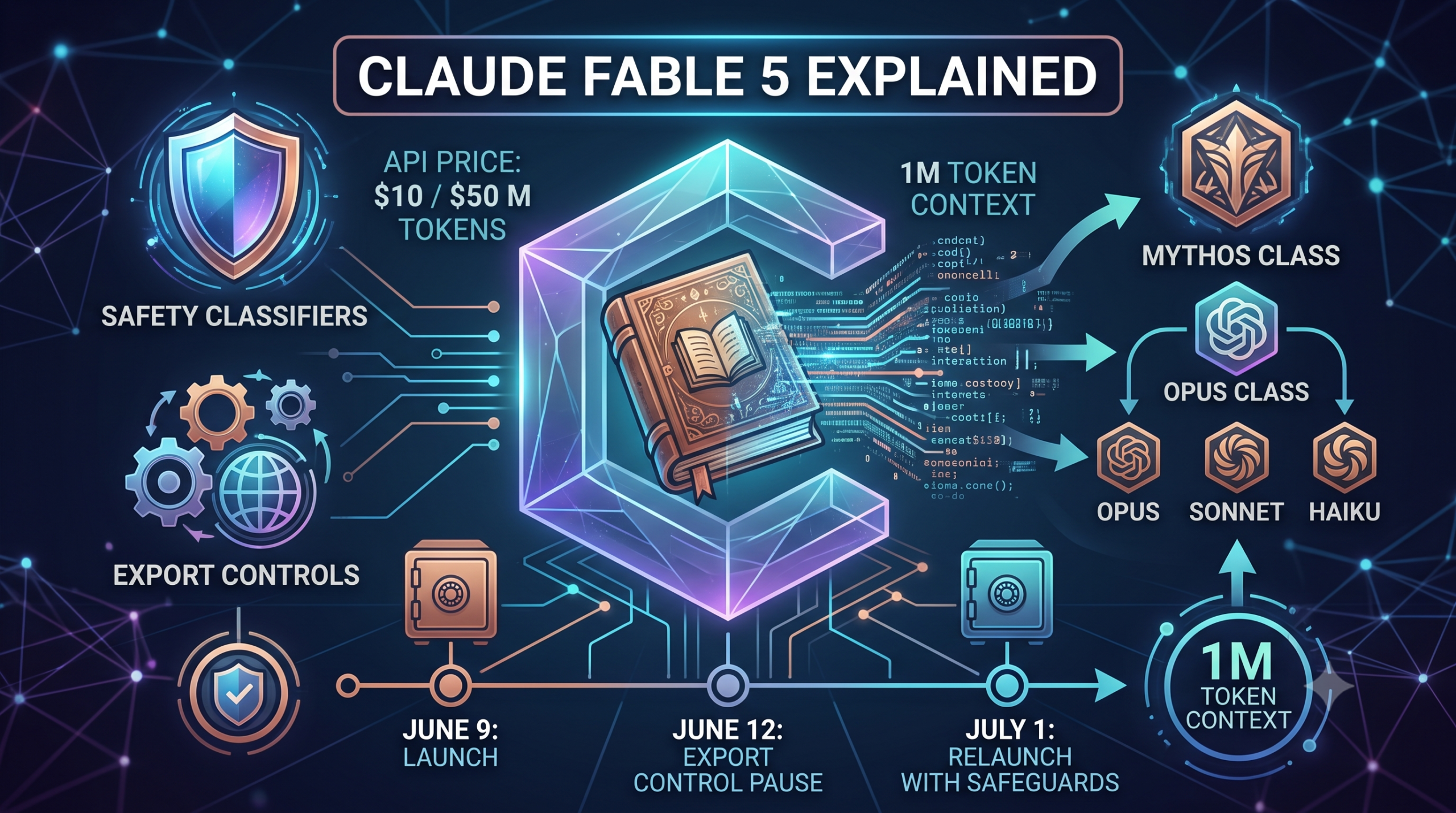
On Friday, June 12, 2026, developers around the world watched a frontier AI model vanish from their tooling in the middle of the workday. Three days earlier, Anthropic had launched Claude Fable 5, the most capable model it had ever made generally available. Then the US government applied export controls, Anthropic pulled access for everyone, and for 19 days the most talked about model in AI simply did not exist for the public. On July 1 it came back. The story of why it left, and what changed before it returned, tells you more about where frontier AI is heading than any benchmark table.
Key Points
- Claude Fable 5 is a Mythos class model, a capability tier Anthropic places above its Opus line, made safe for general use through the strongest safeguards the company has ever shipped.
- Fable 5 and Mythos 5 share one underlying model. The safeguards are the only difference, and that difference is why they carry different names.
- Safety classifiers watch every session. When a request touches offensive cybersecurity, biology and chemistry, or model distillation, the reply is answered by Claude Opus 4.8 instead. Anthropic reports this touches fewer than 5% of sessions.
- The US government applied export controls on June 12 after an Amazon report showed a safeguard bypass. Testing later showed many weaker models could do the same things, and the controls were lifted on June 30.
- Pricing is $10 per million input tokens and $50 per million output tokens, less than half the price of Claude Mythos Preview.
- Anthropic, Amazon, Microsoft, and Google are now drafting a shared framework for scoring how severe an AI jailbreak actually is.
What Fable 5 Actually Is
Anthropic has been naming its models Haiku, Sonnet, and Opus for years, a neat ladder of size and capability. Fable 5 does not sit on that ladder. It belongs to a new tier the company calls Mythos class, which sits above Opus. The first Mythos class model, Claude Mythos Preview, never reached the public at all. It went only to a small group of cyber defenders and infrastructure providers through a government collaboration called Project Glasswing back in April 2026.
Fable 5 is Anthropic’s answer to an awkward question. What do you do when your best model is too dangerous to hand out, but too useful to lock away? The company’s solution was to release the same underlying model twice under two names. Claude Mythos 5 goes to vetted partners with fewer restrictions. Claude Fable 5 goes to everyone else, wrapped in the heaviest safeguard system Anthropic has ever built. The launch announcement is unusually direct about this. The names differ because the safeguards differ, and for no other reason.
The name itself is a small linguistic joke. Fable comes from the Latin fabula, that which is told, a cousin of the Greek mythos. Same story, different telling. That is precisely the relationship between the two models.
The Capability Jump, in Concrete Terms
Launch posts always claim state of the art results. What makes Fable 5 worth taking seriously is the specificity of the third party reports. Stripe ran the model against a Ruby codebase of 50 million lines during early testing and reported that a migration expected to take a full team more than two months by hand was completed in a day. Cognition, the company behind the Devin coding agent, measured Fable 5 as the highest scoring frontier model on its FrontierCode evaluation, which checks whether generated code meets production standards rather than merely passing tests.
The pattern across these reports is consistent. The longer and more complex the task, the larger the gap between Fable 5 and everything else. Hebbia measured the strongest score it had seen on its finance benchmark for senior level reasoning. Hex reported the first model to pass 90% on its analytics suite of long running tasks, a ten point jump over Opus. On the vision side, Anthropic showed the model beating Pokemon FireRed using nothing but raw screenshots, where earlier Claude models needed elaborate helper harnesses to play at all.
Fable 5’s capabilities exceed those of any model we’ve ever made generally available.Anthropic launch announcement, June 9, 2026
Memory is the quieter headline. Anthropic reports the model stays coherent across millions of tokens and actively improves its own outputs using notes it writes to files. In an internal test with the deck building game Slay the Spire, giving Fable 5 persistent file based memory improved its performance three times more than the same setup improved Opus 4.8. For anyone building agents, that number matters more than any leaderboard. It suggests the model knows how to use memory, not merely hold context. If you are experimenting with agents yourself, our guide on how to create an AI agent for your website covers the architecture that features like this plug into.
How the Safeguards Actually Work
This is the part most coverage skips, and it is the most interesting engineering in the whole release. Fable 5 does not simply refuse dangerous requests. It runs behind a set of classifiers, which are smaller separate AI systems that inspect every interaction. When a classifier detects a request in one of three areas, the request is not refused. It is silently rerouted and answered by Claude Opus 4.8, the next most capable model, and the user is told this happened.
The three covered areas are offensive cybersecurity, biology and chemistry, and distillation, which means large scale attempts to extract the model’s capabilities to train a competitor. Anthropic reports that more than 95% of sessions never trigger any fallback, so for most people Fable 5 performs identically to the unrestricted Mythos 5.
The design philosophy has a name, defense in depth, and a deliberate cost. Anthropic tuned the classifiers with what it calls a safety margin. A request has to look clearly safe to avoid triggering them, which means some perfectly benign requests get caught. The company chose to ship with too many false positives rather than too few true negatives, and said so plainly. That honesty turned out to matter a great deal three days after launch.
Nineteen Days of Silence. The Timeline
- June 9, 2026Fable 5 and Mythos 5 launch. Fable is available to everyone, Mythos only to Project Glasswing partners.
- June 12, 2026The US government applies export controls after learning of an Amazon research report describing a technique that bypassed Fable 5’s safeguards. The order restricts access for foreign nationals and takes effect immediately. With no way to verify nationality in real time, Anthropic suspends both models for all users worldwide.
- June 12 to 26Anthropic, Amazon, and government researchers review the evidence. A new classifier targeting the reported technique is trained and validated. Researchers from the Commerce Department’s Center for AI Standards and Innovation test both old and new safeguards.
- June 26, 2026The government approves restored Mythos 5 access for a set of US organizations.
- June 30, 2026Export controls on both models are lifted.
- July 1, 2026Fable 5 returns globally on the Claude Platform, Claude.ai, Claude Code, and Claude Cowork, with the improved classifier in place.
What did the Amazon report actually find? According to Anthropic’s redeployment post, researchers prompted Fable 5 in a way that got it to identify several software vulnerabilities, and in one case to produce demonstration code for exploiting one of them. That sounds alarming until you read the comparison testing. Anthropic found that many less capable models could identify the same vulnerabilities, including Opus 4.8, GPT-5.5, and Kimi K2.7. The single exploit demonstration was reproducible on every model tested, all the way down to Claude Haiku 4.5.
In other words, the bypass unlocked behavior that was already available from the wider model ecosystem, including from models with no blocking cyber safeguards at all. It intruded into the safety margin, the zone of cautious overblocking, rather than into unique Mythos level capability. The government acted on the report before that analysis existed, which is understandable, and lifted the controls once it did. Whether a 19 day global suspension was the right instrument for a borderline finding is a question the industry will be arguing about for a while.
A Common Yardstick for Jailbreaks
The most consequential outcome of the pause may be a scoring rubric. Anthropic is now drafting a consensus framework with Amazon, Microsoft, Google, and other Glasswing partners to grade any discovered jailbreak on four criteria. Capability gain asks how far beyond existing public tools the jailbreak takes an attacker. Breadth asks how many distinct offensive tasks the same technique unlocks. Ease of weaponization asks how much skilled effort it takes to turn the finding into an attack. Discoverability asks how likely others are to find the same technique.
The analogy the industry is reaching for is CVSS, the common scoring system that security teams have used for software vulnerabilities for two decades. Had such a framework existed in June, the Amazon finding would likely have scored low on capability gain and breadth, and the response could have been a classifier update rather than a global shutdown. Anthropic has also opened a HackerOne program where researchers can submit cyber jailbreaks for Fable 5 directly, with a team monitoring submissions around the clock.
Pricing, Access, and the Fine Print
| Item | Detail |
|---|---|
| API pricing | $10 per million input tokens, $50 per million output tokens |
| Relative cost | Less than half the price of Claude Mythos Preview |
| Context window | 1 million tokens by default, with up to 128k output tokens per request |
| Model identifier | claude-fable-5 on the Claude API |
| Subscription access | Included for up to 50% of weekly limits on Pro, Max, Team, and select Enterprise plans through July 7, then available via usage credits |
| Classifier fallback | Flagged requests answered by Claude Opus 4.8, fewer than 5% of sessions on average |
| Data retention | 30 day retention required on all Mythos class traffic, not used for training, deleted after 30 days in almost all cases |
| Cloud availability | Claude Platform and first party apps first, AWS, Google Cloud, and Microsoft Foundry re enabling after relaunch |
Two details deserve attention. First, the data retention change is real and applies to business traffic on all Mythos class models, including through cloud providers. Anthropic frames it as a defense measure against novel attacks spread across many requests, promises the data is never used for training, and logs all human access. If your organization has strict data residency rules, this is the line to review with your compliance team before switching workloads over.
Second, subscription access is deliberately staged. Anthropic expects demand to outstrip capacity and says so openly, which is at least more candid than silently throttling. Developers on the API get full access immediately. For a broader look at where tools like this fit in a working stack, our roundup of the best AI tools to build a full website shows how quickly the agentic tier of the market is moving.
Calling Fable 5 From Code
The model is a drop in replacement on the Claude API. The one new behavior worth handling is the classifier fallback, which the API surfaces so your application can know when Opus 4.8 answered instead. A minimal Python example follows.
# pip install anthropic
import anthropic

client = anthropic.Anthropic()  # reads ANTHROPIC_API_KEY from env

response = client.messages.create(
    model="claude-fable-5",
    max_tokens=2048,
    messages=[
        {"role": "user",
         "content": "Review this architecture and suggest a migration plan..."}
    ],
)

# The response carries the model that actually answered.
# If a safety classifier triggered, this will be an Opus 4.8 identifier.
print(response.model)
print(response.content[0].text)

# Practical pattern. Log fallbacks so you can measure how often
# your real workload touches the safeguards (expect under 5%).
if "fable" not in response.model:
    log_fallback(prompt_id, response.model)
Honest Limitations
Fable 5 ships with real friction, and Anthropic admits most of it. The classifiers overblock by design, so developers doing legitimate security research, malware analysis, or even some routine debugging will hit fallbacks to Opus 4.8, and the new classifier added after the Amazon report flags benign coding requests more often than the launch version did. The biology and chemistry coverage is broad enough that ordinary biomedical questions can be rerouted, which is why a trusted access program for researchers is being set up. The 30 day retention requirement will be a hard no for some enterprises regardless of the privacy protections attached. Subscription users face shifting inclusion windows that depend on capacity. And the UK AI Security Institute made progress toward a universal jailbreak during a brief testing window, a reminder that no safeguard system is permanent. These are the tradeoffs of shipping a Mythos class model to the public at all, and reasonable people will weigh them differently.
Conclusion
The core achievement of Fable 5 is not any single benchmark. It is the demonstration that a company can take a model it considers too dangerous to release unguarded and still get its capabilities into millions of hands within months, by treating safeguards as a product surface rather than an afterthought. The same weights power both Fable and Mythos. Everything that differs is policy, expressed in classifiers.
The conceptual shift is worth sitting with. For years the release question was binary, ship the model or do not ship it. Fable 5 makes the question continuous. How much capability do you route around, for whom, and with what fallback? Anthropic’s answer, reroute under 5% of sessions to a slightly weaker model, will not be the last word, but it establishes that the dial exists.
The transferability is obvious and already happening. The jailbreak severity framework being drafted with Amazon, Microsoft, and Google is a template any frontier lab can adopt, and the CVSS comparison suggests where it lands eventually, in boring, standardized, load bearing infrastructure. Boring is what security looks like when it works.
The open questions are equally clear. The export control episode showed that a single ambiguous research report can take a global product offline for weeks, because neither industry nor government had a shared way to judge severity. That gap is closing, but it is not closed. And the arms race between classifier and jailbreak has no finish line. Anthropic says its goal is not perfection but making attacks slow and costly enough to catch. Time will grade that claim.
For readers of this site, the practical advice is simple. If your work involves long horizon coding, document heavy analysis, or agents that need to remember what they did an hour ago, Fable 5 is currently the strongest tool you can rent for $10 per million input tokens. The model that was briefly too capable to exist in public is now a line item in your API bill. That sentence would have read as science fiction two years ago. It is a Tuesday in 2026.
Frequently Asked Questions
What is Claude Fable 5?
Claude Fable 5 is Anthropic’s Mythos class AI model made safe for general use. It shares the same underlying model as Claude Mythos 5 but adds strong safety classifiers, and it leads nearly all tested benchmarks in coding, knowledge work, and vision.
Why was Claude Fable 5 suspended?
The US government applied export controls on June 12, 2026 after an Amazon report showed a technique that bypassed some safeguards. Anthropic suspended access worldwide, added an improved classifier, and the controls were lifted on June 30.
How much does Claude Fable 5 cost?
Fable 5 costs $10 per million input tokens and $50 per million output tokens on the Claude API, which is less than half the price of Claude Mythos Preview.
What is the difference between Fable 5 and Mythos 5?
They are the same underlying model. Fable 5 carries full safeguards and is available to everyone. Mythos 5 has some safeguards lifted and goes only to vetted partners such as cyber defenders in Project Glasswing.
What happens when a safety classifier triggers?
The request is answered by Claude Opus 4.8 instead of Fable 5, and the user is informed. Anthropic reports that fewer than 5% of sessions trigger any fallback on average.
Does Claude Fable 5 have a large context window?
Yes. Fable 5 offers a 1 million token context window by default and supports up to 128k output tokens per request, and it is designed to stay focused across very long running tasks.
Sources. Anthropic, “Claude Fable 5 and Claude Mythos 5,” June 9, 2026. Anthropic, “Redeploying Fable 5,” June 30, 2026. Claude Platform model documentation, 2026. This analysis is based on the published announcements and an independent evaluation of their claims.