
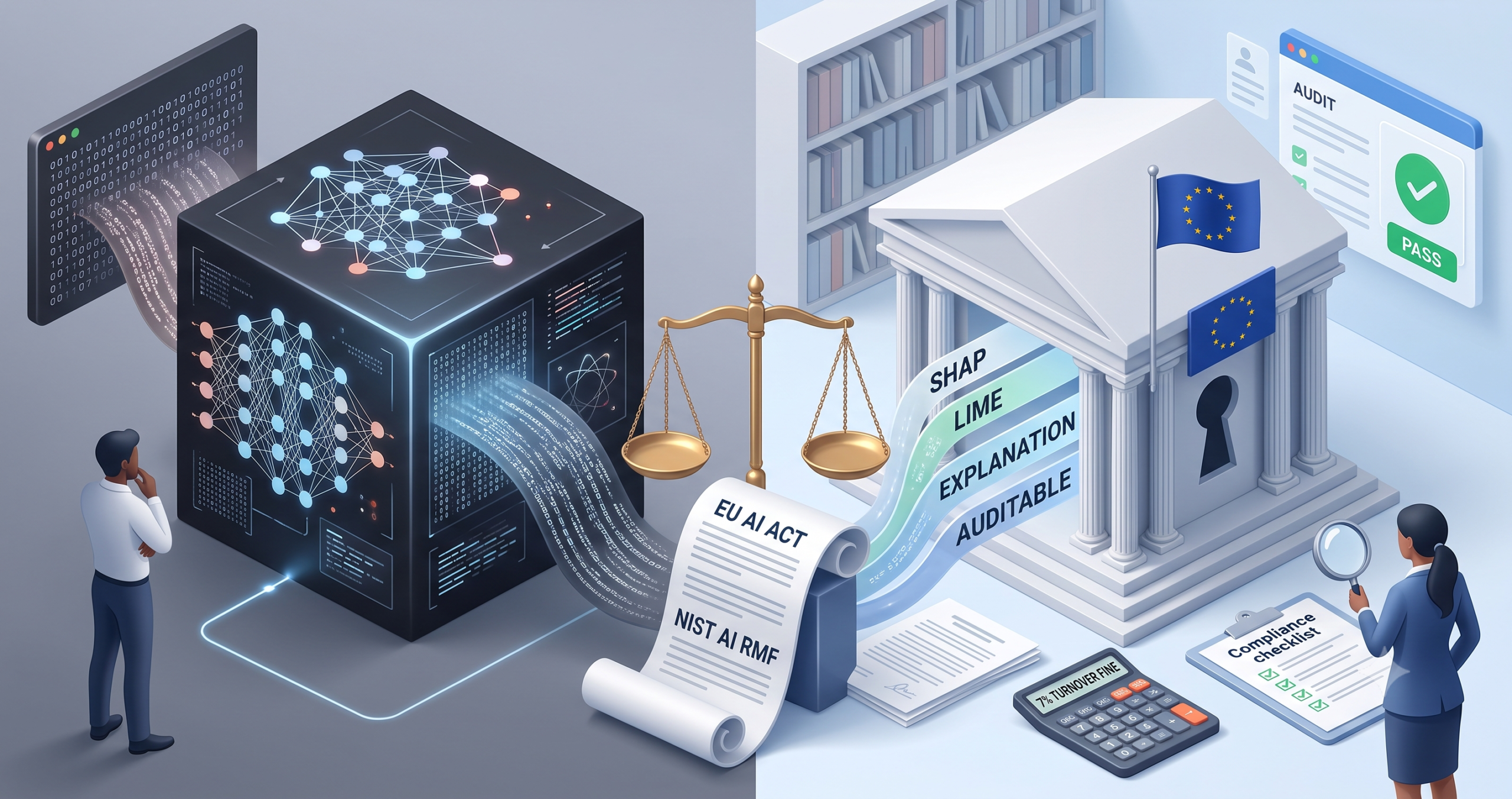
A class action filed in January 2026 accuses the hiring platform Eightfold AI of scoring more than a billion job applicants on a zero to five scale and quietly discarding the low scorers before a human ever opened their resume. What makes the case unusual is what the plaintiffs are not arguing. They are not claiming the scoring was biased. They are claiming the scoring existed in secret, without the disclosures federal law already requires when a company compiles a report used to make an employment decision. That distinction, bias versus secrecy, is the whole story of where AI governance stands in the middle of 2026. Regulators stopped asking whether algorithms are fair a while ago. Now they are asking whether anyone can explain what the algorithm did at all.
Key points
- The EU AI Act’s transparency rules take effect in August 2026, though a Digital Omnibus provisional agreement from May 2026 proposes pushing the main high risk deadline for Annex III systems to December 2027.
- EU AI Act fines reach up to 35 million euros or 7 percent of global turnover for prohibited practices, and up to 15 million euros or 3 percent of turnover for high risk system violations, whichever figure is higher.
- 78 percent of business executives in Grant Thornton’s 2026 AI Impact Survey lack strong confidence they could pass an independent AI governance audit within 90 days.
- A Compliance Week 2026 survey found 83 percent of organizations already using AI tools, while only 25 percent have implemented strong governance frameworks around that use.
- A January 2026 class action against Eightfold AI, brought by former EEOC chair Jenny R. Yang, alleges applicant scoring without required Fair Credit Reporting Act disclosures, not algorithmic bias itself.
- Stanford research from October 2025 found AI resume screening tools rated older male candidates higher than female and younger candidates despite all resumes being built from identical underlying data.
The regulation arrived before most companies were ready
The problem runs deeper than any single lawsuit. For years, explainability in AI was treated as a nice addition, something a data science team might bolt on if a client asked or a conference paper needed a section on interpretability. That changed once regulators started writing explainability into law rather than leaving it to goodwill. The EU AI Act is the clearest example. Its transparency obligations for high risk systems come into force in August 2026, and the penalties attached are not symbolic. Prohibited practices, the small set of AI uses banned outright, already carry fines up to 35 million euros or 7 percent of a company’s total worldwide annual turnover, whichever number is larger. High risk system violations, the category that covers most employment, credit, and biometric applications, carry fines up to 15 million euros or 3 percent of turnover. Providing misleading compliance information carries its own fine tier up to 7.5 million euros or 1 percent of turnover. Prohibited practice rules have been enforceable since February 2025, and general purpose AI model rules since August 2025, so the Act is not a future concern for every company. Parts of it are already live.
Here is where it gets complicated. A Digital Omnibus provisional agreement reached in May 2026 proposes deferring the main high risk obligations for a category called Annex III systems from August 2026 to December 2027. That deferral is not finalized. If it is not formally adopted before the original deadline, the Act’s original timeline applies exactly as written. Companies that assumed the deferral gives them until 2027 and stopped preparing are making a bet on a political process that has not concluded, which is precisely the kind of governance gap this article is about.
What high risk actually requires
High risk AI systems under the Act have to satisfy obligations across risk management, data governance and data quality, technical documentation, record keeping, transparency, human oversight, accuracy, robustness, and cybersecurity. For applications like biometric identification or emotion recognition, explainability specifically means the system has to support a clear, user understandable account of how it reached a given conclusion and which factors drove it, not just a general statement that the system is accurate on average. That is a materially different bar than most machine learning teams have historically built toward, since accuracy on a held out test set says nothing about whether any individual decision can be explained after the fact.
Explainability is not one technique, it is a toolbox
Part of why so many organizations are behind is that explainable AI covers a wider range of methods than the acronym suggests, and picking the wrong one for a given regulatory requirement is its own kind of failure. SHAP and LIME have become the two most widely used interpretability techniques for explaining otherwise opaque models, particularly on tabular data of the kind used in credit scoring, hiring, and insurance underwriting. SHAP assigns each input feature a contribution value grounded in Shapley values from cooperative game theory, giving a mathematically consistent answer to how much each factor mattered for one specific prediction. LIME takes a more empirical approach, perturbing the input and watching how the output shifts, building a local approximation of the model’s behavior around one case at a time. Amazon integrated SHAP directly into SageMaker Autopilot specifically because enterprise customers in regulated industries needed to open up automatically generated models before trusting them in production.
The other major shift in 2026 is renewed interest in models that are interpretable from the start rather than explained after the fact. Decision trees, rule based systems, and hybrid architectures that pair an interpretable front end with a more complex backend are getting a second look specifically because a model that is transparent by design sidesteps a whole category of after the fact explanation disputes. An analysis of the field puts it plainly, 73 percent of organizations using black box models report facing regulatory rejection because the predictions could not be adequately explained to an auditor or regulator. That number is the practical argument for interpretable by design approaches that no amount of clever post hoc explanation tooling fully solves.
What happens when there is no explanation on record
The Eightfold AI case is instructive precisely because it is not a story about a broken algorithm. The complaint alleges the company scraped personal data on over a billion workers, scored applicants on a zero to five scale, and discarded low scoring candidates before any human reviewed them, all without the disclosures the Fair Credit Reporting Act requires when a company compiles what regulators call a consumer report for employment purposes. The lawsuit was brought by former EEOC chair Jenny R. Yang alongside the nonprofit Towards Justice. Its core claim, again, is not that the scoring was unfair. It is that nobody outside the company could see it happening at all.
A separate and earlier case against Workday, filed by plaintiff Derek Mobley in February 2024, alleges a pattern and practice of discrimination based on race, age, and disability running through the company’s AI enabled applicant screening. The EEOC told the court Workday should face those claims. Research has since given the discrimination question its own weight independent of any lawsuit. A VoxDev study published in May 2025 found AI hiring tools systematically favored female applicants over Black male applicants with otherwise identical qualifications. Stanford researchers in October 2025 found AI resume screening tools rated older male candidates higher than both female candidates and younger candidates, even though every resume in the test was generated from the exact same underlying data. Neither study needed a lawsuit to demonstrate the problem. Both simply ran controlled comparisons and reported what came out.
| Case or study | Core allegation or finding | Status as of mid 2026 |
|---|---|---|
| Eightfold AI class action | Applicant scoring at scale without required FCRA disclosures | Filed January 2026, ongoing |
| Mobley v Workday | Pattern and practice discrimination by race, age, and disability in AI screening | Filed February 2024, EEOC supports claims proceeding |
| VoxDev hiring research | AI tools favored female applicants over Black male applicants with equal qualifications | Published May 2025 |
| Stanford resume screening study | Older male candidates rated higher than female and younger candidates on identical data | Published October 2025 |
The governance maturity gap behind the headlines
None of this would matter as much if governance practice were catching up quickly. It is not, at least not yet. Grant Thornton’s 2026 AI Impact Survey found 78 percent of business executives lack strong confidence they could pass an independent AI governance audit within 90 days. A Compliance Week 2026 survey found 83 percent of organizations already using AI tools in production, while only 25 percent have implemented what the survey calls strong governance frameworks around that use. Broader responsible AI maturity research puts only about 30 percent of organizations at a maturity level of three or higher specifically on strategy, governance, and controls for agentic AI systems, even as adoption of those same systems keeps climbing. Adoption is not the bottleneck anymore. Governance capacity is.
Some of the gap is being closed by voluntary frameworks that are becoming operationally mandatory through side doors rather than direct law. The NIST AI Risk Management Framework remains voluntary at the federal level in the United States, but federal agencies and contractors are required to align with it, and Colorado’s AI Act makes NIST AI RMF or ISO or IEC 42001 alignment an affirmative defense against liability for AI related harm, which gives every company operating in Colorado a direct legal incentive to adopt a framework that carries no formal legal mandate on its own. The Treasury Department released a Financial Services AI RMF in February 2026 that translates NIST’s general principles into 230 specific control objectives for banks and other financial institutions, and NIST itself released a concept note in April 2026 for a Trustworthy AI profile aimed at critical infrastructure operators. The pattern across all of these is the same. Governance frameworks that started as guidance are becoming the practical floor for avoiding liability, whether or not a specific law forces adoption directly.
A practical governance checklist teams are actually using
- Map every AI system that touches a hiring, credit, insurance, or biometric decision against the EU AI Act’s high risk category, regardless of whether your company operates in Europe, since similar categories are appearing in US state laws like California’s ADS regulations and Colorado’s AI Act.
- Choose an explainability method that matches the decision type. SHAP and LIME work well for explaining existing tabular models after the fact. An interpretable by design model, such as a constrained decision tree, avoids the explanation dispute entirely for the highest stakes decisions.
- Adopt NIST AI RMF or ISO or IEC 42001 even where neither is legally mandated, since jurisdictions like Colorado already treat documented alignment with a recognized framework as an affirmative legal defense.
- Run a mock governance audit before a regulator or plaintiff’s attorney does one. With 78 percent of executives lacking confidence they could pass a 90 day audit today, a rehearsal is the fastest way to find the gap while it is still cheap to close.
- Document the human oversight step for every high risk decision explicitly, not just the model’s accuracy metrics, since the Eightfold and Workday cases both center on process and disclosure rather than on whether the underlying model was technically accurate.
The honest limitations in this picture
Regulatory timelines are unusually unsettled right now, and this analysis reflects the state of play as of mid 2026 rather than a settled outcome. The Digital Omnibus deferral for high risk obligations is provisional, not adopted law, and could be finalized, rejected, or amended before the original August 2026 deadline arrives. The 73 percent regulatory rejection figure for black box models comes from an industry analysis rather than a peer reviewed study, and should be read as a directional signal about enterprise pain rather than a precise population estimate. The Eightfold AI and Workday cases are both active litigation, and the allegations in a complaint are not findings of fact until a court rules on them, so this piece describes what plaintiffs allege rather than what has been legally proven. The VoxDev and Stanford research findings on hiring bias are strong within their study designs, but hiring algorithm behavior can vary significantly across vendors, industries, and specific job categories, so a finding about one tool or one controlled study should not be read as a claim about every AI hiring product on the market.
Conclusion
The shift from 2024 to 2026 is not that AI got less capable or more biased. It is that the bar for acceptable use moved from does it work to can you explain what it did, and a lot of production systems were built for the first bar without any plan for the second. That gap is now showing up in fines, class actions, and audit failures rather than staying a theoretical concern raised in ethics papers.
The conceptual shift underneath all of this is that explainability stopped being a technical feature and became a governance requirement with real financial consequences attached. A SHAP value or a LIME approximation used to be something a data scientist added to a slide deck to build internal confidence. Now it is closer to evidence a company may need to produce if a regulator or a plaintiff’s attorney asks how a specific decision got made. That reframing changes which techniques get prioritized, favoring methods that produce a clear, individually traceable explanation over methods that only describe average model behavior.
This pattern will not stay confined to hiring and credit decisions. Any domain where an automated system makes or heavily influences a decision about a person, healthcare triage, insurance pricing, content moderation, benefits eligibility, is likely to face the same fork between explainable and unexplainable systems that hiring is facing right now, just on a different regulatory timeline. Teams building in those adjacent domains should expect the Eightfold and Workday playbook, disclosure failures and process gaps rather than pure bias claims, to reach their sector eventually.
None of this argues for abandoning AI assisted decision making. The honest reading of the governance maturity data, 78 percent of executives lacking audit confidence and only 25 percent of organizations with strong governance frameworks in place, is not that AI should be pulled back. It is that the tooling and process side of AI adoption has lagged badly behind the deployment side, and that gap is now the single largest source of legal and reputational risk in this space, larger at this point than most of the model accuracy concerns that dominated the conversation a few years ago.
The realistic path forward looks a lot like the practical checklist above, treated as permanent infrastructure rather than a one time compliance project. Map the high risk systems, pick the right explanation method for each decision type, adopt a recognized governance framework even where it remains technically voluntary, and rehearse the audit before someone else forces the rehearsal. Companies that treat explainability as core infrastructure rather than a legal afterthought will spend 2027 defending their track record. The ones that do not will spend it explaining, for the first time and under far worse conditions, exactly what their algorithm did.
Frequently asked questions
When do the EU AI Act’s explainability requirements actually take effect?
Transparency rules take effect in August 2026. A Digital Omnibus provisional agreement from May 2026 proposes deferring the main high risk deadline for Annex III systems to December 2027, but this deferral has not been formally adopted, and the original 2026 deadline applies unless and until it is.
How large are the fines under the EU AI Act?
Prohibited practices carry fines up to 35 million euros or 7 percent of a company’s total worldwide annual turnover, whichever is higher. High risk system violations carry fines up to 15 million euros or 3 percent of turnover. Providing misleading compliance information carries fines up to 7.5 million euros or 1 percent of turnover.
What is the difference between SHAP, LIME, and interpretable by design models?
SHAP and LIME are both post hoc techniques that explain an existing black box model after training, with SHAP using Shapley value based attributions and LIME using local perturbation of inputs. Interpretable by design models, such as constrained decision trees or rule based systems, are built to be transparent from the start rather than explained afterward, which avoids many disputes over whether a post hoc explanation is accurate.
What is the Eightfold AI lawsuit actually alleging?
The January 2026 class action alleges Eightfold AI scored more than a billion job applicants on a zero to five scale and discarded low scoring candidates before human review, without the disclosures the Fair Credit Reporting Act requires for employment related consumer reports. The suit does not allege the scoring itself was biased, only that it operated without required disclosure.
Are companies actually ready for these AI governance requirements?
Not yet, according to current survey data. Grant Thornton’s 2026 AI Impact Survey found 78 percent of executives lack strong confidence they could pass an independent AI governance audit within 90 days, and a Compliance Week 2026 survey found 83 percent of organizations use AI tools while only 25 percent have strong governance frameworks in place.
Is the NIST AI Risk Management Framework legally required?
It remains voluntary at the federal level for most private companies, though federal agencies and contractors are required to align with it. Some states create indirect legal pressure to adopt it anyway, such as Colorado’s AI Act, which treats documented alignment with NIST AI RMF or ISO or IEC 42001 as an affirmative defense against liability for AI related harm.
Read the primary regulatory and research sources behind this analysis.
Sources referenced in this analysis include the EU Artificial Intelligence Act and its official summary and article texts, NIST’s AI Risk Management Framework, Grant Thornton’s 2026 AI Impact Survey, Compliance Week’s 2026 governance survey coverage, court filings and legal reporting on the Eightfold AI and Mobley v Workday cases, VoxDev’s May 2025 hiring bias research, and Stanford’s October 2025 resume screening study. This analysis is based on the published research, regulatory text, and litigation reporting and an independent evaluation of its implications. It is not legal advice.