
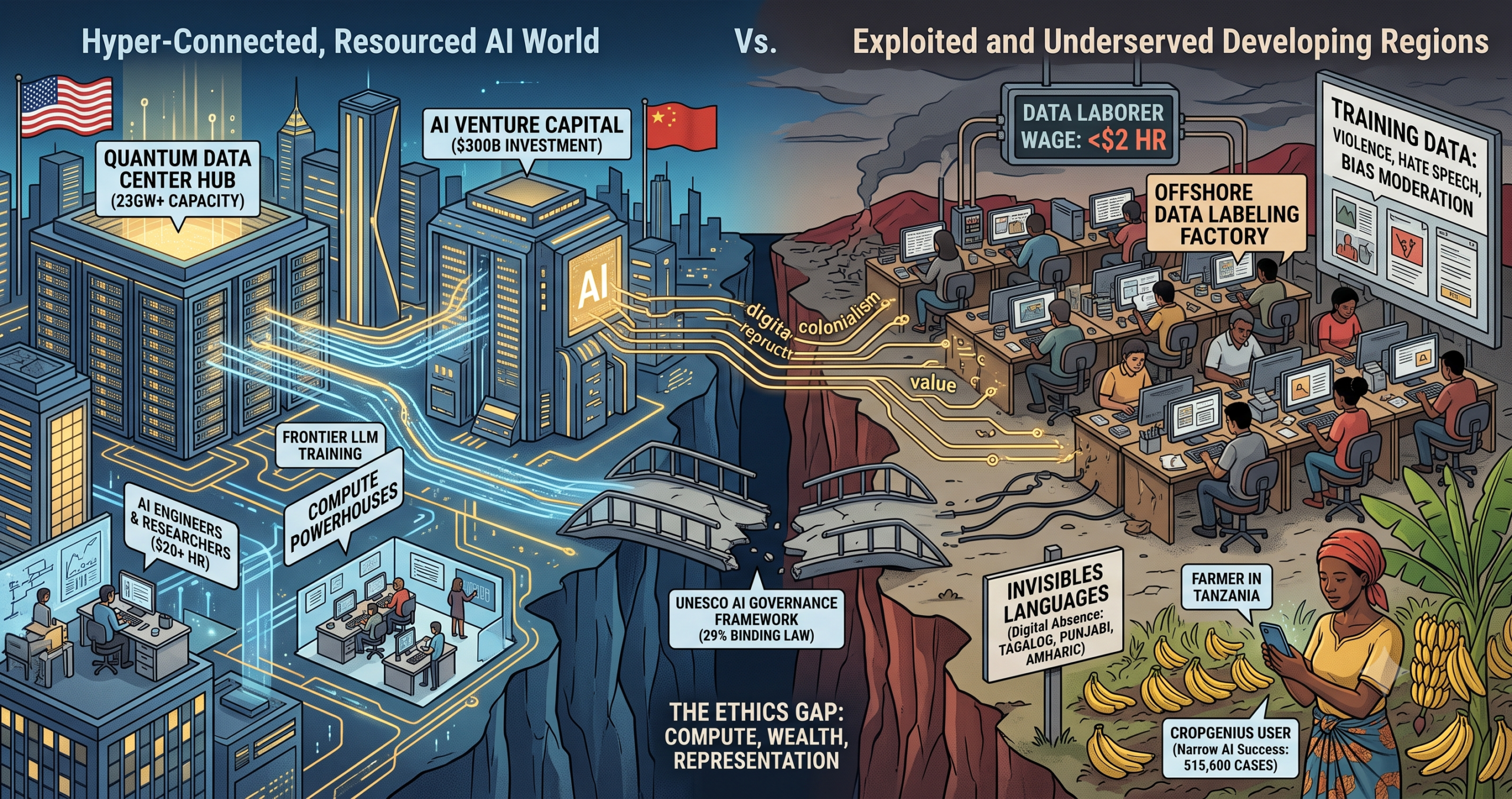
A farmer in the Southern Highlands of Tanzania points her phone camera at a diseased banana leaf and gets an answer in seconds. A content reviewer in Nairobi spends nine hours a day watching the worst material the internet produces so a chatbot in San Francisco never has to see it, for pay that comes out under two dollars an hour. Both of these people are part of the same global AI economy in 2026. One story gets told at AI conferences. The other mostly does not, and that asymmetry is the actual subject of this piece.
Key points
- The United States drew 285.9 billion dollars in private AI investment in 2025, 23.1 times China’s 12.4 billion, while all of Africa attracted an estimated 2 to 3 billion dollars, roughly 1 to 1.5 percent of the global total, according to Stanford HAI’s 2026 AI Index and continent level funding trackers.
- Africa holds less than 1 percent of global data center capacity while home to 18 percent of the world’s population, and India generates about one fifth of the world’s data while holding only around 3 percent of global data center capacity.
- Data workers labeling and moderating content for major AI companies in Kenya have reported earning less than 2 dollars an hour, compared to more than 20 dollars an hour for comparable US based work, based on reporting that has continued into 2025 and 2026.
- Fewer than 0.01 percent of Common Crawl web text comes from languages like Tagalog, Punjabi, Kurdish, Lao, and Amharic, and one 2026 analysis classifies 27 percent of the world’s languages as invisible giants, meaning demographically large but digitally absent from AI training data.
- UNESCO’s March 2026 global progress report on its AI ethics recommendation found 67 percent of 113 responding member states have started national AI governance consultations, but only 29 percent have enacted binding AI legislation aligned with the recommendation’s principles.
- CropGenius, an AI crop disease tool deployed across eleven African countries, logged more than 515,600 verified farmer cases between January 2024 and January 2025 with a 96 percent accuracy rate verified across three growing seasons, a concrete counterexample to the idea that AI in the Global South is only extraction.
Two versions of the same technology
The problem runs deeper than a simple story about rich countries building AI and poor countries receiving it. Both halves of that sentence are true and neither is the whole picture. Stanford HAI’s 2026 AI Index puts US private AI investment at 285.9 billion dollars for 2025, more than 23 times China’s 12.4 billion, with California alone accounting for over 75 percent of the US total. Europe as a whole drew 20.9 billion dollars, a fraction of either superpower’s spending. Africa, a continent of 1.4 billion people, drew somewhere between 2 and 3 billion dollars total, concentrated overwhelmingly in four countries, Kenya, South Africa, Egypt, and Nigeria, which together capture more than 72 percent of the continent’s already small share. This is not a gap that a few more startup accelerators will close. It is a structural feature of how compute, capital, and talent currently flow.
Here is where it gets interesting. The compute divide is not just about money, it is physically about where the machines sit. Of 23 gigawatts of data center capacity under construction globally as of September 2025, roughly 75 percent was in the United States. Africa accounts for less than 1 percent of global data center capacity despite representing 18 percent of the world’s population. India presents an even stranger asymmetry, generating around one fifth of the world’s data while holding only about 3 percent of global data center capacity, a country the CSIS think tank has described as data rich but infrastructure poor. When a region does not host the machines, it does not just lose economic value. It loses control over latency, cost, data residency, and increasingly over which languages and use cases get prioritized at all, since training and inference decisions get made wherever the hardware actually lives.
Where the money is starting to move
None of this is static. India’s government committed roughly 1.25 billion dollars to the IndiaAI Mission launched in March 2024, including a plan to make more than 10,000 GPUs accessible to researchers and startups who would otherwise have no path to serious compute. Saudi Arabia’s Public Investment Fund has allocated more than 40 billion dollars across AI models, software, energy, semiconductors, and connectivity. The African Union declared AI a strategic continental priority in 2025, and African tech startups raised 1.44 billion dollars in the first half of 2026 alone, much of it increasingly sourced from local capital rather than foreign venture funds as US investors chase AI returns closer to home. These are real moves, not gestures, but they are being measured in single digit billions against a US figure approaching 300 billion, which is the scale problem underneath every policy announcement in this space.
The human labor nobody puts in the demo
Every large language model that ships with content filters, safety guardrails, and clean training data got that way partly through human labor that rarely appears in a product launch. Data workers in Kenya labeling and moderating content for major AI companies have been reported earning less than 2 dollars an hour, against more than 20 dollars an hour for comparable work performed in the United States. Workers in the Philippines employed to label data for autonomous vehicle systems have reported pay below the local legal minimum wage with no health insurance or paid leave attached. A study interviewing 113 content moderators and data labelers across Colombia, Kenya, and the Philippines documented long shifts without breaks, repeated exposure to violent and disturbing material, unstable schedules with no fixed salary, and financial penalties for workers who took sick leave or missed unrealistic quality targets.
Workers are not staying quiet about this. Kenyan data workers launched the Data Labelers Association to organize around pay, working conditions, and mental health support after repeated exposure to graphic content left lasting psychological effects documented in multiple journalistic investigations. In January 2026, workers at Covalen’s Dublin operations, which provide AI training services for Meta, went on strike demanding union recognition, better pay, and improved leave and redundancy terms, showing this is not purely a lower income country phenomenon but a structural feature of how the entire AI supply chain treats the human labor inside it, wherever that labor happens to sit.
Whose language counts as data
There are roughly 7,000 spoken languages in the world, and most natural language processing research has historically focused on around 20 of them. Only 38 languages exceed the threshold researchers use to count as meaningfully represented in web content. In Common Crawl, one of the largest text sources used to train large language models, languages including Tagalog, Punjabi, Kurdish, Lao, and Amharic each make up less than 0.01 percent of the corpus, compared to English, German, and Russian. Arabic and Hebrew were absent from the distribution tables Meta published for LLaMA2 entirely, meaning their share fell below even the lowest reported threshold. A 2026 linguistic analysis coined a useful term for languages like these, invisible giants, meaning tongues spoken by tens or hundreds of millions of people that are nonetheless almost absent from the data that shapes modern AI. The analysis found 27 percent of the world’s languages fit that description. This is not a natural fact about which languages are hard to process technically. Researchers increasingly describe it as institutionally constructed, a byproduct of where the internet’s text heavy infrastructure historically got built rather than of any property of the languages themselves.
| Measure | Figure | Source |
|---|---|---|
| Share of Common Crawl text in Tagalog, Punjabi, Kurdish, Lao, Amharic combined | Under 0.01 percent each | Cited NLP corpus analysis, 2026 coverage |
| Share of ACL 2021 papers evaluated only in English | 70 percent | ACL research focus analysis |
| Languages classified as invisible giants | 27 percent of world languages | 2026 linguistic representation analysis |
| Member states with binding AI legislation aligned to UNESCO’s ethics recommendation | 29 percent of 113 responding states | UNESCO global progress report, March 2026 |
What governance on paper looks like in practice
UNESCO’s global progress report on its Recommendation on the Ethics of Artificial Intelligence, released in March 2026 and drawing on submissions from 113 member states, shows the same pattern repeated at the policy level. About 67 percent of responding states have started some kind of national AI governance consultation or working group. Only 29 percent have gone further and enacted binding legislation aligned with the recommendation’s core principles around human rights, transparency, and accountability. Fewer than 20 percent have introduced AI literacy programs into primary and secondary education. UNESCO’s own assessment flagged the representation of women and marginalized communities in AI policymaking as a persistent gap, alongside insufficient cooperation across borders on shared AI risk frameworks. A High Level Expert Forum met in June 2026 to push the next implementation cycle forward, and the fourth Global Forum on the Ethics of Artificial Intelligence is scheduled for September 2026 in Riyadh, which puts a concrete date on when the next round of accountability is supposed to arrive.
Where this is actually working
None of the above should read as a case that AI has nothing to offer the countries it currently extracts the most from and invests the least in. CropGenius, an AI powered crop disease and pest identification tool, has been deployed across eleven African countries including Kenya, Tanzania, Uganda, Nigeria, Ghana, Ethiopia, Rwanda, Zambia, Malawi, Zimbabwe, and South Africa. Between January 2024 and January 2025 it logged more than 515,600 verified farmer cases with a 96 percent accuracy rate confirmed across three separate growing seasons. PlantVillage Plus, a comparable tool, serves between 400,000 and 500,000 users monthly across more than 40 countries. Tanzania’s KilimoAI app reached 63,000 farmers by August 2025 with a target of 400,000 by 2030. These tools succeed for a specific reason worth naming directly. They were built around a narrow, well defined problem, identifying a visible plant disease from a photograph, rather than attempting to replicate the broad general purpose capability that consumes the bulk of global AI investment. Narrow, locally deployed AI aimed at a concrete problem local users actually have is where the Global South is seeing measurable returns right now, even while the compute and investment gap in general purpose AI keeps widening.
A practical checklist for evaluating AI for development claims
- Ask who owns the compute and data infrastructure behind any AI for development program, not just who funds the pilot, since infrastructure ownership determines long term control far more than initial grant money does.
- Ask what the people doing the underlying data labeling or content moderation for a given AI product are actually paid, and treat a company’s unwillingness to disclose that figure as itself informative.
- Check whether a language or dialect central to your use case is meaningfully represented in the model’s training data, since a model’s fluency in a market’s dominant colonial language does not imply fluency in that market’s actually spoken languages.
- Favor narrow, well scoped AI tools aimed at a specific verified problem, on the evidence that tools like CropGenius succeed at real scale precisely because they did not try to be general purpose.
- Track your own country’s or sector’s status against UNESCO’s ethics recommendation benchmarks, since the 67 percent versus 29 percent gap between starting a conversation and passing binding law is exactly where accountability currently stalls out.
The honest limitations in this picture
Figures on Africa’s AI investment share and on data worker wages come from a mix of continent level funding trackers, journalistic investigation, and advocacy research rather than from a single audited dataset, so exact percentages should be read as directionally reliable rather than precise to the decimal point. Wage comparisons between countries do not fully account for cost of living differences, though the gap reported, roughly ten to one, is large enough that purchasing power adjustments would narrow it without eliminating it. The language exclusion statistics come from specific corpus snapshots like Common Crawl and specific model families like LLaMA2, and newer models may have meaningfully improved multilingual coverage since those measurements were taken, even if the underlying structural pattern, English and a handful of other languages dominating training data, has not disappeared. UNESCO’s implementation figures rely on self reported member state submissions, which tend to overstate genuine progress rather than understate it, since governments have an incentive to report consultations and working groups as more advanced than binding enforcement actually reflects. The CropGenius and PlantVillage Plus adoption numbers are self reported by the companies operating those platforms and were not independently audited by a third party in the sources reviewed for this piece, though the reported accuracy figures are described as validated across multiple growing seasons rather than a single internal test.
Conclusion
The story this data tells is not one of AI simply skipping the Global South. It is a more specific and more troubling pattern, where the Global South supplies an outsized share of the labor that makes frontier AI possible, in data labeling and content moderation, while receiving a tiny fraction of the investment and compute that AI generates in return. Kenya’s data workers, the invisible giant languages absent from training corpora, and Africa’s 1 percent share of global data center capacity against 18 percent of global population are not three separate problems. They are the same asymmetry showing up in labor markets, in linguistics, and in physical infrastructure.
The conceptual shift worth naming is that this asymmetry is not an accident of geography or a temporary lag that better internet infrastructure will eventually close on its own. Researchers studying language exclusion increasingly describe resource scarcity as institutionally constructed rather than inherent, meaning the choices about where to build data centers, which languages to prioritize in training corpora, and how much to pay data labeling workers are decisions made by specific companies and governments, not natural facts about the world. That reframing matters because it means the gap is addressable through policy and investment choices, not just through waiting for markets to correct themselves.
The UNESCO implementation numbers, 67 percent starting a conversation and only 29 percent passing binding law, describe a familiar pattern in global technology governance generally, not something unique to AI. Early stage attention is cheap. Binding accountability that touches revenue, hiring practices, and infrastructure investment is expensive and slow, and the gap between those two stages is where most technology governance efforts have historically stalled, from data privacy to platform content moderation before this. AI governance appears to be following the same curve, just compressed into a shorter timeframe given how quickly the underlying technology is moving.
What makes this moment different from prior technology cycles is that there is now a visible counterexample sitting inside the same data. CropGenius and PlantVillage Plus did not wait for the global compute gap to close before delivering real, measured value to hundreds of thousands of farmers. They built narrow tools for specific, verifiable problems using whatever infrastructure was actually available, and the results show up in independently trackable case numbers rather than in investment totals. That is a template other sectors, from healthcare diagnostics to local language education tools, can follow without needing the Global South’s compute share to first reach parity with the United States or China.
The realistic path forward is not a single global fix but a combination of pressures moving at once, worker organizing that is already raising wages and conditions in specific companies, governance frameworks that convert consultations into binding law over the next several implementation cycles, and a growing body of evidence that narrow, well targeted AI tools can deliver real value without requiring the compute budgets that dominate headlines. None of that closes the 23 times investment gap between the US and China, let alone the much larger gap between either country and Africa, by itself. But it does mean the story of AI in global development is not simply one of extraction with no counterweight. The counterweight exists, it is measurable, and it is currently much smaller than the problem it is responding to.
Frequently asked questions
How big is the AI investment gap between rich and poor countries?
Very large. Stanford HAI’s 2026 AI Index puts US private AI investment at 285.9 billion dollars for 2025 against China’s 12.4 billion, while Africa as a whole, home to 1.4 billion people, drew an estimated 2 to 3 billion dollars, roughly 1 to 1.5 percent of global AI investment.
How much are AI data labeling workers actually paid?
Reporting on Kenyan data workers labeling and moderating content for major AI companies has found pay of less than 2 dollars an hour, compared to more than 20 dollars an hour for comparable work in the United States. Workers in the Philippines doing similar labeling for autonomous vehicle systems have reported pay below the local legal minimum wage with no health insurance or paid leave.
Why are so many languages missing from AI training data?
Large language models are trained mostly on web text, and web content itself is heavily concentrated in a small number of languages. Languages including Tagalog, Punjabi, Kurdish, Lao, and Amharic each make up less than 0.01 percent of Common Crawl, a major training text source, and a 2026 analysis found 27 percent of the world’s languages qualify as invisible giants, meaning demographically large but digitally almost absent.
Is any country actually closing the AI governance gap UNESCO identified?
Progress is uneven. UNESCO’s March 2026 global report found 67 percent of 113 responding member states have started AI governance consultations, but only 29 percent have passed binding legislation aligned with the recommendation’s principles, and fewer than 20 percent have introduced AI literacy education programs.
Are there real success stories for AI in the Global South, or is it only extraction?
There are genuine successes, particularly in narrowly scoped tools. CropGenius, an AI crop disease detection tool used across eleven African countries, logged over 515,600 verified farmer cases between January 2024 and January 2025 with 96 percent accuracy verified across three growing seasons, showing that focused, well targeted AI tools can deliver measurable value without requiring the compute budgets that dominate general purpose AI investment.
What can organizations do to build more equitable AI for global markets?
Practical steps include verifying who owns the underlying compute and data infrastructure in any development program, asking what data labeling workers are actually paid, confirming a target market’s actually spoken languages are represented in training data, favoring narrow well scoped tools over general purpose ambitions, and tracking governance commitments against binding legal benchmarks rather than early stage consultations alone.
Read the primary research and policy sources behind this analysis.
Sources referenced in this analysis include Stanford HAI’s 2026 AI Index Report, CSIS analysis on AI and the Global South, Brookings research on the global AI divide and on data and AI labor conditions, UNESCO’s March 2026 global progress report on its Recommendation on the Ethics of Artificial Intelligence, published corpus analyses of language representation in Common Crawl and LLaMA2, and reporting on CropGenius, PlantVillage Plus, and KilimoAI farmer adoption figures. This analysis is based on the published research, policy documents, and reporting cited and an independent evaluation of their implications.