
Somewhere this week a marketer opened six browser tabs, one for each AI video tool a colleague swore by, and closed all six an hour later no closer to a decision. That confusion is reasonable right now. The tool that dominated headlines eighteen months ago, OpenAI’s Sora, is being wound down, its web and app experiences discontinued in April 2026 and its API following in September. Meanwhile a Chinese lab most marketers had never heard of two years ago is sitting at or near the top of independent quality leaderboards. This is not a market with one obvious winner. It is a market where the right answer depends entirely on what you are actually trying to make.
Key points
- OpenAI discontinued the Sora web and app experiences in April 2026, with the API following in September 2026, removing what was once the default answer to this question entirely.
- Kling 3.0 holds a leading Elo score on the Artificial Analysis video arena leaderboard and is the only major model offering native 4K output, at a price around 0.84 dollars for a ten second clip with audio.
- Veo 3.1 remains the strongest option for native audio, generating dialogue, sound effects, and ambient noise in a single pass, but costs meaningfully more, with Google AI Ultra priced at 249.99 dollars a month.
- Runway Gen-4.5 offers the most complete professional editing workspace, at 12 dollars a month for the standard plan with 625 monthly credits, rising to 28 dollars for the pro tier.
- Hailuo, MiniMax’s video model, delivers the most output per dollar at roughly 0.07 dollars per second, making it the cheapest tool that still produces genuinely usable results.
- None of these tools compete directly with HeyGen, which has built its business around talking avatar video and lip synced translation across more than 175 languages rather than cinematic generation.
Why this comparison keeps changing under your feet
The problem runs deeper than picking a favorite. AI video generation is one of the fastest moving corners of the entire AI market, and the tool that was the obvious answer in early 2025 may not exist by the time you read a review of it. Sora is the clearest example. OpenAI announced in March 2026 that the Sora web and app experiences would be discontinued on April 26, 2026, with the API following on September 24, 2026. A tool that once set the standard for what text to video generation could do is now a case study in how quickly this market turns over rather than a live recommendation. Any comparison that does not account for that churn is already out of date the day it publishes.
Here is where it gets interesting. The vacuum Sora left did not get filled by a single successor. It got filled by at least six tools that each do a genuinely different job well, and picking between them now requires knowing your actual use case rather than just asking which one is best in the abstract. A wedding videographer, an indie game studio cutting a trailer, and a marketing team localizing an ad into nine languages are not shopping for the same tool even though all three might describe their need as AI video generation.
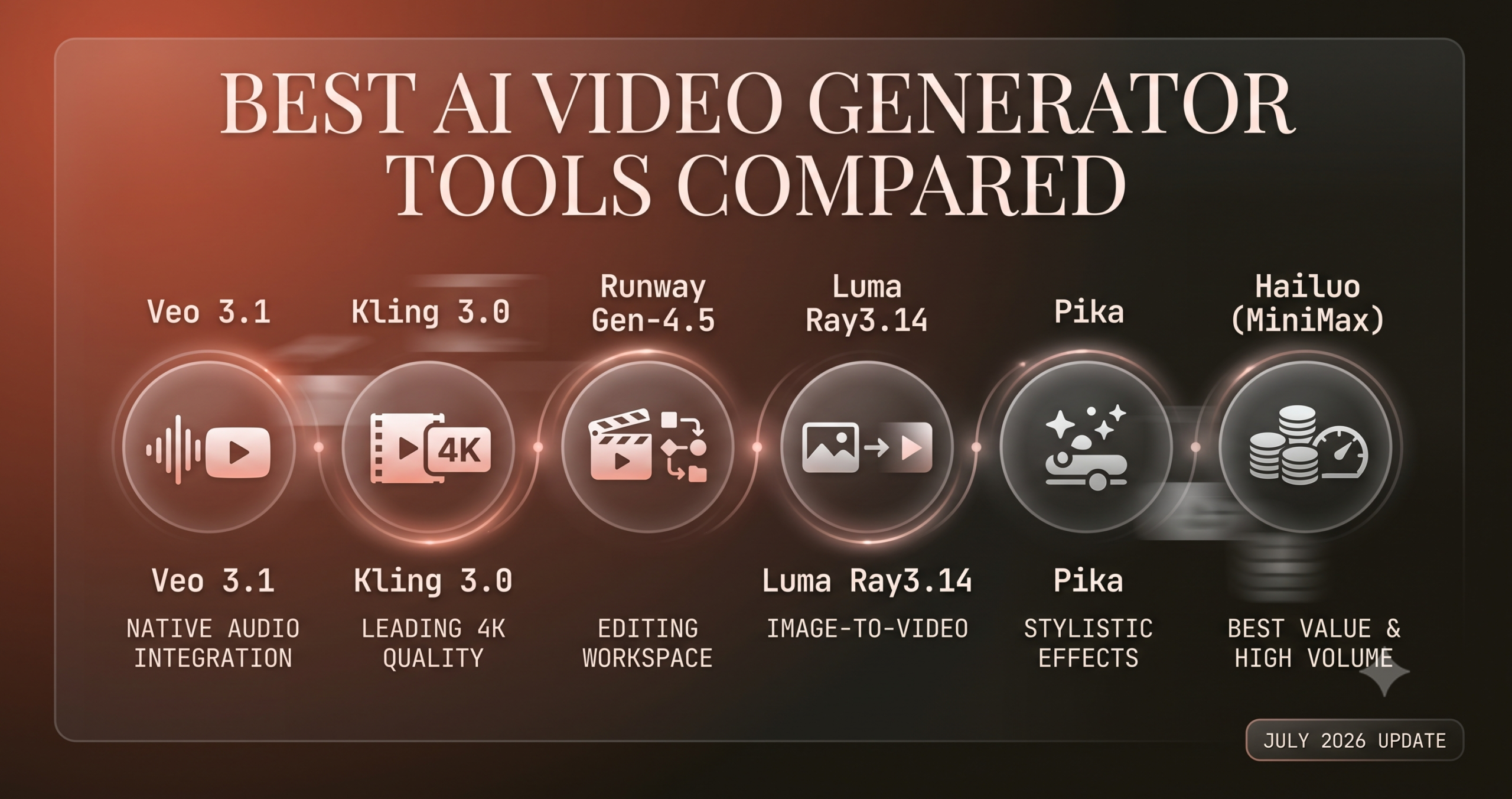
The six tools that actually matter right now
| Tool | Standout strength | Starting price | Best for |
|---|---|---|---|
| Veo 3.1 (Google) | Native audio, dialogue, and sound effects in one pass | 249.99 dollars a month for AI Ultra, or 0.40 dollars per second by API | Cinematic clips where sound design matters as much as picture |
| Kling 3.0 | Native 4K, leading Elo score, multi shot storyboarding | 6.99 dollars a month entry tier, about 0.84 dollars per ten second clip with audio | Photorealistic motion and highest quality per dollar |
| Runway Gen-4.5 | Full editing workspace and professional workflow control | 12 dollars a month standard, 28 dollars a month pro | Teams that need a complete production suite, not just a generator |
| Luma Ray3.14 | Fast concepting and strong image to video reasoning | 7.99 dollars a month for the Lite tier | Starting from a reference image or controlled concept frame |
| Pika | Pikascenes, Pikaswaps, and effect focused creative tools | 8 dollars a month | Stylized, effect heavy social content rather than realism |
| Hailuo, MiniMax | Lowest cost per second with usable output quality | About 8 dollars a month, roughly 0.07 dollars per second | High volume, budget constrained short form content |
Veo 3.1 still owns the sound
Google’s Veo 3.1 remains the only major model that treats audio as a first class output rather than an afterthought, generating dialogue, ambient noise, and sound effects in the same pass as the visual. On the Artificial Analysis text to video leaderboard, Veo 3 posted an Elo rating around 1217, competitive with the field’s leaders even before accounting for its audio advantage. The catch is price. Google AI Ultra runs 249.99 dollars a month for full access, and API pricing at 0.40 dollars per second adds up fast on any project longer than a few clips. Veo earns its premium on projects where synchronized sound is not optional.
Kling 3.0 is the value and quality leader at once
Kling, from the Chinese company Kuaishou, has quietly become the tool independent benchmarks rate most highly. Kling 3.0 1080p Pro posted an Elo near 1248 on the no audio leaderboard, among the top scores tracked, and it is the only model in this comparison offering native 4K output. It also pioneered multi shot storyboard sequences, letting a single prompt chain generate a sequence of connected shots rather than one isolated clip. Pricing starts at 6.99 dollars a month, with a roughly 0.84 dollar cost for a ten second clip including audio, a fraction of what Veo charges for comparable length. Reporting across several 2026 comparisons puts Kling at 80 to 90 percent of Veo’s perceived quality for 30 to 40 percent of the cost, which is the kind of ratio that changes what a small studio can actually afford to produce.
Runway Gen-4.5 sells the workspace, not just the clip
Runway’s pitch has never been pure generation quality alone. Gen-4.5 posted an Elo score around 1247 in earlier 2026 testing, competitive with Kling, but Runway’s real advantage is the surrounding editing environment built for teams that need version control, precise camera direction, and integration into an existing production pipeline. The standard plan costs 12 dollars a month per user with 625 monthly credits, rising to 28 dollars for 2,250 credits on the pro tier. Runway is the tool to reach for when video generation is one step in a larger workflow rather than the entire deliverable.
Luma, Pika, and Hailuo cover the rest of the map
Luma’s current model, Ray3.14, is built around starting from an image or a controlled concept frame rather than a blank text prompt, and reviewers consistently point to it as the strongest option when the goal is refining an existing visual idea rather than generating one from scratch. Its Lite tier costs 7.99 dollars a month, an accessible entry point for solo creators. Pika differentiates through a set of named creative tools, Pikascenes for full scene generation, Pikaswaps for element replacement, Pikatwists for style transformation, and Pikaffects for visual effects, aimed squarely at short form social content rather than photorealism. Hailuo, MiniMax’s video model, wins on pure economics, delivering usable output at roughly 0.07 dollars per second, making it the practical choice for anyone generating high volumes of short clips on a tight budget.
The tool playing a completely different game
HeyGen deserves its own category rather than a row in the comparison table above, because it is not competing for the same job at all. Its core strength is personalized, talking avatar video, the kind sales teams and marketing agencies need for outreach at scale, plus video translation that preserves lip sync and emotional tone across more than 175 languages. None of the six cinematic generation tools above do this well, and HeyGen does not compete on cinematic quality or camera movement the way Kling or Veo do. Premium avatar generation burns credits fast, around 20 credits per minute, so it is not a budget option for long form content, but for a company that needs the same script delivered convincingly in a dozen languages without hiring a dozen presenters, nothing else on this list solves that problem as directly.
A practical way to pick, based on the actual job
- If the deliverable needs synchronized dialogue or sound effects generated alongside the visual, start with Veo 3.1 and budget for its premium pricing rather than trying to bolt audio on afterward.
- If the priority is the best visual quality per dollar spent, and native 4K matters, test Kling 3.0 first. Its leaderboard position and price point make it the default recommendation for most independent creators in 2026.
- If video generation is one stage inside a larger production pipeline with a team that needs shared control and iteration, Runway Gen-4.5’s workspace will save more time than a marginally better looking clip from a cheaper tool.
- If you are starting from a reference photo or an existing concept frame rather than a blank prompt, try Luma Ray3.14 before anything else, since that is specifically the workflow it was built around.
- If the project needs a talking presenter delivered in multiple languages rather than a cinematic scene, none of the generation tools above are the right fit. Go directly to HeyGen.
The honest limitations in this comparison
Leaderboard Elo scores like the ones cited here come from blind pairwise comparisons on the Artificial Analysis video arena, where users vote on which of two anonymized outputs they prefer for the same prompt. That is a genuinely useful signal, but it measures aggregate human preference on a specific prompt set, not performance on your specific footage, subject matter, or brand style, and rankings shift as vendors ship updates between snapshots of the leaderboard. Pricing in this piece reflects publicly listed rates as of mid 2026, and every vendor here has changed pricing at least once in the past year, so readers should verify current rates before budgeting a project around any single number in this article. The cost per second and cost per clip figures also vary by resolution, clip length, and whether audio is included, so a stated price should be read as directional rather than as a guaranteed quote for your exact output. Finally, the Kling to Veo quality ratio cited here comes from aggregated third party reviewer impressions rather than a single controlled study, and different reviewers weight different qualities, motion realism, prompt adherence, audio fidelity, differently enough that your own test render is worth more than any published comparison, including this one.
Conclusion
The AI video generator market in 2026 looks less like a race with one winner and more like a set of specialized tools that happen to share a category label. Sora’s discontinuation is the clearest sign of how quickly a market leader can lose its position when it stops shipping fast enough, and the tools that replaced it in relevance, Veo, Kling, Runway, Luma, Pika, and Hailuo, each carved out a specific job rather than trying to be everything at once.
The deeper shift is that video generation quality alone stopped being the differentiator it was in 2024. Multiple tools now produce output good enough for most commercial purposes, which means the actual buying decision has moved to secondary factors, audio integration, workflow tooling, cost per clip, and multilingual delivery, that used to be afterthoughts. Kling’s rise from a relatively unknown model to a leaderboard leader happened specifically because it competed hard on resolution and price at a moment when the field’s other leaders were competing mostly on marketing.
This pattern will likely keep repeating rather than settling into a permanent hierarchy. A tool leading the leaderboard in July 2026 has no guarantee of leading it in July 2027, given how fast Kling itself displaced earlier leaders. Teams that pick a single tool and never revisit that choice risk paying a premium for capability a cheaper competitor now matches, or missing a feature, like native audio or multilingual avatars, that a specialized competitor already solved better.
None of this means the comparison exercise is pointless. It means the right way to use a comparison like this one is as a starting shortlist rather than a final verdict. Test the two or three tools that match your actual job, using your own footage and your own prompts, before committing budget to a subscription tier. The gap between a tool’s leaderboard score and its fit for your specific brand voice or subject matter is often larger than the gap between competing tools on the leaderboard itself.
The realistic advice for mid 2026 is straightforward even if the market is not. Reach for Veo when sound matters as much as picture, Kling when quality per dollar is the priority, Runway when you need a production workflow rather than a single clip, Luma when you are refining an existing image, Hailuo when budget is the binding constraint, and HeyGen when the job is a talking presenter rather than a cinematic scene. Match the tool to the job, expect this list to look different again within a year, and treat any single answer to which AI video generator is best as a sign the person answering has not asked what you are actually trying to make.
Frequently asked questions
Is Sora still worth using in 2026?
No. OpenAI announced the Sora web and app experiences would be discontinued on April 26, 2026, with the API following on September 24, 2026. Any workflow still built around Sora needs a replacement, and the tools covered in this comparison are the practical alternatives filling that gap.
Which AI video generator offers the best value for money?
Kling 3.0 is generally considered the strongest quality per dollar option, with a leading Elo score on independent leaderboards, native 4K output, and a cost around 0.84 dollars for a ten second clip with audio. Hailuo, MiniMax’s model, is cheaper still at roughly 0.07 dollars per second, though with a step down in overall output quality.
Which tool should I use if I need generated dialogue or sound effects?
Veo 3.1 from Google remains the strongest option for native audio, generating dialogue, ambient sound, and effects in the same pass as the visual output. It costs more than most competitors, with Google AI Ultra priced at 249.99 dollars a month, but no other tool in this comparison matches its audio integration as directly.
Is Runway Gen-4.5 worth it over a cheaper generator?
It depends on whether you need a full production workflow or just a single generated clip. Runway’s real advantage is its editing workspace and professional workflow integration rather than raw generation quality alone, so it is worth the 12 to 28 dollar monthly cost mainly for teams producing video regularly rather than for a one off clip.
What is the difference between these video generators and HeyGen?
HeyGen focuses on talking avatar video and multilingual lip synced translation across more than 175 languages, a different job from the cinematic scene generation Veo, Kling, Runway, Luma, Pika, and Hailuo compete on. If your need is a presenter delivering a script rather than a generated scene, HeyGen is the more direct fit.
How reliable are AI video leaderboard scores like Elo ratings?
They are a useful directional signal based on blind pairwise human preference votes, but they measure aggregate preference on a specific prompt set rather than performance on your exact footage or use case, and rankings shift as vendors update their models between leaderboard snapshots. Testing a tool on your own actual project is more reliable than relying on any single published ranking.
Check current rankings and pricing before committing budget to any single tool.
Sources referenced in this analysis include OpenAI’s announcement of the Sora discontinuation timeline, the Artificial Analysis text to video and image to video arena leaderboards, and multiple 2026 AI video generator comparison and pricing reports covering Veo 3.1, Kling 3.0, Runway Gen-4.5, Luma Ray3.14, Pika, Hailuo, and HeyGen. This analysis is based on the published pricing, leaderboard data, and reviewer comparisons cited and an independent evaluation of their implications.