
When the Prime Number Decides Everything — Chaos and Phase Transitions in the p-adic Ising Model on Irregular Trees
Two mathematicians from the UAE and Uzbekistan have proven that whether a p-adic spin model behaves predictably or descends into complete chaos depends entirely on the arithmetic of a single prime number — a result that opens entirely new territory in non-Archimedean statistical mechanics.
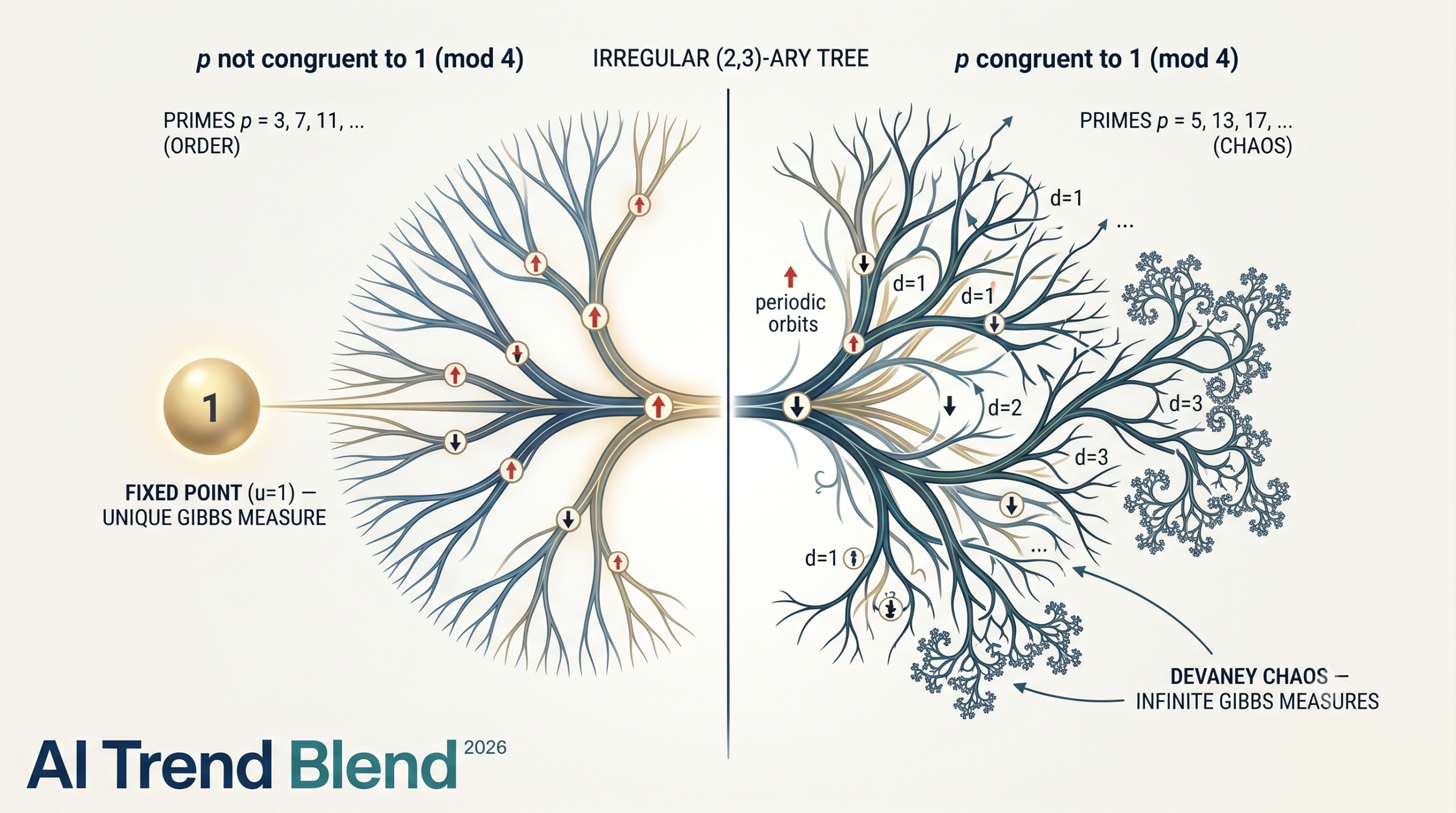
Imagine a magnetic material whose atoms sit on a strange branching lattice that is not quite regular — some vertices have more neighbors than others in a precise alternating pattern. Now ask a deceptively simple question: how many distinct equilibrium states can this system have at low temperature? In the classical real-valued world, the answer is known. But swap out ordinary real numbers for p-adic numbers — a completely different number system built around a prime p — and the answer changes dramatically based on nothing more than the residue of that prime modulo 4. This is the core discovery of a new paper by Farrukh Mukhamedov and Otabek Khakimov, published in the Journal of Mathematical Analysis and Applications in 2026.
Two Number Systems, Two Radically Different Worlds
Most people encounter only one notion of distance in mathematics: the ordinary absolute value, where 7 is closer to 8 than it is to 100. But there is an entirely different way to measure closeness among rational numbers, one that assigns distance based on divisibility by a prime rather than on magnitude. This is the p-adic absolute value, and it turns the rational numbers into a completely alien geometric landscape.
In the p-adic world, two numbers are close when their difference is divisible by a high power of p. The number 1 and the number 1 plus one million are extremely close in the 1000003-adic metric if one million is divisible by a high power of 1000003. More strikingly, a sequence of numbers can converge in the p-adic sense while flying off to infinity in the ordinary sense. The field of p-adic numbers Q_p is the completion of the rationals under this exotic metric, just as the real numbers are the completion under the ordinary one.
This is not pure abstraction. p-adic numbers appear naturally in string theory, quantum mechanics, number theory, and increasingly in mathematical biology. What makes them relevant to statistical mechanics is a deep structural property called non-Archimedean geometry. Unlike the real number line, p-adic space satisfies the strong triangle inequality, which says that the distance from A to C can never exceed the maximum of the distances from A to B and from B to C. This single property causes p-adic dynamical systems to behave in ways that have no classical analogue.
In ordinary geometry, a ball can overlap another ball of the same size. In p-adic geometry, any two balls of the same radius are either identical or completely disjoint. This makes p-adic space look like a fractal Cantor set rather than a smooth continuum, and it is why p-adic dynamical systems naturally produce Cantor-type Julia sets and shift-conjugate chaos.
The Ising Model on an Irregular Tree
The Ising model is one of the most studied objects in all of mathematical physics. In its simplest form, each vertex of a graph is assigned a spin value of plus or minus one. Nearest-neighbor spins interact with a coupling constant J, and the system tends toward configurations that minimize energy. In the real-valued setting on regular trees (also called Bethe lattices or Cayley trees), the structure of all possible equilibrium measures — called Gibbs measures — is well understood.
This paper works on something more interesting than a regular tree. It works on what the authors call a (2,3)-ary tree. This is a rooted tree where the root has exactly two edges, vertices at even depth have exactly three edges total, and vertices at odd depth have exactly four edges total. The alternation between these two branching numbers is what makes the geometry irregular, and irregular geometry introduces complications that the standard theory cannot handle without modification.
The Hamiltonian of the model on this tree takes the standard form, summing J times the product of neighboring spins over all edges in a finite subgraph. The coupling constant J is required to belong to pZ_p, the set of p-adic integers divisible by p. This technical condition ensures that the p-adic exponential function converges on the relevant domain, which is necessary to define the Gibbs measure in the first place.
Regular Cayley trees, where every non-root vertex has the same number of neighbors, are mathematically convenient but physically artificial. Real hierarchical structures — from protein folding landscapes to taxonomic trees — often have irregular branching. The (2,3)-ary tree is the simplest non-trivial irregular example, and understanding it is a necessary step toward a general theory of p-adic statistical mechanics on arbitrary hierarchical graphs.
What a Gibbs Measure Actually Is in This Setting
Before describing what the paper proves, it is worth pausing on what a p-adic Gibbs measure actually means. In classical statistical mechanics, a Gibbs measure is a probability distribution over infinite spin configurations that is consistent with finite-volume conditional distributions derived from the Boltzmann weight. It represents a possible thermodynamic equilibrium state of the system.
In the p-adic setting, probabilities are no longer real numbers in the interval from zero to one. They are elements of Q_p. A p-adic measure assigns p-adic number values to events, satisfying the usual additivity conditions but with p-adic-valued outcomes. This opens the door to a richer and stranger theory. The set of all p-adic Gibbs measures for a given model can be larger, more complicated, and harder to classify than in the real case.
The construction starts with a vector function h that assigns a pair of p-adic numbers to each vertex, representing the local fields in the up and down spin directions. A measure is constructed from h via the partition function, and the compatibility condition — which ensures that the finite-volume measures fit together consistently into an infinite-volume measure — reduces to a nonlinear functional equation for the ratio of the two components of h at each vertex.
This reduction is a key structural insight. The existence of all translation-invariant and periodic p-adic Gibbs measures for the model on the (2,3)-ary tree is completely controlled by the dynamics of one rational function of degree six on the p-adic line. Every periodic orbit of this function gives a periodic Gibbs measure, and every fixed point gives a translation-invariant one.
The Rational Map and Its Fixed Points
The rational function that controls everything is given by a specific degree-six formula in u, with a parameter a that depends on theta and therefore on J and p. The fixed points of this function correspond to translation-invariant Gibbs measures, and their count depends on the arithmetic of p in a precise and striking way.
For any prime p greater than 3 and coupling constant J in pZ_p not equal to zero, the rational map f_a has exactly one fixed point when p is not congruent to 1 modulo 4. It has exactly three fixed points when p is congruent to 1 modulo 4 but not congruent to 1 modulo 12. And it has exactly five fixed points when p is congruent to 1 modulo 12.
In all cases, the fixed point u equal to 1 — corresponding to the symmetric, paramagnetic state — is always present. The additional fixed points appear or disappear based on whether certain square roots exist in Q_p, which depends entirely on the quadratic residue structure of the prime.
The reason the prime’s residue class matters so deeply is this. The analysis of the fixed point equation reduces to asking whether the square root of a specific p-adic number exists in Q_p. By the general theory of p-adic square roots, a p-adic number has a square root in Q_p if and only if it satisfies two conditions: its p-adic valuation must be even, and its leading coefficient must be a quadratic residue modulo p. The question of whether minus one is a quadratic residue modulo p — which determines whether negative one has a square root in Q_p — is answered by classical number theory: minus one is a quadratic residue modulo p if and only if p is congruent to 1 modulo 4. This single arithmetic fact cascades through the entire analysis.
The behavior of a statistical mechanical model — whether it has one equilibrium state or many, whether its dynamics is simple or chaotic — depends not on temperature alone, but on which prime number you are working modulo. The arithmetic of the prime is embedded in the physics. — Theme of Mukhamedov and Khakimov, J. Math. Anal. Appl. 560 (2026)
The Main Theorem: A Sharp Dichotomy
The central result of the paper is a complete classification of all periodic p-adic quasi-Gibbs measures for the Ising model on the (2,3)-ary tree. The answer is a clean dichotomy with no ambiguous middle ground.
Let p be a prime greater than 3 and let J be a nonzero element of pZ_p. For the set of all periodic p-adic quasi-Gibbs measures of the Ising model on the (2,3)-ary tree, exactly one of two situations occurs.
When p is not congruent to 1 modulo 4, every periodic measure is translation-invariant, and there is exactly one such measure. The system is in a unique equilibrium with no phase transition.
When p is congruent to 1 modulo 4, for every positive integer d, there exists at least one d-periodic quasi-Gibbs measure. Measures of all periods coexist simultaneously. The system undergoes a phase transition, with infinitely many distinct equilibrium states.
The contrast between these two cases is not a matter of degree — it is a fundamental qualitative difference. In the first case, the system has a unique equilibrium and all perturbations relax back to it. In the second case, there are infinitely many distinct equilibria of arbitrarily high period, which is the hallmark of complex and chaotic behavior.
What is remarkable is that nothing about the physical parameters of the model — the coupling constant J, the temperature, the specific geometry of the tree — changes this conclusion once p is fixed. The prime number alone determines which regime the system is in. This is a genuinely non-classical phenomenon with no analogue in real-valued statistical mechanics, where the existence of phase transitions typically depends on the coupling constant crossing a critical threshold.
The Proof: Chaos Through Conjugacy to a Full Shift
The proof of the periodic measures result does not rely on finding periodic orbits one at a time. Instead it uses a much more powerful argument: it shows that the p-adic dynamics of the rational map is conjugate to the full shift on two symbols, which is the canonical example of Devaney chaos. Since the full shift has periodic orbits of every period, so does the rational map, and hence so does the model.
The key analytical step is Proposition 4.5 in the paper, which establishes three things about the rational map when p is congruent to 1 modulo 4. First, there are two repelling fixed points u plus and u minus in Q_p, and they are surrounded by disjoint balls of radius equal to the p-adic norm of a minus 1. Second, the map expands distances by a factor of exactly one over that same norm on each of these balls. Third, and most crucially, each of these two balls maps surjectively onto a single large ball in Q_p under the rational map.
This means the map has exactly two inverse branches, each mapping from the large ball back into one of the two small disjoint balls. The dynamics is exactly that of a two-symbol full shift: each application of the map takes any point in either small ball and sends it into the large ball, where it will land in one of the two small balls on the next application, depending on which inverse branch is followed. The sequence of choices — left ball or right ball — is an arbitrary binary sequence, which precisely encodes the full shift.
A dynamical system is Devaney chaotic if it has a dense set of periodic orbits, is topologically transitive (orbits can get close to any point), and exhibits sensitive dependence on initial conditions. The conjugacy to the full shift on two symbols gives all three properties simultaneously. It also gives a precise value for the topological entropy of the system, which equals the logarithm of 2. Higher iterates, formed by composing multiple copies of the rational map, are conjugate to full shifts on more symbols and have correspondingly higher entropy.
The proof of the surjectivity step — showing that each ball maps onto the large ball — uses Hensel’s lemma, a fundamental tool in p-adic analysis that allows approximate solutions of polynomial equations to be lifted to exact solutions when a simple non-degeneracy condition is met. The non-degeneracy condition is verified by explicit calculation using the p-adic norm estimates established earlier in the paper.
When Order Prevails: The Case of Other Primes
For primes that are not congruent to 1 modulo 4, the story is completely different and considerably simpler. The paper proves that in this case, the unique fixed point u equal to 1 is a global attractor for the rational map. Every orbit, no matter where it starts, converges to 1 under repeated application of the map.
The proof proceeds in two steps. The first step shows that any point in Q_p that is not a p-adic unit — either it has very large p-adic norm or it is divisible by p — maps into the set E_p under one application of the map. The set E_p is a compact neighborhood of 1 in Q_p on which the exponential function converges. The second step shows that on E_p, the map is a strict contraction toward 1 with contraction factor equal to the p-adic norm of a minus 1. By the contraction mapping principle, all orbits therefore converge to 1.
The remaining case — points that are p-adic units but not in E_p — requires checking that these points also map into E_p. When p is not congruent to 1 modulo 4, the condition that minus 1 is not a quadratic residue implies that a certain square root does not exist in Q_p. The absence of this square root prevents the denominator of the map from becoming small near the relevant points, ensuring that the map indeed maps into E_p everywhere outside it. This is the step where the arithmetic assumption on p enters decisively.
p not ≡ 1 (mod 4)
The rational map has a unique fixed point that attracts all orbits globally. There is exactly one translation-invariant p-adic Gibbs measure. No phase transition occurs. The system has a single stable equilibrium regardless of the coupling constant.
p ≡ 1 (mod 4)
The rational map has additional repelling fixed points and its Julia set is a Cantor-type set. The dynamics is conjugate to the full shift on two symbols. Periodic measures of every period exist simultaneously, giving a genuine phase transition and Devaney-chaotic renormalization group dynamics.
Beyond the (2,3)-ary Tree: Compositions and Higher Entropy
The paper contains a section that goes beyond the main theorem and explores what happens when multiple rational maps are composed together. This has a natural interpretation in terms of more general hierarchical structures.
When two maps f_a and f_b with different parameters are composed, the result is a degree-36 rational map that has not two but four inverse branches in the chaotic regime. The paper proves that this composed map is conjugate to the full shift on four symbols, giving a topological entropy of the logarithm of 4 rather than the logarithm of 2. The argument is essentially the same as for the single map, but the branch structure is doubled at each step.
More generally, composing a sequence of L different maps gives a rational map conjugate to the full shift on 2L symbols with entropy equal to L times the logarithm of 2. This gives an infinite family of increasingly chaotic systems, all arising from the same basic building block — the p-adic rational map associated with the Ising model on the (2,3)-ary tree.
The authors note that the same general approach applies to arbitrary (i,k)-ary trees, where the branching numbers at odd and even levels are i and k respectively. In each case, the compatibility conditions reduce to a single rational map on Q_p whose degree and form depend on i and k. The existence of periodic Gibbs measures of all periods is controlled by the periodic orbits of that map, just as in the (2,3)-ary case. However, for general (i,k), the maps have higher degree and more complex critical structure, making the full analysis considerably more involved.
Why This Contrast With the Classical Case Matters
One of the most striking aspects of the paper is the repeated emphasis on the contrast with real-valued models. In the real-valued Ising model on a Cayley tree, the renormalization-group map is a real rational function on the real line. Phase transitions occur when the coupling constant crosses a critical value — a temperature-like threshold. Below the critical value, there is a unique Gibbs measure. Above it, multiple Gibbs measures can coexist.
In the p-adic setting, there is no such smooth transition. The behavior is determined entirely by the arithmetic of p, not by the value of the coupling constant. Even without an external magnetic field, and even for coupling constants arbitrarily close to zero, the model can exhibit chaos if p is the right kind of prime. The authors state this contrast directly and emphasize that the chaotic behavior of the p-adic renormalization-group map is qualitatively different from anything that occurs in the real-valued analogue.
This is not merely a technical curiosity. It suggests that p-adic statistical mechanics is a genuinely distinct theory, not just a formal generalization of the classical one. The physical intuition that comes from real-valued models — that phase transitions are caused by competition between energy and entropy at a critical temperature — does not transfer to the p-adic setting. Something different is happening, and the relevant invariant is number-theoretic rather than thermodynamic.
The Boundedness Question and What It Leaves Open
The paper is careful about what it does and does not prove regarding the physical relevance of the measures it constructs. In p-adic probability theory, a measure is called bounded if its values are bounded in the p-adic norm. Only bounded measures are considered physically meaningful, in the sense that they can serve as genuine probability distributions in a p-adic quantum or statistical mechanical model.
For the translation-invariant measure corresponding to the fixed point u equal to 1, the paper provides a direct verification of boundedness using the strong triangle inequality and the structure of the partition function. The exponential of the Hamiltonian and the partition function both have p-adic norm exactly equal to 1, which gives the measure values of norm 1 — perfectly bounded.
For the periodic quasi-Gibbs measures appearing when p is congruent to 1 modulo 4, the situation is more subtle. These measures involve local fields that lie in the complement of E_p, which means they are quasi-Gibbs in the technical sense but not full Gibbs measures as usually defined. Their boundedness requires delicate estimates on partition functions that the authors explicitly set aside as beyond the scope of the present work. They do not claim the existence of a strong phase transition — the coexistence of bounded and unbounded measures for the same Hamiltonian — because that stronger statement would require this additional analysis.
The complete analysis of boundedness for the periodic quasi-Gibbs measures in the chaotic regime remains open. This matters because bounded measures are the physically meaningful ones. Establishing which of the infinitely many periodic measures are bounded, and whether bounded and unbounded measures coexist for the same coupling constant, would constitute a proof of strong phase transition — a harder result that the current paper deliberately leaves for future investigation.
The Restriction to Primes Greater Than 3
The paper works exclusively with primes p greater than 3 and explicitly explains why. The arguments break down for the small primes 2 and 3 in multiple places, and each breakdown requires a fundamentally different treatment rather than a minor patch.
For p equal to 2, the set E_2 has a different structure. In particular, the simple additivity property that says the norm of a plus b in E_p equals 1 for odd primes fails for p equal to 2, where the norm can be one half instead. The general criterion for square roots in Q_2 also involves additional congruence conditions on the first three digits of the 2-adic expansion, not just on the leading digit. This makes all the norm estimates in the paper invalid as stated.
For p equal to 3, the problem is different. Several key coefficients in the polynomials that arise during the fixed-point analysis become divisible by 3, which means their reductions modulo 3 have multiple or degenerate roots. This prevents Hensel’s lemma from being applied in the straightforward way the paper uses it. A case-by-case analysis of the degenerate situations would be needed, and the authors expect it to require substantial additional work.
The authors state clearly that these cases are expected to require separate, more delicate treatments and will be addressed in future work.
Connections to Broader Themes in p-adic Mathematical Physics
This paper sits within a well-established research program on p-adic statistical mechanics that has been developing since the late 1980s. The motivation for studying p-adic number systems in physics comes from several directions. In string theory, p-adic strings appeared as natural objects in the work of Volovich, Freund, and others. In quantum mechanics, p-adic probability frameworks were proposed by Khrennikov as an alternative to the Kolmogorov axioms. In number theory, the connections between p-adic dynamics and the structure of Gibbs measures on trees have turned out to be extraordinarily rich.
What distinguishes the present work is its focus on irregular trees and on establishing chaotic behavior rather than merely identifying phase transitions. Earlier work by the same authors and by others established chaos for the Ising and Potts models on regular Cayley trees. The extension to the (2,3)-ary tree requires different arguments because the renormalization-group map has a different algebraic form, and the fixed-point structure is more complex.
The paper also connects to the theory of p-adic dynamical systems, particularly the work of Fan, Liao, Wang, and Zhou establishing that p-adic repellers in Q_p are subshifts of finite type. It is this general theorem that allows the authors to conclude, from the local expansion properties they prove for their rational map, that the full dynamics on the Julia set is conjugate to a full shift rather than merely a subshift. The key is that their system satisfies the hypotheses of that theorem, and the Julia set they construct is compact, totally disconnected, and locally expanding.
What This Paper Provides
A complete classification of all periodic p-adic quasi-Gibbs measures for the Ising model on the irregular (2,3)-ary tree, with a sharp arithmetic condition on p distinguishing the unique-measure regime from the infinitely-many-measures regime.
What It Opens Up
A template for analyzing p-adic Gibbs measures on general (i,k)-ary trees via renormalization-group maps, with the expectation of similar arithmetic-driven phase transitions and chaotic RG dynamics for a broad class of irregular hierarchical geometries.
Why This Paper Matters Beyond Its Immediate Results
Results in pure mathematics earn their importance in several ways. Some solve long-standing open problems. Some introduce new techniques that prove useful across many fields. Some reveal unexpected connections between apparently unrelated areas. This paper does the third: it reveals that the arithmetic of prime numbers is not just a background parameter in p-adic statistical mechanics but a fundamental determinant of physical behavior.
The fact that a single congruence condition on p — whether p leaves remainder 1 when divided by 4 — completely determines whether the Ising model on the (2,3)-ary tree has one equilibrium state or infinitely many is a striking and non-obvious result. It says something deep about the interaction between number theory and statistical mechanics in the p-adic setting. And because the method is based on renormalization-group dynamics, it connects to one of the most powerful conceptual frameworks in all of physics.
The paper is also notable for what it leaves explicitly unresolved. The restriction to primes greater than 3, the open question of boundedness for periodic measures, and the challenge of extending to general (i,k)-ary trees are all stated clearly as limitations and future directions. This intellectual honesty about the boundaries of the current work is a sign of careful scholarship. The results that are proven are proven completely, with full proofs and verification of all technical hypotheses. What is not proven is not claimed.
For researchers working at the intersection of p-adic analysis, dynamical systems, and mathematical physics, this paper provides both a concrete set of results and a flexible methodology. The combination of Hensel’s lemma, p-adic norm estimates, and the theory of p-adic repellers is a toolkit that can be deployed on many related problems. And the central theme — that arithmetic properties of primes drive qualitative changes in physical behavior — is rich enough to sustain a substantial further research program.
Read the Full Paper
Published open-access in the Journal of Mathematical Analysis and Applications, Volume 560 (2026). All proofs, fixed-point analyses, and dynamical system results are freely available via the journal website.
F. Mukhamedov, O. Khakimov. Chaotic behavior of renormalization group of the p-adic Ising model on ary trees. Journal of Mathematical Analysis and Applications, 560 (2026) 130568. https://doi.org/10.1016/j.jmaa.2026.130568
This article is an independent editorial analysis of a peer-reviewed open-access paper published under the CC BY 4.0 license. Mathematical statements paraphrase the original results. For complete proofs and precise formulations, consult the published paper. The paper was received 10 September 2025 and made available online 3 March 2026. F. Mukhamedov was supported by UAEU UPAR Grant No. G00004962.
References
- [1] Z. Abdukaxorova. Translation-invariant p-adic generalized Gibbs measures for the Ising model with a homogeneous external field on a Cayley tree. Math. Phys. Anal. Geom. 28 (2025) 19.
- [2] R.J. Baxter. Exactly Solved Models in Statistical Mechanics. Academic Press, London, 1982.
- [3] B. Dragovich, A. Yu. Khrennikov, S.V. Kozyrev, I.V. Volovich. On p-adic mathematical physics. P-Adic Numb. Ultrametr. Anal. Appl. 1 (2009) 1–17.
- [4] A.H. Fan, L.M. Liao, Y.F. Wang, D. Zhou. p-adic repellers in Q_p are subshifts of finite type. C. R. Math. Acad. Sci. Paris 344 (2007) 219–224.
- [5] H.O. Georgii. Gibbs Measures and Phase Transitions. Walter de Gruyter, Berlin, 1988.
- [6] A. Yu. Khrennikov. p-Adic Valued Distributions in Mathematical Physics. Kluwer Academic Publisher, Dordrecht, 1994.
- [7] N. Koblitz. p-Adic Numbers, p-Adic Analysis and Zeta-Function. Springer, Berlin, 1977.
- [8] F. Mukhamedov, O. Khakimov. Phase transition and chaos: p-adic Potts model on a Cayley tree. Chaos Solitons Fractals 87 (2016) 190–196.
- [9] F. Mukhamedov, O. Khakimov. On Julia set and chaos in p-adic Ising model on the Cayley tree. Math. Phys. Anal. Geom. 20 (2017) 23.
- [10] F. Mukhamedov, O. Khakimov. Translation-invariant generalized p-adic Gibbs measures for the Ising model on Cayley trees. Math. Methods Appl. Sci. 44 (2021) 12302–12316.
- [11] A. Qawasmeh, F. Mukhamedov, O. Khakimov. On Gibbs measures of the Ising model on (m,k)-ary trees. Rev. Math. Phys. 36 (2025) 2450042.
- [12] U.A. Rozikov. Gibbs Measures on Cayley Trees. World Scientific, 2013.
- [13] V.S. Vladimirov, I.V. Volovich, E.I. Zelenov. p-Adic Analysis and Mathematical Physics. World Scientific, Singapore, 1994.
- [14] K.G. Wilson, J. Kogut. The renormalization group and the epsilon-expansion. Phys. Rep. 12 (1974) 75–200.