
Key Points
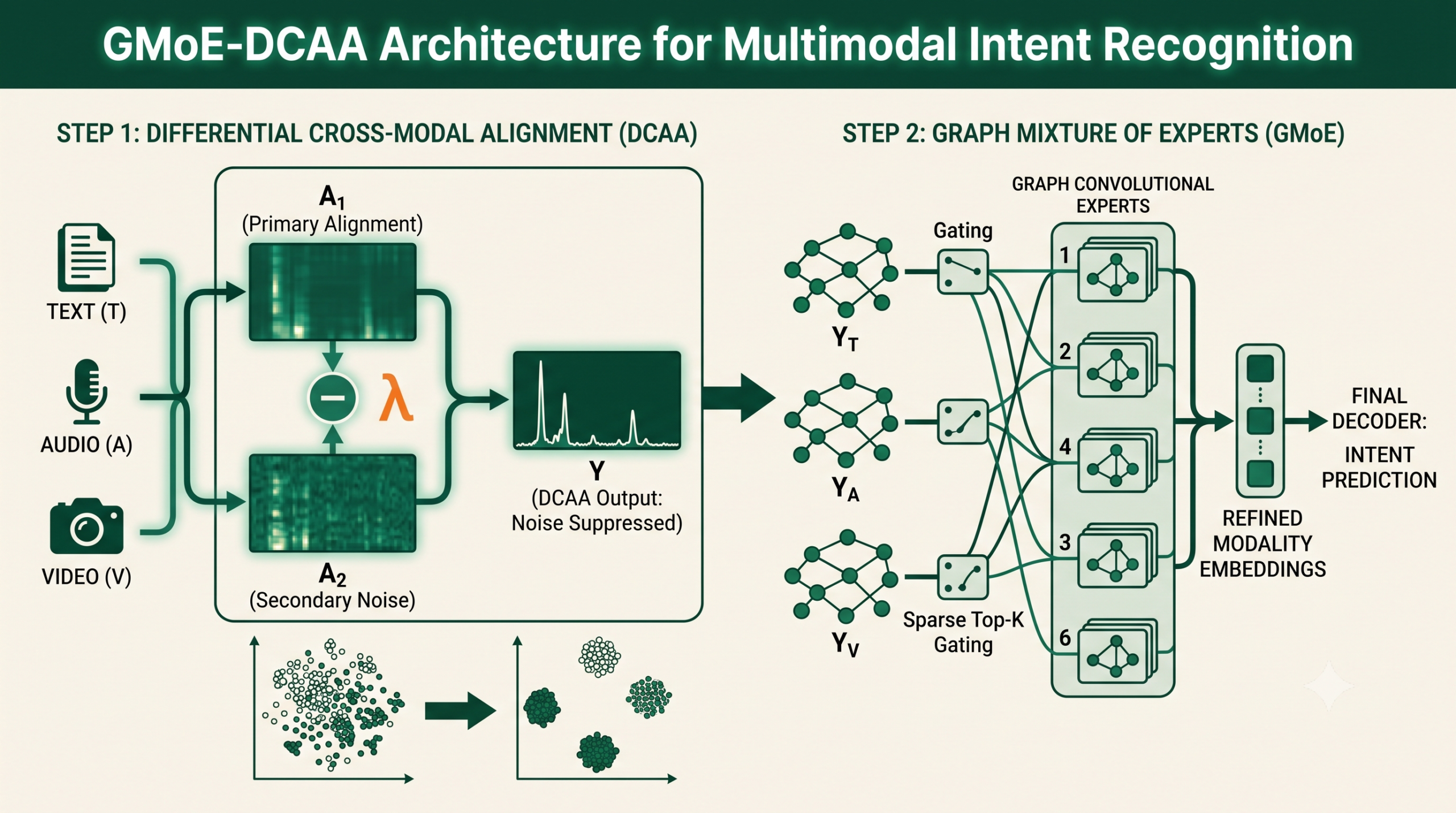
- GMoE-DCAA pairs a Differential Cross-Attention Alignment module, which computes two attention maps per modality pair and subtracts one from the other, with a Graph Mixture of Experts module that routes each modality’s structured graph to specialized graph neural network experts.
- The subtraction step is adapted from the noise canceling idea behind Differential Transformer, but reworked for cross modal alignment rather than single sequence self attention, with a learnable coefficient that the model tunes through ordinary gradient descent.
- Across three dialogue benchmarks, GMoE-DCAA beats the strongest prior baseline while also using fewer trainable parameters and running faster at inference, a combination that is unusual for a method with this many moving parts.
- The model is unusually robust to missing or corrupted input. It stays ahead of the baseline when an entire modality disappears at test time, and keeps working when up to 70 percent of text tokens are removed, conditions that collapse the comparison method.
- Buried in the paper’s own per class results table is a result the text never mentions. On the “Agree” intent class, GMoE-DCAA scores 40 percent F1 while every single baseline, including a plain text classifier, scores in the low 90s, a gap worth understanding before trusting this method on a task where agreement matters.
The Problem With Fusing Modalities Through A Single Static Network
Multimodal intent recognition asks a system to classify what a speaker actually wants, complaining, agreeing, joking, asking for help, by combining what they said with how they said it and how they looked while saying it. Text alone captures a lot, but it misses vocal prosody and facial expression, both of which carry real information about intent that words by themselves do not convey.
The trouble is that combining modalities is not free. Prior approaches generally fall into two camps. Explicit alignment methods, cross attention models among them, force correspondence between modalities directly, strengthening interaction but often importing redundant or outright noisy correlations along with the useful signal. Implicit alignment methods disentangle shared and modality specific representations instead, which helps, but mostly operates at the representation level without any task aware mechanism to actively suppress misleading cross modal signals during fusion itself. Both camps end up trading off rich interaction against robustness to noise, without a clean way to get both.
Two specific limitations motivate this paper. First, cross modal noise. Every modality carries a mixture of task relevant and task irrelevant features, and when an attention mechanism fuses them, nothing stops a misleading cue, a raised eyebrow that happens to look confrontational, a gentle vocal timbre that happens to sound sincere, from getting blended into the query modality’s representation even when it actually conflicts with the true intent. Second, the single static network problem. Most fusion architectures apply the same shared network to every modality, which is convenient but ignores the fact that text, audio, and video have genuinely different structure, and a network tuned to work reasonably well across all three may not capture what is distinctive about any one of them.
How GMoE-DCAA Works
GMoE-DCAA runs modality specific encoders first, frozen pretrained backbones, BERT for text, wav2vec 2.0 for audio, Swin Transformer for video, then passes the extracted features through two novel modules in sequence. Differential Cross-Attention Alignment cleans up cross modal interactions before fusion. Graph Mixture of Experts then turns each modality’s refined features into a structured graph and routes it to specialized experts. You can read the full method and every experiment in the original paper, published in Knowledge-Based Systems.
Two Attention Maps, One Subtracted From The Other
The core idea behind DCAA is borrowed from Differential Transformer, a noise canceling attention design originally built for suppressing irrelevant context within a single sequence. GMoE-DCAA adapts that same subtraction principle to the cross modal case, where the query comes from a target modality and the key and value come from an auxiliary modality.
The query and key are split into two branches after a rotary positional encoding, producing two separate attention maps.
The first map, A1, models the primary cross modal alignment. The second map, A2, is treated as a secondary path that tends to capture shared but weakly discriminative interactions, the cross modal equivalent of background noise. A learnable coefficient, computed from semantic correlations between latent vectors, controls how strongly the second map gets subtracted from the first.
The result passes through RMSNorm for numerical stability, then an output projection modulated by a factor tied to the same coefficient, which softly regulates how much of the raw residual attention path survives into the final representation. This whole block runs inside an iterative encoder that refines a target modality using an auxiliary modality across several layers, each one alternating a differential attention update with a gated feed forward step, before the outputs from both auxiliary modalities get concatenated into the final aligned representation for each target modality.
Why The Subtraction Actually Works
The authors back the mechanism with a short piece of analysis worth walking through, since it explains what the learnable coefficient is actually doing rather than just asserting that subtraction helps. Conceptually partition cross modal token pairs into an informative subset and a nuisance subset, purely for analysis, this split is never explicitly constructed during training. Define a selectivity score comparing how much of each attention map’s mass lands on informative versus nuisance pairs.
Differentiating this with respect to the coefficient and finding when that derivative is positive gives a clean condition. Increasing the coefficient improves selectivity whenever the second attention branch’s nuisance mass, weighted against the first branch’s informative mass, outweighs the reverse. In plain terms, if the second branch really is capturing more noise than signal relative to the first branch, cranking up how strongly it gets subtracted makes the combined map more selective toward what actually matters. And because the coefficient itself is a trainable parameter sitting inside the differentiable pipeline, gradient descent adjusts it automatically, increasing it when suppressing the second branch reduces the training loss and backing off when that branch turns out to carry complementary information worth keeping. The coefficient is best understood as a learned trade off between preserving and suppressing the secondary attention path, not as an explicit, hand built noise detector.
Turning Each Modality Into A Graph And Routing It To Experts
Once cross modal noise has been suppressed, each modality’s refined features get converted into a graph. A capsule network forms semantic nodes through dynamic routing, and a self attention mechanism captures pairwise relations between them, producing a structured graph input with rich intra modal semantics for each modality separately.
Graph convolutional experts then process this graph. The framework maintains a set of two layer graph convolutional network experts, each one aggregating information across the graph structure.
A gating network decides which experts actually contribute to a given node, using a sparse top k softmax so that only a handful of experts activate per node rather than the full pool.
What makes this design worth noting is where the experts live. A competing approach, EMOE, performs its expert routing after modalities have already been fused into a single embedding. GMoE-DCAA routes before that point, operating on modality specific graphs, which preserves each modality’s own relational structure through the specialization process instead of flattening it into a shared representation first. The resulting node level outputs get aggregated into a single graph level embedding per modality through a routing based pooling step borrowed from capsule networks, and the three modality embeddings are concatenated, passed through dropout, and fed into a small two layer decoder that produces the final intent prediction.
The Experiments
The authors evaluate on three dialogue datasets that differ substantially in scale and utterance length.
| Dataset | Train | Valid | Test | Max Utterance Length |
|---|---|---|---|---|
| MIntRec | 1,334 | 445 | 445 | 26 tokens |
| MELD-DA | 6,991 | 999 | 1,998 | 70 tokens |
| MIntRec2.0 | 9,989 | 1,821 | 3,230 | 46 tokens |
Baselines span attention based fusion methods, MulT, MAG-BERT, MTAG, TCL-MAP, MVCL-DAF, and GraphCAGE, a disentanglement based method, MISA, and a prior mixture of experts approach, EMOE. MVCL-DAF, which combines multi view contrastive learning with adaptive attention fusion, is the strongest of these and the primary comparison point throughout the paper.
What The Results Show
GMoE-DCAA posts the best Weighted F1 on all three datasets, beating MVCL-DAF by 1.49 points on MIntRec, 1.71 points on MELD-DA, and a smaller 0.76 points on MIntRec2.0, the largest and most diverse of the three benchmarks. Every metric moved in the same direction across all three datasets except one detail worth flagging. On MELD-DA, GMoE-DCAA’s Recall (49.88 percent) is actually a touch below the older MTAG baseline’s Recall (51.40 percent), even though GMoE-DCAA wins comfortably on Accuracy, Weighted F1, and Weighted Precision on that same dataset. A single metric lagging behind an older baseline on one of three datasets is a minor asterisk on an otherwise clean sweep, but it is a reminder that a model rarely wins on every axis simultaneously.
Winning On Accuracy Without Losing On Efficiency
The efficiency numbers are where this paper distinguishes itself from a lot of architecturally heavier proposals. Despite integrating two new modules, GMoE-DCAA actually uses fewer trainable parameters than MVCL-DAF.
| Model | Trainable Parameters | Time To Best Performance (MIntRec) | Inference Latency (MIntRec) |
|---|---|---|---|
| MVCL-DAF | 281.31M | 26.41 min | 29.56 ms/sample |
| GMoE-DCAA | 247.95M | 14.07 min | 18.86 ms/sample |
The Graph Mixture of Experts module itself is almost weightless, under 1 million parameters, because it reuses a shared network structure rather than giving every modality its own separate branch. Most of the parameter count actually sits in the DCAA module and the graph construction step. The practical upshot is that GMoE-DCAA trains in roughly half the time MVCL-DAF needs to reach its best performance on MIntRec and MIntRec2.0, and runs meaningfully faster at inference across every dataset tested, while still winning on accuracy. That is a genuinely uncommon combination, most papers that add this many specialized components pay for it somewhere.
Staying Useful When A Modality Disappears
Real deployments lose modalities. A camera gets occluded, a microphone cuts out. The authors test this directly by dropping entire modalities at evaluation time.
| Available Modalities | MVCL-DAF ACC / WF1 | GMoE-DCAA ACC / WF1 |
|---|---|---|
| Text + Audio + Video | 74.72 / 74.61 | 76.18 / 76.10 |
| Text + Audio only | 73.93 / 74.09 | 75.51 / 75.39 |
| Text + Video only | 74.16 / 74.32 | 75.06 / 74.88 |
| Text only | 73.48 / 73.64 | 74.83 / 74.62 |
GMoE-DCAA stays ahead of MVCL-DAF in every configuration, including text only, where it still beats MVCL-DAF’s full three modality score. A separate stress test corrupts the dominant text modality directly, removing text tokens at increasing rates from 10 percent up to 70 percent. Both models lose accuracy as expected, but at the extreme 70 percent missing rate the paper reports that MVCL-DAF experiences what the authors describe as a near total performance collapse, while GMoE-DCAA maintains more than double MVCL-DAF’s Accuracy and Weighted F1 at that same corruption level. Separately, a test that shuffles 40 percent of audio and video segment order during training, breaking local timing while keeping coarse alignment intact, shows the same pattern in miniature. GMoE-DCAA degrades by only 0.22 points of Weighted F1 under this perturbation, against declines of 0.81 points for MVCL-DAF and roughly 1 point for the older text centric baselines.
A Concrete Look At What The Subtraction Fixes
The paper includes a case study that makes the noise suppression idea concrete rather than abstract. For the utterance “it couldn’t hurt to shake things up a little bit here,” ordinary cross attention overemphasizes the word “hurt,” pulling in visual and acoustic cues tied to negative sentiment and pushing the model toward misreading the utterance as a complaint. DCAA suppresses attention to that misleading token and instead boosts attention toward “shake” and “up,” the actual action relevant words, correctly steering the prediction toward “Advise.” A t-SNE visualization of the resulting embeddings backs this up at a broader scale, differential cross attention produces compact, well separated clusters by modality, where ordinary cross attention produces scattered, overlapping ones, and a separate correlation analysis shows differential attention achieves a Pearson correlation of 0.7613 between how audio and video allocate attention to matching text segments, compared to 0.6585 for ordinary cross attention, meaning the modalities agree with each other about what matters far more consistently once the noise has been subtracted out.
What The Ablations Reveal
Removing each module in turn shows the two pieces are not equally important everywhere. Dropping DCAA produces the sharpest decline on MELD-DA, Weighted F1 falls from 61.61 to 57.36, which fits MELD-DA’s longer and more variable utterances giving the noise suppression mechanism more actual noise to suppress. Dropping GMoE produces a more moderate decline concentrated on MIntRec, Weighted F1 falls from 76.10 to 74.47. Replacing the graph structure entirely with a standard Transformer causes Accuracy on MELD-DA to fall to 59.86 percent, evidence that the graph based relational modeling specifically, not just the expert routing on top of it, is doing real work capturing structure within an utterance.
A separate comparison tests two alternative designs for the expert routing itself. A sparse, pre selection variant that activates only a subset of experts based on input features underperforms the full model. So does a non shared variant that gives each modality its own private mixture of experts rather than sharing one pool across modalities. The design actually used, a shared pool of experts with post selection aggregation, beats both alternatives, suggesting the right balance sits between full specialization and full sharing rather than at either extreme. A hyperparameter sweep over the number of experts and how many activate per node finds a similarly non obvious optimum, the best result comes from a moderate expert count with most, but not all, experts active per node, rather than from maximum sparsity or maximum capacity.
Where This Falls Short
The paper’s own error analysis is honest about a category of failure the architecture cannot fix by design. In a case where an utterance reads as “that’s past the property line,” delivered without notable vocal arousal or negative wording, the model predicts “Inform” when the correct label is “Complain,” because the complaint only makes sense given an ongoing situational dispute the model has no access to from a single isolated utterance. A second case, “and we thought of you,” gets misread as “Flaunt” instead of “Inform” because its warm affective tone overlaps more with expressive intent categories than with a neutral informative one. Both cases require dialogue history and speaker context beyond what a single utterance, however well its modalities are fused, can supply.
Beyond what the authors discuss directly, two more limitations are worth naming. First, the unexplained collapse on the “Agree” class discussed above sits alongside strong performance almost everywhere else in the same results table, and a model that is dramatically better on hard, ambiguous classes while dramatically worse on one common, straightforward one deserves scrutiny before deployment on tasks where agreement detection specifically matters. Second, MIntRec, the smallest and most frequently cited benchmark here, is sourced from a single scripted television show, which means everything learned about how sarcasm, agreement, or complaint gets expressed multimodally in that dataset reflects the acting and production choices of one show, not necessarily how real, unscripted speakers behave.
A Working PyTorch Implementation
The code below implements the two core mechanisms from the paper, differential cross modal attention with a learnable suppression coefficient, and a sparse top k graph expert layer with gated aggregation. A smoke test runs both on random tensors representing two aligned modalities to confirm the shapes and gradients behave correctly.
# gmoe_dcaa.py
# Reference style implementation of the DCAA and GMoE modules
# Sun, An, Liu, Nan, Nie, Zeng, Hua, Wu, and Tian
# Knowledge-Based Systems 349 (2026) 116392

import torch
import torch.nn as nn
import torch.nn.functional as F


class DifferentialCrossAttention(nn.Module):
    """Multi-Head Differential Cross-Attention (MHDCA).

    Query comes from the target modality, key and value come from
    the auxiliary modality. Two attention branches are computed and
    the second is subtracted from the first, scaled by a learnable
    coefficient lambda, following Eqs. (4)-(8) in the paper.
    """

    def __init__(self, dim, num_heads=4):
        super().__init__()
        assert dim % (2 * num_heads) == 0, "dim must split evenly across 2 branches per head"
        self.num_heads = num_heads
        self.head_dim = dim // (2 * num_heads)

        self.q_proj = nn.Linear(dim, dim)
        self.k_proj = nn.Linear(dim, dim)
        self.v_proj = nn.Linear(dim, dim)
        self.out_proj = nn.Linear(dim, dim)

        # learnable vectors used to compute the differential coefficient lambda (Eq. 6)
        self.lambda_q1 = nn.Parameter(torch.randn(self.head_dim) * 0.1)
        self.lambda_k1 = nn.Parameter(torch.randn(self.head_dim) * 0.1)
        self.lambda_q2 = nn.Parameter(torch.randn(self.head_dim) * 0.1)
        self.lambda_k2 = nn.Parameter(torch.randn(self.head_dim) * 0.1)
        self.lambda_init = nn.Parameter(torch.tensor(0.5))

        self.rms_norm = nn.RMSNorm(dim)

    def _compute_lambda(self):
        term1 = torch.exp(torch.sum(self.lambda_q1 * self.lambda_k1))
        term2 = torch.exp(torch.sum(self.lambda_q2 * self.lambda_k2))
        return term1 - term2 + self.lambda_init

    def forward(self, x_target, x_aux):
        # x_target: (B, T, D) target modality (query source)
        # x_aux:    (B, T, D) auxiliary modality (key/value source)
        B, T, D = x_target.shape

        q = self.q_proj(x_target).view(B, T, self.num_heads, 2, self.head_dim)
        k = self.k_proj(x_aux).view(B, T, self.num_heads, 2, self.head_dim)
        v = self.v_proj(x_aux)

        q1, q2 = q[:, :, :, 0, :], q[:, :, :, 1, :]
        k1, k2 = k[:, :, :, 0, :], k[:, :, :, 1, :]

        # (B, H, T, T) attention maps for each branch
        q1, k1 = q1.transpose(1, 2), k1.transpose(1, 2)
        q2, k2 = q2.transpose(1, 2), k2.transpose(1, 2)

        scale = self.head_dim ** 0.5
        a1 = F.softmax(torch.matmul(q1, k1.transpose(-1, -2)) / scale, dim=-1)
        a2 = F.softmax(torch.matmul(q2, k2.transpose(-1, -2)) / scale, dim=-1)

        lam = self._compute_lambda()
        a_diff = a1 - lam * a2  # Eq. (7): the differential attention map

        v_heads = v.view(B, T, self.num_heads, 2 * self.head_dim).transpose(1, 2)
        y = torch.matmul(a_diff, v_heads)  # (B, H, T, 2*head_dim)
        y = y.transpose(1, 2).reshape(B, T, D)

        y = self.rms_norm(y)
        return self.out_proj(y) * (1 - self.lambda_init)  # Eq. (8)


class GraphExpertLayer(nn.Module):
    """Simplified Graph Mixture of Experts: E GCN-style experts with
    sparse top-k gating, following Eqs. (15)-(18)."""

    def __init__(self, dim, num_experts=6, top_k=2, temperature=1.0):
        super().__init__()
        self.num_experts = num_experts
        self.top_k = top_k
        self.temperature = temperature

        self.experts = nn.ModuleList([nn.Linear(dim, dim) for _ in range(num_experts)])
        self.gate = nn.Linear(dim, num_experts)

    def forward(self, x, adj):
        # x:   (B, N, D) node features for a modality-specific graph
        # adj: (B, N, N) normalized adjacency matrix
        expert_outputs = []
        for expert in self.experts:
            h = torch.bmm(adj, x)          # aggregate neighbor features
            h = F.relu(expert(h))          # Eq. (16): one GCN layer per expert
            expert_outputs.append(h)
        expert_stack = torch.stack(expert_outputs, dim=2)  # (B, N, E, D)

        logits = self.gate(x)  # (B, N, E)
        top_vals, top_idx = torch.topk(logits, self.top_k, dim=-1)
        mask = torch.full_like(logits, float("-inf"))
        mask.scatter_(-1, top_idx, top_vals)
        gate_weights = F.softmax(mask / self.temperature, dim=-1)  # Eq. (17)

        gate_weights = gate_weights.unsqueeze(-1)  # (B, N, E, 1)
        fused = (gate_weights * expert_stack).sum(dim=2)      # Eq. (18)
        return fused


if __name__ == "__main__":
    torch.manual_seed(0)

    batch, seq_len, dim = 2, 12, 32
    x_text = torch.randn(batch, seq_len, dim)
    x_audio = torch.randn(batch, seq_len, dim)

    dcaa = DifferentialCrossAttention(dim=dim, num_heads=4)
    aligned = dcaa(x_text, x_audio)
    print(f"DCAA output shape: {tuple(aligned.shape)}")
    assert aligned.shape == x_text.shape

    # Build a toy graph: a chain adjacency over the aligned tokens, row-normalized
    n_nodes = seq_len
    adj = torch.eye(n_nodes) + torch.diag(torch.ones(n_nodes - 1), diagonal=1) + torch.diag(torch.ones(n_nodes - 1), diagonal=-1)
    adj = adj / adj.sum(dim=-1, keepdim=True)
    adj = adj.unsqueeze(0).repeat(batch, 1, 1)

    gmoe = GraphExpertLayer(dim=dim, num_experts=6, top_k=2)
    routed = gmoe(aligned, adj)
    print(f"GMoE output shape: {tuple(routed.shape)}")
    assert routed.shape == aligned.shape

    loss = routed.pow(2).mean()
    loss.backward()
    assert dcaa.lambda_init.grad is not None, "lambda_init did not receive a gradient"
    print("Smoke test passed. Differential attention and expert routing both produced gradients.")
Where GMoE-DCAA Ends Up
GMoE-DCAA makes a specific, well supported case rather than a general one. Subtracting a second attention branch from a primary one, with a coefficient the model learns rather than hand tunes, measurably sharpens cross modal alignment, and routing modality specific graphs to shared experts before final fusion measurably helps beyond what either the graph structure or the expert routing could do alone. Both claims hold up under ablation, and the accompanying t-SNE and correlation analyses give a genuinely intuitive picture of what “cleaner alignment” looks like in practice.
The efficiency result deserves equal billing with the accuracy result. A method that adds two nontrivial new modules and still trains faster, runs faster at inference, and uses fewer parameters than its strongest baseline is not the typical trade off story in this area of research, and it is worth taking at face value rather than treating accuracy as the only number that matters. The robustness results tell a complementary story, a model that keeps working when a whole modality vanishes or when most of the text gets corrupted is solving a real deployment problem, not just chasing a benchmark number under ideal conditions.
The unexplained result on the “Agree” class is the detail that keeps this from being an uncomplicated recommendation. It sits in the paper’s own published table, it is large, and it runs in the opposite direction from the model’s otherwise consistent strength on hard, ambiguous categories. Differential attention that aggressively subtracts shared, low discriminative cross modal signal is, by the mechanism’s own design, most likely to suppress exactly the kind of consistent, low conflict multimodal agreement that a genuine “yes, I agree” utterance would produce, text, tone, and expression all pointing the same unremarkable direction. That is a plausible hypothesis grounded in how the mechanism is built, not a claim the paper makes, and it would need direct verification before anyone should treat it as settled.
None of this erases the paper’s genuine limitations, discussed and undiscussed alike. Context dependent pragmatic cases that require dialogue history are explicitly out of scope for a per utterance architecture no matter how well its modality fusion works. The primary benchmark is built from a single scripted television series. And the one glaring per class anomaly deserves direct follow up before this architecture gets trusted on any task where correctly identifying agreement is the point.
Strip away the acronym, and GMoE-DCAA is demonstrating something worth remembering past this specific paper. A fusion mechanism does not have to choose between rich cross modal interaction and robustness to noise if it is willing to explicitly model and subtract the difference between the two, and specialized routing does not have to cost you parameters or speed if the specialization happens on a shared, lightweight structure rather than duplicated heavy branches. Whether either idea survives contact with a class as ordinary as simple agreement is the open question worth watching for a follow up study to resolve.
Frequently Asked Questions
What problem does GMoE-DCAA solve in multimodal intent recognition
It addresses two limitations in prior fusion methods, cross modal noise where irrelevant or misleading cues from one modality contaminate another during fusion, and the use of a single static network across all modalities, which fails to capture what is distinctive about text, audio, and video individually.
How does the differential attention mechanism suppress noise
It computes two separate cross modal attention maps and subtracts one from the other, scaled by a learnable coefficient. The coefficient is optimized through ordinary gradient descent, increasing when suppressing the second map reduces the training loss and decreasing when that map carries useful complementary information.
Does GMoE-DCAA cost more compute than the methods it outperforms
No. Despite adding two new modules, it uses fewer trainable parameters than the strongest baseline, MVCL-DAF, and trains in roughly half the time to reach its best performance while also running faster at inference.
How robust is the model to missing or corrupted input
It stays ahead of the comparison baseline when an entire modality is missing at test time, including text only input, and it maintains more than double the baseline’s accuracy and Weighted F1 when 70 percent of text tokens are removed, a condition under which the baseline nearly collapses.
What is the unexplained result in the paper’s per class table
On the “Agree” intent class, every baseline model scores in the low 90s for F1, including a plain text classifier. GMoE-DCAA scores 40 percent on that same class, the largest gap in the entire results table and in the opposite direction from the model’s usual advantage. The paper’s discussion does not address this result.
Which datasets and baselines were used to test GMoE-DCAA
The datasets are MIntRec, MELD-DA, and MIntRec2.0. Baselines include MulT, MAG-BERT, MTAG, TCL-MAP, MVCL-DAF, GraphCAGE, MISA, and EMOE, covering attention based, disentanglement based, and mixture of experts approaches to multimodal fusion.
Read the full method, every ablation, and the complete per class results table directly from the source.
This analysis is based on the published paper and an independent evaluation of its claims, including an independent reading of the per class results table.