
Key points
- Traditional automation like RPA and workflow scripts excels at repetitive, high volume, rule based tasks where the steps never change.
- AI agents handle ambiguity, unstructured data, and tasks that require judgment, but they cost more per task and need monitoring.
- Traditional automation gives near perfect accuracy on defined tasks. AI agents give flexible but occasionally inconsistent results on undefined tasks.
- Most production deployments in 2026 combine both, using rule based automation for the predictable 80 percent and agents for the exception handling.
- The real comparison is not which is smarter. It is which one matches the shape of the problem you are trying to solve.
What traditional automation actually does
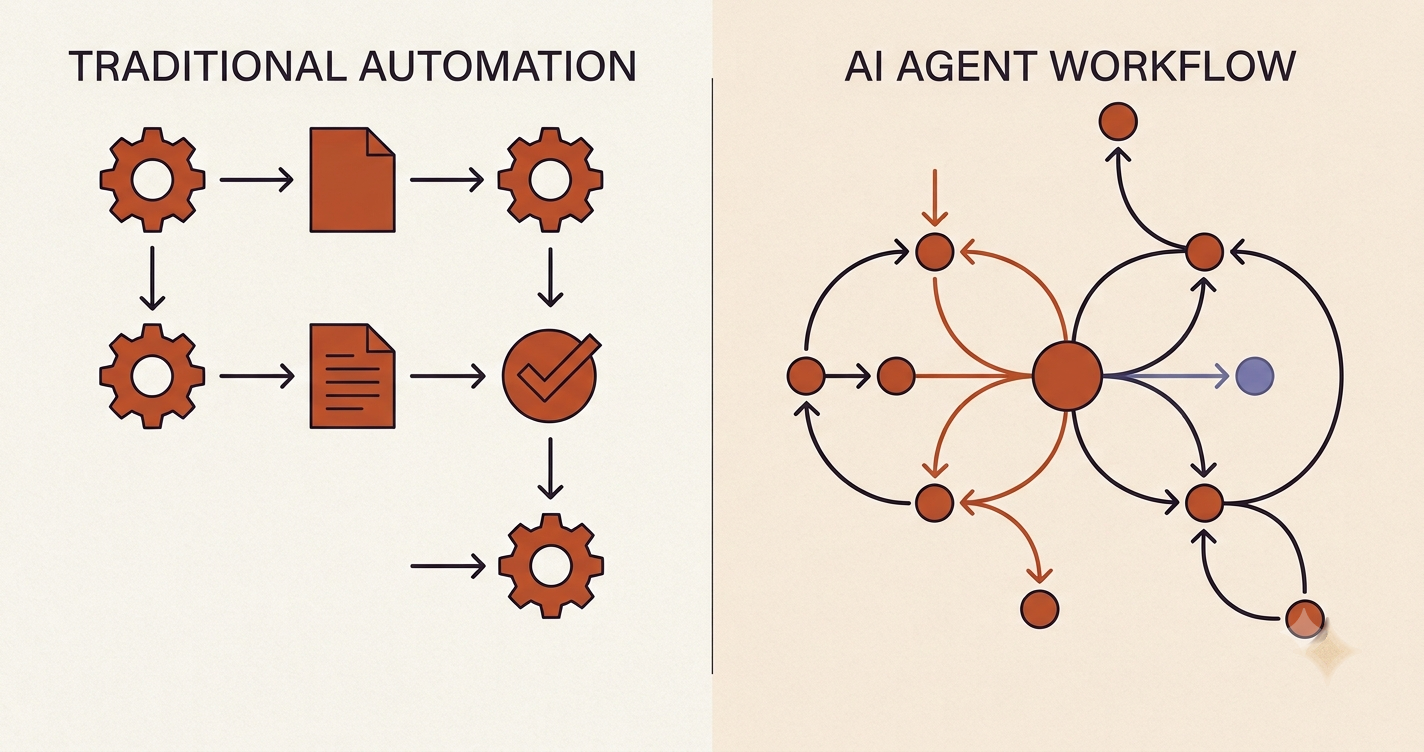
Traditional automation covers robotic process automation, scripted workflows, and rule engines. Tools like UiPath, Zapier, and Power Automate fall into this bucket. They follow a fixed sequence. If a field on a screen matches a condition, do this. If a form arrives in this format, extract these fields and push them to that database. There is no reasoning involved. The logic was written by a human in advance, and the software executes it the same way every single time.
This is a strength, not a weakness. A payroll run, an invoice reconciliation, or a nightly data sync does not need creativity. It needs consistency. Traditional automation delivers that consistency at a fraction of the cost of a person doing the same task by hand, and it does it without getting tired or making a typo on the two thousandth entry.
The limitation shows up the moment the input changes shape. A new invoice template, a slightly reworded customer request, or a step that was never scripted breaks the flow. The automation does not adapt. It fails, throws an error, or silently produces a wrong result, and someone has to notice and fix the underlying script.
What an AI agent does differently
An AI agent, built on a large language model with access to tools and memory, does not follow a fixed script. It is given a goal, a set of tools such as a search function, a database query, or an email sender, and it plans its own sequence of steps to reach that goal. It can read an unfamiliar document, decide what matters, choose which tool to call, and adjust if the first approach fails.
That adaptability is the entire pitch for agentic AI. Customer support platforms like Intercom and Zendesk now run agents that read a full conversation thread, pull relevant order data, and draft a contextual response rather than matching keywords to a canned reply. Coding agents such as those built into Claude Code or GitHub Copilot Workspace read an entire codebase, form a plan, and execute multi step changes without a human writing each command.
The tradeoff is real. Agents can misjudge a situation, hallucinate a fact, or take a longer path than necessary because they are reasoning rather than executing a fixed path. They also cost more per run since every step involves a model call, and they need guardrails such as approval steps for anything irreversible like sending money or deleting data.
Head to head on the metrics that matter
Numbers here vary by vendor and task, and no single benchmark covers every industry. The pattern below reflects what shows up consistently across enterprise automation reporting and agentic AI case studies through 2026.
| Factor | Traditional automation | AI agents |
|---|---|---|
| Accuracy on defined tasks | Near 100 percent, deterministic | 85 to 97 percent, probabilistic |
| Handles unstructured input | Poorly, needs preprocessing | Well, reads text, images, tickets directly |
| Setup effort | Manual scripting per workflow | Prompt and tool setup, faster iteration |
| Cost per task at scale | Very low once built | Higher, scales with model calls |
| Adapts to change | No, breaks on new formats | Yes, reasons through novel cases |
| Auditability | Fully traceable, fixed logic | Needs logging and guardrails |
| Best fit | High volume, repetitive, rule bound work | Judgment calls, exceptions, open ended tasks |
Where traditional automation still wins
Anywhere the task is the same every time, traditional automation is the better economic choice. Bank reconciliation, invoice data entry, password resets, moving data between two systems on a schedule. These tasks have a correct answer, a fixed format, and no room for interpretation. Paying for an AI model to reason through something that could be a five line script is wasted compute and wasted money.
Regulated environments also lean toward traditional automation for the final execution step. A bank might use an agent to draft a suggested fraud flag, but the actual account freeze often still runs through a deterministic rule engine that regulators and auditors can fully trace, because a probabilistic decision is harder to defend in an audit.
Where AI agents pull ahead
Agents earn their cost in the messy middle ground that scripts cannot reach. Sorting inbound leads by genuine buying intent rather than a keyword match. Reading a contract and flagging the three clauses that differ from a standard template. Triaging a support ticket that blends a billing question with a technical bug. These tasks involve interpretation, and interpretation is exactly what large language models are built for.
Multi step research and coordination is another strong fit. An agent that needs to check inventory, compare it against a supplier catalog, and draft a purchase order handles that chain of decisions in one pass, where a traditional pipeline would need a person at every junction to make the judgment call the software cannot make on its own. For a deeper look at how agents coordinate with each other on exactly this kind of multi step task, see our explainer on agent to agent communication.
The pattern showing up in production
Companies that get the best results are not replacing automation with agents. They are putting a rule based system in front for the predictable volume, and routing only the exceptions, the ambiguous cases, and the judgment calls to an agent. This cuts the agent’s workload down to the tasks it is actually good at, and keeps cost per task low.
A practical decision framework
Before choosing either path, three questions tend to settle it. First, does the task have a single correct output that never changes shape. If yes, script it. Second, does the input arrive in a format that varies, such as free text, images, or inconsistent documents. If yes, an agent will save far more rework than it costs. Third, what happens if the system is wrong. If a mistake is expensive or hard to reverse, keep a human or a deterministic rule as the final check regardless of which system makes the first pass.
Teams running defect detection or quality workflows on a factory floor face this tradeoff directly, since a missed defect and a false alarm carry very different costs. Our piece on multi agent systems for supply chain defect detection walks through how that balance gets struck in a real production setting.
Cost and ROI, honestly
Traditional automation has a well understood ROI model. Build once, run for years at a marginal cost near zero, and the payback period is easy to calculate. Agentic AI does not follow that curve as cleanly yet. Model calls cost money on every run, prompts need tuning as edge cases surface, and unlike a script, an agent’s behavior can shift slightly when the underlying model is updated. That said, the labor cost an agent replaces is often the cost of a person doing judgment heavy work, which is far more expensive per hour than the automation it replaces. For small teams weighing this exact tradeoff, our guide on how small businesses use AI to save time and increase revenue breaks down realistic payback timelines.
Limitations worth stating plainly
Neither approach is a universal fix. Traditional automation is brittle by design, and every unhandled exception becomes a support ticket for the engineering team maintaining the script. AI agents introduce a different kind of risk, since an agent given too much autonomy can take an action nobody intended, and debugging why a model made a particular decision is harder than reading a script’s logic line by line. Cost also scales differently. A script that runs a million times a month costs roughly the same as one that runs a thousand times. An agent’s bill grows with volume in a way that needs active monitoring.
Practical applications by industry
In finance, traditional automation still processes the bulk of transaction matching, while agents increasingly handle first pass fraud investigation and customer dispute summaries. In healthcare administration, automation handles insurance claim formatting while agents assist with prior authorization requests that require reading clinical notes. In software development, deterministic CI pipelines still run the tests, while coding agents handle the actual bug fixes and refactoring that used to require a developer’s full attention. In ecommerce, order fulfillment stays scripted end to end, while agents field the customer messages that fall outside a standard return policy.
Frequently asked questions
Is an AI agent just a smarter version of RPA?
No. RPA follows a fixed sequence written by a person in advance. An AI agent reasons about the task and decides its own sequence of actions, which means it can handle situations nobody explicitly programmed for.
Do AI agents replace traditional automation entirely?
Rarely, and usually not in production systems built for scale. Most teams keep rule based automation for high volume repetitive work and add agents specifically for the exceptions and judgment calls that scripts cannot handle.
Which is cheaper to run, AI agents or traditional automation?
Traditional automation is cheaper per task once built, since it involves no ongoing model cost. AI agents cost more per run but can eliminate the manual labor that traditional automation cannot touch, so the cheaper option depends on what the task would otherwise cost in human time.
Are AI agents accurate enough for regulated industries?
Agents are increasingly used to draft or suggest decisions in regulated settings, but the final action in a regulated workflow, such as approving a loan or freezing an account, usually still passes through a deterministic, auditable rule before it executes.
How do I decide between building a script or deploying an agent?
Ask whether the task’s input format and required judgment are fixed or variable. Fixed input and fixed logic favor a script. Variable input or a decision that needs context favors an agent.
Can AI agents and traditional automation work in the same workflow?
Yes, and this is the most common production pattern in 2026. A rule based system handles the routine volume and hands off only the exceptions to an agent, which keeps both cost and error rates lower than using either system alone.
The bottom line
Neither system delivers better results in every case, and the question itself assumes a competition that does not really exist on the ground. Traditional automation is still the correct default for anything repetitive, high volume, and rule bound, and no amount of AI sophistication changes that math. AI agents earn their keep on the tasks that involve genuine judgment, ambiguity, or unstructured input, the exact tasks that used to require a person and a lot of patience.
The teams getting real results are not asking which technology wins. They are mapping their workflows, sorting tasks by whether the logic is fixed or contextual, and assigning each one to whichever system fits its shape. That sorting exercise, more than any model choice, is what determines whether an automation project actually pays for itself.
Expect the line between the two to blur further as agent frameworks add more deterministic guardrails and traditional RPA vendors bolt language models onto their platforms for exception handling. The distinction that matters today, rules versus reasoning, will likely become a spectrum rather than a binary choice within the next few product cycles.
For now, the practical move is straightforward. Audit what your current automation actually breaks on, and that list is your agent roadmap. Everything else can stay exactly as scripted as it already is.
Have a follow up question about agents or automation in your own workflow?
Ask our research assistant directly or browse the full agent systems archive.
Independent analysis by the aitrendblend editorial team, drawing on publicly available vendor documentation, case studies, and current agentic AI research. Figures cited reflect general industry patterns as of mid 2026 rather than a single benchmark study, and results vary by implementation.