
- Kimi K3
- Claude Fable 5
- Moonshot AI
- Open Weight
- Agentic Coding
- Frontier Models
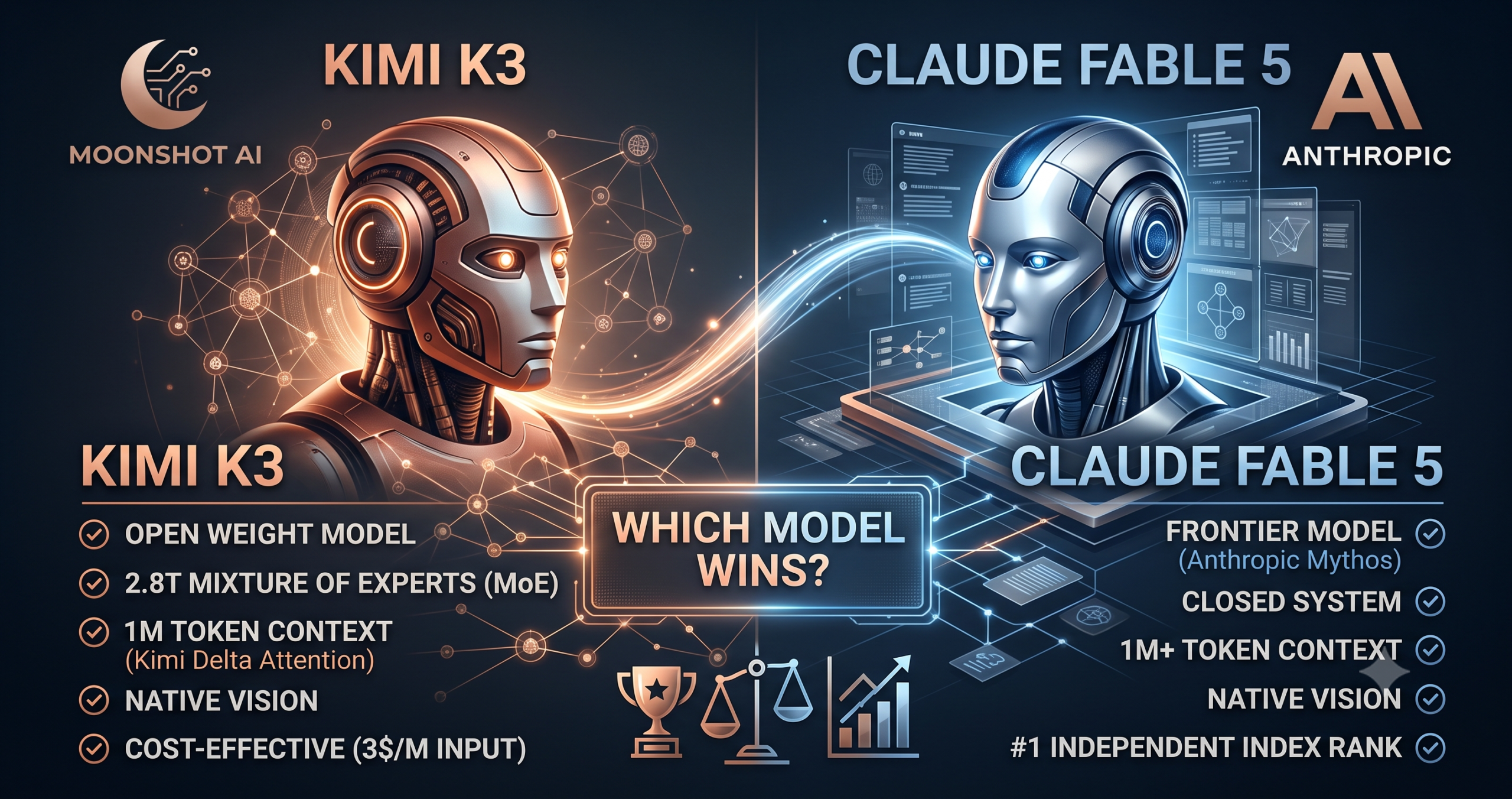
On the morning of 16 July 2026, a WeChat post did something that would have sounded absurd a year earlier. It put an open weight Chinese model on the same chart as the two most capable closed models on Earth, and on a handful of benchmarks the open one came out on top. That model is Kimi K3, and the closed frontier it is chasing is anchored by Claude Fable 5. This is the comparison a lot of people typed into a search box that same afternoon, often as Kimi 3.0, so let us settle it with real numbers and honest caveats.
Key points
- Kimi K3 is a 2.8 trillion parameter open weight Mixture of Experts model with a 1 million token context window and native vision, released by Moonshot AI on 16 July 2026 with full weights promised by 27 July.
- Claude Fable 5 is Anthropic’s Mythos tier closed model from 9 June 2026, and it still leads the overall Artificial Analysis Intelligence Index while Kimi K3 lands fourth.
- The head to head is not a clean sweep for either side. Fable 5 wins the hardest agentic and reasoning tests, K3 wins several long horizon coding, browsing, and document tasks, and each trades wins with GPT-5.6 Sol in between.
- Cost is the sharpest divider. K3 runs roughly a third of Fable 5’s token price and finishes many tasks for a fraction of the dollar cost, which changes the calculus for anything run at scale.
- Almost every published chart mixes evaluation harnesses, so most of these bars are directional, not controlled head to head facts. The last section gives you a harness to test both on your own work.
The real question behind the matchup
Nobody actually wants to know which model is better in the abstract. They want to know which one to point a workflow at next week, and whether the cheaper option gives up enough quality to matter. That is a different question, and it has a different answer depending on what you build.
The framing that makes this interesting is not open versus closed as a slogan. It is a specific tradeoff that finally got tight enough to argue about. For most of 2025 the open models were a generation behind on the hardest work, and the choice was easy for anyone chasing peak capability. K3 narrows that gap to the point where, on a real slice of tasks, the open model is the one you would pick even before you look at the bill.
Here is where it gets interesting. Moonshot said out loud that K3 sits behind Fable 5 and GPT-5.6 Sol on overall intelligence. They put it in the launch materials. And then they published a benchmark table where K3 beats one or both of those two frontier models on a majority of the individual tests they ran. Both of those things are true at once, and understanding why is most of the value in this comparison.
Two very different releases, five weeks apart
Anthropic shipped Claude Fable 5 on 9 June 2026 as part of a new Mythos tier that sits above Opus. Fable 5 and its sibling Mythos 5 share the same underlying model, with Fable carrying extra safety measures around biology, cybersecurity, and model research work. It is closed, served only through Anthropic, and it launched at the top of the Artificial Analysis Intelligence Index. One quirk matters for any benchmark you read. On some sensitive requests Fable 5 hands the query to Opus 4.8 instead, which means a Fable row on a leaderboard sometimes describes the production configuration rather than the raw model.
Moonshot AI took the opposite path. Kimi K3 is the successor to the well received Kimi K2 family, and it arrived on 16 July 2026 as an open weight release under a Modified MIT license, with the full weights due on Hugging Face by 27 July. It is a sparse Mixture of Experts model with about 2.8 trillion total parameters that activates only 16 of its 896 experts per token, so the compute per token stays far below what a dense model that size would need. Moonshot ships it in two flavors, a Max version for chat and coding and a Swarm version that runs sub agents for deep research. You can read Moonshot’s own writeup through this launch coverage, which links back to the technical page.
What is new inside Kimi K3
Two architecture pieces do the heavy lifting. Kimi Delta Attention is a hybrid linear attention scheme that changes how information moves across a very long sequence, which is what makes a 1 million token window practical rather than merely advertised. Attention Residuals is Moonshot’s drop in replacement for the usual residual connection, and the team credits it with steady scaling gains as the model grows. Together with the sparser routing, Moonshot reports roughly two and a half times better scaling than K2. Both techniques were published as open research before the model shipped, which is a real point in the open camp’s favor.
The sparsity is worth making concrete, because it is the whole reason a 2.8 trillion parameter model can be priced like a mid size one. In a Mixture of Experts layer only a small subset of experts runs per token.
So the model carries frontier scale knowledge in its full weight set, yet each token only pays for a sliver of it. That is the trick behind the pricing, and it is also why cache behavior matters so much to the real cost, which we come back to.
The benchmark story, read honestly
Start with the single number people quote. On the independent Artificial Analysis Intelligence Index, Kimi K3 scores 57 and ranks fourth among 189 models, sitting behind Claude Fable 5 and two GPT-5.6 Sol reasoning settings, then ahead of Claude Opus 4.8, GPT-5.5 at its high setting, Claude Sonnet 5, and GLM-5.2. So on the broadest independent measure available, Fable 5 is ahead. That is the clean part.
The messy part is the task by task table, and it is messy for a reason worth stating plainly. Moonshot ran K3 inside its own Kimi Code harness, ran the Claude models through Claude Code, and ran GPT through Codex. Different scaffolds change scores by more than the gaps between these models, so the bars below should be read as directional. Several independent reviewers flagged exactly this, and noted that public leaderboard pages had not yet reproduced Moonshot’s numbers under a shared harness at launch.
| Benchmark | Kimi K3 | Claude Fable 5 | GPT-5.6 Sol | Notes |
|---|---|---|---|---|
| Artificial Analysis Index | 57 | higher, rank 1 | two settings ahead | Independent, K3 ranks 4th of 189 |
| Kimi Code Bench 2.0 | 72.9 | 76.9 | 64.8 | Moonshot internal |
| DeepSWE | 67.5 | 70.0 | 73.0 | Sol leads coding here |
| Program Bench | 77.8 | 76.8 | 77.6 | K3 edges the field |
| SWE Marathon | 42.0 | lower | lower | Long session coding, K3 leads by about 3 |
| Terminal-Bench 2.1 | 88.3 | 84.6 | 88.8 | Independent page lists 84.6 as top verified |
| FrontierSWE | 81.2 | 86.6 | lower | Fable 5 recomputed value |
| GDPval-AA v2 (agent Elo) | 1668 | 1760 | 1748 | Fable 5 clearly ahead |
| OfficeQA Pro | 63.3 | 57.9 | n/a | K3’s largest single win in the matchup |
| BrowseComp | 91.2 | lower per cost | lower per cost | K3 reaches it for under 2 dollars a task |
Squint at that and a shape appears. K3 is strongest where long horizon coding, browsing, tool use, and document work overlap. It leads Program Bench, SWE Marathon, Automation Bench, BrowseComp, SpreadsheetBench 2, DeepSearchQA, OmniDocBench, and OfficeQA Pro on Moonshot’s own runs. Fable 5 pulls ahead on the hardest, most open ended agentic and reasoning work, and it holds the top of the independent aggregate. GPT-5.6 Sol keeps trading blows with both in the coding lane.
One more caveat cuts in Fable 5’s favor and is easy to miss. Because Fable 5 routes some policy sensitive requests to Opus 4.8, a few of its benchmark rows describe that fallback path rather than the underlying Fable model. A row that looks like a Fable loss might partly be an Opus row wearing Fable’s name. This is a genuine reason not to over read any single comparison against it.
The interesting result is not that an open model won a benchmark. It is that the argument now turns on price and task fit rather than a raw capability gap. Reading of Moonshot’s own launch framing and independent Artificial Analysis results
Cost, where the comparison gets decisive
Capability charts get the headlines. Cost decides deployments. Kimi K3 lists at 3 dollars per million input tokens, 15 dollars per million output tokens, and a striking 30 cents per million on a cache hit, and it speaks the OpenAI SDK so it drops into existing toolchains. Moonshot reports cache hit rates above 90 percent on coding workloads, which means the effective input cost in a repetitive agent loop can sit far below the headline. Reported figures put Claude Fable 5 at a clear premium, on the order of 10 dollars input and 50 dollars output per million tokens, in line with its Mythos tier positioning.
The per task numbers make it vivid. On Moonshot’s score against cost chart, K3 at maximum thinking effort reaches about 73 percent on Kimi Code Bench for roughly 3 dollars and 50 cents a task, while Fable 5 at maximum effort scores a bit higher near 78 percent but costs closer to 9 dollars a task. On BrowseComp the gap widens further, with K3 reaching a state of the art 91.2 for under 2 dollars a task while several closed models need anywhere from 5 to 27 dollars, some only by feeding in multi million token contexts.
| Dimension | Kimi K3 | Claude Fable 5 |
|---|---|---|
| Access model | Open weight, self hostable | Closed, Anthropic only |
| License | Modified MIT | Proprietary |
| Input price per 1M | about 3 dollars, 30 cents on cache hit | about 10 dollars |
| Output price per 1M | about 15 dollars | about 50 dollars |
| Context window | 1 million tokens | 1 million or more |
| Native vision | Yes | Yes |
| Overall intelligence rank | 4th, independent index | 1st, independent index |
| SDK compatibility | OpenAI SDK | Anthropic SDK |
So which one should you use
The honest answer is that the two models point at different jobs, and the split is clean enough to act on.
Reach for Kimi K3 when volume and cost dominate, when you want the weights on your own hardware or in a neutral jurisdiction, when the work is long horizon coding, browsing, spreadsheet, or document heavy, or when native vision and a genuine 1 million token window are load bearing. The openness is not a footnote here. Self hosting removes a whole class of privacy and vendor lock questions that closed models cannot answer.
Reach for Claude Fable 5 when you are chasing the top of the difficulty curve, the ambiguous multi step agent problems where the strongest reasoning still separates the field, and where a more mature independent evaluation record lowers your risk. Early hands on testers describe Fable 5 as faster and steadier on user facing components, while K3 tends toward more complex and visually ambitious output. That difference in temperament matters more than a benchmark point for some products.
For a lot of teams the real answer is both. Route the bulk of traffic to the cheaper open model and escalate the hardest cases to the premium closed one. That pattern is exactly why the next section hands you a way to measure the crossover on your own work rather than trusting anyone’s chart, including this one.
Measure it yourself, a runnable comparison harness
The template this article follows usually ends with a full model implementation. That does not apply here, and pretending otherwise would mean fabricating internals for two models nobody outside Anthropic and Moonshot has fully seen. The useful, honest artifact is different. Below is a small Python harness that sends the same prompts to both models, then reports latency, token usage, and estimated dollar cost so you can see the tradeoff on your actual tasks. Both endpoints are API compatible in the ways this needs, so the code stays short. Swap in your own prompt set and your current prices.
# Compare Kimi K3 and Claude Fable 5 on your own prompts.
# Reports latency, tokens, and estimated cost per task.
# Prices are placeholders, update them from each provider's page.

import os, time, statistics
from dataclasses import dataclass, field

# Anthropic SDK for Claude Fable 5
from anthropic import Anthropic
# Kimi K3 speaks the OpenAI SDK, point base_url at Moonshot
from openai import OpenAI

anthropic_client = Anthropic(api_key=os.environ["ANTHROPIC_API_KEY"])
kimi_client = OpenAI(
    api_key=os.environ["MOONSHOT_API_KEY"],
    base_url="https://api.moonshot.ai/v1",
)

# Update these to the live rates before trusting the dollar column.
PRICES = {
    "fable-5": {"in": 10.0, "out": 50.0},   # dollars per 1M tokens
    "kimi-k3": {"in": 3.0,  "out": 15.0},
}

@dataclass
class Result:
    model: str
    latency_s: float
    in_tokens: int
    out_tokens: int
    text: str = ""

    def cost_usd(self):
        p = PRICES[self.model]
        return (self.in_tokens * p["in"] + self.out_tokens * p["out"]) / 1_000_000

def run_fable(prompt, max_tokens=1024):
    t0 = time.time()
    r = anthropic_client.messages.create(
        model="claude-fable-5",
        max_tokens=max_tokens,
        messages=[{"role": "user", "content": prompt}],
    )
    dt = time.time() - t0
    text = "".join(b.text for b in r.content if b.type == "text")
    return Result("fable-5", dt, r.usage.input_tokens, r.usage.output_tokens, text)

def run_kimi(prompt, max_tokens=1024):
    t0 = time.time()
    r = kimi_client.chat.completions.create(
        model="kimi-k3-max",
        max_tokens=max_tokens,
        temperature=1.0,
        messages=[{"role": "user", "content": prompt}],
    )
    dt = time.time() - t0
    u = r.usage
    return Result("kimi-k3", dt, u.prompt_tokens, u.completion_tokens,
                  r.choices[0].message.content)

def bench(prompts, runners):
    log = {name: [] for name in runners}
    for p in prompts:
        for name, fn in runners.items():
            try:
                log[name].append(fn(p))
            except Exception as e:
                print(f"{name} failed on a prompt: {e}")
    return log

def summarize(log):
    for name, results in log.items():
        if not results:
            continue
        lat = statistics.mean(r.latency_s for r in results)
        cost = sum(r.cost_usd() for r in results) / len(results)
        out = statistics.mean(r.out_tokens for r in results)
        print(f"{name:9s}  avg_latency={lat:5.2f}s  "
              f"avg_out_tokens={out:6.0f}  avg_cost=${cost:.4f}")

# Smoke test on dummy prompts, safe to run as is.
if __name__ == "__main__":
    sample = [
        "Refactor this function for readability, then explain the change.",
        "Summarize the tradeoffs between open weight and closed models.",
        "Write a SQL query that finds the top 3 products per region.",
    ]
    runners = {"fable-5": run_fable, "kimi-k3": run_kimi}
    summarize(bench(sample, runners))
Run that against a representative slice of your own workload rather than a generic set, add a small quality rubric so you are not comparing on speed alone, and the crossover point will show up in the cost column. That single measurement is worth more than any leaderboard for a decision you actually have to ship.
Where the numbers deserve doubt
None of this comes for free, and the biggest limitation is the evidence itself. Most of the flashy head to head bars come from Moonshot’s own launch runs under a mix of harnesses. K3 ran in Kimi Code, the Claude models in Claude Code, GPT in Codex, and a difference in scaffold can swing a score by more than the gap between two models. At publication several public benchmark pages had not yet shown an independent K3 entry that reproduced Moonshot’s figures, and reviewers noted small configuration mismatches such as the reported top-p differing between the launch runs and the public API quickstart.
The independent picture is thinner too. One aggregator that scores both models called it a partial evidence comparison built on 19 shared benchmark results across a handful of categories, and told readers to treat the verdict as directional. That is the right posture for everyone right now. Fable 5 has the more mature evaluation record simply because it has been public longer and has been probed by more third parties.
Two more honest wrinkles. K3’s open weights were promised for 27 July, so at the moment of the launch the strongest claim about self hosting was still a promise rather than a download. And Fable 5’s safety routing means some of its published rows reflect an Opus 4.8 fallback rather than the underlying model, which cuts against reading any single loss against it as decisive. Verify both models on your workload before you trust any leaderboard, including the table above.
Conclusion
The headline that K3 beats Fable 5 on some benchmarks is true, and it is also the least useful way to describe what happened this week. What actually changed is that an open weight model closed the everyday gap far enough that the decision now hinges on cost and task fit rather than a raw capability chasm. A year ago the open option was a compromise. Now it is a live contender that wins outright on a real class of long horizon coding, browsing, and document work.
The conceptual shift is the one worth keeping. Frontier capability stopped being a single ranked list and became a portfolio question. Fable 5 owns the top of the difficulty curve and the most mature independent record. K3 owns the price per useful result and the freedom that comes with open weights. Neither of those crowns is the same trophy, and pretending they are is how people pick the wrong model.
This pattern will transfer well beyond these two names. The right architecture for most teams is a router, not a religion. Send the bulk of traffic to the cheap capable model, escalate the genuinely hard cases to the premium one, and measure the crossover continuously as prices and scores move, because they will move again within weeks.
The remaining limitations are real and worth repeating without flinching. The comparison rests heavily on self reported, mixed harness numbers, the open weights were still landing at launch, and the routing behavior on the closed side muddies a few rows. Anyone who tells you the matchup is settled is reading a chart too literally.
So run the harness, weight it toward your own prompts, and let the cost column make the argument. The models will keep leapfrogging. The habit of measuring on your own workload is the thing that keeps paying off no matter which one is on top next month.
Frequently asked questions
Is Kimi K3 the same as Kimi 3.0
Yes, they refer to the same model. Moonshot AI named it Kimi K3, following the K2 family naming, and many people search for it as Kimi 3.0. There is no separate model called Kimi 3.0.
Which model is stronger overall, Kimi K3 or Claude Fable 5
On the independent Artificial Analysis Intelligence Index, Claude Fable 5 ranks first while Kimi K3 lands fourth, so Fable 5 is stronger on the broadest measure. On individual tasks the picture splits, and K3 wins several long horizon coding, browsing, and document benchmarks.
Is Kimi K3 cheaper than Claude Fable 5
Yes, and by a wide margin. Kimi K3 lists at roughly 3 dollars input and 15 dollars output per million tokens, with cache hits near 30 cents, while reported Fable 5 pricing sits around 10 dollars input and 50 dollars output. On several tasks K3 finishes for a fraction of the dollar cost.
Can I run Kimi K3 on my own hardware
Yes. Kimi K3 is an open weight release under a Modified MIT license, with full weights promised on Hugging Face by 27 July 2026. Claude Fable 5 is closed and available only through Anthropic, so self hosting is not an option there.
Why do the benchmark charts disagree with each other
Because most published charts mix evaluation harnesses. K3 was run in Kimi Code, the Claude models in Claude Code, and GPT in Codex, and the scaffold can change a score by more than the gap between models. Independent reproduction under a shared harness was still limited at launch.
Should my team pick one model or use both
Many teams get the best result by routing. Send high volume, cost sensitive traffic to Kimi K3 and escalate the hardest reasoning and agent tasks to Claude Fable 5. Measure the crossover on your own prompts before committing, since prices and scores keep shifting.
Test the comparison for yourself
Read the primary sources, then run the harness above on your own workload.
Kimi K3 launch details Anthropic and Claude Fable 5This analysis is based on the public launch materials from Moonshot AI, independent evaluations from Artificial Analysis and third party reviewers, and reported pricing, together with an independent reading of their claims. Primary and secondary sources include Moonshot’s launch coverage via MarkTechPost, benchmark breakdowns from OfficeChai and Trilogy AI, and comparison notes from OrcaRouter. Benchmark scores are largely self reported under mixed harnesses and should be verified against independent reproductions as they land. Prices move, confirm current rates with each provider before relying on them.