
Key points
- The survey by Ponnuru, Mukherjee, Azab, Chantem and Gracanin screened 1,286 records down to 114 studies through a PRISMA process, then organized moving target defense, MTD, across IoT, Industrial IoT, smart grids, vehicular systems, software defined networks and cloud enabled cyber physical systems.
- Its central argument is that most prior MTD research ignores real time, availability and safety constraints, and it proposes a three part evaluation lens of security effectiveness, real time impact and control or safety impact to fix that.
- When that three part framework actually gets applied to the 114 studies, the ratings run on a plus sign scale, limited, moderate or strong, rather than a shared quantitative benchmark, which the paper itself admits in its closing gap analysis.
- The AI assisted MTD section is unusually candid about weak points, none of the six representative deep learning approaches it tables offer formal robustness guarantees, and only one offers even limited explainability.
- The survey’s own related work table grades its contribution as comprehensive on every column while grading thirteen prior surveys as partial or absent on the same columns, a self scoring pattern worth reading with a raised eyebrow.
Why this survey sets a higher bar for itself than most
Survey papers in cybersecurity often stop at cataloging techniques. This one tries to do something harder, and says so directly in its motivation section, arguing that prior MTD surveys treat timing constraints as an afterthought even though cyber physical systems, CPS, live or die by their deadlines. An anti lock braking system that reconfigures its network stack half a second too slowly is not a security success story. The paper opens with a table of major cyberattacks from 2010 to 2023, Stuxnet damaging Iranian centrifuges, the 2015 Ukrainian grid attack cutting power to roughly 225,000 customers, the SolarWinds supply chain compromise, Colonial Pipeline’s ransomware payment, to ground the argument that these are not hypothetical risks.
The methodology backs up the ambition. Search across five databases from January 2009 to December 2024 returned 1,286 records. After duplicate removal and title or abstract screening, 312 papers reached full text review, and 114 made the final cut for taxonomy classification and synthesis. That is a properly documented systematic review, complete with a PRISMA flow diagram, rather than a loosely curated reading list, and it is worth taking seriously as evidence that the coverage claims are grounded in an actual search process rather than convenience sampling.
| Domain | Papers surveyed |
|---|---|
| Smart grid | 26 |
| Small and medium IoT | 22 |
| Industrial IoT | 17 |
| SDN | 15 |
| Vehicular systems | 12 |
| AI assisted MTD | 12 |
| Cloud | 9 |
One detail in the paper’s own publication timeline chart is worth flagging before going further. Surveyed paper counts per year climb from single digits before 2018 to a peak of 24 in 2022, then drop to 12 in 2023 and just 4 in 2024. Read uncritically, that looks like MTD research cooling off right when the survey was written. Read carefully, it is far more likely an artifact of the search cutoff, a search conducted through December 2024 will always undercount that final year, since recent papers take time to get indexed, cited by others, and picked up by snowball searching. The paper does not flag this explicitly, and a reader taking the chart at face value could walk away with the wrong impression about where the field’s momentum actually sits.
What moving target defense actually changes, and how
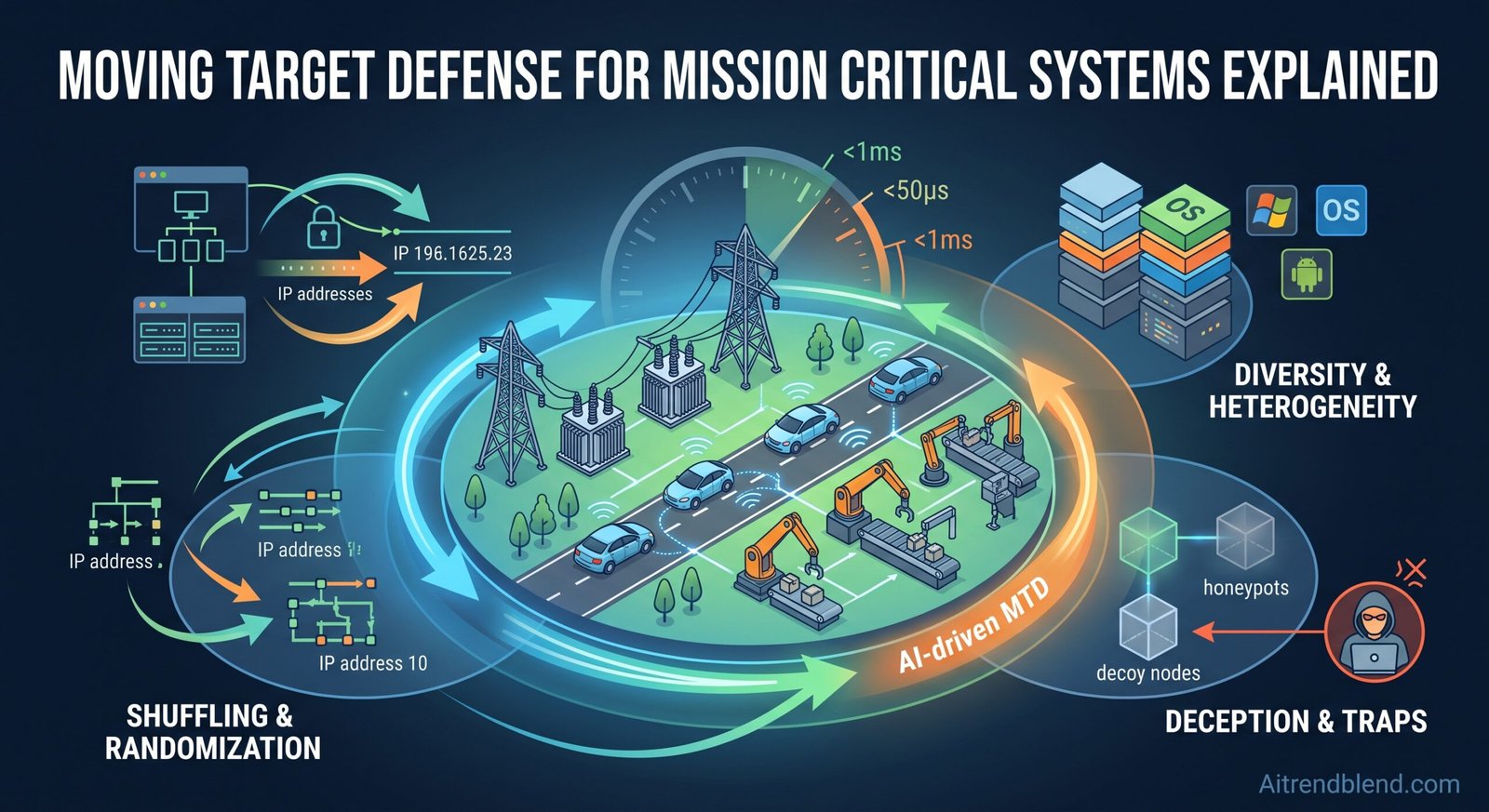
The paper organizes MTD strategy around three design questions, what to move, how to move, and when to move. What to move covers the actual system attributes in play, network configurations, IP addresses, software versions. How to move covers the mechanism, shuffling, randomization or diversification. When to move covers timing, fixed intervals, random intervals, or event triggered responses to detected anomalies. That three question framing is a clean way to organize what could otherwise be an unwieldy design space, and it holds up well across every domain the paper later surveys.
From there the paper groups concrete strategies into three families. Shuffling randomizes parameters like IP addresses or port numbers to frustrate reconnaissance. Diversity spreads defenses across heterogeneous hardware, software or protocols so a single exploit cannot compromise the whole system. Deception introduces decoy nodes or false data to mislead attackers and, as a side benefit, gather threat intelligence about how they operate. A separate axis classifies activation timing as reactive, triggered by detected anomalies, proactive, running on a fixed schedule regardless of detected threats, or hybrid, blending both to stay unpredictable while limiting the window an undetected threat can exploit.
What separates CPS security from ordinary IT security
The paper makes a genuinely useful distinction here that a lot of general cybersecurity content glosses over. Traditional IT security organizes around the confidentiality, integrity and availability triad, commonly called the CIA triad. CPS security, the paper argues, needs a fourth pillar, authenticity, because so many CPS interactions happen without a human in the loop to catch an impersonated sensor or a spoofed actuator command. Without authenticity, the other three pillars can silently erode. A sensor reporting false but internally consistent readings does not obviously look like a confidentiality, integrity or availability failure in the moment, yet it can drive a control system toward an unsafe state just as effectively as any of those three failing outright.
Worth remembering
The paper also draws a sharper line than most between IT security and CPS security in terms of focus. IT security protects individual components. CPS security has to protect the relationships and interactions between components, because a breach that never crashes any single component can still erode system safety gradually over time. That framing matters more than it sounds, since it means a CPS defense that looks fine component by component can still be failing at the system level.
Domain by domain, what actually works and what it costs
The paper’s domain sections are its most concrete contribution, and each closes with an observations paragraph that is candid about tradeoffs rather than purely celebratory. In small and medium IoT environments, decoy nodes and operating system diversity raise attacker workload effectively, but hardware constraints limit how often shuffling can run, and decoy nodes need periodic refreshing to stay convincing. One cited study reduced denial of service likelihood by 70 percent at the cost of a 19 percent increase in system overhead, a tradeoff ratio that is at least stated plainly rather than buried.
Industrial IoT gets strategies built around stochastic switching and game theoretic modeling of attacker defender interactions, validated in testbeds ranging from a quadruple tank process to an autonomous vehicle hardware in the loop setup. The paper’s own observation here is blunt, precise modeling of system parameters is crucial for these stochastic approaches, and that precision requirement is exactly what makes the strategies hard to scale to large or highly heterogeneous industrial deployments.
Smart grid MTD is where the numbers get most impressive and also where the physical stakes are highest. Cyber physical MTD strategies that dynamically vary transmission line reactance using flexible AC transmission devices reportedly block over 90 percent of false data injection attempts in some cited simulations, with under 9 percent added latency. That is a strong result, but it is worth noting these are simulation results on IEEE test bus systems rather than field deployments, and the paper’s own observation section flags that D-FACTS device costs and coordination requirements across large grid networks remain real deployment barriers.
Vehicular systems bring the tightest timing budgets in the whole survey. CAN bus identifier randomization schemes report sub millisecond overhead in several cited studies, which matters enormously given that these systems sit directly between a cyberattack and a moving vehicle’s braking or steering behavior. Software defined networks turn out to be a naturally good fit for MTD because their centralized, programmable control plane makes reconfiguration cheap, though the paper notes that frequent reconfiguration at scale introduces its own latency and operational overhead. Cloud environments show the lowest real time sensitivity of any domain surveyed, unsurprising given that cloud workloads are generally far more latency tolerant than a braking system or a grid relay.
The AI assisted MTD section is the paper’s most honest chapter
Reinforcement learning, deep Q networks, actor critic methods and meta reinforcement learning all show up as ways to make MTD smarter, choosing when to shuffle, what to diversify, and how aggressively to respond based on observed attacker behavior rather than a fixed schedule. The results reported are often striking, one cited deep reinforcement learning approach for false data injection detection in power systems reportedly cut the false positive rate from 12.8 percent to 1.8 percent while reaching 96 percent detection accuracy.
What makes this section stand out is the systematic evaluation the authors run afterward, scoring six representative AI driven MTD techniques across five dimensions, decision latency, model complexity, data requirements, robustness to distribution shifts, and explainability.
| Technique | Latency | Robustness to shifts | Explainability | Hardware |
|---|---|---|---|---|
| DDPG routing randomization | 15 to 25 ms | Not evaluated | None | Cloud |
| A3C address mutation | 30 to 50 ms | Partial | None | Edge |
| Meta reinforcement learning | 200 to 500 ms | Not evaluated | None | GPU cluster |
| Tabular Q learning | Under 10 ms | Limited | Low | Embedded |
| DQN traffic inspection | 20 to 40 ms | Not evaluated | None | Cloud |
| LSTM autoencoder | 50 to 100 ms | Limited | Low | Edge |
Look at that robustness column. Three of the six approaches were simply not evaluated for how they behave when conditions shift away from their training distribution, and none of the six offers more than low explainability. This is exactly the kind of table a survey is supposed to produce, one that lets a reader see the gap between what a technique claims in its headline result and what the technique has actually been checked against. The paper’s own text is equally direct about the consequence, none of the surveyed approaches provide worst case execution time bounds or formal schedulability analysis, which is a real problem for anything claiming applicability to hard real time systems where a missed deadline is not a degraded experience but a potential safety failure.
Where control theory enters the picture
One of the more technically substantial contributions is an attempt to formalize how MTD interacts with control system stability rather than treating security and control as separate concerns. The paper models MTD induced changes as a bounded perturbation on top of normal system dynamics.
\( \dot{V}(x) \leq -\alpha V(x) + \beta \left\| \delta_{\text{MTD}}(t) \right\| \)
where \( V(x) \) is a Lyapunov function for the system without any defense running, \( \delta_{\text{MTD}}(t) \) is the disturbance the defense mechanism itself introduces, and \( \alpha, \beta > 0 \). The claim is that stability holds as long as the defense’s own disruption stays bounded, consistent with standard input to state stability results. Separately, MTD operations get modeled as periodic real time tasks with utilization \( U_{\text{MTD}} = C_{\text{MTD}} / T_{\text{MTD}} \), the execution cost divided by how often the defense runs, so that a defense’s overhead can be checked against standard schedulability analysis rather than assumed to be free.
This is a genuinely useful contribution because it gives future researchers a shared vocabulary for checking whether a proposed defense might destabilize the very system it protects, something almost none of the 114 surveyed studies actually verify. The catch, which the paper is upfront about, is that this framework is proposed rather than demonstrated at scale, very few of the surveyed studies actually report the values needed to plug into these formulas, so the equations describe what should be checked more than they summarize what has been checked.
A closer look at the paper’s own scorecard
The survey includes a related work comparison table grading thirteen prior MTD surveys against six criteria, including cyber threat coverage, MTD evaluation depth, AI or ML coverage, and real time direction. Every prior survey gets marked no, partially, or comprehensive on each column. The row for this survey itself is marked comprehensive on every single column.
There is nothing dishonest about this, self positioning tables are standard practice in academic surveys, and the paper’s actual content mostly backs up the claim, the domain coverage is genuinely broad and the AI assisted MTD section genuinely does go deeper than a typical survey chapter. But a reader should notice that this is the authors grading their own work using criteria the authors themselves defined, not an independent assessment. The same pattern shows up again in Table 20, the paper’s headline comparative evaluation of MTD strategies across CPS domains, which scores security effectiveness, real time impact and deployment feasibility using a plus sign scale, limited, moderate or strong, rather than numbers pulled from a shared benchmark. That is a reasonable way to summarize thirty plus heterogeneous studies that were never designed to be compared against each other, but it means the paper’s central evaluation framework, the thing it presents as its main methodological contribution, ultimately produces a qualitative rating rather than a number a reader could independently verify.
Honest limitations, both the paper’s and this coverage of it
The paper is refreshingly candid about several of its own gaps, more so than most surveys manage. Its cross dimensional synthesis in section seven states plainly that only a small number of studies jointly evaluate security effectiveness, real time impact and control or safety impact together, and that most literature in IoT, SDN and cloud contexts remains security centric with little attention paid to timing or control implications. That kind of self critical accounting is exactly what makes a survey trustworthy, and this one earns credit for including it rather than glossing over the gap it just spent nine sections building a framework to fill.
Where a reader should stay cautious is in treating any single cited number, the 70 percent denial of service reduction, the 90 percent false data injection block rate, the 96 percent detection accuracy, as representative of the technique’s general performance rather than a result from one specific simulated testbed. None of these figures come from a shared benchmark, and the paper’s own admission about fragmented evaluation practices applies just as much to the individual numbers a reader might be tempted to quote out of this coverage as it does to the literature the survey is critiquing. The publication timeline chart discussed earlier is a similar case, a number that looks meaningful, MTD research declining in 2024, but likely reflects search cutoff timing more than an actual trend, and the paper does not flag that possibility itself.
Conclusion
What this survey does well is refuse to treat security as a standalone concern. Building an evaluation lens around security effectiveness, real time impact and control or safety impact, and then actually trying to apply it across 114 studies from IoT to smart grids to vehicles, is a more ambitious project than most MTD literature reviews attempt, and the domain by domain observations sections back up that ambition with specific, sourced tradeoffs rather than generic pros and cons lists. The distinction the paper draws between IT security’s component level focus and CPS security’s relationship level focus is a genuinely useful lens that readers can carry into other CPS security literature well beyond this one paper.
The AI assisted MTD evaluation table is the standout contribution here, precisely because it does not flatter the field it is covering. Reporting that three of six representative deep learning approaches were never checked for robustness under distribution shift, and that none of the six offer more than minimal explainability, is the kind of finding that actually helps a practitioner make a deployment decision, rather than just cataloging what exists.
Where the paper is weaker is in the gap between its methodological ambition and what its own evidence base can support. The unified evaluation framework it proposes as a central contribution resolves, in practice, to a qualitative plus sign scale rather than a shared quantitative benchmark, because the 114 underlying studies were never designed to be compared against each other on common terms. The formal control theoretic stability bound is a valuable piece of vocabulary for the field to adopt going forward, but almost none of the surveyed literature actually reports the values needed to apply it retroactively. And the self scoring in the related work table, while standard practice, is worth reading as the authors’ own assessment rather than an independently verified ranking.
The ideas here transfer well beyond CPS specifically. The tension between adaptive, unpredictable defense and deterministic, verifiable timing behavior shows up anywhere a security mechanism gets bolted onto a system with hard performance guarantees, from real time trading systems to medical device firmware. The CIA plus authenticity framing is a useful lens for any system where sensors or automated agents act without direct human verification, well beyond industrial control. And the honest accounting of AI robustness gaps in the AI assisted MTD section is a pattern worth watching for in any survey that pairs machine learning with a safety critical domain, since the gap between a headline accuracy number and a verified robustness guarantee tends to recur everywhere reinforcement learning meets infrastructure.
For now, the practical takeaway is to treat this survey as an excellent map of what has been tried and a fair warning about what has not yet been proven. A reader deciding whether to deploy a specific MTD technique in a mission critical setting will still need to check whether that technique’s original paper reports worst case execution time bounds, distribution shift testing, and control stability analysis, because this survey’s own tables make clear that most of the literature it covers does not.
Frequently asked questions
What is moving target defense in cybersecurity
Moving target defense, MTD, is a proactive security approach that continually changes system attributes, such as IP addresses, network configurations, or software versions, to make it harder for an attacker to study a system and plan an exploit. Instead of relying on a static, unchanging defense, MTD assumes the attack surface itself should keep shifting, increasing the cost, time and effort required for a successful attack.
Why is moving target defense harder to apply in cyber physical systems than in regular IT systems
Cyber physical systems, CPS, often operate under strict real time constraints where a delayed response can cause physical harm, such as a car’s braking system or a power grid’s control loop. Standard MTD techniques introduce timing variability through reconfiguration, context switches, or added computation, and that variability can conflict with the deadline guarantees CPS operation depends on. This survey argues most prior MTD research does not adequately account for that tension.
What is the difference between shuffling, diversity and deception in MTD
Shuffling randomizes system parameters like IP addresses or port numbers to frustrate reconnaissance. Diversity spreads a system across different hardware, software or communication protocols so a single vulnerability cannot compromise the entire system. Deception introduces decoy nodes or false data designed to mislead attackers and, as a side benefit, gather intelligence about their methods. Many real deployments combine more than one of these three strategies.
Is AI driven moving target defense ready for mission critical systems
Not fully, according to this survey’s own evaluation. Of six representative AI driven MTD techniques it assessed, three were never tested for robustness under changing conditions, and none offered more than minimal explainability. None of the surveyed AI approaches provide formal worst case timing guarantees, which the survey identifies as a significant barrier to deployment in systems with hard real time safety requirements.
Why does CPS security need a fourth principle beyond confidentiality, integrity and availability
Traditional IT security organizes around confidentiality, integrity and availability, known as the CIA triad. This survey argues cyber physical systems need a fourth pillar, authenticity, because many CPS components, sensors and actuators, interact without direct human oversight. Without verifying that a sensor or device is genuinely what it claims to be, an attacker can inject false but consistent data that erodes the other three security goals without triggering an obvious failure.
Read the full peer reviewed paper for every domain table and the complete taxonomy.
Read the paper on ScienceDirect Browse the Federated Learning pillarPonnuru, R.B., Mukherjee, R., Azab, M., Chantem, T., and Gracanin, D. Moving target defense strategies for mission critical cyber physical systems, a comprehensive survey and open challenges. Computer Science Review, volume 62, article 101029, 2026. https://doi.org/10.1016/j.cosrev.2026.101029
This analysis is based on the published paper and an independent evaluation of its claims.