Image Segmentation

Image segmentation is the task of labeling an image at the pixel level, and it underpins much of modern medical imaging, autonomous perception, and scene understanding. Here we break down segmentation architectures, loss functions, and evaluation practices, with frequent attention to the medical settings where boundary accuracy and robustness matter most. Each piece traces the method back to its source research.

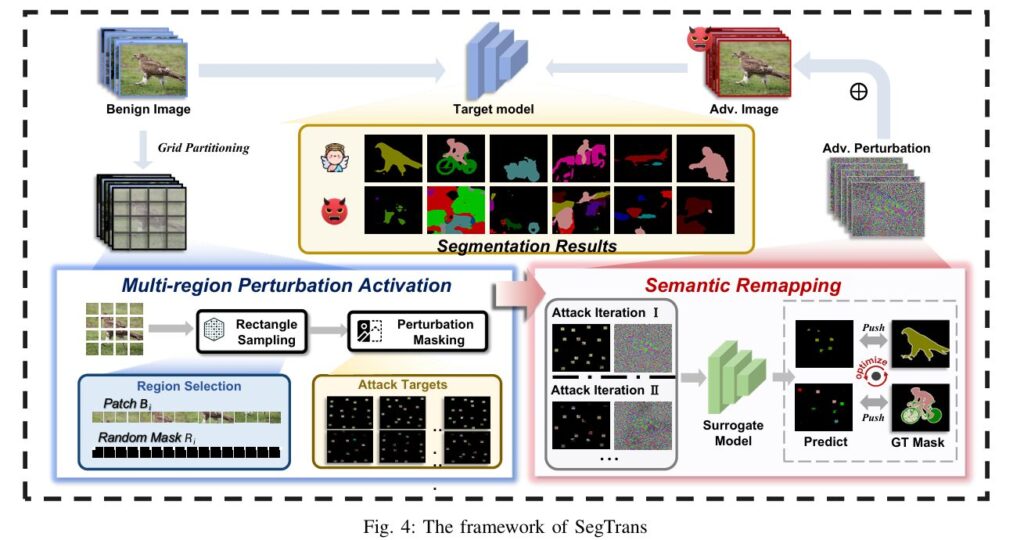
The framework of SegTrans.

SegTrans: The Transfer Attack That Finally Broke Segmentation Models (Without Extra Compute)

SegTrans: The Transfer Attack That Finally Broke Segmentation Models (Without Extra Compute) | AI Security Research Adversarial Machine Learning · arXiv:2510.08922v1 [cs.CV] · 18 min read SegTrans: How to Make Adversarial Examples Transfer Across Segmentation Models Without Extra Cost Segmentation models correct each other’s mistakes through a “tight coupling” phenomenon – which makes them brutally […]

SegTrans: The Transfer Attack That Finally Broke Segmentation Models (Without Extra Compute) Read More »

TAM: Plug-and-Play Temporal Attention Module for Motion-Guided Cardiac Segmentation

TAM: Plug-and-Play Temporal Attention Module for Motion-Guided Cardiac Segmentation

TAM: Plug-and-Play Temporal Attention Module for Motion-Guided Cardiac Segmentation | MedAI Research MedAI Research machine Learning About Cardiac AI · Medical Image Analysis, 2026 · 17 min read The Plug-and-Play Module That Taught Neural Networks to Watch the Heart Move A compact temporal attention module called TAM quietly outperforms much heavier architectures on cardiac segmentation

TAM: Plug-and-Play Temporal Attention Module for Motion-Guided Cardiac Segmentation Read More »

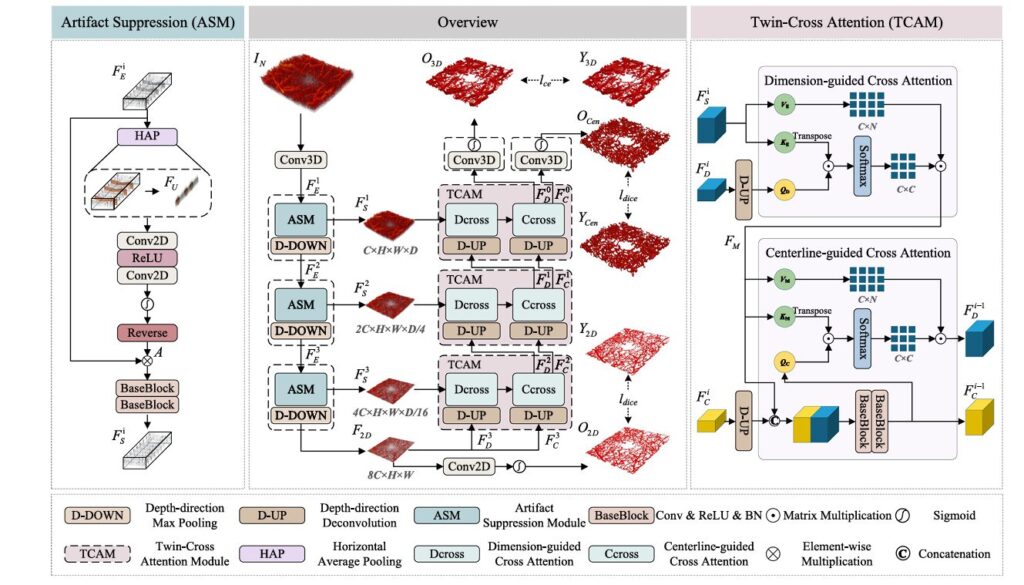
The MT-Net encoder-decoder architecture with dimension transformation. D-DOWN operations compress depth while preserving lateral structure; D-UP operations restore volumetric resolution during decoding

MT-Net: 3D Retinal Microvascular Segmentation via Multi-Scale Topology Regulation

MT-Net: 3D Retinal Microvascular Segmentation via Multi-Scale Topology Regulation Medical Image Analysis · 2026 Vol. 110 · doi:10.1016/j.media.2026.103988 When the Vessels Disappear in Three Dimensions:MT-Net and the Geometry of Retinal Blood Flow Ophthalmic AI ~2,600 words · 12 min read Luo, Zhang et al. — Ningbo University & Chinese Academy of Sciences Every ophthalmologist interpreting

MT-Net: 3D Retinal Microvascular Segmentation via Multi-Scale Topology Regulation Read More »

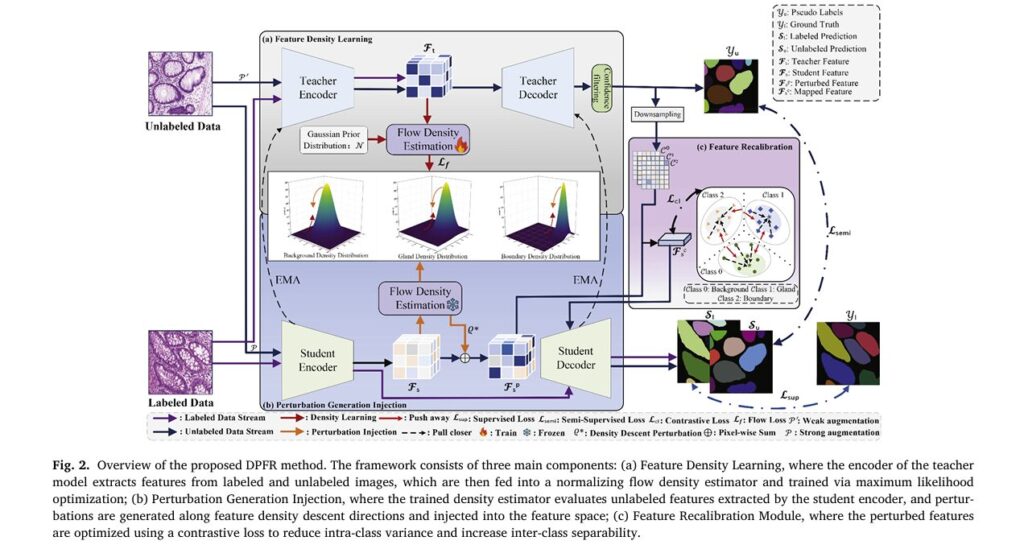
DPFR: A Breakthrough in AI-Powered Gland Segmentation for Cancer Diagnosis

DPFR: A Breakthrough in AI-Powered Gland Segmentation for Cancer Diagnosis

Introduction: The Critical Challenge in Digital Pathology The early detection and accurate grading of cancer remains one of modern medicine’s most pressing challenges. For pathologists worldwide, the assessment of gland morphology in histopathological images serves as the gold standard for cancer diagnosis—particularly in colorectal and prostate cancers. However, this critical diagnostic process faces a fundamental

DPFR: A Breakthrough in AI-Powered Gland Segmentation for Cancer Diagnosis Read More »

M2CR: Revolutionizing Primary Liver Cancer Diagnosis with AI-Powered Multimodal Analysis

M2CR: Revolutionizing Primary Liver Cancer Diagnosis with AI-Powered Multimodal Analysis

Primary liver cancer stands as the third leading cause of cancer-related deaths worldwide, claiming hundreds of thousands of lives annually. Despite advances in medical imaging, diagnosing the three distinct subtypes—hepatocellular carcinoma (HCC), intrahepatic cholangiocarcinoma (ICC), and the rare combined hepatocellular-cholangiocarcinoma (cHCC-CCA)—remains a complex challenge that demands both radiological expertise and comprehensive clinical assessment. A revolutionary

M2CR: Revolutionizing Primary Liver Cancer Diagnosis with AI-Powered Multimodal Analysis Read More »

Revolutionary DMGSA Model: How AI is Transforming Automated Airway Segmentation for Lung Disease Detection

DMGSA Traces Lung Airways With Far Fewer Labeled CT Scans

AI for medical imaging and healthcare · Analysis by the aitrendblend editorial team · Based on Zhang, Nan, Fang et al., Medical Image Analysis 108 (2026) 103867 airway segmentation CT imaging pulmonary fibrosis COVID-19 masked image modeling adversarial learning unsupervised learning A note before you read on. This article explains a published research paper about

DMGSA Traces Lung Airways With Far Fewer Labeled CT Scans Read More »

TransUNet: How Transformer Architecture Revolutionizes Medical Image Segmentation

TransUNet And Where Transformers Help Medical Segmentation

Analysis by the aitrendblend editorial team · Technical review · 14 min read Medical Imaging Vision Transformers Segmentation Architecture Design Ask ten different medical imaging papers where to put a transformer inside a U-Net and you will get ten different answers, mostly because nobody had run the controlled experiment to actually check. A team spanning

TransUNet And Where Transformers Help Medical Segmentation Read More »

tbconvl-net-hybrid-medical-image-segmentation

TBConvL-Net Pairs Swin Transformers With ConvLSTM for Segmentation

Analysis by the aitrendblend editorial team, filed under AI for Medical Imaging and Healthcare About an 18 minute read Medical Image Segmentation Swin Transformer ConvLSTM Hybrid CNN Architecture Skin Lesion Segmentation Most segmentation papers pick one organ, one modality, and one dataset, then spend the whole paper proving a single number went up. A team

TBConvL-Net Pairs Swin Transformers With ConvLSTM for Segmentation Read More »

proposed Seg-Zero model

Seg-Zero Teaches Segmentation Models To Reason From Scratch

Analysis by the aitrendblend editorial team · Computer vision · Source paper published March 2025, revised May 2026 Reasoning Segmentation Reinforcement Learning GRPO Qwen2.5-VL SAM2 Ask a segmentation model to find “the player” in a photo of a baseball game and it has no idea what you mean unless someone already taught it what a

Seg-Zero Teaches Segmentation Models To Reason From Scratch Read More »

SegTrans: The Breakthrough Framework That Makes AI Segmentation Models Vulnerable to Transfer Attacks

SegTrans Explained, Why Segmentation Models Cannot Hide Behind Context

AI SECURITY & ADVERSARIAL ROBUSTNESS · 15 MIN READ · Analysis by the aitrendblend editorial team SegTrans transfer attack semantic segmentation adversarial robustness tight coupling feature fixation A segmentation model has a quiet advantage that a plain image classifier does not. When it sees a person standing next to a bicycle, it uses that relationship

SegTrans Explained, Why Segmentation Models Cannot Hide Behind Context Read More »