Machine Learning

Machine learning sits at the core of everything we cover at AI Trend Blend. This section gathers our research breakdowns, method explainers, and practical analyses across supervised, self-supervised, and generative learning, with a steady focus on the ideas that actually move results rather than the noise around them. You will find work spanning optimization, model architectures, training dynamics, and the theory that explains why modern systems behave the way they do, written for readers who want depth without filler.

SurgeNetXL: Revolutionizing Surgical Computer Vision with Self-Supervised Learning

SurgeNetXL: Revolutionizing Surgical Computer Vision with Self-Supervised Learning

Introduction The operating room represents one of the most data-rich environments in modern medicine, yet surprisingly, computer vision technology has lagged behind other medical specialties. While pathology and radiology have embraced AI solutions at near-market deployment stages, surgical computer vision remains in its infancy—constrained not by algorithmic limitations, but by the scarcity of comprehensive, well-annotated […]

SurgeNetXL: Revolutionizing Surgical Computer Vision with Self-Supervised Learning Read More »

Revolutionary DMGSA Model: How AI is Transforming Automated Airway Segmentation for Lung Disease Detection

DMGSA Traces Lung Airways With Far Fewer Labeled CT Scans

AI for medical imaging and healthcare · Analysis by the aitrendblend editorial team · Based on Zhang, Nan, Fang et al., Medical Image Analysis 108 (2026) 103867 airway segmentation CT imaging pulmonary fibrosis COVID-19 masked image modeling adversarial learning unsupervised learning A note before you read on. This article explains a published research paper about

DMGSA Traces Lung Airways With Far Fewer Labeled CT Scans Read More »

High-Accuracy Indoor Positioning Systems: Using Galois Field Cryptography and Hybrid Deep Learning

High-Accuracy Indoor Positioning Systems: Using Galois Field Cryptography and Hybrid Deep Learning

Indoor positioning systems (IPS) have emerged as a critical technology in the age of smart manufacturing, logistics, and enterprise solutions. Unlike GPS, which relies on satellite signals that cannot penetrate building structures, IPS provides accurate location tracking within enclosed environments. This capability has become indispensable for warehouses, hospitals, shopping malls, airports, and manufacturing facilities where

High-Accuracy Indoor Positioning Systems: Using Galois Field Cryptography and Hybrid Deep Learning Read More »

Title: Next-Gen Data Security: A Deep Dive into Multi-Layered Steganography Using Huffman Coding and Deep Learning

Next-Gen Data Security: A Deep Dive into Multi-Layered Steganography Using Huffman Coding and Deep Learning

Introduction In an era where digital connectivity is ubiquitous, the sanctity of data transmission has never been more critical. As we navigate the complex landscape of the digital world, traditional methods of securing information—such as basic encryption and simple data hiding—are increasingly being challenged by sophisticated cyber threats. The need for robust, imperceptible, and efficient

Next-Gen Data Security: A Deep Dive into Multi-Layered Steganography Using Huffman Coding and Deep Learning Read More »

Radar Gait Recognition Using Swin Transformers: Beyond Video Surveillance

Radar Gait Recognition Using Swin Transformers: Beyond Video Surveillance

In an era where privacy concerns and environmental limitations increasingly challenge traditional video-based biometric systems, a sophisticated new approach to human identification is emerging from the intersection of radar technology and deep learning. Video-based gait recognition, while successful in many applications, suffers from significant limitations including potential privacy issues and performance degradation due to dim

Radar Gait Recognition Using Swin Transformers: Beyond Video Surveillance Read More »

TransUNet: How Transformer Architecture Revolutionizes Medical Image Segmentation

TransUNet And Where Transformers Help Medical Segmentation

Analysis by the aitrendblend editorial team · Technical review · 14 min read Medical Imaging Vision Transformers Segmentation Architecture Design Ask ten different medical imaging papers where to put a transformer inside a U-Net and you will get ten different answers, mostly because nobody had run the controlled experiment to actually check. A team spanning

TransUNet And Where Transformers Help Medical Segmentation Read More »

tbconvl-net-hybrid-medical-image-segmentation

TBConvL-Net Pairs Swin Transformers With ConvLSTM for Segmentation

Analysis by the aitrendblend editorial team, filed under AI for Medical Imaging and Healthcare About an 18 minute read Medical Image Segmentation Swin Transformer ConvLSTM Hybrid CNN Architecture Skin Lesion Segmentation Most segmentation papers pick one organ, one modality, and one dataset, then spend the whole paper proving a single number went up. A team

TBConvL-Net Pairs Swin Transformers With ConvLSTM for Segmentation Read More »

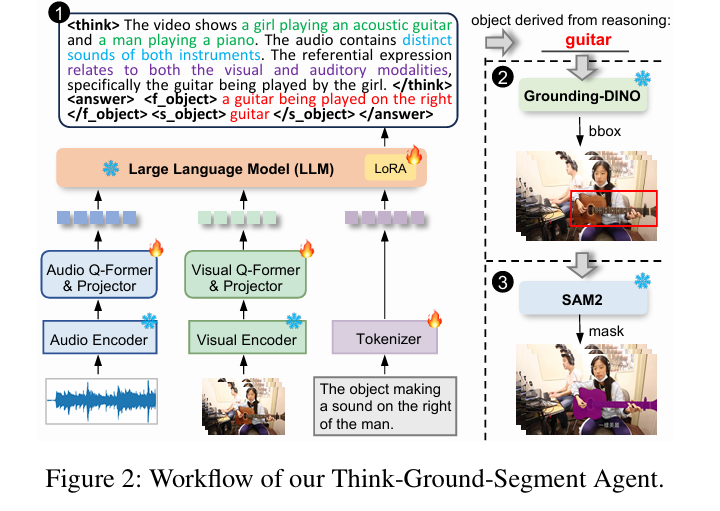
proposed Seg-Zero model

Seg-Zero Teaches Segmentation Models To Reason From Scratch

Analysis by the aitrendblend editorial team · Computer vision · Source paper published March 2025, revised May 2026 Reasoning Segmentation Reinforcement Learning GRPO Qwen2.5-VL SAM2 Ask a segmentation model to find “the player” in a photo of a baseball game and it has no idea what you mean unless someone already taught it what a

Seg-Zero Teaches Segmentation Models To Reason From Scratch Read More »

DVIS++: The Game-Changing Decoupled Framework Revolutionizing Universal Video Segmentation

Decoupled Video Segmentation Outperforms End To End Models

Analysis by the aitrendblend editorial team · Computer vision · Source paper published December 2023 Video Instance Segmentation Video Panoptic Segmentation Referring Tracker Temporal Refiner Open Vocabulary Three horses graze in tall grass, drifting in and out of each other’s silhouettes for nearly a hundred frames. This single clip from the OVIS validation set breaks

Decoupled Video Segmentation Outperforms End To End Models Read More »

Video Segmentation Looked Solved Until MOSEv2 Cut SAM2's Score in Half

Video Segmentation Looked Solved Until MOSEv2 Cut SAM2’s Score in Half

Analysis by the aitrendblend editorial team. Twelve minute read. Source paper posted to arXiv, September 2025. Video Object Segmentation MOSEv2 SAM2 Complex Scenes Occlusion Benchmark Video Object Tracking Dataset Paper A tiny person crossing a packed square, a car ducking under an overpass, a shadow with no fixed shape. None of it looks like DAVIS.

Video Segmentation Looked Solved Until MOSEv2 Cut SAM2’s Score in Half Read More »