
Key Points
- Standard benchmarks compress model behavior into one number, which hides exactly the failure modes that matter for real work.
- The prompts that actually separate models tend to fall into a small set of categories, not a giant test suite.
- Multi step arithmetic wrapped in a story problem is a reliable way to catch a model quietly skipping a step.
- Asking a model to admit uncertainty, rather than answer confidently, separates models faster than asking it a hard question outright.
- Long context recall late in a document exposes attention weaknesses that short prompts never touch.
- None of this replaces a real evaluation harness for production decisions, it is a fast way to get a feel for a model before you commit to it.
Most people compare models the wrong way. They open two chat windows, type something like explain quantum computing, read both answers, and decide the one that sounds more confident is smarter. That tells you almost nothing. Both models were trained on enough physics writing that a general explanation is close to memorized. You are comparing writing style, not capability.
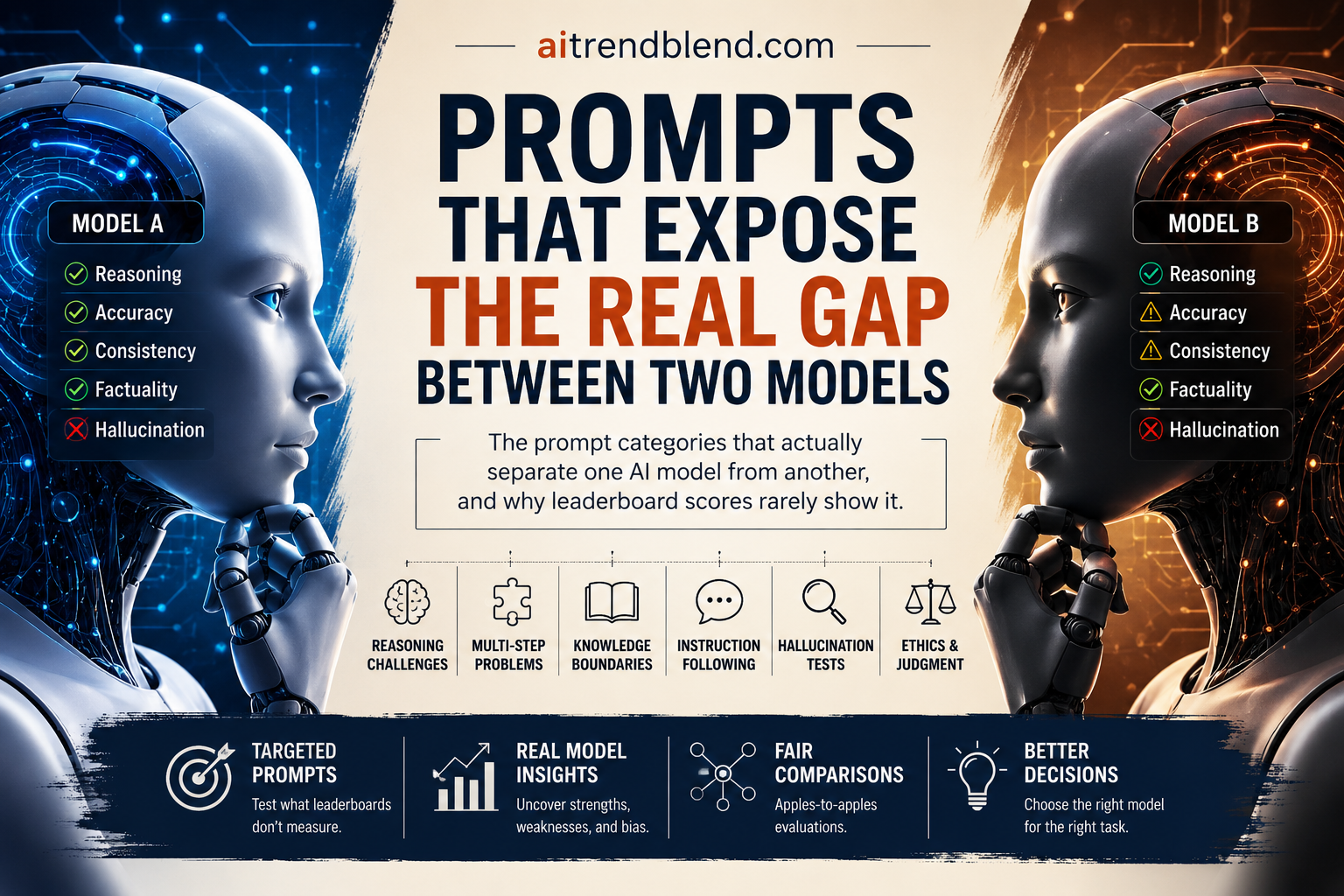
The gap between two models rarely shows up on the easy questions. It shows up on the prompts that force a model off its training distribution, that require it to hold several pieces of information in mind at once, or that quietly punish it for guessing instead of reasoning. Here is where it gets interesting. Once you know what those prompts look like, you can build a small personal test set in about ten minutes and learn more about a model than a leaderboard score will tell you in a week.
Why benchmark scores flatten real differences
A benchmark like MMLU or GSM8K reports one aggregate number across thousands of questions. That number is useful for tracking progress release over release, but it buries the shape of the errors. A model can score well on a math benchmark by getting the easy sixty percent of questions right and the hard forty percent wrong in a predictable pattern, and a competing model can score the same overall number while failing on a completely different forty percent. The average looks identical. The behavior underneath does not.
This matters because your actual use case is not a random sample of benchmark questions. If you are building a customer support tool, you care about the model’s behavior on ambiguous refund requests, not its score on abstract algebra. The benchmark tells you almost nothing about that specific slice of behavior. A handful of well chosen prompts, run by hand, tells you a lot more.
The prompt categories that actually separate models
Buried instructions inside a longer request
Write a prompt with five distinct instructions, but bury the third one in the middle of a paragraph instead of listing it clearly. For example, ask a model to summarize an article, and somewhere in the middle of your instructions mention that the summary must avoid the word innovative and must be under one hundred words. Weaker models will nail the obvious instructions and quietly drop the buried one. Stronger models track every constraint regardless of where it sits in the prompt. This single test tells you more about a model’s instruction following reliability than a dozen simple one line prompts.
Arithmetic hidden inside a word problem
Do not ask a model to compute 47 times 83. Ask it a multi step story problem where the arithmetic is one part of several. A bakery sells muffins for a certain price, gets a discount on a bulk order, has a delivery fee that only applies past a threshold, and you ask for the final total. Models that reason step by step get this right. Models that pattern match toward a plausible sounding number, without actually tracking the running total, get it subtly wrong in a way that reads confidently correct if you do not check the math yourself.
Asking the model to say it does not know
Give a model a specific, obscure, plausible sounding but fake detail, such as a fictional paper title attributed to a real researcher, and ask it to summarize the paper’s findings. A model that has been trained and tuned to prioritize honesty over helpfulness will say it cannot find that paper and ask for more context. A model tuned harder toward being agreeable will often invent a plausible summary rather than admit the gap. This single prompt is one of the fastest ways to separate models on hallucination behavior, and it costs you nothing to run.
Long context recall from the middle of a document
Paste in a long document, several thousand words, and ask a specific factual question whose answer sits somewhere in the middle third of the text, not the beginning or the end. Models are generally strong at recalling information near the start and end of a long context and weaker in the middle, an effect researchers have called lost in the middle. The size of that weak spot varies a lot between models, and it is one of the most practically important gaps if you are doing document analysis, contract review, or research summarization.
Self correction under gentle pressure
Ask a model a question with a correct, verifiable answer. Once it answers correctly, push back and say you think it is wrong, without giving a reason. A model with a reasonably calibrated sense of its own confidence will hold its position and explain why, or ask what specifically seems wrong. A model tuned too heavily toward agreeableness will often cave and produce an incorrect revised answer just to satisfy the pushback. This test reveals something benchmarks almost never capture, which is how a model behaves under social pressure rather than under a neutral question.
| Prompt category | What it reveals | Why it beats a simple question |
|---|---|---|
| Buried instruction | Instruction following under complexity | Simple prompts have no competing demands on attention |
| Word problem arithmetic | Genuine step by step reasoning versus pattern matching | Direct math prompts can be answered from memorized examples |
| Fabricated reference | Honesty calibration and hallucination rate | Real facts do not test what happens when there is no real answer |
| Mid document recall | Attention across long context | Short prompts never exercise long range retrieval |
| Gentle pushback | Confidence calibration under social pressure | A single correct answer does not show how the model behaves when challenged |
The gap between two models is rarely about what they know. It is about what they do when they are not sure.Working principle behind this comparison framework
What the differences usually turn out to be about
When you actually run these prompts across a few current models, the pattern that shows up again and again is not raw knowledge. Every mainstream model today has read enough of the internet to know roughly the same set of facts. The differences cluster around three things. How carefully the model tracks multiple constraints at once. How willing it is to say it does not know rather than produce something plausible. And how much it holds its ground when a user pushes back without giving a reason.
Those three traits map fairly directly onto how a model was fine tuned after pretraining, not onto how big it is or how much data it saw. A smaller model tuned carefully for calibrated honesty can outperform a larger model tuned mainly for user satisfaction scores on exactly the prompts described above. This is part of why raw parameter count stopped being a useful predictor of real world reliability a while ago.
Reasoning models change the picture, but not completely
Models built around extended reasoning, the kind that generate a long internal chain of thought before answering, tend to do noticeably better on the buried instruction and word problem categories, because the extra reasoning steps give them room to catch their own mistakes. They do not automatically do better on the fabricated reference test, because the tendency to invent a plausible answer is a separate behavior from the ability to reason carefully once information is actually available. A model can reason its way through a complex math problem and still confidently invent a paper that does not exist, because reasoning ability and honesty calibration are trained somewhat independently.
Honest limitations of this approach
None of this is a substitute for a real evaluation pipeline if you are making a production decision with real cost attached. A handful of manually run prompts gives you a fast, useful signal, but it is not statistically rigorous, and it is easy to fool yourself if you only run each prompt once. Model outputs vary between runs even at the same temperature setting on some systems, so a single failure on one category is a signal to investigate, not proof of a permanent weakness. Run each category prompt three or four times before drawing a conclusion.
There is also a moving target problem. Providers update models frequently, sometimes without renaming them, so a comparison you ran three months ago may no longer describe the model you are using today. Treat this framework as a habit to repeat periodically, not a one time verdict you can rely on indefinitely.
Conclusion
The instinct to compare models by asking them the same easy question and reading the tone of the answer is understandable, and it is also almost useless. Easy questions sit comfortably inside every major model’s training distribution, and the answers you get back are closer to a writing style comparison than a capability comparison. The actual gaps between models live in the places that require sustained attention, honest uncertainty, and resistance to social pressure, none of which show up when you ask something a model has effectively memorized.
What changes once you switch to the prompt categories described here is that you start seeing the actual shape of a model’s weaknesses instead of a vague impression. A model that reliably drops the third instruction in a five part request is going to cause real problems in an automated workflow, even if it writes beautifully. A model that invents a plausible sounding but fake citation is going to cause a different kind of problem in any research or writing tool, even if its reasoning on math problems is excellent. These are specific, testable, and they matter far more for real deployment than a general sense that one model feels smarter than another.
This kind of testing also transfers well beyond comparing two chat products. The same five categories work for evaluating a fine tuned model against its base version, for checking whether a smaller distilled model has kept the important behaviors of its teacher, and for deciding whether a cheaper model is actually good enough for a specific internal tool rather than a general purpose assistant. The categories are not tied to any particular provider or architecture, they are tied to the kinds of demands that real tasks place on a model.
The honest limitation is that none of this scales into a rigorous scientific comparison without a much larger, repeated test set and statistical analysis, and it should not be mistaken for one. What it does give you, in about fifteen minutes, is a far better sense of how a model will actually behave once you hand it your specific task, which is usually the only comparison that matters.
As reasoning focused models and longer context windows keep pushing the frontier forward, expect the categories that reveal real gaps to shift too. Buried instructions and mid document recall may become less discriminating as models improve at both. Honesty calibration under a fabricated fact and composure under gentle pushback look like the more durable tests, because they are about how a model was tuned to behave, not just what it is capable of computing. Save your ten prompts, rerun them every few months, and you will learn more about where the field is actually heading than any single leaderboard update will tell you.
Build Your Own Model Comparison Set
Try the Chatbot Arena to see how thousands of head to head model comparisons get scored in practice, then build your own ten prompt test using the categories above.
Frequently Asked Questions
What is the fastest way to tell two AI models apart
Run the same set of five to ten prompts across both models, using categories that stress instruction following, multi step reasoning, honesty about uncertainty, long context recall, and resistance to pushback. Easy general knowledge questions rarely show a difference because most current models handle them equally well.
Do bigger models always win these comparisons
Not consistently. Fine tuning choices around honesty and instruction following often matter more for these specific prompt categories than raw parameter count. A smaller model tuned carefully can outperform a larger model on the fabricated reference test or the buried instruction test.
Why do models fail at recalling information from the middle of a long document
This pattern is commonly described as lost in the middle. Attention tends to weight the beginning and end of a long context more heavily, so factual details placed in the middle third of a long document are recalled less reliably than details near either edge, and the size of this effect varies between models.
Is asking a model about a fake paper a fair test
Yes, as long as the fake detail is specific and plausible sounding rather than obviously absurd. The point is to see whether the model checks its own certainty before answering or fills the gap with a confident guess. A model that asks for clarification or says it cannot verify the reference is showing better calibration than one that invents a summary.
How many times should I run each test prompt before trusting the result
Run each prompt at least three times. Model outputs can vary between runs even at a low temperature setting, so a single pass is not enough to separate a genuine weakness from ordinary variance.
Does this replace formal model evaluation for production use
No. This approach is meant for fast, practical screening before you commit real engineering time to a model. Production decisions with real cost attached still deserve a proper evaluation set with repeated trials and statistical analysis specific to your task.
Related Reading
This analysis is an original practical framework built by the aitrendblend editorial team from direct testing patterns and general prompt engineering practice.