
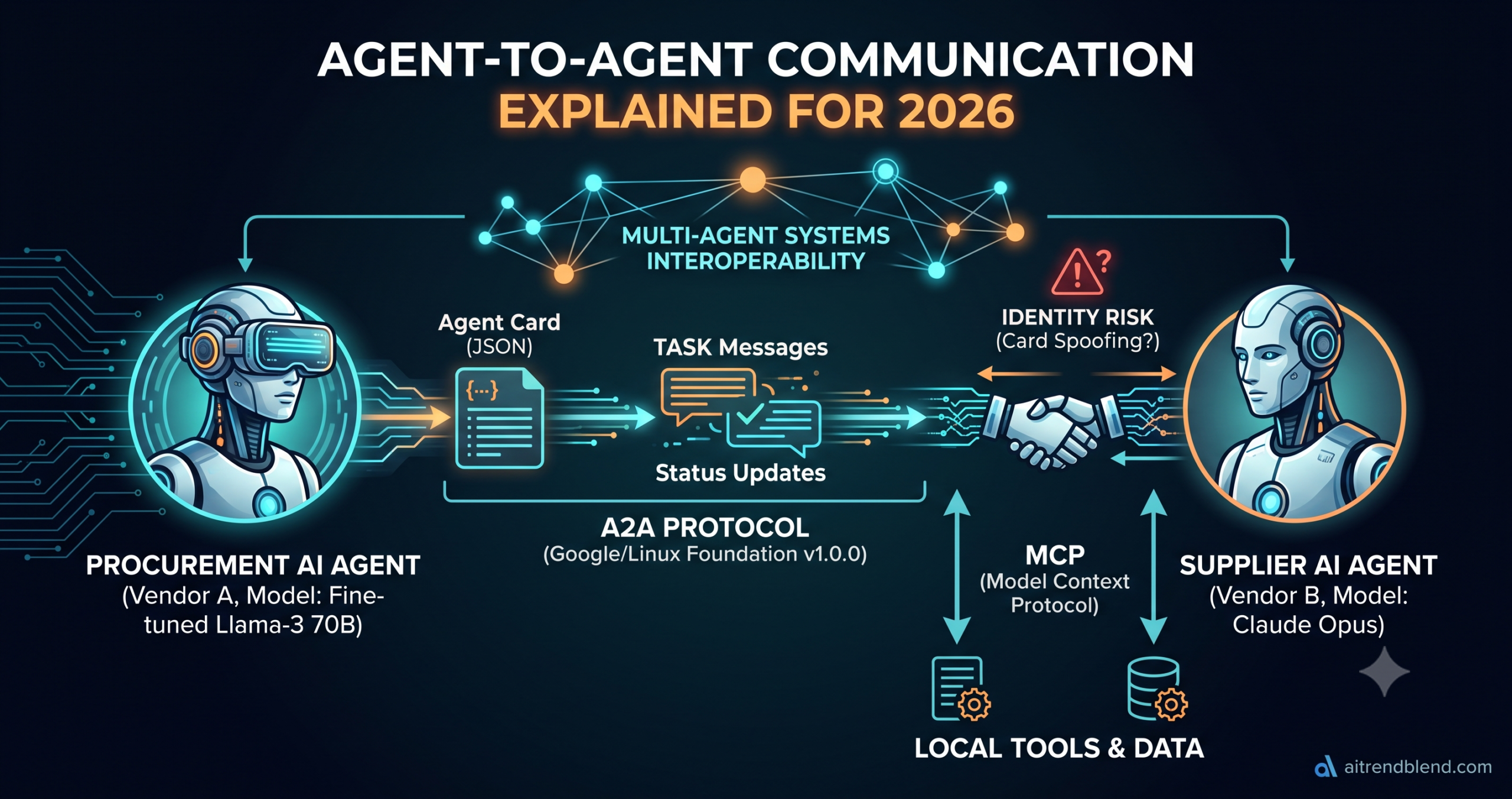
Key points
- Google’s Agent2Agent protocol, known as A2A, reached version 1.0.0 in January 2026 and moved from experimental to production status, with more than 150 organizations building on it by April 2026.
- A2A and Anthropic’s Model Context Protocol solve different problems. MCP connects one agent to its tools and data. A2A connects one agent to another agent, often across company boundaries.
- The ecosystem has settled on four overlapping standards so far, A2A from Google, MCP from Anthropic, ACP from IBM, and ANP from the open community.
- MCP alone has passed 110 million monthly downloads, and A2A is now integrated into Microsoft Azure AI Foundry, AWS Bedrock AgentCore, and Google Cloud.
- The same openness that lets a stranger’s agent join a workflow also lets a forged identity join one. Agent card spoofing is a documented, low cost attack against A2A deployments that only 29 percent of organizations report feeling prepared to defend against.
Why a single agent was never going to be enough
The first wave of AI agents worked alone. Give a model a goal, a set of tools, and a loop that lets it plan and act, and it can book a flight or summarize a document without much help. That model works fine right up until the task needs something the agent does not own. A travel agent that has to check a corporate expense system it was never connected to. A customer support agent that needs a shipping partner’s real time tracking data. A research agent that needs another team’s private model to run one specialized step.
The obvious fix, custom integration code for every pair of systems, does not scale. Every new agent added to a company’s stack would need bespoke connectors to every other agent it might ever need to reach. That is the same problem the web solved decades ago with HTTP, a shared language that lets any two systems talk without knowing anything about each other in advance. Agent to agent communication is the current attempt to do the same thing for autonomous AI systems, and the field has not converged on one answer, it has converged on a layered one.
Two problems, two different protocols
It helps to separate what an agent needs vertically from what it needs horizontally. Vertically, an agent needs a standard way to reach its own tools, its own files, its own databases. That is what Anthropic’s Model Context Protocol, released in November 2024, was built for. MCP defines a client server model where an AI application keeps a connection open to a tool server that exposes capabilities and context in a predictable format. Horizontally, an agent needs a way to reach a completely different agent, one it does not control and possibly does not trust yet. That is what Google’s Agent2Agent protocol, introduced in April 2025 and donated to the Linux Foundation later that year, was built for.
The two are not competitors so much as neighbors. A serious agent deployment in 2026 tends to run both at once, MCP handling the connection between an agent and its own tools, A2A handling the connection between that agent and someone else’s. Our earlier guide on building multi agent systems with Claude Opus and Gemini Flash runs into exactly this split once a workflow needs more than one vendor’s model in the loop.
What an A2A conversation actually contains
Three building blocks show up in nearly every A2A exchange. An Agent Card is a JSON document one agent publishes describing what it can do, where to reach it, and how to authenticate with it, roughly the agent equivalent of a business card with an API attached. A Task is a unit of work with its own identifier, one that can move through multiple rounds of status updates rather than resolving in a single request and response. A Message is the actual content passed back and forth while that task is in progress, which can include plain text, structured data, or file references.
None of that requires either agent to know how the other was built. One side could be running on a fine tuned open model, the other on a frontier API model from a different lab entirely. The protocol only cares that both sides speak the same envelope format.
A crowded field of four standards
A2A and MCP get most of the attention, but they are not alone. IBM has pushed its own Agent Communication Protocol, ACP, aimed at similar peer coordination problems with a different design philosophy. A community driven Agent Network Protocol, ANP, has emerged from researchers who want an open, less centrally governed alternative. None of these four has been abandoned as of mid 2026, and most serious analyses expect consolidation to take years rather than months.
| Protocol | Backed by | Primary job | 2026 status |
|---|---|---|---|
| MCP | Anthropic | Connects an agent to its own tools and data sources | Over 110 million monthly downloads across the ecosystem |
| A2A | Google, now under the Linux Foundation | Connects one agent to another, often across organizations | Version 1.0.0, production ready, 150 plus adopting organizations |
| ACP | IBM | Peer agent coordination with an alternate message design | Active development, narrower adoption than A2A or MCP |
| ANP | Open community | Decentralized agent discovery and messaging | Early stage, mostly research and pilot deployments |
“MCP defines a client server model where an AI application maintains connections to tool servers providing context and capabilities, while A2A enables peer to peer agent collaboration with bidirectional communication.” Industry protocol comparison summary, 2026
The security problem nobody has fully closed
Letting an unfamiliar agent join a workflow on the strength of a published Agent Card is powerful and also exactly the kind of trust shortcut attackers look for. Researchers have already documented a working attack pattern. A malicious agent publishes a deceptive Agent Card that overstates its own capabilities or impersonates a legitimate one, aiming to get selected by a host system doing agent discovery. Because A2A supports card signing without requiring it in most deployments, a compromised DNS record or CDN endpoint is enough to serve a spoofed card to an unsuspecting client, described by one security research group as a low cost, routine threat rather than an exotic one.
The protocol itself leaves credential management to whoever implements it, which means agent impersonation, card tampering, and replay attacks stay live risks unless a team adds its own controls. The mitigations researchers currently recommend are not exotic either, mutual TLS between agents, cryptographically signed and verified agent identities, tokens scoped to a specific audience rather than broadly valid ones, and a plan then execute separation so an agent proposes an action before a system commits to running it. Our AI Agent Security guide goes deeper on locking down permissions before any of this reaches production, and the overlap between that checklist and what A2A specifically needs is significant.
Honest limitations in what we actually know
Most of the adoption numbers cited for A2A and MCP come from the organizations building or promoting the protocols, Google, Anthropic, the Linux Foundation, and vendors selling supporting infrastructure. That does not make the numbers wrong, but it does mean independent, third party audits of real production traffic are still thin on the ground. A count of “adopting organizations” also does not tell us how many of those deployments are pilots versus full production systems handling real customer workflows.
The security research is further ahead of the deployment reality than most teams would like. Threat models for A2A, MCP, ACP, and ANP have been published and are reasonably thorough, but the survey finding that only 29 percent of organizations feel prepared to secure these systems suggests the gap between known risks and applied defenses is wide right now, not narrowing quickly. It is also worth remembering that the four protocols are still moving targets, each has shipped multiple versions inside a single year, and any comparison written today is describing a snapshot rather than a fixed destination.
Where this is headed
None of the four protocols is likely to disappear in the next year, and that is probably fine. HTTP did not need to be the only possible way to move bytes across a network, it needed to be good enough and adopted widely enough that building on top of it made sense. A2A and MCP are on that trajectory for agent coordination specifically because major cloud providers have already wired them into their platforms rather than waiting for a single winner to emerge.
What changes next is less about new protocol versions and more about trust infrastructure catching up. Signed agent identities, audited agent registries, and standardized permission negotiation are the unglamorous pieces still being built out, and they matter more than any new feature added to the message format itself. A protocol that lets any two agents talk is only useful once both sides can be reasonably sure who they are actually talking to.
The comparison to earlier web infrastructure only goes so far, though. HTTP requests do not usually authorize a wire transfer or place a real purchase order on their own initiative. Agent to agent tasks increasingly do exactly that, which means the cost of getting authentication wrong here is higher than it was for the web’s own early, famously insecure decades.
For teams evaluating this today, the practical takeaway is not to wait for a single protocol to win before building anything. It is to build with the assumption that whichever protocol gets used will need real identity verification bolted on from day one, not retrofitted after an incident. The organizations moving fastest right now are the ones treating agent identity as seriously as they already treat human identity and access management.
Multi agent systems that spread work across models from different vendors are becoming the normal architecture rather than the exception, and the protocol layer connecting them is quietly becoming as consequential as the models themselves. Anyone building agent systems in 2026 without an opinion on this layer is missing a piece that will matter as much as which model they picked.
Frequently asked questions
What is the difference between A2A and MCP?
MCP connects an AI agent to its own tools, files, and data sources through a client server model. A2A connects one agent to a separate, independently built agent, often across company or vendor boundaries, using a peer to peer message format. Most production systems in 2026 use both at once rather than choosing one over the other.
Who created the A2A protocol?
Google introduced Agent2Agent in April 2025 and later donated it to the Linux Foundation for open governance. It reached version 1.0.0 and production ready status in January 2026.
Is agent to agent communication actually being used in production, or is it still experimental?
Both, depending on the organization. The Linux Foundation reports active production deployments in supply chain, financial services, insurance, and IT operations, and A2A is integrated into Azure AI Foundry, AWS Bedrock AgentCore, and Google Cloud. Independent, third party verification of how much of that traffic is full production versus pilot use is still limited.
What is an Agent Card?
An Agent Card is a JSON document an agent publishes that describes what it can do, where to reach it, and how to authenticate with it. It works like a machine readable business card, but because signing it is optional rather than required in most deployments, a forged card is a documented and relatively low cost attack.
Do I need to pick one protocol, A2A, MCP, ACP, or ANP?
Not necessarily. MCP and A2A solve different layers of the same stack, so many teams run both. ACP and ANP have smaller but active communities and may fit specific coordination or decentralization needs. The field has not consolidated to a single winner, and most analysts expect that to take years.
What is the biggest risk with agent to agent protocols right now?
Identity verification. The protocols make it easy for an unfamiliar agent to join a workflow based on a published capability card, and that same openness is what a spoofed or tampered card exploits. Mutual TLS, signed agent identities, and audience scoped tokens are the current recommended mitigations, and only a minority of organizations report feeling ready to implement them fully.
Go deeper on the protocols and the security layer
Read more on how A2A actually works, and see how our own agent security checklist overlaps with the mitigations this space needs.