
Key points
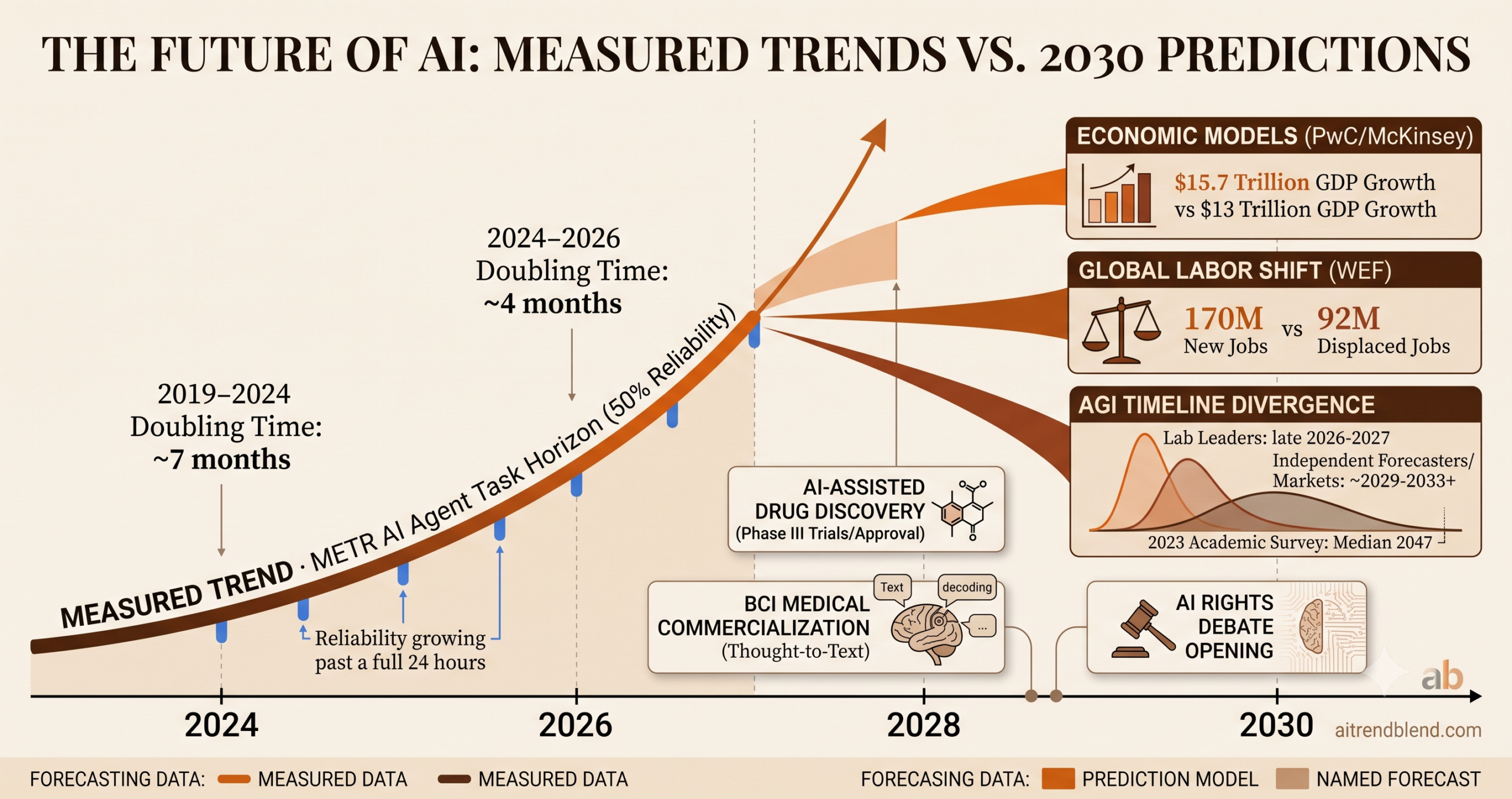
- The one genuinely measured trend, not a guess, is METR’s tracking of how long a task an AI agent can complete reliably. That capability has been doubling roughly every four months since 2024, faster than the seven month pace seen from 2019 to 2024.
- PwC projects AI could add $15.7 trillion to global GDP by 2030. McKinsey’s independent modeling lands lower, around $13 trillion. Both are economic models built on assumptions, not measurements of money that has already changed hands.
- The World Economic Forum projects 170 million new jobs created and 92 million displaced by 2030, a net gain of 78 million, though the same report notes Black and Latino workers are overrepresented in the roles most exposed to displacement.
- Forecasters disagree by years, not months, on when AI might reach human level general intelligence. Lab leaders with a commercial stake in the answer tend to name earlier dates than independent superforecasters and aggregate prediction markets.
- Some of the most science fiction sounding predictions, thought to text communication and AI systems whose welfare labs are actively researching, are grounded in real, already published clinical and research results, not pure speculation.
The one thing that is not a guess
Before getting to anyone’s predictions, it is worth separating out the part of this story that is not a prediction at all. METR, an organization that independently evaluates frontier AI models, tracks a specific measurable quantity, the length of task that a model can complete with 50 percent reliability. This number has grown exponentially for years, and the doubling time itself has been shortening. Across 2019 to 2024 it doubled roughly every seven months. From 2024 onward, METR’s own data shows a faster pace, doubling closer to every three to four months. By May 2026, the strongest models METR had assessed were operating near the edge of what its current test suite can even reliably measure, with 50 percent task horizons estimated in the range of 16 to 20 hours.
Extrapolating a trend line is still a bet on the future holding the same shape it has held in the past, and METR itself is careful to frame it that way rather than as a certainty. But this is the closest thing in this entire piece to a fact rather than a forecast, a real, tracked, published number, not an executive’s talking point.
The economic numbers everyone quotes, and what they assume When analyzing the potential AI economic impact
The two most cited 2030 economic forecasts come from PwC and McKinsey, and both are worth reading as models rather than measurements. PwC’s often quoted figure is that AI could add $15.7 trillion to global GDP by 2030, split roughly into $6.6 trillion from productivity gains and $9.1 trillion from consumption side effects as AI enabled products reach more people. McKinsey’s independent modeling arrives at a lower but still enormous number, around $13 trillion in additional global economic activity, or about 16 percent higher cumulative GDP compared with a world without this wave of AI investment.
Neither figure is a prediction that a specific dollar amount will land in a specific year. Both are built from assumptions about adoption speed, productivity gains per task automated, and how quickly capital gets deployed, the same kind of modeling every large economic forecast depends on and the same kind that has been wrong before in both directions. What is easier to verify in real time is capital expenditure. Citigroup raised its forecast for global AI related capital spending between 2026 and 2030 to $8.9 trillion, up from an earlier estimate of $8 trillion, alongside a revenue forecast of $3.3 trillion over the same window. That is money being committed now, which is a different kind of signal than a GDP model projecting seven years out.
The jobs number that hides a harder story
The World Economic Forum’s Future of Jobs research is the source almost everyone points to for AI’s labor market effect, and the headline sounds reassuring on its own. By 2030, the WEF projects that AI and related technologies will help create 170 million new roles while making 92 million existing roles redundant, a net gain of 78 million jobs globally. The survey behind that number covers roughly 1,000 companies across 22 industries and 55 economies.
The net number is real, but it flattens a distribution that matters more than the total. The WEF’s own reporting notes that frontline roles such as farm work, delivery driving and construction are expected to see some of the largest job growth in absolute terms, while Black and Latino or Hispanic workers are more likely to experience AI related job losses because they are overrepresented in the categories of roles most exposed to automation. A net positive global number can sit comfortably alongside a genuinely difficult transition for specific workers, specific regions and specific demographic groups, and the WEF’s own researchers frame the skills gap, not the job count, as the harder problem to solve. Seventy percent of surveyed companies plan to hire for new skills directly, and 85 percent are prioritizing internal upskilling, which is itself a signal that employers do not expect the transition to be frictionless.
Where AI is already rewriting science
Away from GDP models, there is a quieter, more concrete story building in laboratories. More than 173 AI discovered drug programs are already in clinical development as of early 2026, with 15 to 20 expected to enter pivotal trials this year. Insilico Medicine’s Rentosertib, developed with heavy AI involvement, is approaching Phase III trials after positive Phase IIa results published in Nature Medicine.
Anthropic’s own trajectory is a useful case study in how fast a company’s ambitions can shift. According to a widely read Forbes analysis by AI investor Rob Toews, Anthropic launched Claude for Life Sciences in October 2025, made its first ever corporate acquisition in April 2026 by buying computational biology startup Coefficient Bio for $400 million, and by May had publicly confirmed it was building its own wet labs and hiring biologists directly. Anthropic CEO Dario Amodei laid out the scale of his own ambition in an October 2024 essay called Machines of Loving Grace, predicting AI could compress fifty to a hundred years of biological progress into five to ten years. Toews goes further, predicting Anthropic could become a fully vertically integrated life sciences company by 2030, a claim worth reading as one well informed investor’s forecast rather than a settled outcome. Google DeepMind’s Isomorphic Labs offers a real precedent for a lighter version of that path, having already signed multi billion dollar drug co development deals with Eli Lilly, Novartis and Johnson and Johnson.
“My basic prediction is that AI enabled biology and medicine will allow us to compress the progress that human biologists would have achieved over the next 50 to 100 years into 5 to 10 years.” Dario Amodei, Machines of Loving Grace, October 2024
The hardware race behind the software headlines
Every capability forecast in this piece assumes a supply of chips to run on, and that supply chain is more fragile than most predictions acknowledge. A single company, TSMC, manufactures effectively all of the world’s cutting edge AI chips today, and a single company’s lithography machines make that manufacturing possible. Multiple challengers are now trying to break that concentration. Lace, backed by $40 million from Atomico and Microsoft, is pursuing atom lithography and targets deployment inside a chip fabrication facility by 2029. Substrate, a Thiel backed startup, is pursuing X-ray lithography and aims to become a leading edge chip manufacturer itself rather than just selling machines. In March 2026, Elon Musk announced Terafab, a joint SpaceX, xAI, Tesla and Intel project in Texas aiming to produce a full terawatt of AI computing capacity a year, more than fifty times what TSMC currently produces annually.
A separate and just as consequential trend is energy. Austin based Extropic is building thermodynamic computing chips that harness thermal noise directly as computation rather than fighting it, and the company is targeting a late 2026 commercial launch for its first full scale chip, claiming up to 10,000 times better energy efficiency than today’s GPUs. Whether or not that exact figure holds up commercially, the direction is a reasonable bet, the human brain itself proves that intelligence vastly more energy efficient than today’s AI hardware is physically possible.
From lab demo to everyday technology, brain computer interfaces
The Neuralink clip that opened this piece is not an isolated stunt. Dr. Edward Chang’s lab at UCSF demonstrated in 2021 that an invasive brain computer interface could turn thoughts into written words, limited then to a 50 word vocabulary with a 25 percent error rate. A 2023 follow up expanded that to over 1,000 words at 78 words per minute, decoding speech and facial expression together from a paralyzed patient. Several non invasive competitors, including Alljoined, Conduit, Hemispheric and Sabi, are betting that the same scaling approach that worked for language models, more data, bigger models, will eventually let sensors outside the skull achieve what today only implants can do. Ultrasound based approaches, backed by ventures including OpenAI CEO Sam Altman’s Merge Labs, are the newest and most closely watched entrants.
The realistic 2030 version of this story is not telepathy for the general public. It is regulatory approval and early commercialization for people with severe paralysis from stroke, spinal cord injury or ALS, a population in the tens of millions worldwide who currently have no equivalent way to communicate. Broader consumer adoption, if it happens at all, is a story for the 2030s rather than for 2030 itself.
The timeline question nobody agrees on
Ask when AI will reach something like human level general intelligence and the answer depends entirely on who is asked. Sam Altman, Dario Amodei and Elon Musk, all of whom run companies whose valuations depend partly on that narrative, have offered aggressive timelines clustering around late 2026 to 2027. Demis Hassabis and Shane Legg at Google DeepMind have generally described more moderate odds, around a 50 percent chance by 2028 to 2030. Aggregated professional forecasters and prediction markets sit further out still, with roughly a 25 percent chance assigned to arrival by 2029 and 50 percent by 2033. A structured 2023 survey of AI researchers put the median estimate for human level machine intelligence at 2047, itself a 13 year pull forward from a similar survey’s 2060 median just one year earlier.
| Source | Rough timeline given | Worth noting |
|---|---|---|
| Altman, Amodei, Musk | Late 2026 to 2027 | Each leads a company whose valuation is tied to this narrative |
| Hassabis, Legg, DeepMind | 50% chance by 2028 to 2030 | Still an industry insider view, but notably more conservative |
| Aggregate forecasters and prediction markets | 25% by 2029, 50% by 2033 | No direct financial stake in the specific date named |
| 2023 AI researcher survey | Median 2047 | Broader academic sample, shifted 13 years earlier than the 2022 version |
A debate that sounds like science fiction until it does not
One prediction worth taking seriously precisely because it sounds far fetched is that AI rights and welfare will become a mainstream political debate by 2030. This is not a fringe idea anymore. Anthropic published a research post titled Exploring Model Welfare asking directly whether the potential consciousness and experiences of its own models deserve moral consideration. Google DeepMind, Meta and Anthropic have all begun hiring philosophers and psychologists to work on questions of machine consciousness and AI welfare specifically. Iason Gabriel, who leads DeepMind’s AGI and society team, has publicly called the question of AI consciousness very complicated and said it requires sustained reflection rather than dismissal.
None of this means today’s models are sentient, and most researchers and most of the public do not believe they are. But the infrastructure for a serious debate, corporate research teams, named ethicists, and a public already forming emotional attachments to AI systems, is being built now rather than in some distant future. Historical parallels are imperfect, but the shift in animal welfare law took centuries to move from Aristotle’s view of animals as mere mechanisms to felony level cruelty statutes in every US state. If AI welfare follows anything like that arc, 2030 would only mark the early, contested opening of that debate, not its resolution.
Honest limitations in every prediction here
Every forecaster quoted in this piece has a track record worth checking, and forecasting technology’s trajectory has a long history of confident misses in both directions, from decades of “self driving cars are five years away” to AI winters that followed earlier waves of over promised progress. The economic models from PwC and McKinsey depend on adoption assumptions that could easily run faster or slower than modeled. The WEF jobs numbers come from a survey of employer intentions, not a census of what actually happens, and employer intentions are notoriously unstable across a seven year window. Rob Toews’ predictions about Anthropic’s life sciences ambitions are one well sourced investor’s read, not a company roadmap Anthropic itself has confirmed in that form.
The starkest pattern across every section here is that the people with the most confident, earliest timelines are consistently the people with the most to gain from those timelines being believed. That does not make them wrong. It does mean their forecasts deserve the same scrutiny a person would apply to any claim made by someone with a financial stake in the answer, which is a different standard than the one applied to METR’s measured trend data or to a peer reviewed clinical trial result.
What actually seems likely by 2030
Pulling these threads together, the more measured version of 2030 looks less like a single dramatic turning point and more like several trends that are already visibly underway simply continuing to compound. AI agents will very likely handle longer, less supervised tasks than they do today, because that trend has been consistent and measured for years rather than promised for the first time. Global GDP will likely show a measurable AI attributable bump, though probably somewhere inside the wide range PwC and McKinsey have modeled rather than at either extreme.
The labor market will likely show both real job creation and real, unevenly distributed displacement at the same time, which is a harder story to tell in a headline than either “AI takes your job” or “AI creates more jobs than it destroys,” but is the story the data actually supports. AI assisted drug discovery will likely produce its first handful of genuinely AI originated, commercially approved treatments, building on programs already in clinical trials today rather than starting from nothing.
Brain computer interfaces will likely move from research demonstration to approved medical device for a meaningful population of paralyzed patients, a real and significant milestone that is nonetheless narrower than mainstream telepathy. Whether anything resembling AGI arrives by 2030 remains the single least resolved question in this entire piece, and treating any one person’s date as settled fact would be the least defensible claim of all.
The honest posture for 2030 is not confident prediction in either direction. It is watching the handful of things that are actually measurable, METR’s trend line, capital expenditure figures, clinical trial results, and treating everything else as an informed guess from someone with a particular vantage point and, often, a particular incentive.
Frequently asked questions
Will AGI arrive by 2030?
Nobody knows, and credible forecasters disagree by years. Company leaders like Sam Altman, Dario Amodei and Elon Musk have named dates as early as late 2026 to 2027. Google DeepMind’s Demis Hassabis and Shane Legg describe roughly a 50 percent chance by 2028 to 2030. Aggregate forecaster and prediction market estimates run later still, closer to a 50 percent chance by 2033.
How much will AI add to global GDP by 2030?
PwC projects up to $15.7 trillion, while McKinsey’s independent modeling estimates around $13 trillion in added global economic activity. Both figures are economic models built on adoption assumptions, not measurements of realized economic output.
Will AI create or destroy more jobs by 2030?
The World Economic Forum projects a net gain, 170 million new jobs created against 92 million displaced, for a net increase of 78 million. That positive net figure sits alongside a real, unevenly distributed transition, with the WEF’s own research noting Black and Latino workers are overrepresented in roles most exposed to displacement.
Is brain computer interface telepathy actually realistic by 2030?
A narrower version is already real. UCSF researchers and Neuralink have both demonstrated invasive brain computer interfaces converting thoughts into words and speech for paralyzed patients. The realistic 2030 outcome is regulatory approval and early commercialization for that medical population, not mainstream telepathy for the general public.
Why do AI predictions vary so much depending on who makes them?
Many of the most confident, earliest predictions come from people running AI labs whose companies benefit commercially from that narrative. Independent superforecasters, prediction markets and academic surveys, which carry no direct financial stake in a specific date, tend to give later and more conservative timelines.
Read the primary forecasts yourself
See METR’s measured capability data directly, and compare it against our coverage of the AI capability jumps already happening in 2026.