
Key points
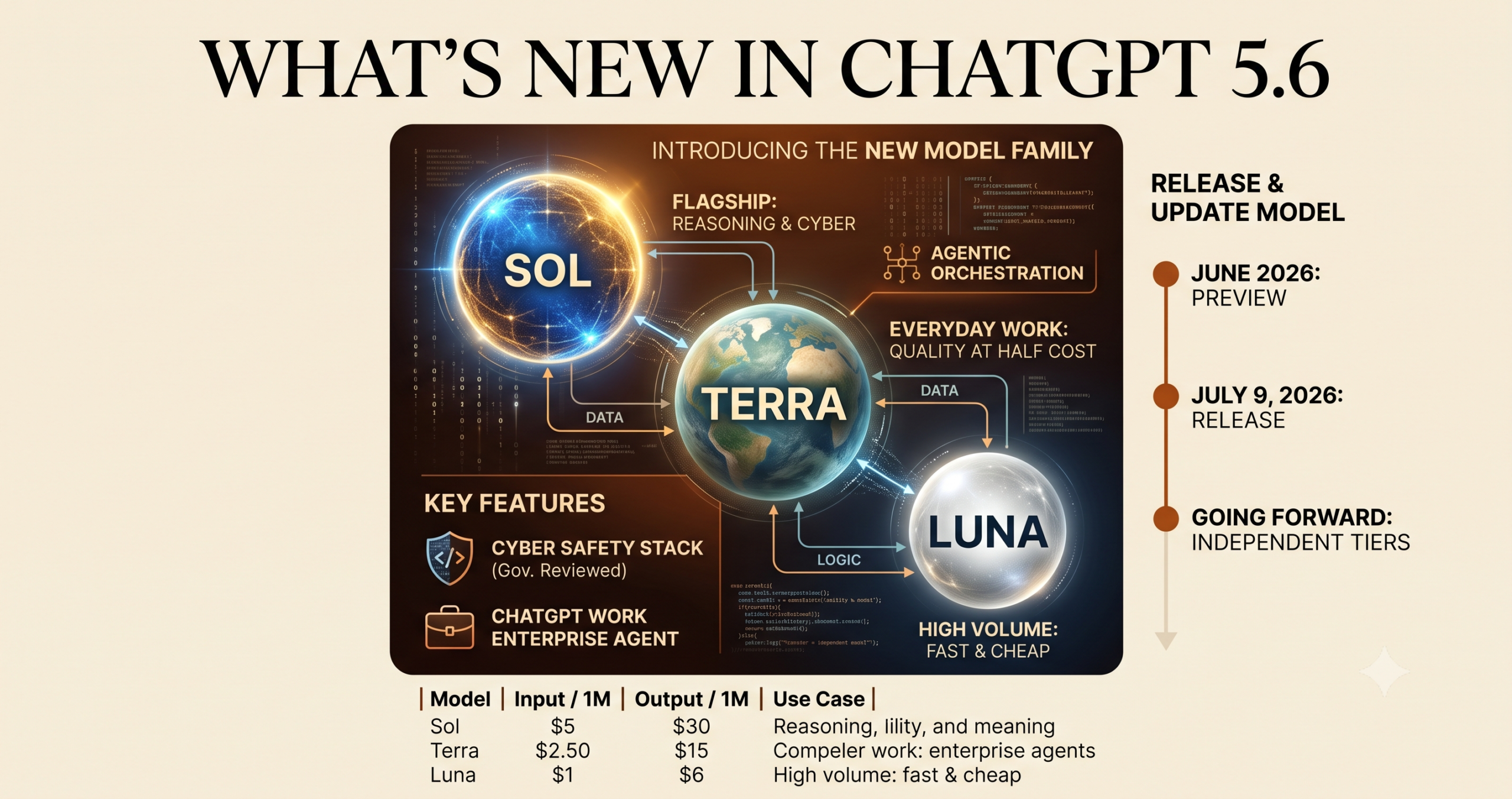
- GPT-5.6 replaces a single model with three tiers, Sol, Terra and Luna, each able to update on its own schedule going forward rather than as one bundled release.
- OpenAI calls Sol its strongest cybersecurity model yet, and says it does not cross the Cyber Critical threshold in its own Preparedness Framework testing, though it found real exploitation building blocks in Chromium and Firefox during evaluation.
- Pricing per million tokens is Sol at $5 input and $30 output, Terra at $2.50 input and $15 output, and Luna at $1 input and $6 output, with Terra pitched as matching GPT-5.5 quality at half the cost.
- A new enterprise tool called ChatGPT Work ships alongside the models, aimed at daily clerical tasks like documents, spreadsheets and presentations, plus a refreshed desktop app that folds in Codex.
- OpenAI’s own benchmark citations claim Sol beats Anthropic’s Claude Fable 5 on a coding agent index while using under half the output tokens, a competitive framing worth reading with some skepticism since the comparison comes from OpenAI itself.
A new naming system, not just a version bump
The headline change is less about raw intelligence and more about how OpenAI plans to ship models going forward. Under the old system, GPT-5, GPT-5.5, and now GPT-5.6 each replaced the entire lineup at once. Starting with this release, the number identifies a generation, while the names Sol, Terra and Luna identify capability tiers that can advance independently. Sol is the flagship, built for the hardest reasoning and coding work. Terra targets everyday use, and OpenAI says it now matches GPT-5.5’s quality while costing half as much to run. Luna is the fast, cheap option meant for high volume tasks where latency and cost matter more than squeezing out the last bit of reasoning depth.
That separation matters for anyone building on the API, since it means a jump in Sol’s capability will not necessarily force a pricing or behavior change on whatever is currently running on Terra or Luna. It is a similar idea to how our earlier piece on what changed in Claude Opus 4.8 covered Anthropic settling into a comparable tiered naming approach, and it suggests both labs have concluded that one giant model trying to be everything to everyone was not the right shape for 2026 workloads.
The cybersecurity story is the real headline
OpenAI is calling Sol its strongest cybersecurity model to date, and the framing is deliberate. GPT-5.6 Sol shifts what the company calls the performance efficiency frontier for long horizon security tasks, including vulnerability research and exploitation. On OpenAI’s own preview writeup, Sol is described as competitive with Anthropic’s Mythos Preview model on a benchmark called ExploitBench while using roughly a third of the output tokens, and all three GPT-5.6 tiers show improvements on ExploitGym, a benchmark built by UC Berkeley researchers in collaboration with several frontier labs.
That same capability is exactly what worried the government enough to ask for a delay. OpenAI says GPT-5.6 Sol does not cross the Cyber Critical threshold defined in its Preparedness Framework. In testing against Chromium and Firefox, the model found bugs and what OpenAI calls exploitation primitives, meaning the raw building blocks of an attack, but it did not autonomously chain those into a working exploit under the conditions tested. OpenAI’s own language is careful here. It says Sol is better at helping people find and fix vulnerabilities than at reliably carrying out full attacks end to end, and frames the model as more useful to defenders doing patch development and blue teaming than to attackers.
What actually shows up in ChatGPT
Most people using ChatGPT day to day will notice two things before anything else. The first is ChatGPT Work, a new agent built for enterprise teams that runs on desktop, web and mobile and handles daily clerical tasks such as drafting documents, building spreadsheets and putting together presentations. The second is a refreshed desktop app that now folds Codex directly in, closing some of the gap with tools our guide to how developers actually use AI for coding in 2026 describes as the messier, multi tool reality most teams were dealing with before.
On the API side, developers get two features aimed squarely at agent builders. Programmatic Tool Calling lets GPT-5.6 write and run small in memory programs that coordinate multiple tool calls and process intermediate results without round tripping back to the model each time. A new multi agent capability lets the model spin up concurrent subagents and synthesize their output inside a single request, which overlaps meaningfully with the kind of orchestration our piece on building multi agent systems with Claude Opus and Gemini Flash walks through from the other side of the model landscape.
Reasoning and pricing changes worth knowing
GPT-5.6 introduces a new max reasoning effort setting that gives Sol the most time to think through a problem, alongside a separate ultra mode that goes further still by delegating pieces of a task to subagents rather than solving everything in one linear chain. Prompt caching also changed in ways that matter for anyone running production traffic. Cache breakpoints are now explicit rather than automatic, cached content has a firm 30 minute minimum life, cache writes are billed at 1.25 times the uncached input rate, and cache reads keep the existing 90 percent discount. None of that is exciting on its own, but for teams running high volume agent workloads it changes the actual cost math more than any single benchmark number will.
| Model | Role | Input price per 1M tokens | Output price per 1M tokens |
|---|---|---|---|
| Sol | Flagship, hardest reasoning and coding work | $5 | $30 |
| Terra | Everyday work, matches GPT-5.5 quality at roughly half the cost | $2.50 | $15 |
| Luna | Fast, low cost, high volume tasks | $1 | $6 |
“That advantage extends across the family. Terra performs just above Fable 5, while Luna outperforms Opus 4.8.” OpenAI benchmark claim, as reported by TechCrunch, July 2026
That comparison is not incidental. OpenAI explicitly measured Sol against Anthropic’s Claude Fable 5 on the Artificial Analysis Coding Agent Index, claiming a score of 80 against Fable 5’s 77.2, while using less than half the output tokens, less than half the time, and about a third less cost. Whether that framing holds up under independent testing is a separate question from whether OpenAI published it, and it arrives in the middle of a genuinely crowded week, with SpaceXAI and Meta both shipping competing model families within days of GPT-5.6.
Honest limitations in what we know so far
This is very fresh news, published within a day of the general release, and several things are still unclear. OpenAI’s own footnotes on its release page note that latency and cost estimates come from simulating offline production behavior rather than live measurement, and that real world results may vary substantially. The ExploitGym results were run on an internal alpha API and then rescaled to match public API speeds, which OpenAI discloses but which outside researchers have not yet independently reproduced. The coding agent comparisons against Claude Fable 5 and Claude Opus 4.8 also come entirely from OpenAI’s own citation of a third party index, not from Anthropic or a neutral benchmark operator confirming the same numbers.
The safety story deserves the same caution in both directions. OpenAI’s claim that Sol does not cross its Cyber Critical threshold is a self administered test against a framework OpenAI itself wrote, even though the company did coordinate a preview with the US government before wider release. That coordination is a meaningful signal, but it is not the same as independent, external certification, and OpenAI’s own post is candid that safeguards may still misfire on legitimate dual use security work during this early period.
What this means for the rest of 2026
The tiered naming system is probably the change with the longest tail. If Sol, Terra and Luna genuinely update on separate schedules going forward, developers building on the API get more predictable behavior than they had when an entire model family shifted underneath them at once. That is a meaningfully different promise than past releases made, and it puts OpenAI’s versioning closer to how Anthropic has been running its own Opus, Sonnet and Haiku tiers.
The government preview precedent is the more unusual thread to watch. OpenAI went out of its way to say this should not become the normal process for future launches, which reads as the company trying to head off a pattern before it hardens into policy. Whether that holds depends on what the next frontier release from OpenAI, or from Anthropic, or from Google, looks like when it ships. If a coordinated government preview becomes routine rather than an exception, that changes the competitive rhythm of the entire industry, not just one company’s release calendar.
For everyday ChatGPT users, the more immediate change is probably ChatGPT Work landing inside a tool people already open every day, rather than anything happening at the model layer. Enterprise adoption of agent style tools has been building for a year across every major lab, and folding a dedicated work agent directly into ChatGPT’s existing surface is a distribution advantage that raw benchmark scores do not capture.
The competitive framing against Claude Fable 5 and Claude Opus 4.8 is worth watching less for who wins a particular index and more for what it signals about where the two labs think the real fight is. OpenAI picked coding and agentic efficiency as its battleground with this release, which tracks with where enterprise budgets are actually flowing in 2026.
None of this settles the question of which model family is actually better for a given team’s workload. That answer still depends on the task, the budget, and how much a given safety posture matters for what is being built, and the only way to know is to run the same job through Sol, Terra, Fable 5 and Opus 4.8 side by side rather than trusting any single vendor’s index.
Frequently asked questions
What is GPT-5.6, and how is it different from GPT-5.5?
GPT-5.6 is OpenAI’s newest model generation, released generally on July 9, 2026 after a limited preview that started June 26. Unlike GPT-5.5, it ships as three separate tiers, Sol, Terra and Luna, that OpenAI says can now update on independent schedules rather than as one bundled release.
What are Sol, Terra and Luna?
Sol is the flagship model built for the hardest reasoning, coding and cybersecurity work. Terra is a balanced option OpenAI says matches GPT-5.5 quality at roughly half the cost. Luna is the fastest and cheapest tier, aimed at high volume, latency sensitive tasks.
Why did the government reportedly delay the GPT-5.6 rollout?
Reporting from TechCrunch and other outlets says the Trump administration raised concerns about the model’s cyber capabilities and asked OpenAI to limit the initial rollout. OpenAI ran a short, coordinated preview with a small group of trusted partners before the July 9 general release, and stated publicly that this kind of government access process should not become the standing default for future launches.
How much does GPT-5.6 cost to use through the API?
Pricing per million tokens is Sol at $5 input and $30 output, Terra at $2.50 input and $15 output, and Luna at $1 input and $6 output. GPT-5.6 also changed how prompt caching is billed, with cache writes now costing 1.25 times the uncached input rate while cache reads keep a 90 percent discount.
Is GPT-5.6 actually better than Claude Fable 5 or Claude Opus 4.8?
OpenAI claims Sol outperforms Claude Fable 5 on the Artificial Analysis Coding Agent Index while using far fewer output tokens, and that Luna outperforms Claude Opus 4.8. Those numbers come from OpenAI’s own citation of a third party benchmark rather than independent, neutral testing, so they are worth verifying against your own workload before treating them as settled.
What is ChatGPT Work?
ChatGPT Work is a new enterprise focused agent released alongside GPT-5.6. It runs on desktop, web and mobile and is designed to help with daily clerical tasks such as drafting documents, building spreadsheets and preparing presentations.
Read the primary sources
See OpenAI’s own release details, and compare the competitive claims against our coverage of Anthropic’s latest models.