Key points
- The review screened 1126 records from IEEE Xplore, Elsevier, PubMed, ACM, Springer and Web of Science, and kept 73 studies that met its inclusion criteria after a full PRISMA style screening process.
- Brain imaging and EEG signals account for the largest share of published work, 38 articles by the review’s own count, well ahead of video, facial, speech and genetic modalities.
- Deep learning models generally beat traditional machine learning on neuroimaging and EEG tasks, but the gap narrows or disappears on behavioral and questionnaire data, where simpler models like decision trees and support vector machines still hold their own.
- Multi site datasets such as ABIDE solve the sample size problem but introduce a generalization problem of their own, one study saw accuracy fall from 93 percent on a single site to 83.5 percent once tested across multiple sites.
- Multimodal fusion, combining EEG with eye tracking, or facial expression with speech, is where some of the strongest and most clinically interesting results are showing up.
- Explainable AI tools such as Grad-CAM, SHAP and LIME are increasingly used to show which brain region or facial feature actually drove a prediction, though the review notes there is still no shared standard for judging whether one explanation method is more trustworthy than another.
The Diagnosis Problem This Review Is Actually Mapping
Autism has no blood test. There is no scan a doctor can order and no single marker to check off a list. Diagnosis instead rests on structured behavioral observation, developmental history and tools such as the Autism Diagnostic Observation Schedule, known as ADOS-2, and the Autism Diagnostic Interview Revised, known as ADI-R. Both are thorough. Both also take time, training and access to a specialist, three things that are unevenly distributed even within wealthy countries.
The scale of the problem is not small. Citing the CDC’s Autism and Developmental Disabilities Monitoring network, the review reports that roughly 1 in 31 eight year old children in the United States were identified with autism spectrum disorder in 2022, with 4.92 percent of boys affected against 1.43 percent of girls. Two years earlier, the same monitoring network put the rate at 1 in 36, with about 4 percent of boys and 1 percent of girls affected. Read those two numbers side by side and a pattern appears fast. Prevalence is rising, or at least detection is, and the gap between boys and girls has not closed.
Early intervention improves outcomes. That claim is well supported in the clinical literature the review draws on, and it is also the whole justification for building faster, cheaper screening tools in the first place. An AI model does not need to replace a clinician to be useful here. It only needs to flag a child earlier than the current system typically does, and do so reliably enough that a clinician trusts the flag.
How the Review Was Built
Systematic reviews live or die on their search methodology, and this one is unusually transparent about its process. The authors searched IEEE Xplore, Elsevier, PubMed, ACM, Springer and Web of Science for studies published between 2010 and 2026, running the search on 12 June 2025 and revising it on 15 February 2026. That search, targeting autism spectrum disorder detection, returned 1126 records in total, 216 from IEEE Xplore, 431 from Elsevier, 127 from PubMed, 75 from ACM, 171 from Springer and 106 from Web of Science.
From there the numbers thin out quickly. After removing 432 duplicates and 40 records excluded for other reasons, 654 records went to screening, and 495 were dropped at that stage. Of the 159 reports sought for full retrieval, 15 could not be obtained at all. The remaining 144 were assessed for eligibility, and 71 were excluded, 28 for being out of scope, 10 because they were themselves review articles rather than original studies, and 33 because the full text simply was not accessible. That left 73 studies in the final review, the set this article is built around.
Worth sitting with for a moment, the fact that even a well resourced academic team could not retrieve full text for 33 otherwise eligible papers says something about how fragmented access to this literature still is, quite apart from anything about the AI methods themselves.
Six Kinds of Data for Autism Spectrum Disorder Detection
Strip away the modality specific detail and the review is organized around a simple observation. Autism does not show up in one place. It shows up in brain structure and connectivity, in the electrical rhythm of the resting brain, in where a child’s gaze lands on a face, in the cadence of their speech, in repetitive movement, and in inherited genetic variation. Researchers have built detection pipelines around each of these signals separately, and the review counts how much attention each has received.
Brain imaging and EEG signals dominate, accounting for 38 of the articles the review tracked by modality category, roughly matching the combined total of every other category. Facial and thermal image studies and video and motion studies each account for 14 articles. Audio and speech studies account for 12, genetic and genomic studies for 11, and eye tracking and vision studies for 8. The publication timeline tells its own story, rising from just 3 papers in 2010 and 2011 to 129 in the 2024 to 2026 window the review covers, a trajectory that makes clear this is a field still accelerating rather than settling.
The Dataset Problem Nobody Talks About Enough
Before any model gets trained, someone has to collect the data, and this is where the review earns its keep as a reality check. ABIDE and its successor ABIDE-II remain the backbone of neuroimaging work in this space, pooling functional and structural MRI scans from close to a thousand participants across as many as 18 international sites. That scale is genuinely valuable. It is also a double edged sword. Different scanners, different acquisition protocols and different patient populations get blended into one dataset, and a model trained on that blend can end up learning site specific quirks rather than anything that generalizes to a new clinic.
Kang and colleagues tackled that exact problem head on in 2025, introducing a partitioning method they call Split Merge Split, designed to reduce the noise that comes from combining data across sites. Their model reached 93 percent accuracy when trained and tested within a single site. Tested across multiple sites, accuracy fell to 83.5 percent. A ten point drop is not a rounding error. It is close to the clearest illustration in the whole review of the distance between a promising benchmark result and something that would actually hold up walking into a new clinic.
EEG datasets have the opposite problem, small rather than heterogeneous. Several of the EEG studies the review catalogs work with fewer than 50 participants, and a few go smaller still, Divya and colleagues collected data from 20 children in 2023, and Lalawat and colleagues worked with just 16 participants, 12 with autism and 4 typically developing, in 2024. Recording clean EEG from a young child who may struggle to sit still is genuinely hard, so small cohorts are close to unavoidable in this modality. That does not make them free of consequence. A model trained on 16 or 20 people carries a real risk of memorizing quirks specific to that small group rather than learning anything that transfers.
Facial image datasets sit at the other extreme, several running past 2900 labeled images, largely because facial photographs are comparatively easy and inexpensive to collect and label at scale. Video and behavioral datasets have grown more inventive rather than simply larger. The Enhanced Self Stimulatory Behavior Dataset, expanded from an earlier 75 video collection to 400 videos spanning arm flapping, head banging, spinning, slapping and biting, adds categories that older stereotypy datasets never captured. The MMASD dataset takes a different approach entirely, storing 2D and 3D skeletal motion data extracted from therapy sessions rather than raw identifiable video, a design choice that matters given how sensitive pediatric health footage is to begin with.
Four Families of AI Methods, Compared Honestly
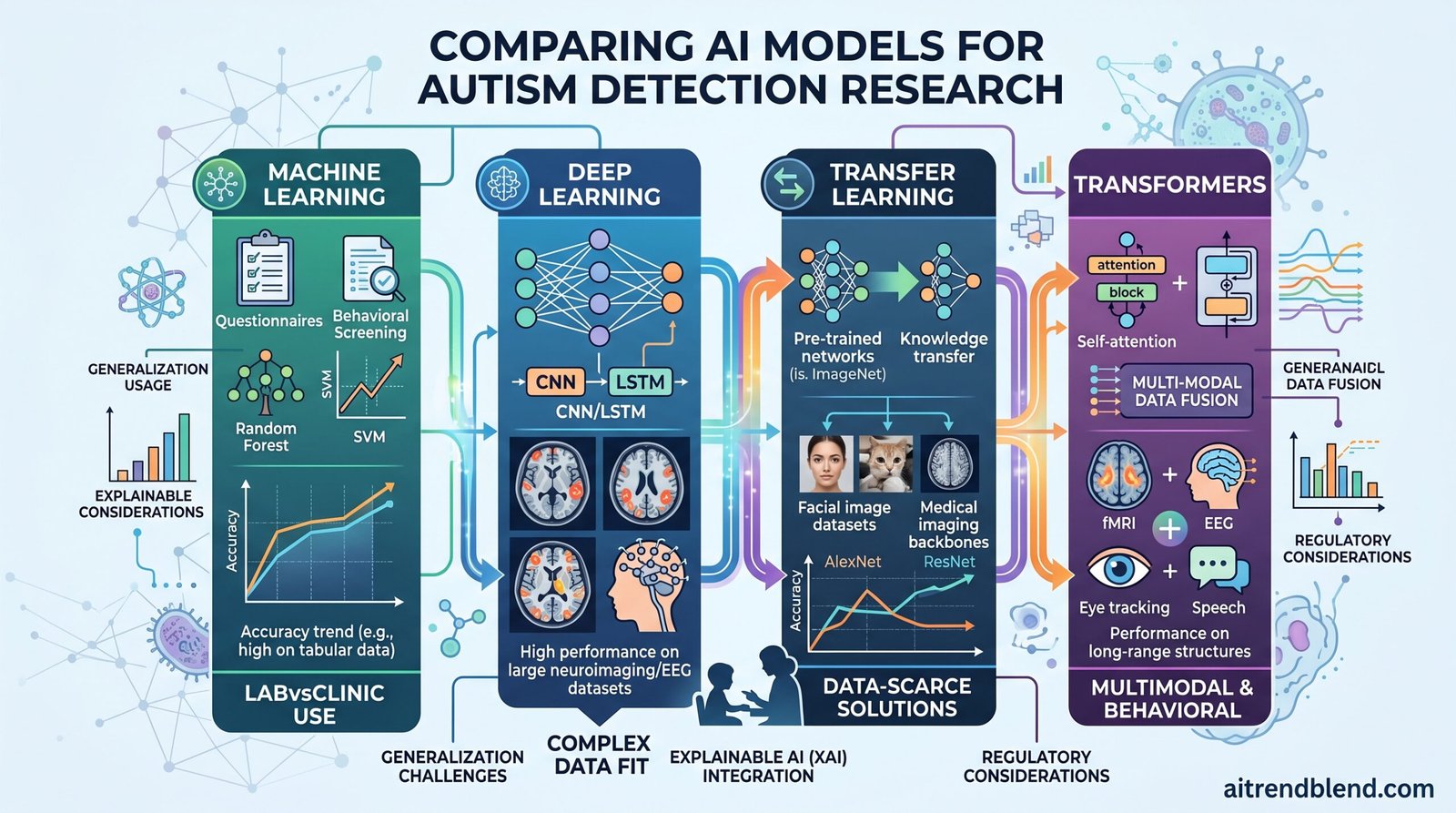
The review’s real analytical contribution is putting machine learning, deep learning, transfer learning and transformer based models side by side rather than treating each as its own silo. The pattern that emerges is consistent even as the exact numbers shift by modality, more architectural complexity tends to buy higher accuracy, but only when there is enough data to support it, and the review is honest about where that condition does and does not hold.
Traditional Machine Learning
Support vector machines, random forests, decision trees and K nearest neighbors remain competitive on behavioral and questionnaire data, and in some cases they win outright. Bawa and colleagues reported 99.55 percent accuracy on a multiclass autism screening task in 2024 using support vector machines, with performance broken down by age group, 94.3 percent accuracy in children, 99 percent in adolescents using logistic regression, and 98.5 percent in adults using a support vector machine. Shinde and Patil found decision trees and random forests outperforming other classifiers on behavioral assessment data in 2023, largely because tree based models handle the nonlinear relationships buried in questionnaire responses more naturally than linear methods do. These simpler models remain attractive for a reason that has nothing to do with accuracy, they are cheap to run and comparatively easy to explain, which matters when a prediction needs to be defensible in a clinical setting.
Deep Learning
This is where the headline accuracy numbers get more dramatic, particularly for neuroimaging and EEG. Sheik Abdullah and colleagues combined CNN, LSTM and BiLSTM architectures with an attention mechanism on ABIDE MRI and phenotypic data in 2025, reporting 93 percent accuracy, 0.90 precision and an AUC ROC of 0.93. Khalfallah and colleagues pushed EEG classification to 99.85 percent accuracy in 2025 using FIR filtering and independent component analysis ahead of the network. Numbers like that are genuinely impressive on the page. The catch, which the review is upfront about, is that deep networks are hungry for data, and data volume is exactly what most ASD datasets, particularly EEG ones, do not have.
Transfer Learning
Transfer learning exists specifically to work around that data shortage, borrowing feature representations learned on massive unrelated datasets such as ImageNet and fine tuning them for the ASD specific task at hand. The spread of results here is its own finding. Al Qazzaz and colleagues tested seven pretrained backbones on the identical EEG classification task in 2024 and watched accuracy swing from 60.5 percent using EfficientNetB0 up to 85.53 percent using SqueezeNet, with MobileNetV2, AlexNet, ResNet18, GoogLeNet and ShuffleNet scattered in between. That is not a small spread for the same task and the same data. It is a reminder that transfer learning is not one technique, it is a family of choices, and the backbone architecture chosen matters as much as the fact of using transfer learning at all. Results cluster tighter and higher on facial image tasks, Lu and colleagues reached 95 percent accuracy with VGG16 in 2021, and Beno Ranjana and colleagues reported 97.07 percent with a DenseResNet hybrid in 2025.
Transformer Based Models
Transformers are the newest arrivals in this space, and the review treats them with curiosity rather than hype. Their real strength is modeling long range relationships, connecting activity in one brain region to activity in a distant one, or linking an early frame of a video to a behavior that only appears seconds later. Hayder Ibadi and colleagues combined a Vision Transformer with squeeze and excitation blocks on facial images in 2025 and reached 97.77 percent accuracy. Applied to functional connectivity data, results have been more modest, Wang and colleagues reported 73.4 percent with a Residual Graph Transformer Network on ABIDE in 2024, and Gao and colleagues reported between 67.64 percent and 72.00 percent across two ABIDE sites the same year. The pattern is less transformers win outright and more transformers help most where the data actually has long range structure worth exploiting, which facial and video sequences tend to have more of than smaller localized EEG or connectivity signals do.
Results at a Glance
| Method family | Representative study | Modality | Reported accuracy |
|---|---|---|---|
| Machine learning | Bawa et al, 2024 | Behavioral screening data | Up to 99.55 percent, multiclass |
| Machine learning | Shinde and Patil, 2023 | Behavioral assessment data | 100 percent on the tested set, decision trees and random forests |
| Deep learning | Sheik Abdullah et al, 2025 | ABIDE MRI and phenotypic data | 93 percent, AUC ROC 0.93 |
| Deep learning | Khalfallah et al, 2025 | EEG | 99.85 percent |
| Transfer learning | Al Qazzaz et al, 2024 | EEG | 60.5 to 85.53 percent, backbone dependent |
| Transfer learning | Beno Ranjana et al, 2025 | Facial image | 97.07 percent |
| Transformer | Hayder Ibadi et al, 2025 | Facial image | 97.77 percent |
| Transformer | Wang et al, 2024 | ABIDE resting state fMRI | 73.4 percent |
Where the Real Progress Is Showing Up, Combining Signals
If there is one throughline connecting the review’s most encouraging results, it is combination rather than any single modality winning outright. Junxia Han and colleagues fused EEG with eye tracking data across 90 children in 2022 and captured neurophysiological and behavioral signal together in a way neither modality alone would reveal. Vidivelli and colleagues combined EEG and facial image features in a CNN and BiGRU hybrid in 2025, fusing spatial and temporal information from two entirely different sensory channels and reporting 89.26 percent accuracy with feature level fusion. Revathy and colleagues went further still in 2025, using a conditional generative model with transformer based cross modal attention to synthesize additional multimodal training data and reporting 99.2 percent accuracy, a number that deserves some healthy skepticism until it holds up on a genuinely independent test set the model never touched during training.
The logic behind fusion is intuitive once you sit with it. Autism is not one thing happening in one place. It shows up in connectivity, in gaze, in vocal rhythm, in repetitive movement, and a model trained on only one of those signals is, almost by definition, only seeing part of the picture. The review is candid that fusion brings its own engineering headaches, aligning data recorded at different temporal resolutions, with different noise characteristics and different collection costs, is a genuinely hard problem that nobody in this literature has fully solved yet.
The Black Box Problem, and Who Is Actually Trying to Open It
None of this matters much to a working clinician if the model cannot explain its own reasoning. The review gives real attention to explainable AI, SHAP, LIME and Grad-CAM among the most common tools, and the examples it collects are worth sitting with. Sravani and colleagues used Grad-CAM in 2024 to highlight which brain regions actually drove a 95.9 percent accurate MRI based classification, turning an otherwise opaque prediction into something a radiologist could visually inspect. Atlam and colleagues applied LIME to facial image classification in 2025 and found the model attending to eye region shape and facial symmetry, features with some grounding in prior clinical observation rather than some arbitrary artifact of the training data, and reported 98.2 percent accuracy for the underlying classifier. Jung and colleagues took a more structural route with their EAG-RS model in 2024, using layer wise relevance propagation to trace which specific brain region connections influenced a prediction rather than treating an entire scan as one undifferentiated block of voxels, reaching 73.71 percent accuracy on the harder task of region of interest selection.
That line from the abstract is worth taking seriously and also worth pushing on a little. It is true within the review’s own dataset, and the pattern holds across most of the neuroimaging and EEG comparisons collected here. It is also true that deep learning’s advantage shows up most clearly on exactly the modalities where dataset size is most constrained, which should make anyone reading these numbers ask how much of that advantage would survive contact with a genuinely large, independently collected test set.
The Clinical Translation Gap
Every strong benchmark number in this review was produced under lab conditions, on a curated dataset, evaluated by researchers with a direct interest in the model performing well. None of that is a criticism of the researchers involved, it is simply how early stage research works. But it means a wide gap sits between what these numbers show and what would actually happen if one of these models were deployed in a pediatric clinic tomorrow.
Three specific gaps stand out. First, most models are trained on children with well established, clearly presenting symptoms, exactly the population where a diagnostic aid matters least, because these are often the cases a clinician would catch anyway. The harder and more clinically valuable task, flagging subtle early signs in children under three, is the one this literature has engaged with the least. Second, the multi site accuracy drop that Kang and colleagues documented, from 93 percent to 83.5 percent, is a preview of what happens when a model trained on one population meets a genuinely different one, different scanner, different clinic, different demographic mix. Third, computational cost is a real barrier to deployment outside a well funded research lab. The review notes that some lightweight models run on a modest 4GB GPU with 8GB of system memory, while the larger multimodal fusion networks increasingly require far more substantial infrastructure, hardware on the order of an NVIDIA Tesla P100 with 16GB of GPU memory and correspondingly larger system memory, with training runs measured in hours rather than minutes. That is a reasonable ask for a university lab. It is a much harder one for a rural clinic or a lower resource health system, which happens to be exactly where specialist access is scarcest and where an early screening tool would do the most good.
Regulatory and Safety Notes
The review does not itself address regulatory pathways for clinical deployment, and this article will not invent claims about what regulators would require. What can be said honestly is that any tool built from this research and intended for real diagnostic use would need validation on populations and sites it was never trained on, transparent reporting of its false negative rate given how costly a missed early diagnosis can be, and a clearly defined role as a screening aid that supports a clinician’s judgment rather than one that replaces it.
Clinical and Methodological Limitations
The review is unusually candid about where this literature still falls short, and three limitations stand out as more than academic footnotes. Datasets remain small, imbalanced and demographically narrow, particularly for EEG and speech studies, several of which work with fewer than 50 participants and sometimes as few as 16 or 20. A model trained almost entirely on one clinic’s population, often from a single country and a narrow age range, is unlikely to generalize the way its reported accuracy suggests. Multi site pooling, as ABIDE demonstrates, partially solves the sample size problem while introducing a site related noise problem of its own.
Early detection specifically remains underserved by this literature. Most models are trained on clearly diagnosed, often older children with well established symptoms, which is precisely the population where a diagnostic aid matters least. The clinical case for AI assisted screening rests on catching signs before age three or four, when intervention has the greatest impact, and that is exactly where symptom overlap with other developmental conditions makes classification hardest, and where this literature has the least data to work with.
Overfitting is a related and persistent risk given how small many of these cohorts are. When a deep network is trained on 16 or 30 or even 90 participants, it can achieve strong accuracy on its own held out test set while learning patterns specific to that dataset rather than to autism itself. The review notes that researchers commonly guard against this with cross validation, data augmentation, regularization and testing on genuinely external datasets, though not every study in the review reports doing all of these consistently.
Where This Research Is Headed
The review’s authors point toward three directions with real momentum behind them. Large language models applied to speech and text could capture subtler patterns of language development than current acoustic feature extraction methods manage. Unified multimodal fusion frameworks, robust enough to combine neuroimaging, EEG, eye tracking, speech and video without falling apart at the data alignment stage, remain more aspiration than reality right now. And closer collaboration between AI researchers and practicing clinicians is needed to confirm that the features an explainable AI system highlights actually correspond to something clinically meaningful, rather than something statistically convenient that happens to correlate with the label in a particular dataset.
Conclusion
What this review actually delivers is not a single winning model, and it does not pretend to. What it delivers is an honest map of a field still working out its own shape, seventy three studies spread across six or seven kinds of data, four families of modeling approach, and a publication rate that has grown more than forty fold since 2010. The core achievement here is not any one accuracy number, it is the act of putting all of these separate, often siloed research threads next to each other so the tradeoffs between them become visible for the first time in one place.
There is a conceptual shift buried in this literature worth naming directly. Autism detection research has quietly moved away from the idea that one modality, one scan, one signal, will eventually crack the problem, and toward the idea that the disorder’s own heterogeneity is the reason no single signal ever will. The strongest recent results in this review, the multimodal fusion work combining EEG with eye tracking or facial expression with speech, are a direct expression of that shift, and they point toward where the next genuinely useful advances are likely to come from.
The methods surveyed here are not unique to autism. The same tension between dataset scale and model complexity, the same gap between single site and multi site performance, and the same need for explainability before clinical trust shows up across nearly every application of AI to pediatric and neurological health. A screening tool built for early language delay, or for ADHD, or for a dozen other developmental conditions, would run into nearly identical obstacles, which makes this review useful reading well beyond autism research specifically.
None of that should paper over the honest limitations documented throughout this piece. Small cohorts, narrow demographics, a near total absence of models tested on truly independent multi country populations, and a computational cost that puts the strongest multimodal systems out of reach for exactly the clinics that need them most. Future work that closes even one of these gaps, larger and more diverse shared datasets, standardized explainability benchmarks, or lightweight architectures built for low resource deployment from the start, would do more for this field than another incremental point of accuracy on ABIDE.
Autism will probably never have a single diagnostic test the way strep throat does. The condition is too heterogeneous, spread too widely across brain, behavior and biology, for that to be a realistic goal. But a tool that gives a clinician a second, earlier signal, rather than a final verdict, does not need to replace the ADOS-2 to matter. It only needs to be reliable enough, explainable enough and cheap enough to reach the clinics that currently wait the longest. This review is a useful, unglamorous accounting of how far that goal still is, and, cautiously, how much closer the field has moved in just the last three years.
Frequently Asked Questions
What is this review actually about
It is a systematic review of 73 published studies that use artificial intelligence to help detect autism spectrum disorder from data such as brain scans, EEG signals, eye tracking, speech, video and genetic information, published in Computer Science Review by researchers at Vellore Institute of Technology.
Which AI method works best for autism detection
There is no single best method across all data types. Deep learning tends to outperform traditional machine learning on neuroimaging and EEG data, while simpler models such as decision trees and support vector machines remain competitive on behavioral and questionnaire data. The strongest recent results come from combining multiple data types rather than any one method alone.
Can AI actually diagnose autism today
No. These are research models built and tested on curated datasets under controlled conditions. None of the studies in this review describe a system validated and deployed as a clinical diagnostic tool. Any concerns about a child’s development should go to a qualified pediatrician or developmental specialist.
What is the ABIDE dataset
ABIDE, short for Autism Brain Imaging Data Exchange, is a large open dataset that pools MRI and functional MRI scans from people with autism and typically developing controls across many international research sites, and it is the most widely used neuroimaging dataset in this field.
Why do accuracy numbers vary so widely between studies
Because studies use different datasets, different sample sizes, different preprocessing steps and different evaluation methods, direct comparison between reported accuracy figures is often misleading. The review itself flags a case where the same model dropped ten accuracy points once tested across multiple sites instead of one.
What is explainable AI and why does it matter here
Explainable AI refers to techniques such as SHAP, LIME and Grad-CAM that show which parts of the input data, a brain region, a facial feature, an EEG channel, actually influenced a model’s prediction. It matters because clinicians are unlikely to trust a diagnostic aid that cannot show its reasoning.
Read the Original Research
This article is an independent analysis of a peer reviewed systematic review covering 73 studies on AI based autism spectrum disorder detection.
Read the Paper (DOI)Related Reading
This analysis is based on the published paper and an independent evaluation of its claims. No proprietary code implementation accompanies this article because the source is a systematic review synthesizing 73 separate published studies and does not itself propose a single novel model architecture to reproduce.