Generative & Diffusion Models

GANs, diffusion models, and the architectures behind modern generative AI. Research-grade explainers on how generative models learn, where they fail, and the design choices that separate state-of-the-art methods from the rest, each tied to the paper it came from.

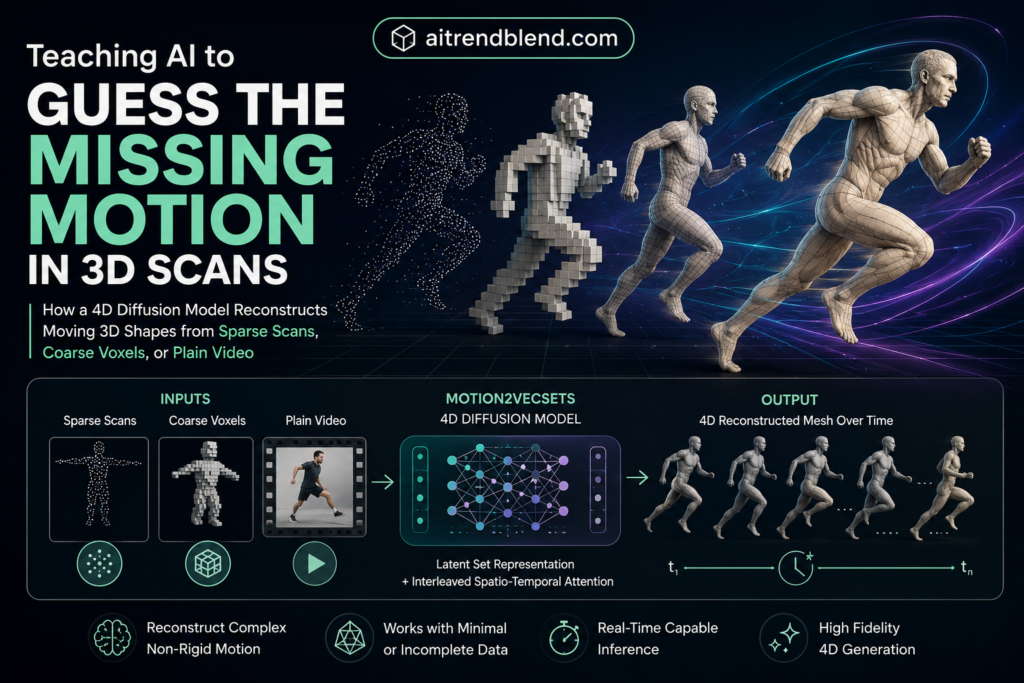
Motion2VecSets: Teaching AI to Guess the Missing Motion in 3D Scans

Generative AI and Diffusion Models · 3D and 4D Computer Vision · 12 min read Diffusion Models 4D Reconstruction Non Rigid Tracking Latent Sets Motion2VecSets Motion2VecSets · 4D Latent Set DiffusionA sparse, noisy scan going in, a complete, temporally coherent moving mesh coming out. Point a single depth sensor at someone from one angle while […]

Motion2VecSets: Teaching AI to Guess the Missing Motion in 3D Scans Read More »

DreamFuse Teaches Diffusion Models Real Image Fusion

Analysis by the aitrendblend editorial team • Generative AI and Diffusion Models • Published July 16, 2026 Diffusion Transformer Image Fusion Positional Affine Preference Optimization Flux DreamFuse places foreground objects into new backgrounds while generating matching shadows, reflections and perspective, rather than pasting a flat cutout. Picture a product photographer who needs to drop a

DreamFuse Teaches Diffusion Models Real Image Fusion Read More »

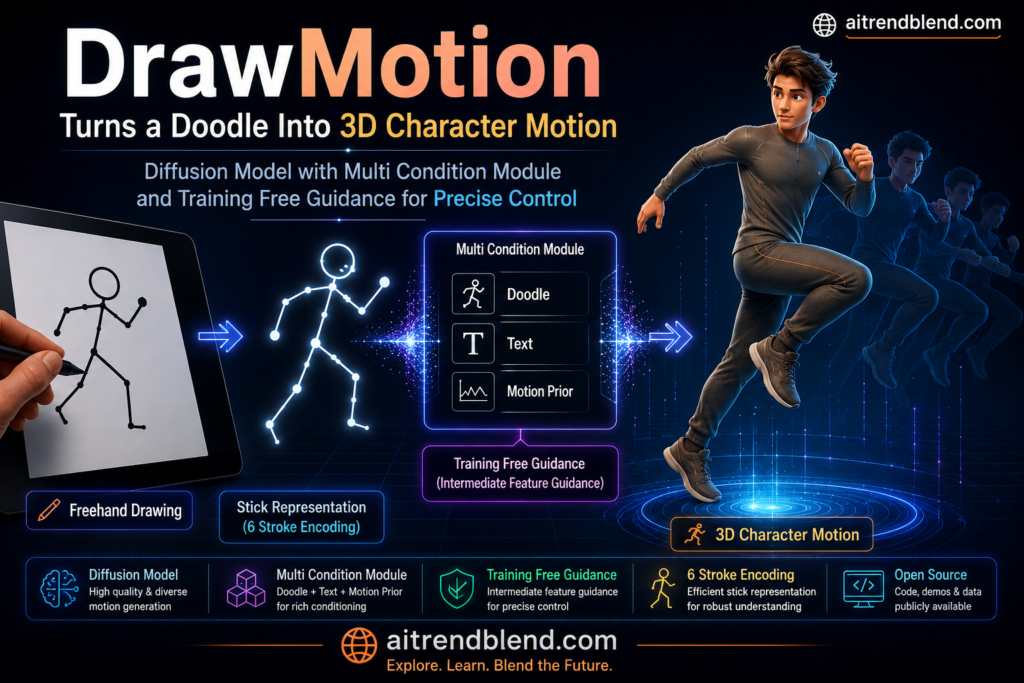
DrawMotion Turns a Doodle Into 3D Character Motion

DrawMotion Turns a Doodle Into 3D Character Motion

Analysis by the aitrendblend editorial team • Generative AI and Diffusion Models • Published July 21, 2026 Diffusion Model 3D Motion Generation Freehand Drawing Multi Condition Module Training Free Guidance DrawMotion lets a user sketch a path and a few stick figures, then generates a full 3D motion sequence that follows the drawing. Try describing,

DrawMotion Turns a Doodle Into 3D Character Motion Read More »

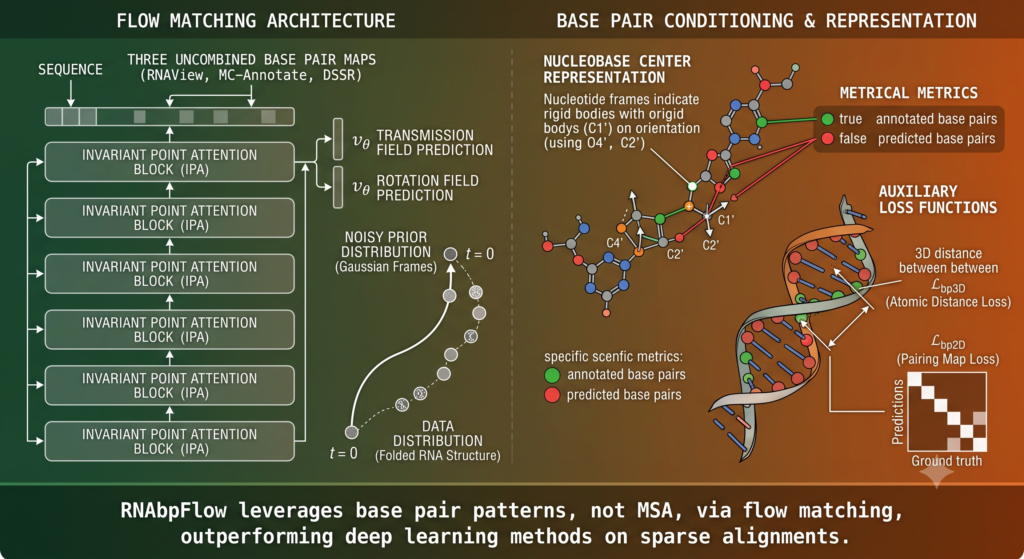
How Base Pair Conditioning Lets RNAbpFlow Skip the MSA

How Base Pair Conditioning Lets RNAbpFlow Skip the MSA

Generative AI Nature Methods, Volume 23, July 2026 21 minute read RNA 3D Structure Flow Matching SE(3) Equivariance Base Pair Conditioning Structural Biology CASP16 Invariant Point Attention Template Free Modeling Nucleobase Representation RNAbpFlow starts every nucleotide as a random frame drawn from Gaussian noise and walks it toward a folded RNA structure, with the base

How Base Pair Conditioning Lets RNAbpFlow Skip the MSA Read More »

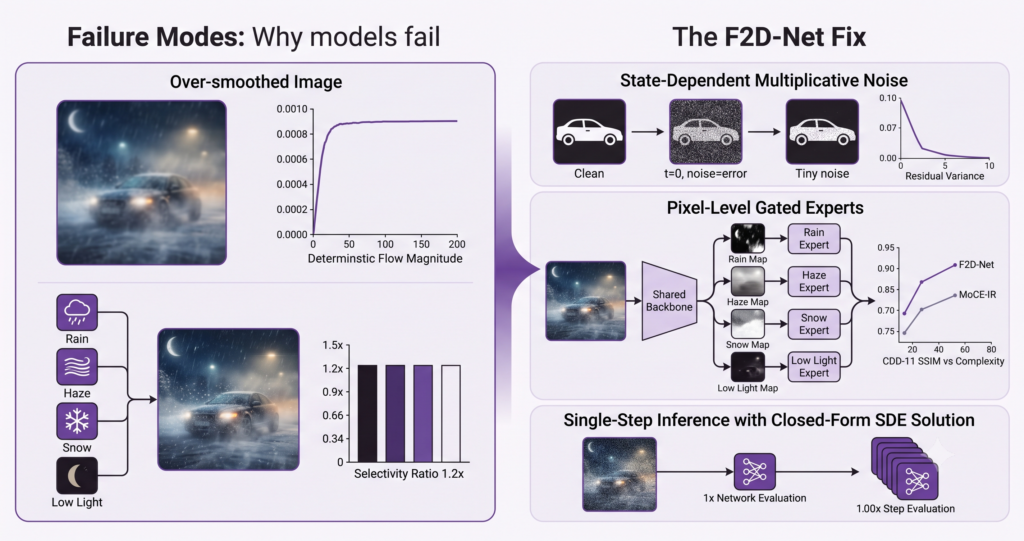
How Stochastic Transport Fixes Composite Image Restoration.

How Stochastic Transport Fixes Composite Image Restoration

Analysis by the aitrendblend editorial team · Pillar 3, Generative AI and diffusion models · Published in Knowledge-Based Systems, volume 349, 2026, DOI 10.1016/j.knosys.2026.116411 stochastic transport flow matching mixture of experts composite degradation image restoration F2D-Net factorizes the restoration flow into a shared backbone plus pixel gated experts, driven by noise that shrinks to zero

How Stochastic Transport Fixes Composite Image Restoration Read More »

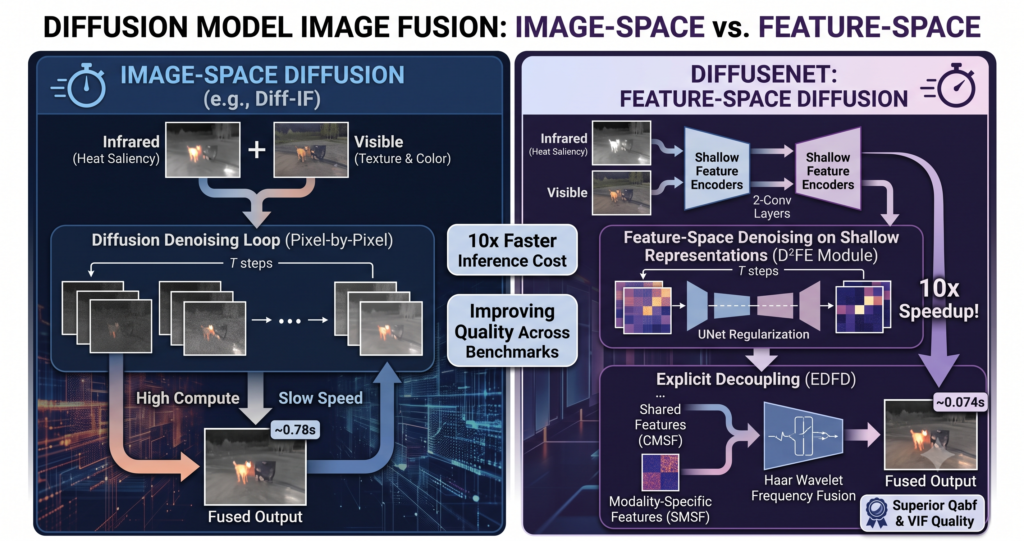
DiffFuseNet: Why Feature-Space Diffusion Beats Image-Space Diffusion for Infrared-Visible Fusion

DiffFuseNet: Why Feature-Space Diffusion Beats Image-Space Diffusion for Infrared-Visible Fusion

DiffFuseNet runs diffusion denoising on shallow encoded features instead of full images, making infrared-visible fusion roughly ten times faster than prior diffusion methods without sacrificing quality.

DiffFuseNet: Why Feature-Space Diffusion Beats Image-Space Diffusion for Infrared-Visible Fusion Read More »

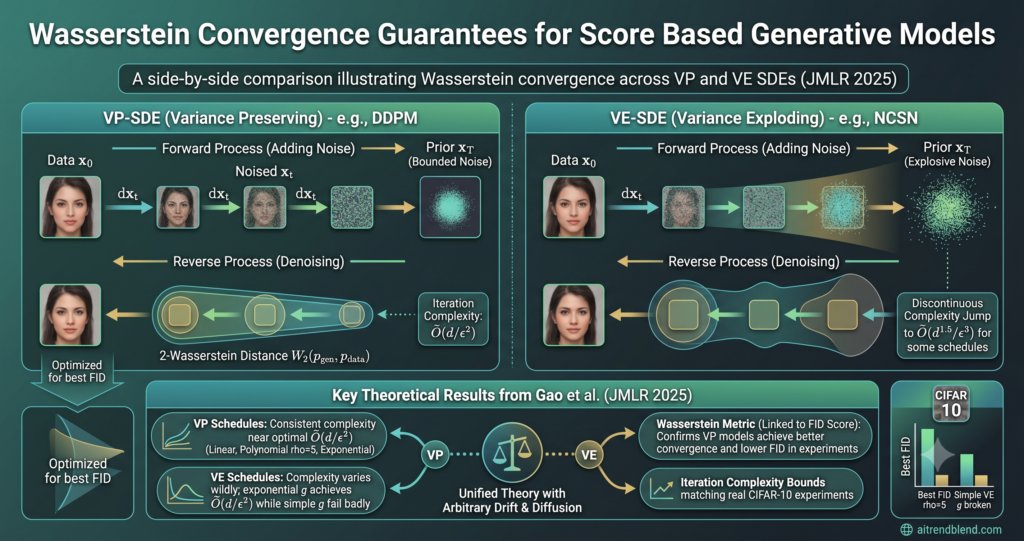
Wasserstein Convergence Guarantees for Score-Based Generative Models.

Wasserstein Convergence Guarantees for Score-Based Generative Models

Generative Models · Journal of Machine Learning Research 26 (2025) 1 to 54 · 16 min read A research team from the Chinese University of Hong Kong and Florida State University has delivered the first unified convergence theory for a broad class of score based generative models in 2-Wasserstein distance, and it shows that the

Wasserstein Convergence Guarantees for Score-Based Generative Models Read More »

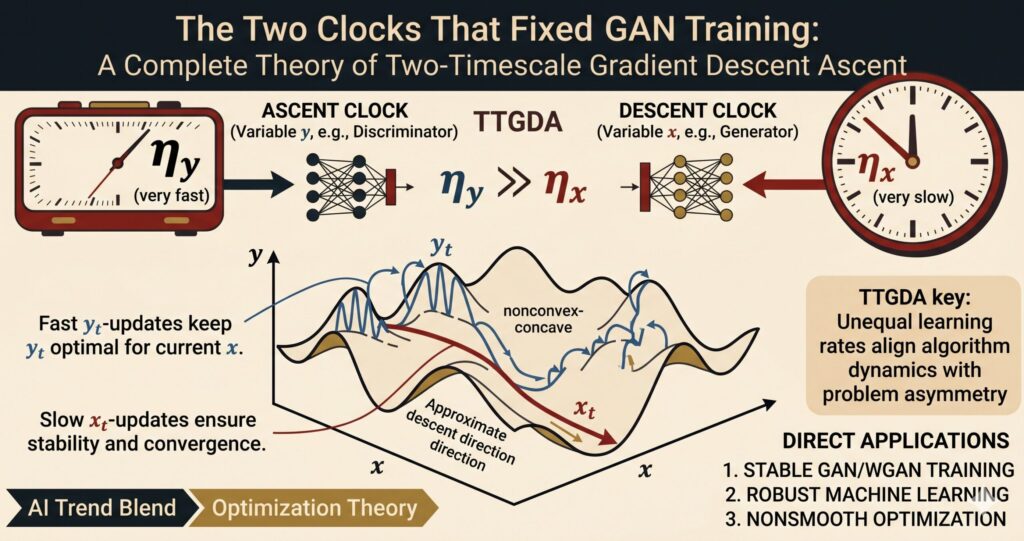
TTGDA: Two-Timescale Gradient Descent Ascent for Nonconvex Minimax Optimization.

TTGDA: Two-Timescale Gradient Descent Ascent for Nonconvex Minimax Optimization

TTGDA: Two-Timescale Gradient Descent Ascent for Nonconvex Minimax Optimization | AI Trend Blend Optimization Theory · Journal of Machine Learning Research 26 (2025) 1–45 · 19 min read The Two Clocks That Fixed GAN Training: A Complete Theory of Two-Timescale Gradient Descent Ascent Tianyi Lin, Chi Jin, and Michael I. Jordan from Columbia, Princeton, and

TTGDA: Two-Timescale Gradient Descent Ascent for Nonconvex Minimax Optimization Read More »