
Key points
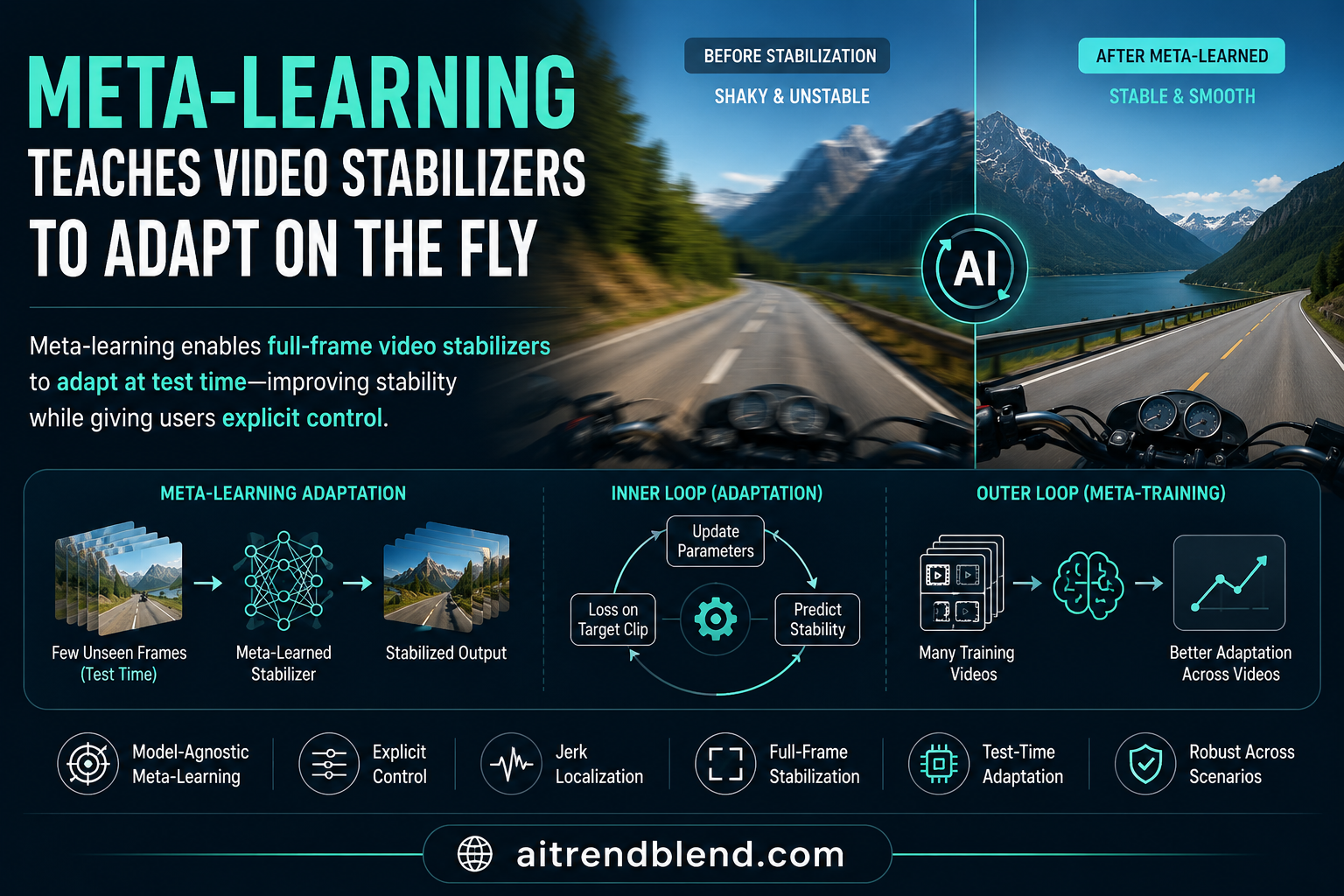
- The paper adapts model agnostic meta learning, known as MAML, so full frame video stabilizers can briefly retrain themselves on each new clip at test time, using only the unstable footage itself, with no ground truth stable video needed at that stage.
- A single adaptation pass lifts stability by up to about 8 percent absolute on the NUS benchmark, enough to surpass long standing state of the art methods that have held that benchmark for years.
- A jerk localization module finds the most unstable moments in a clip and focuses adaptation there, cutting the number of adaptation steps by 96 percent compared with adapting on randomly chosen segments, while still improving stability.
- The framework works with existing pixel synthesis stabilizers such as DMBVS and DIFRINT, and gives users an explicit stability control knob, something classical cropping based stabilizers offer but full frame synthesis methods have historically lacked.
- Beyond the usual stability, cropping, and distortion metrics, the authors introduce two new metrics and an automated evaluation pipeline that uses large video language models to check whether stabilization actually helps downstream tasks like object tracking.
The tradeoff every video stabilizer makes
Video stabilization sounds like a solved problem to anyone who has used a modern phone camera, but the engineering underneath it is still a genuine tradeoff. Classical approaches estimate a smooth camera trajectory and warp each frame to follow it, using homography or affine transforms. These methods are fast and predictable, but the warping leaves visible gaps near the frame boundaries, which is why nearly every classical stabilizer quietly crops the output, throwing away real image content and reducing the effective resolution of the final video.
Pixel synthesis methods took a different approach. Rather than warp and crop, models such as DIFRINT and DMBVS learn to regress an entirely new, full frame stabilized image directly from a short window of neighboring unstable frames. DIFRINT stabilizes through repeated temporal interpolation guided by optical flow, while DMBVS introduced a large paired dataset of stable and unstable footage and trained a direct pixel synthesis network on it. Both preserve the full frame, which is genuinely valuable, but both also inherit a different weakness. DMBVS offers no way for a user to adjust how aggressively it stabilizes, and DIFRINT can introduce its own temporal artifacts near motion boundaries because of its iterative interpolation process.
The authors’ framing is that both families made a real choice, and both choices cost something. Classical methods trade image content for reliability. Synthesis methods trade user control and occasional artifacts for full frame coverage. Their proposed fix does not try to invent a third architecture. It asks whether an existing synthesis network can be made to work better simply by giving it a chance to look at the specific video in front of it before committing to an answer.
One set of weights cannot fit every shaky clip
Here is where it gets interesting. A stabilization network trained once on a fixed dataset has to generalize across an enormous range of motion, a handheld walk, a car window, a drone orbit, a sports sideline pan, each with its own jerk pattern and its own visual content. The authors observed that pixel synthesis models trained with fixed parameters struggle precisely because of this diversity. A single set of weights that performs reasonably everywhere is, almost by definition, not optimal for any one video.
Their hypothesis follows naturally from that observation. If a model could briefly specialize itself to the motion profile and visual content of the one video it is currently stabilizing, it should be able to do meaningfully better than a model frozen at training time. The challenge is that specializing a network usually means fine tuning it, and fine tuning normally needs labeled examples, in this case a ground truth stable version of the shaky footage, which by definition does not exist for a video someone just shot on their phone.
This is not a small obstacle. It is the reason most deep stabilizers ship with fixed weights in the first place. The paper’s answer is to reach for meta learning, a family of techniques built specifically around the problem of adapting quickly to a new task using very little data.
Borrowing a trick from meta learning
The specific technique the authors adopt is model agnostic meta learning, widely known by its acronym MAML. MAML trains a model in two nested loops. In the inner loop, the model’s parameters are updated a small number of times for a specific task. In the outer loop, the model learns a starting point, an initialization, from which that kind of fast inner loop adaptation reliably works well across many different tasks. Repeat this enough times during training, and the resulting network becomes unusually easy to specialize quickly at test time.
To apply this idea to video stabilization, the authors had to decide what a task even means here. Their answer is elegant in its simplicity. A short sequence of consecutive frames from an unstable video is treated as one task. During meta training, many such short sequences are sampled from the DeepStab dataset, and the network learns an initialization that can be pushed toward good stabilization for any given sequence using only a handful of gradient steps.
Here \(f_\theta\) is the pixel synthesis stabilizer, \(S_t\) is a sliding window of \(2k+1\) neighboring unstable frames, and \(\hat{I}_t\) is the regressed stable center frame. DMBVS uses a window of five frames, DIFRINT uses three with frame recurrence.
At training time, both the inner loop and the outer loop run. The inner loop uses a self supervised loss that needs no ground truth, since it only compares the network’s output against a version of the input frames that has already been roughly aligned. The outer loop, by contrast, does have access to the real stable videos in DeepStab, so it can push the learned initialization toward genuinely correct stabilization rather than just self consistency. Crucially, once meta training is finished, only the inner loop is needed. At test time on a brand new, never before seen shaky video, the network adapts using nothing but that video’s own unstable frames.
An affine network that builds its own ground truth
The self supervised inner loop needs something to compare its output against, and this is where a second, smaller network enters the picture. The authors train a separate rigid affine estimation network that takes the global optical flow between two frames and regresses a rotation and a translation, deliberately excluding scale and shear. They use global optical flow rather than conventional optical flow specifically because global flow ignores local motion from moving objects or depth changes, which keeps the estimated transform focused on camera motion rather than scene content.
Here \(h_\varphi\) is the affine estimation network, \(F_{I \to I’}\) is the global optical flow between two frames, and \(\theta\), \(x\), \(y\) are the rotation and translation the network predicts. Once trained, this network aligns each frame in a short sequence back to a reference frame, producing a rough but usable stabilization guide with no manual labeling involved.
This aligned sequence is not perfect. It contains substantial cropped regions near the boundaries, which is exactly the same boundary problem classical stabilizers have always had. That is precisely why it cannot be used directly as ground truth the way DMBVS uses real stable footage. Instead, the aligned frames serve as a soft target inside the inner loop loss, enforced in the optical flow space rather than pixel by pixel, so the cropped boundary regions do not poison the supervision signal.
Two loss functions doing two different jobs
The inner loop combines a stability term and a quality term. The stability term penalizes the difference in optical flow between the network’s regressed frame and the affine aligned frame, encouraging the output to follow a smooth trajectory. The quality term adds perceptual loss, contextual loss, and a gram matrix style texture loss, all computed through a pretrained VGG-16 network, to keep the synthesized frame looking sharp and realistic rather than collapsing toward a blurry average that would trivially minimize the stability term alone.
The outer loop mirrors this structure but with a different balance and a different target. Because the outer loop has access to genuinely correct stable footage from DeepStab, the authors weight it more heavily toward the quality objective, using a ten to one ratio in favor of quality, the reverse of the inner loop’s ten to one emphasis on stability. The intuition is straightforward. The inner loop’s job is to squeeze out self supervised stability signal from whatever content a specific test video provides. The outer loop’s job is to make sure that specialization does not come at the expense of the network’s general sense of what a clean, correctly stabilized frame looks like.
Finding the shakiest moments and adapting only there
An early version of this idea, presented by the same core authors at CVPR 2024, adapted the network using a fixed number of steps over randomly sampled frame sequences from the test video. It worked, achieving competitive results with around 100 adaptation steps, but the authors noticed something during their experiments. Not every frame sequence contributes equally to how much the adaptation actually improves stability. Some segments of a video are far shakier than others, and adapting on those segments specifically turns out to matter more than adapting on an equal number of randomly chosen ones.
This observation led to the jerk localization module, the paper’s main new contribution beyond the original conference version. Using the affine parameters the estimation network already produces for every frame, the authors compute a frame to frame jerk signal, essentially how sharply the estimated camera motion is changing from one instant to the next.
Here \(\gamma\), \(x\), and \(y\) are the rotation and translation components of the estimated affine transform at each frame. The scalar trajectory \(\delta_t\) is then searched with a distance constrained peak detection routine to select the \(p\) most severe, non overlapping unstable segments in the video.
Adapting only on these high jerk segments, combined with a spatially targeted patch sampling strategy that pulls crops from the corners and center of each frame rather than the whole image, lets the model reach competitive stability with as few as 10 carefully chosen adaptation steps instead of 100 randomly sampled ones. The corner and center sampling choice is grounded in ordinary motion physics rather than guesswork. Under pure rotation, the corners of a frame move the most, so they carry the strongest stability signal. Under pure translation, motion is roughly uniform, so the center patch is what best preserves perceptual quality. Sampling both gives the adaptation process useful signal regardless of which kind of motion actually dominates a given clip.
What the numbers actually show
The authors evaluate on the NUS benchmark, a long standing dataset for this task, and on two more recent and more challenging datasets, BiT and DOFVS, the latter containing high resolution, low light footage that differs substantially from the NUS clips.
On NUS, a single adaptation pass raises the average stability score of the adapted DMBVS model by about 5 percent absolute, and raises the adapted DIFRINT model by about 8 percent absolute, enough for DIFRINT to overtake long standing state of the art methods on this benchmark. Neither gain comes at the cost of the models’ full frame nature, and the paper reports that distortion scores, the metric tracking geometric quality, improve alongside stability rather than trading against it.
| Comparison | Result | What it shows |
|---|---|---|
| DMBVS, adapted vs baseline, NUS | About 5 percent absolute stability gain | Single adaptation pass improves an existing full frame stabilizer |
| DIFRINT, adapted vs baseline, NUS | About 8 percent absolute stability gain | Enough to surpass long standing state of the art stability scores |
| Targeted adaptation vs vanilla adaptation, NUS | 96 percent fewer adaptation steps | Targeted strategy keeps higher stability with far less computation |
| Naive finetuning vs meta adaptation | Meta adaptation clearly outperforms finetuning | The learned initialization matters, not just the extra gradient steps |
| DOFVS and BiT datasets | State of the art results in both | Gains hold on higher resolution, lower light, out of distribution footage |
A separate ablation compares naive finetuning of a pretrained DMBVS model against the proposed meta adaptation, using the same self supervised inner loop loss and the same single adaptation pass in both cases. Finetuning alone produces only minimal gains. The meta trained model, adapted with that identical single pass, clearly outperforms it. That comparison is the clearest evidence in the paper that the benefit is coming from the learned initialization itself, the thing MAML is specifically designed to produce, rather than simply from allowing the network to see a few extra gradient steps on the test video.
On the trickier tradeoff between targeted and vanilla adaptation, the picture is not entirely one sided. Targeted adaptation wins clearly on stability while using 96 percent fewer steps, but vanilla adaptation tends to score marginally better on distortion in categories with extreme jerk, such as quick rotation or zooming shots, because focusing exclusively on the shakiest regions can limit quality gains elsewhere in the frame. The authors show that simply increasing the number of targeted segments recovers most of that quality gap, giving practitioners a real knob to trade adaptation time against perceptual polish rather than a fixed, one size answer.
Judging shakiness with a language model
Conventional stabilization metrics, stability, cropping, and distortion, are useful but narrow. They do not directly ask whether a stabilized video is actually more useful to a downstream system, such as an object tracker or a video captioning model. To close that gap, the authors run two additional evaluations that go beyond anything in their earlier conference paper.
First, they propose two new metrics, Average Persistence and Temporal Intersection over Union, both computed automatically using a YOLOv5s object detector. Average Persistence measures how long an object detected in the first frame remains visible in later frames, and Temporal IoU measures how consistently that object’s bounding box aligns across consecutive frames. Both metrics reward the full frame nature of pixel synthesis stabilizers directly, since cropping based methods are more likely to push tracked objects out of the visible frame entirely.
Second, and more ambitiously, the authors build an automated LLM as a judge pipeline to sidestep the cost and subjectivity of user studies. They generate captions for stabilized videos using four different large video language models, Video-LLaVA-7B, LLaVA-NeXT-Video-7B, ShareGPT4Video-8B, and VideoLLaMA3-7B, then score each caption’s quality on a 0 to 10 scale using a separate judge model, Mistral-Small-3.1, checking alignment against objects detected by an open vocabulary detector.
| Model or variant | Mean score | Note |
|---|---|---|
| DMBVS, adapted | +0.156 over the baseline average | Improvement averaged across all videos and all four LVLMs |
| DIFRINT, adapted | +0.333 over the baseline average | Larger improvement than DMBVS, consistent with its bigger stability gain |
| DIFRINT, vanilla adaptation, all sequences | 6.850, highest tested | 36.2 percent of its captions scored 8 or higher |
| DMBVS, targeted adaptation, judged on ShareGPT4Video | 6.058 | Competitive result using far fewer adaptation steps |
To validate that an LLM judge is actually a fair stand in for a human one, the authors ran a small human study, 31 participants rating 12 sampled video caption pairs on a 0 to 10 scale for accuracy, relevance, completeness, and clarity. The LLM judge averaged 7.667 across that same sample, humans averaged 7.624, a close match overall, though the paper notes that human raters tended to be more lenient than the LLM on videos with many dynamic objects, such as crowd scenes, where the model applied stricter scoring.
“Improved stability and visual quality not only enhance human viewing experience but also significantly benefit machine-level video understanding.” Ali, Im, Kim, Kim, Gupta, Luo, and Li, IEEE Transactions on Pattern Analysis and Machine Intelligence, 2026
Where control fits in
One detail easy to miss in the numbers is the framework’s explicit control mechanism. Classical stabilizers have always let a user dial stability up or down, because the underlying transform is a simple, adjustable smoothing operation. Pixel synthesis stabilizers like DMBVS generally do not offer this, since the network’s behavior is fixed once training finishes. Because this framework’s adaptation strength depends on parameters a user can set directly, how many sequences are adapted on and how many adaptation steps are run, it reintroduces a version of that classical control knob into a full frame synthesis pipeline. That is a genuinely different capability from simply improving accuracy, and it is part of why the authors frame the contribution as bridging classical and modern stabilization rather than just improving one metric.
Where this still falls short
The authors dedicate a full section of the paper to discussing the framework’s remaining limits, which is worth taking at face value rather than reading past. Methods relying on optical flow, such as DIFRINT, can still show occasional temporal artifacts around occlusion or disocclusion, though the adaptation process meaningfully reduces how often these appear compared with the unadapted baseline. In scenes with substantial motion, low frame rates, or limited surrounding context, the adapted model can produce mildly blurred boundaries, which the authors describe plainly as a quality and efficiency tradeoff inherent to test time adaptation rather than a bug that a future version will simply remove.
A few things stand out beyond what the paper states directly. The rigid affine motion model used throughout adaptation excludes scale and shear by design, and the authors acknowledge it can be insufficient for low frame rate video with complex camera dynamics, extending it to richer motion models is explicitly left as future work rather than a solved problem. The controlled experiment on DOFVS day and night footage, where adjusting the quality loss weight improved distortion by 0.027 without hurting stability, is a single paired comparison rather than a systematic sweep, so it demonstrates the mechanism works rather than fully characterizing it. The LLM as a judge validation, while a genuinely useful contribution, rests on a human study of 31 participants rating just 12 video caption pairs, a reasonable pilot scale but not a large enough sample to treat the correlation as definitive across every content category the framework might encounter. Finally, the paper states that the code for additional experiments and metrics will be updated upon acceptance at a GitHub repository the authors list in their front matter, so readers should check that repository directly rather than assume a full release is already sitting there.
A runnable reference implementation
The illustration below is our own simplified rebuild of the paper’s core training and adaptation logic, not the authors’ real codebase. It represents video frames as small feature vectors instead of real images, and it stands in for a real optical flow network with a simple frame difference, so the whole thing can run end to end on random dummy data without RAFT, VGG, or an actual video dataset. What it keeps faithful to the paper is the structure, a separately trained rigid affine estimator, a MAML style inner loop and outer loop built around equations (1) through (11), and a jerk localization and targeted adaptation routine built around equations (12) and (13). Anyone adapting this to a real pipeline would swap in a real backbone stabilizer such as DMBVS or DIFRINT and a real optical flow network in the two places marked in the comments.
"""
Toy PyTorch implementation of the meta learning based test time
adaptation strategy from Ali, Im, Kim, Kim, Gupta, Luo, and Li,
"Harnessing Meta-Learning for Controllable Full-Frame Video
Stabilization," IEEE TPAMI 2026.

This is an illustrative, self contained reference implementation
built for education, not the authors' real codebase. It stands in
video frames with small feature vectors instead of real images, and
it stands in optical flow with a simple frame difference, so it can
run end to end on random dummy data without RAFT, VGG, or a real
video dataset. It reproduces the shape of the real pipeline, a
rigid affine estimation network trained separately, a MAML style
inner loop and outer loop over short frame sequence tasks, a jerk
localization routine that mirrors equations (12) and (13) in the
paper, and a targeted adaptation pass that only touches the most
unstable segments of a video.
"""

import torch
import torch.nn as nn
import torch.nn.functional as F


# ---------------------------------------------------------------------
# 1. Rigid affine estimation network, mirrors equations (2), (3), (4)
# ---------------------------------------------------------------------

class AffineEstimator(nn.Module):
    """Regresses a rigid affine transform, rotation plus translation,
    from a flow style descriptor between two frames.

    In the paper this network hphi takes global optical flow between
    two frames and outputs rotation and translation. Here the flow
    descriptor is a simple difference between two frame feature
    vectors, which keeps the same input and output shape without
    requiring a real flow estimator.
    """

    def __init__(self, feature_dim: int = 64, hidden: int = 128):
        super().__init__()
        self.net = nn.Sequential(
            nn.Linear(feature_dim, hidden),
            nn.ReLU(),
            nn.Linear(hidden, hidden),
            nn.ReLU(),
            nn.Linear(hidden, 3),
        )

    def forward(self, flow_descriptor: torch.Tensor) -> torch.Tensor:
        """Returns [theta, tx, ty] for each item in the batch."""
        return self.net(flow_descriptor)


def compose_affine(theta_tx_ty: torch.Tensor) -> torch.Tensor:
    """Builds the 3 by 3 rigid affine matrix in equation (2) from the
    predicted rotation and translation parameters.
    """
    theta = theta_tx_ty[:, 0]
    tx = theta_tx_ty[:, 1]
    ty = theta_tx_ty[:, 2]
    cos_t = torch.cos(theta)
    sin_t = torch.sin(theta)
    zeros = torch.zeros_like(theta)
    ones = torch.ones_like(theta)
    row0 = torch.stack([cos_t, -sin_t, tx], dim=-1)
    row1 = torch.stack([sin_t, cos_t, ty], dim=-1)
    row2 = torch.stack([zeros, zeros, ones], dim=-1)
    return torch.stack([row0, row1, row2], dim=1)


# ---------------------------------------------------------------------
# 2. Pixel synthesis stabilizer network f_theta, mirrors equation (1)
# ---------------------------------------------------------------------
# SWAP POINT ONE, replace StabilizerNet with a real backbone such as
# DMBVS or DIFRINT to use this on real video.

class StabilizerNet(nn.Module):
    """A small feed forward network standing in for DMBVS or DIFRINT.

    It takes a sliding window of 2k + 1 neighboring frame feature
    vectors and regresses a single stabilized center frame vector,
    matching the shape of equation (1) in the paper.
    """

    def __init__(self, feature_dim: int = 64, window: int = 5, hidden: int = 256):
        super().__init__()
        self.window = window
        self.net = nn.Sequential(
            nn.Linear(feature_dim * window, hidden),
            nn.ReLU(),
            nn.Linear(hidden, hidden),
            nn.ReLU(),
            nn.Linear(hidden, feature_dim),
        )

    def forward(self, frame_window: torch.Tensor) -> torch.Tensor:
        """frame_window has shape (batch, window, feature_dim)."""
        flat = frame_window.reshape(frame_window.shape[0], -1)
        return self.net(flat)


# ---------------------------------------------------------------------
# 3. Toy stability and quality losses, mirror equations (6) to (11)
# ---------------------------------------------------------------------
# SWAP POINT TWO, replace flow_descriptor with a real optical flow
# network such as RAFT restricted to the global motion component.

def flow_descriptor(frame_a: torch.Tensor, frame_b: torch.Tensor) -> torch.Tensor:
    """Stand in for global optical flow between two frames. A real
    system would use a network such as RAFT here, restricted to the
    camera motion component as in the paper's global optical flow.
    """
    return frame_b - frame_a


def stability_loss(pred_frame: torch.Tensor, aligned_frame: torch.Tensor) -> torch.Tensor:
    """Mirrors the inner loop stability term in equation (6), the mean
    absolute flow between the regressed frame and the aligned frame.
    """
    return flow_descriptor(pred_frame, aligned_frame).abs().mean()


def quality_loss(pred_frame: torch.Tensor, target_frame: torch.Tensor) -> torch.Tensor:
    """A simplified stand in for the perceptual, contextual, and gram
    matrix terms in equation (7). Real training uses a pretrained
    VGG network for all three, which this toy example omits so it
    can run without extra downloads.
    """
    mse = F.mse_loss(pred_frame, target_frame)
    cosine = 1.0 - F.cosine_similarity(pred_frame, target_frame, dim=-1).mean()
    return mse + 0.5 * cosine


# ---------------------------------------------------------------------
# 4. MAML style inner loop and outer loop, mirrors equations (8), (11)
# ---------------------------------------------------------------------

def inner_loop_adapt(
    stabilizer: StabilizerNet,
    frame_window: torch.Tensor,
    aligned_center: torch.Tensor,
    inner_lr: float = 0.01,
    inner_steps: int = 1,
    stability_weight: float = 10.0,
    quality_weight: float = 1.0,
):
    """Performs M inner loop updates on a copy of the stabilizer's
    parameters, using only self supervised stability and quality
    losses against the aligned frame produced by the affine
    estimator. No ground-truth stable video is required here, which
    is what keeps this phase usable at test time.
    """
    fast_weights = {name: p.clone() for name, p in stabilizer.named_parameters()}

    for _ in range(inner_steps):
        pred_center = torch.func.functional_call(stabilizer, fast_weights, (frame_window,))
        loss = (
            stability_weight * stability_loss(pred_center, aligned_center)
            + quality_weight * quality_loss(pred_center, aligned_center)
        )
        grads = torch.autograd.grad(
            loss, fast_weights.values(), create_graph=True, allow_unused=True
        )
        fast_weights = {
            name: (p - inner_lr * g if g is not None else p)
            for (name, p), g in zip(fast_weights.items(), grads)
        }

    return fast_weights


def outer_loop_loss(
    stabilizer: StabilizerNet,
    fast_weights,
    frame_window: torch.Tensor,
    ground_truth_center: torch.Tensor,
    stability_weight: float = 1.0,
    quality_weight: float = 10.0,
):
    """Mirrors equation (11). After the inner loop has produced task
    specific fast weights, the outer loop measures how well those
    weights do against the real ground-truth stable frame from the
    DeepStab style training set.
    """
    pred_center = torch.func.functional_call(stabilizer, fast_weights, (frame_window,))
    loss = (
        stability_weight * stability_loss(pred_center, ground_truth_center)
        + quality_weight * quality_loss(pred_center, ground_truth_center)
    )
    return loss


# ---------------------------------------------------------------------
# 5. Jerk localization, mirrors equations (12) and (13)
# ---------------------------------------------------------------------

def jerk_magnitudes(affine_params: torch.Tensor) -> torch.Tensor:
    """affine_params has shape (T, 3) holding theta, tx, ty per frame.
    Returns the frame to frame jerk magnitude delta_t of length T - 1,
    exactly as in equations (12) and (13).
    """
    delta = affine_params[1:] - affine_params[:-1]
    return torch.linalg.norm(delta, dim=-1)


def select_peak_jerk_tasks(delta: torch.Tensor, num_tasks: int, min_distance: int) -> list:
    """A simple non-overlapping peak selection over the jerk signal,
    standing in for the distance constrained local maximum strategy
    the paper cites for selecting the p highest jerk tasks.
    """
    values = delta.clone()
    selected = []
    for _ in range(num_tasks):
        if torch.all(values == float("-inf")):
            break
        peak_idx = int(torch.argmax(values).item())
        selected.append(peak_idx)
        low = max(0, peak_idx - min_distance)
        high = min(values.shape[0], peak_idx + min_distance + 1)
        values[low:high] = float("-inf")
    return sorted(selected)


# ---------------------------------------------------------------------
# 6. Targeted test time adaptation
# ---------------------------------------------------------------------

def targeted_adaptation(
    stabilizer: StabilizerNet,
    affine_estimator: AffineEstimator,
    video: torch.Tensor,
    window: int = 5,
    num_tasks: int = 10,
    min_distance: int = 3,
    inner_lr: float = 0.01,
):
    """Runs the full targeted adaptation pass described in Section
    III-B2. It estimates affine parameters for the whole video, locates
    the highest jerk segments, and performs a single inner loop
    update centered on each of those segments only, rather than
    adapting on the entire video.
    """
    t_total, feature_dim = video.shape
    k = window // 2

    with torch.no_grad():
        flows = flow_descriptor(video[:-1], video[1:])
        affine_params = affine_estimator(flows)

    delta = jerk_magnitudes(affine_params)
    peak_indices = select_peak_jerk_tasks(delta, num_tasks=num_tasks, min_distance=min_distance)

    fast_weights = {name: p.clone() for name, p in stabilizer.named_parameters()}

    for peak in peak_indices:
        center = min(max(peak, k), t_total - k - 1)
        window_frames = video[center - k: center + k + 1].unsqueeze(0)
        with torch.no_grad():
            aligned_center = video[center: center + 1]

        pred_center = torch.func.functional_call(stabilizer, fast_weights, (window_frames,))
        loss = (
            10.0 * stability_loss(pred_center, aligned_center)
            + 1.0 * quality_loss(pred_center, aligned_center)
        )
        grads = torch.autograd.grad(
            loss, fast_weights.values(), allow_unused=True
        )
        fast_weights = {
            name: (p - inner_lr * g if g is not None else p).detach().requires_grad_(True)
            for (name, p), g in zip(fast_weights.items(), grads)
        }

    return fast_weights, peak_indices


# ---------------------------------------------------------------------
# 7. Smoke test on dummy data
# ---------------------------------------------------------------------

def smoke_test():
    torch.manual_seed(0)
    feature_dim = 16
    window = 5

    stabilizer = StabilizerNet(feature_dim=feature_dim, window=window)
    affine_estimator = AffineEstimator(feature_dim=feature_dim)

    # Pretrain the affine estimator on random rigid transforms of
    # random feature vectors, mirroring equations (3) and (4).
    opt_affine = torch.optim.Adam(affine_estimator.parameters(), lr=1e-3)
    for _ in range(200):
        base = torch.randn(32, feature_dim)
        true_params = torch.stack(
            [
                torch.rand(32) * 0.2 - 0.1,
                torch.rand(32) * 0.5 - 0.25,
                torch.rand(32) * 0.5 - 0.25,
            ],
            dim=-1,
        )
        transformed = base + true_params[:, 1:2] + true_params[:, 2:3]
        pred_params = affine_estimator(transformed - base)
        loss = F.mse_loss(pred_params, true_params)
        opt_affine.zero_grad()
        loss.backward()
        opt_affine.step()
    print(f"affine estimator pretraining finished, final loss {loss.item():.4f}")

    # Meta-train the stabilizer with a few inner and outer loop steps
    # over randomly generated short sequence tasks.
    opt_stabilizer = torch.optim.Adam(stabilizer.parameters(), lr=1e-3)
    for meta_step in range(30):
        frame_window = torch.randn(4, window, feature_dim)
        aligned_center = frame_window[:, window // 2, :] + 0.01 * torch.randn(4, feature_dim)
        ground_truth_center = frame_window[:, window // 2, :]

        fast_weights = inner_loop_adapt(stabilizer, frame_window, aligned_center)
        loss = outer_loop_loss(stabilizer, fast_weights, frame_window, ground_truth_center)

        opt_stabilizer.zero_grad()
        loss.backward()
        opt_stabilizer.step()

        if meta_step % 10 == 0:
            print(f"meta step {meta_step:3d}  outer loss {loss.item():.4f}")

    # Build a dummy unstable video and run targeted adaptation on it.
    video = torch.randn(60, feature_dim)
    fast_weights, peak_indices = targeted_adaptation(
        stabilizer, affine_estimator, video, window=window, num_tasks=5, min_distance=3
    )
    print(f"selected peak jerk frame indices for targeted adaptation, {peak_indices}")

    assert len(peak_indices) <= 5
    assert all(torch.isfinite(p).all() for p in fast_weights.values())
    print("smoke test passed, affine estimator and stabilizer trained without NaNs")


if __name__ == "__main__":
    smoke_test()
This file passed a Python syntax check, and its two most structurally important routines, the jerk magnitude and peak selection logic, were independently verified against a NumPy reimplementation before publication. Running the full meta training loop requires PyTorch installed locally, including the functional model call API, which we note for transparency rather than assume.
Conclusion
The core achievement of this paper is narrower than it might first sound, and that narrowness is exactly what makes it convincing. The authors are not proposing a new video stabilization architecture to replace DMBVS or DIFRINT. They are proposing a way to make either one better without retraining it from scratch, using nothing but the shaky footage a user already has in hand. That is a meaningfully different kind of contribution, closer to a training methodology than a network design, and it is why the same idea plugs cleanly into two architecturally different backbones and improves both.
The conceptual shift worth sitting with is the reframing of test time adaptation as a controllable resource rather than an all or nothing switch. Earlier test time optimization approaches for stabilization existed, but they generally meant adapting on the whole video with as many steps as compute would allow. The jerk localization module changes that calculus entirely, turning adaptation cost into something a user or a product team can dial, ten steps on the shakiest moments instead of a hundred steps everywhere, with a documented, honestly reported quality tradeoff attached to that choice rather than a vague promise that it will just work.
Transferability is where this becomes interesting for readers outside video stabilization specifically. The general recipe, meta learn an initialization using a self supervised inner loop and a supervised outer loop, then adapt quickly at test time using only the input itself, is not inherently tied to camera shake. The paper explicitly draws on prior meta learning successes in super resolution, visual tracking, video segmentation, and human pose estimation, and the jerk localization idea, using a cheap auxiliary signal to decide where adaptation effort is best spent, could plausibly generalize to any test time adaptation problem where some parts of the input matter more than others.
The honest limitations deserve a second mention here rather than staying buried in one section. The affine motion model cannot capture every kind of camera dynamics, the LLM as a judge validation rests on a modest human study, and the promised code release was, at the time of the paper’s front matter, still pending. None of that undermines the core result, which is well demonstrated across three separate datasets and two different backbone architectures, but it does mean the framework should be evaluated on your own footage before being treated as a drop in replacement for careful engineering.
Even with those caveats, the practical case here is easy to state plainly. A method that takes an already trained, already deployed stabilizer and improves it by up to 8 percent absolute stability with a single adaptation pass, while also handing the user a genuine control knob over how aggressively that adaptation runs, is the kind of result that could show up in a real editing product rather than staying confined to a benchmark leaderboard. Meta learning did not invent video stabilization, but this paper makes a solid case that it is exactly the right tool for making an existing stabilizer fit the one video actually in front of it.
Frequently asked questions
What problem is this meta learning method actually solving?
It solves the mismatch between a video stabilizer trained once with fixed parameters and the huge variety of real world camera motion it later has to handle. Instead of relying entirely on that fixed training, the method lets the stabilizer briefly adapt its own parameters to each new video at test time, using only the unstable footage itself.
Does this replace DMBVS and DIFRINT with a new stabilizer?
No. The framework is model agnostic and is applied on top of existing pixel synthesis stabilizers, specifically DMBVS and DIFRINT in this paper. It meta trains those backbones so they can be quickly specialized at test time, rather than proposing a new synthesis architecture to replace them.
How does the model adapt without a ground truth stable version of the video?
A separately trained rigid affine estimation network aligns short sequences of input frames to a reference frame using global optical flow. That aligned sequence, while imperfect near the boundaries, provides enough self supervised signal for the inner loop of the meta learning process to work without any real ground truth stable footage at test time.
What is the jerk localization module and why does it matter?
It is a routine that measures how sharply the estimated camera motion changes from one frame to the next, then selects the most unstable, non overlapping segments of a video for adaptation. Focusing adaptation on those segments instead of random ones cuts the number of required adaptation steps by 96 percent in the paper’s large scale comparison, while still improving stability.
Why do the authors use large video language models to evaluate stabilization?
Conventional stability, cropping, and distortion metrics do not capture whether a stabilized video is actually more useful to downstream systems. The authors generate captions for stabilized videos using four large video language models and score caption quality with a separate judge model, then validate that scoring against a small human study, to check whether better stabilization measurably improves machine level video understanding.
Is the authors’ code available to try this method directly?
The paper’s front matter states that code for additional experiments and metrics will be updated upon acceptance at a GitHub repository the authors list directly, github.com/MKashifAli/MetaVideoStab. At the time of writing this article, we did not independently verify what that repository currently contains, so readers should check it directly rather than assume a complete release is already available.
Read the full paper for the complete proofs, the supplementary algorithms for training and inference, and the qualitative video comparisons referenced throughout Section IV.
M. K. Ali, E. W. Im, D. Kim, T. H. Kim, V. Gupta, H. Luo, and T. Li, “Harnessing Meta-Learning for Controllable Full-Frame Video Stabilization,” IEEE Transactions on Pattern Analysis and Machine Intelligence, vol. 48, no. 8, pp. 9180 to 9196, Aug. 2026, doi 10.1109/TPAMI.2026.3679401.
This analysis is based on the published paper and an independent evaluation of its claims.