
Key points
- The paper introduces HeteroHBA, a backdoor attack designed specifically for heterogeneous graphs, where nodes and edges come in multiple types and cannot be connected arbitrarily.
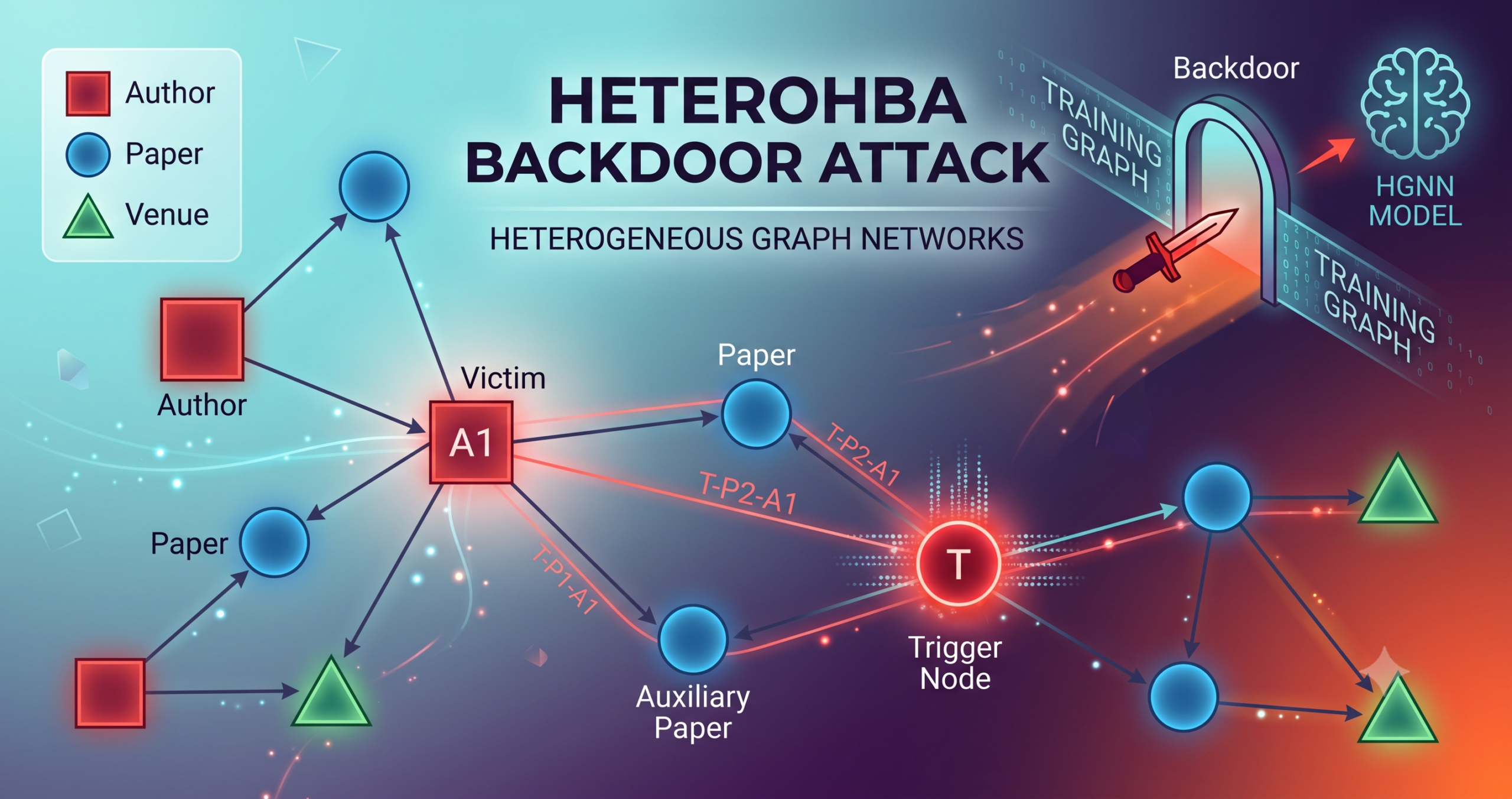
- Instead of injecting a whole trigger subgraph, HeteroHBA attaches a single generated trigger node per victim and adapts its features and connections to the local context.
- A generative module called GraphTrojanNet produces the trigger, and a bilevel training scheme tunes it against a surrogate model to maximize attack success while protecting clean accuracy.
- Adaptive Instance Normalization and Maximum Mean Discrepancy loss pull the trigger’s feature statistics toward normal nodes, and a lightweight refinement step tightens that alignment further.
- The authors also propose their own defense, Cluster based Structural Defense, and show that HeteroHBA remains largely effective against it, which is the part practitioners should sit with the longest.
Why a homogeneous graph trigger does not just transfer over
Most of what the research community knows about backdoor attacks on graphs comes from homogeneous graphs, where every node and every edge is the same type. In that setting, an attacker can attach almost any subgraph to almost any node, because nothing in the graph schema stops them. Methods like UGBA and DPGBA, both built around a bilevel optimization framework, showed that carefully shaped trigger subgraphs can flip a target node’s predicted label while staying hard to spot under a limited budget of changes.
Heterogeneous graphs do not offer that freedom. An author node in a citation graph cannot connect directly to a keyword node the same way it connects to a paper. A device node in a fraud graph carries a completely different feature space than an account node. The paper’s authors put it plainly, a trigger that looks perfectly normal in a homogeneous graph can become an obvious outlier the moment it has to respect type constrained relations and type dependent feature spaces. That mismatch is the actual research gap this paper is trying to close, not just a smaller technical tweak on existing methods.
A prior attempt called HGBA did adapt backdoor attacks to heterogeneous graphs using relation aware triggers built along metapaths, but the authors point out a real limitation, its connection templates are fixed and shared across every trigger. Once a defender has seen one HGBA trigger, they have effectively seen them all, which makes the pattern easier to catch and remove at scale.
What a graph backdoor attack actually requires
It helps to be precise about what this kind of attack does and does not assume, because the threat model shapes how seriously to take the result. The attacker gets to see the training graph, its node features, its schema, and its labels, and is allowed to inject a small number of new trigger nodes and edges before training happens. The attacker does not get to see the final deployed model’s internal parameters. During training, the poisoned graph teaches the model an association between the trigger pattern and a target label. At inference time, any node wearing that same trigger pattern gets nudged toward the attacker’s chosen class, while every other node keeps classifying normally.
That last clause is what makes backdoor attacks genuinely dangerous compared to a blunt adversarial perturbation. A model under a successful backdoor attack still looks completely healthy on every standard accuracy benchmark, because the backdoor only activates on the specific trigger pattern. Nobody reviewing the model’s overall test accuracy would have any reason to suspect a problem.
Comparing HeteroHBA to what came before it
The paper positions HeteroHBA against four prior methods along three dimensions, whether the method was designed for heterogeneous graphs at all, how it inserts its trigger, and whether the trigger adapts to context rather than staying fixed.
| Method | Built for heterogeneous graphs | Trigger insertion style | Adapts per victim |
|---|---|---|---|
| CGBA | No | Feature perturbation | No |
| UGBA | No | Subgraph injection | Yes |
| DPGBA | No | Subgraph injection | Yes |
| HGBA | Yes | Connection based injection | No |
| HeteroHBA | Yes | Single node injection | Yes |
The single node choice is worth pausing on. Injecting an entire trigger subgraph, the way UGBA and DPGBA do, leaves more moving parts for a defender to notice, extra nodes, extra edges, an unusual local topology. HeteroHBA’s authors bet that a single, carefully generated node with adaptive connections can achieve comparable or better attack strength while leaving a smaller, less structurally obvious footprint. Given the results discussed below, that bet largely paid off.
The four stage pipeline, described conceptually
HeteroHBA is built as a sequence of stages, and understanding the shape of that pipeline is more useful for a general reader than tracing every equation, so this section stays at the conceptual level.
Stage one, deciding where the trigger is allowed to attach
Not every node in a heterogeneous graph makes sense as a trigger’s neighbor. The framework first narrows down a candidate pool of auxiliary nodes, meaning nodes of the types that are actually allowed to connect to a trigger under the graph’s own schema. It then filters that pool further using a saliency based screening step, essentially asking a surrogate classifier which candidate nodes have the most influence over the target class’s predictions, and keeping only the most influential ones. The idea is to spend the attacker’s limited connection budget on the neighbors that matter most, rather than attaching randomly.
The paper also makes a practical observation about connection budgets. Real heterogeneous graphs have long tailed degree distributions, where a handful of nodes have enormous numbers of connections and most nodes have very few. Copying that high end of the distribution for a trigger node would make it stick out immediately, so the authors calibrate the trigger’s connectivity to the ninetieth percentile of normal node degree, a level generous enough to be effective but not so unusual that it reads as anomalous on its own.
Stage two, generating the trigger itself
A learned generator, referred to in the paper as GraphTrojanNet, takes a victim node’s own features as input and produces a matching trigger feature vector along with a set of connection preferences toward the filtered candidate pool. Because the generator conditions on each victim individually, plus a source of random noise to encourage variety, different victims end up with different triggers rather than one fixed template repeated everywhere. That variety is precisely what HGBA lacked, and the paper argues it is a meaningful part of why HeteroHBA is harder to catch through pattern matching.
Stage three, tuning the trigger through bilevel optimization
The generator is not trained in isolation. A surrogate model stands in for the eventual victim classifier, and the two are trained against each other in a nested loop. The surrogate learns to classify the poisoned graph as well as it can, and the generator is periodically updated to make its triggers more effective against whatever the current surrogate has learned. This is the same style of nested optimization that UGBA and DPGBA use on homogeneous graphs, adapted here to respect heterogeneous type constraints throughout. A diversity term is added specifically to stop the generator from collapsing into producing the same trigger pattern for every victim, a known failure mode in generative attack methods where the network finds one good solution and stops exploring.
Stage four, polishing the trigger’s statistics
Even after the bilevel training converges, the raw trigger features can still carry subtle statistical fingerprints that separate them from genuine nodes. The framework addresses this with two complementary techniques. Adaptive Instance Normalization rescales the trigger’s feature mean and spread to match clean trigger type nodes during generation, and afterward a lightweight refinement module trained with a Maximum Mean Discrepancy loss nudges the trigger’s fuller feature distribution even closer to normal, while a separate loss term checks that the attack still works after this polishing. The authors describe these two tools as complementary rather than redundant, since matching mean and variance is not the same as matching the full shape of a distribution in a high dimensional feature space.
How well does it actually work
The authors test HeteroHBA on three widely used heterogeneous benchmarks, ACM, DBLP, and IMDB, each with its own set of node types and its own primary classification task, and against three representative heterogeneous graph models, HAN, HGT, and SimpleHGN. Two metrics carry the evaluation, Attack Success Rate, meaning how often a poisoned node gets pushed into the attacker’s target class, and Clean Accuracy Drop, meaning how much the model’s ordinary performance suffers because of the poisoning. A good attack wants a high Attack Success Rate paired with a Clean Accuracy Drop close to zero.
Against CGBA, a feature only baseline, and HGBA, the prior heterogeneous specific method, HeteroHBA generally posts a noticeably higher Attack Success Rate while keeping Clean Accuracy Drop competitive. On DBLP with the HGT model, for example, HeteroHBA reaches a near perfect attack success rate while the Clean Accuracy Drop stays under two percentage points, in the same range as the comparison methods. CGBA in particular struggles across the board, which the authors read as evidence that feature only triggers cannot compete once message passing is doing most of the heavy lifting in a heterogeneous model. HGBA shows large swings in effectiveness from setting to setting, consistent with its reliance on one fixed connection template that works better in some graphs than others.
One dataset breaks the pattern in an interesting way. IMDB consistently shows lower attack success than ACM or DBLP across every method tested, and the authors offer a plausible, non speculative explanation grounded in the data itself, many movies genuinely belong to more than one genre, but the dataset forces a single label per movie. That built in label ambiguity makes the underlying classifier less confident to begin with, which in turn makes it a harder target for any backdoor to reliably flip.
The defense evaluation is where this paper earns its keep
Plenty of attack papers stop at showing the attack works. This one goes further and builds its own defense specifically because, as the authors point out, most graph pruning defenses assume homophily, meaning connected nodes should look similar in feature space, and that assumption falls apart in heterogeneous graphs where an author node and a paper node live in entirely different feature spaces to begin with. A cosine similarity threshold tuned for one type pair can misfire badly on another.
Their proposed answer, Cluster based Structural Defense, works per node type rather than across the whole graph. For each node type, it projects features into a lower dimensional space, splits them into two clusters, and measures how well separated those clusters are using a ratio of the distance between cluster centers to the spread within each cluster. If that separation crosses a fixed threshold, the smaller cluster is treated as suspicious, its edges get pruned, and any primary node that was connected to it gets its label corrected using a majority vote among its remaining clean neighbors.
Tested against DPGBA and UGBA, two homogeneous methods adapted to this setting, Cluster based Structural Defense works about as well as you would hope, both baselines lose most of their attack success once the defense is applied. HeteroHBA fares differently. Across the datasets and models tested, its attack success rate stays high even under this defense, and a variant that swaps out AdaIN and the Maximum Mean Discrepancy alignment for a plain autoencoder holds up on ACM but falls apart on the other two datasets. That gap between the full method and the stripped down variant is itself useful evidence, it tells you the statistical alignment components are not cosmetic, they are load bearing for surviving structural defenses specifically, not just for looking clean in a scatter plot.
Beyond the benchmarks, a fake news case study
To show this is not a purely academic exercise confined to citation networks and movie databases, the authors build a heterogeneous graph out of a fake news detection pipeline, with news articles, extracted entities, and assigned topics as three distinct node types, then run HeteroHBA against classifiers trained on two established fake news datasets, ISOT and LIAR. The results are stark, on ISOT the attack reaches one hundred percent success against both HGT and SimpleHGN, while the Clean Accuracy Drop stays close to zero or even slightly negative, meaning the poisoned model performs no worse, and in a couple of cases marginally better, on ordinary articles.
The implication is straightforward and worth sitting with. A misinformation detector that appears to be working perfectly on every routine accuracy check could, in principle, have been quietly taught to wave through one specific piece of content or one specific narrative, and nothing in its aggregate performance numbers would give that away.
What this means for anyone building on heterogeneous graphs
Step back from the specific numbers and the paper is making a broader argument that graph security research has been lagging behind graph modeling research. Heterogeneous graph neural networks like HAN, HGT, and SimpleHGN have gotten steadily better at representing complex relational data, but as this paper documents, the security tooling built to protect homogeneous graphs does not transfer cleanly, and the field has not yet built enough dedicated defenses to fill that gap.
That gap matters commercially, not just academically. Fraud detection, recommendation systems, and knowledge graph based search all increasingly run on heterogeneous graph architectures precisely because those architectures capture more of the real structure in the data. Every one of those systems inherits the same exposure this paper describes, a small, carefully placed set of poisoned training examples with essentially no visible cost to ordinary accuracy.
Honest limitations worth keeping in mind
The authors are refreshingly direct about where their own method still falls short. HeteroHBA remains a structure injection attack at its core, meaning it still depends on adding a real node and real edges to the graph, and the paper acknowledges that more advanced defenses built around deliberately perturbing local subgraph structure could disrupt the propagation paths the attack relies on. Different heterogeneous models also respond differently to the same trigger style, some are more sensitive to structural changes and others to feature level patterns, so there is no evidence here that one trigger design is universally optimal across every architecture. The fake news case study, while a useful proof of concept, is also a single application domain built on two datasets, and generalizing its one hundred percent success rate to other content moderation systems would be reading more into the result than the paper claims.
Conclusion
The core achievement of this paper is showing, convincingly and with real benchmarks, that heterogeneous graphs need their own backdoor threat model rather than a borrowed one. Simply porting homogeneous graph attacks like UGBA or DPGBA into a heterogeneous setting does not respect the type constraints that make these graphs useful in the first place, and the prior heterogeneous specific attempt, HGBA, left enough of a fixed fingerprint that adaptive defenses could plausibly catch up to it.
The more important conceptual shift is what the defense evaluation reveals. It would have been easy for this paper to stop at attack effectiveness and call it a contribution. Instead, the authors built a defense specifically tuned to heterogeneous graphs and then showed their own attack surviving it, which is a far more credible and more useful kind of result for the field, because it tells defenders exactly where the current bar sits rather than letting them assume a plausible sounding defense would just work.
Whether this generalizes cleanly to the largest production heterogeneous graphs, with millions of nodes and dozens of relation types, is an open question the paper does not fully answer, and any organization running fraud detection or content moderation on a heterogeneous graph should treat that as a reason for caution rather than reassurance.
The remaining gaps, dependence on real structural injection, uneven behavior across different HGNN architectures, and a defense evaluation limited to the mechanisms tested here, all point toward genuinely open research directions rather than settled questions. The authors name several of them directly as their own next steps.
What stays with you after reading this paper is the fake news result more than any single number in the main tables. A detector that looks completely healthy on every accuracy dashboard can still have been taught, quietly and specifically, to let exactly the wrong thing through, and that is the kind of risk that benchmark accuracy alone will never surface.
A runnable defense you can actually use, Cluster based Structural Defense
Because HeteroHBA is an active attack method rather than a defensive tool, this section does not include a working reproduction of the trigger generator, the bilevel training loop, or the attack itself. What follows instead is a simplified but complete and runnable implementation of the paper’s own defense, Cluster based Structural Defense, which any team running a heterogeneous graph classifier can adapt as a screening step before or after training.
from sklearn.decomposition import PCA
from sklearn.cluster import KMeans
from sklearn.neighbors import NearestNeighbors
# —————————————————————–
# Cluster based Structural Defense, following Appendix B of the paper
# Works per node type, since heterogeneous node types do not share a
# single feature space and a global similarity threshold is unsafe
# —————————————————————–
def separation_ratio(features, labels):
“””Compute the separation ratio R between two clusters, Eq. 25.”””
cluster_0 = features[labels == 0]
cluster_1 = features[labels == 1]
mu_0, mu_1 = cluster_0.mean(axis=0), cluster_1.mean(axis=0)
rms_0 = np.sqrt(((cluster_0 – mu_0) ** 2).sum(axis=1)).mean()
rms_1 = np.sqrt(((cluster_1 – mu_1) ** 2).sum(axis=1)).mean()
center_distance = np.linalg.norm(mu_0 – mu_1)
return center_distance / (rms_0 + rms_1 + 1e-8)
def screen_node_type(features, node_ids, pca_dim=10, threshold=2.0):
“””Run PCA plus 2 means on one node type’s features and flag the
smaller cluster as suspicious if the separation ratio clears the
threshold, following the CSD procedure in Appendix B.”””
n_components = min(pca_dim, features.shape[1], features.shape[0] – 1)
reduced = PCA(n_components=n_components).fit_transform(features)
labels = KMeans(n_clusters=2, n_init=10, random_state=0).fit_predict(reduced)
ratio = separation_ratio(reduced, labels)
if ratio <= threshold:
return np.array([], dtype=node_ids.dtype), ratio
sizes = [(labels == 0).sum(), (labels == 1).sum()]
suspicious_label = int(np.argmin(sizes))
suspicious_ids = node_ids[labels == suspicious_label]
return suspicious_ids, ratio
def prune_and_rectify(edge_index, node_types, features, primary_labels,
primary_type, k=5, threshold=2.0):
“””Full CSD pass over a heterogeneous graph.
edge_index, array of shape (num_edges, 2), directed edges as node id pairs
node_types, dict mapping node id to its type string
features, dict mapping type string to a feature matrix indexed by local id
primary_labels, dict mapping primary type node id to its current label
primary_type, the node type string that carries the classification task
“””
all_suspicious = set()
report = {}
for node_type, type_features in features.items():
ids = np.array([nid for nid, t in node_types.items() if t == node_type])
if len(ids) < 4:
continue # too few nodes of this type to cluster meaningfully
suspicious, ratio = screen_node_type(type_features, ids, threshold=threshold)
report[node_type] = {“separation_ratio”: ratio, “flagged”: len(suspicious)}
all_suspicious.update(suspicious.tolist())
# prune every edge that touches a suspicious node
keep_mask = np.array([
(u not in all_suspicious) and (v not in all_suspicious)
for u, v in edge_index
])
pruned_edges = edge_index[keep_mask]
# find which primary type nodes were connected to a suspicious node
victim_nodes = set()
for u, v in edge_index[~keep_mask]:
if node_types.get(u) == primary_type and u not in all_suspicious:
victim_nodes.add(u)
if node_types.get(v) == primary_type and v not in all_suspicious:
victim_nodes.add(v)
# rectify each victim’s label using a k nearest neighbor majority vote
# among clean, same type neighbors, following Algorithm 2, lines 12 to 16
primary_ids = np.array([nid for nid, t in node_types.items() if t == primary_type])
clean_primary_ids = np.array([nid for nid in primary_ids if nid not in all_suspicious])
clean_features = features[primary_type][[list(primary_ids).index(nid) for nid in clean_primary_ids]]
neighbor_finder = NearestNeighbors(n_neighbors=min(k, len(clean_primary_ids))).fit(clean_features)
rectified_labels = dict(primary_labels)
for victim in victim_nodes:
local_index = list(primary_ids).index(victim)
victim_feature = features[primary_type][local_index].reshape(1, –1)
_, neighbor_positions = neighbor_finder.kneighbors(victim_feature)
neighbor_ids = clean_primary_ids[neighbor_positions[0]]
neighbor_votes = [primary_labels[nid] for nid in neighbor_ids]
values, counts = np.unique(neighbor_votes, return_counts=True)
rectified_labels[victim] = values[np.argmax(counts)]
return pruned_edges, rectified_labels, all_suspicious, report
# —————————————————————–
# Smoke test on a tiny synthetic heterogeneous graph with one obviously
# out of place injected node mixed into an author type node population
# —————————————————————–
def run_smoke_test():
rng = np.random.default_rng(0)
num_authors, num_papers = 40, 10
author_features = rng.normal(loc=0.0, scale=1.0, size=(num_authors, 16))
# inject one anomalous author far from the benign cluster
author_features[-1] = rng.normal(loc=12.0, scale=0.3, size=16)
paper_features = rng.normal(loc=0.0, scale=1.0, size=(num_papers, 16))
node_types = {}
for i in range(num_authors):
node_types[i] = “author”
for j in range(num_papers):
node_types[1000 + j] = “paper”
edges = []
for i in range(num_authors):
paper = 1000 + rng.integers(0, num_papers)
edges.append((i, paper))
edge_index = np.array(edges)
primary_labels = {i: int(rng.integers(0, 3)) for i in range(num_authors)}
primary_labels[num_authors – 1] = 2 # the label the poisoned node was pushed toward
features = {“author”: author_features, “paper”: paper_features}
pruned_edges, rectified_labels, suspicious, report = prune_and_rectify(
edge_index, node_types, features, primary_labels, primary_type=“author”
)
print(f”separation report, {report}”)
print(f”flagged node ids, {sorted(suspicious)}”)
print(f”edges before pruning, {len(edge_index)}, after pruning, {len(pruned_edges)}”)
if __name__ == “__main__”:
run_smoke_test()
Running this on the tiny synthetic graph should flag the single injected outlier author node, prune the edge connecting it to the graph, and print a separation ratio well above the paper’s threshold of two, which is exactly the signal Cluster based Structural Defense is designed to catch. Worth repeating the paper’s own finding here though, HeteroHBA’s trigger nodes are deliberately built to blend into this kind of screening, so a real deployment should treat this defense as one useful layer rather than a complete answer.
Go straight to the source
This article summarizes and analyzes the original research. Read the full methodology, the complete result tables, and the appendix proofs directly from the publisher, and check the authors’ own repository for their reference implementation.
Read the paper View the code repositoryFrequently asked questions
What is a backdoor attack on a graph neural network?
It is a training time attack where the attacker adds a small trigger pattern to the graph so the model learns to associate that pattern with a chosen target label, while behaving normally on every node that does not carry the trigger.
Why do heterogeneous graphs need a different attack model than homogeneous graphs?
Heterogeneous graphs restrict which node types can connect to each other and give each node type its own feature space, so a trigger pattern built for a homogeneous graph often breaks those constraints and becomes an obvious outlier rather than blending in.
How is HeteroHBA different from earlier heterogeneous graph attacks like HGBA?
HGBA relies on a fixed connection template shared across every trigger, while HeteroHBA generates a distinct trigger node and connection pattern for each victim, adding a diversity term specifically to stop the generator from collapsing into one repeated pattern.
Does the paper’s own defense actually stop the attack?
Only partially. Cluster based Structural Defense successfully weakens two adapted homogeneous baselines, but the paper reports that HeteroHBA keeps a high attack success rate even when this defense is applied, which the authors attribute to its feature alignment components.
Could this kind of attack affect a real fraud detection or content moderation system?
The paper’s fake news case study suggests real risk, showing very high attack success with almost no drop in ordinary accuracy on two established datasets, though the authors only tested this in one application domain and caution against overgeneralizing.
Does this article include the attack’s source code?
No. This article explains the published research and its defensive implications but does not provide a runnable implementation of the trigger generator or the attack’s optimization procedure. The code example included here implements the paper’s defense mechanism instead.
Academic citation. Gao, H., Zhao, L., Ren, J., Li, X., and Xiao, G. HeteroHBA, a generative structure manipulating backdoor attack on heterogeneous graphs. Knowledge Based Systems, 349, 116456, 2026.
This analysis is based on the published paper and an independent evaluation of its claims.